From Surf Wiki (app.surf) — the open knowledge base
Alaskan Malamute
Dog breed

Dog breed
| Field | Value | |
|---|---|---|
| image | [[File:Alaskan Malamute.jpg | 235px]] |
| image_caption | Grey and white Alaskan Malamute | |
| name | Alaskan Malamute | |
| country | Alaska | |
| nickname | Malamute | |
| maleweight | 38 kg | |
| femaleweight | 34 kg | |
| maleheight | 25 in | |
| femaleheight | 23 in | |
| coat | Thick, a double coat, with plush undercoat | |
| color | Grey, sable, black, or red, always with white, as well as all white and brown | |
| litter_size | 4–10 puppies | |
| kc_name | AKC | |
| kc_std | http://www.akc.org/dog-breeds/alaskan-malamute/#standard | |
| fcistd | http://www.fci.be/Nomenclature/Standards/243g05-en.pdf | |
| note | State dog of Alaska |
The Alaskan Malamute () is a large breed of dog that was originally bred for its strength and endurance to haul heavy freight as a sled dog. It is similar to other arctic breeds such as the husky, the spitz, the Greenland Dog, Canadian Eskimo Dog, the Siberian Husky, and the Samoyed.
Lineage
Although it is believed that the first dogs arrived in the Americas 12,000 years ago, people and their dogs did not settle in the Arctic until the Paleo-Eskimo people 4,500 years ago, followed by the Thule people 1,000 years ago, with both originating from Siberia. Malamutes were thought to be bred by the Malimiut Inupiaq people of Alaska's Norton Sound region.
The Malamute has been identified as a basal breed that predates the emergence of the modern breeds in the 19th century. A study in 2013 showed that the Alaskan Malamute has a similar east Asian origin to, but is not clearly related to, the Greenland dog and the Canadian Eskimo dog, but contains a possible admixture of the Siberian husky.
In 2015, a study using several genetic markers indicated that the Malamute, the Siberian husky, and the Alaskan husky share a close genetic relationship between each other and were related to Chukotka sled dogs from Siberia. They were separate from the two Inuit dogs, the Canadian Eskimo dog and the Greenland dog. In North America, the Malamute and the Siberian husky both had maintained their Siberian lineage and had contributed significantly to the Alaskan husky, which showed evidence of crossing with European breeds that was consistent with this breed being created in post-colonial North America.
Appearance
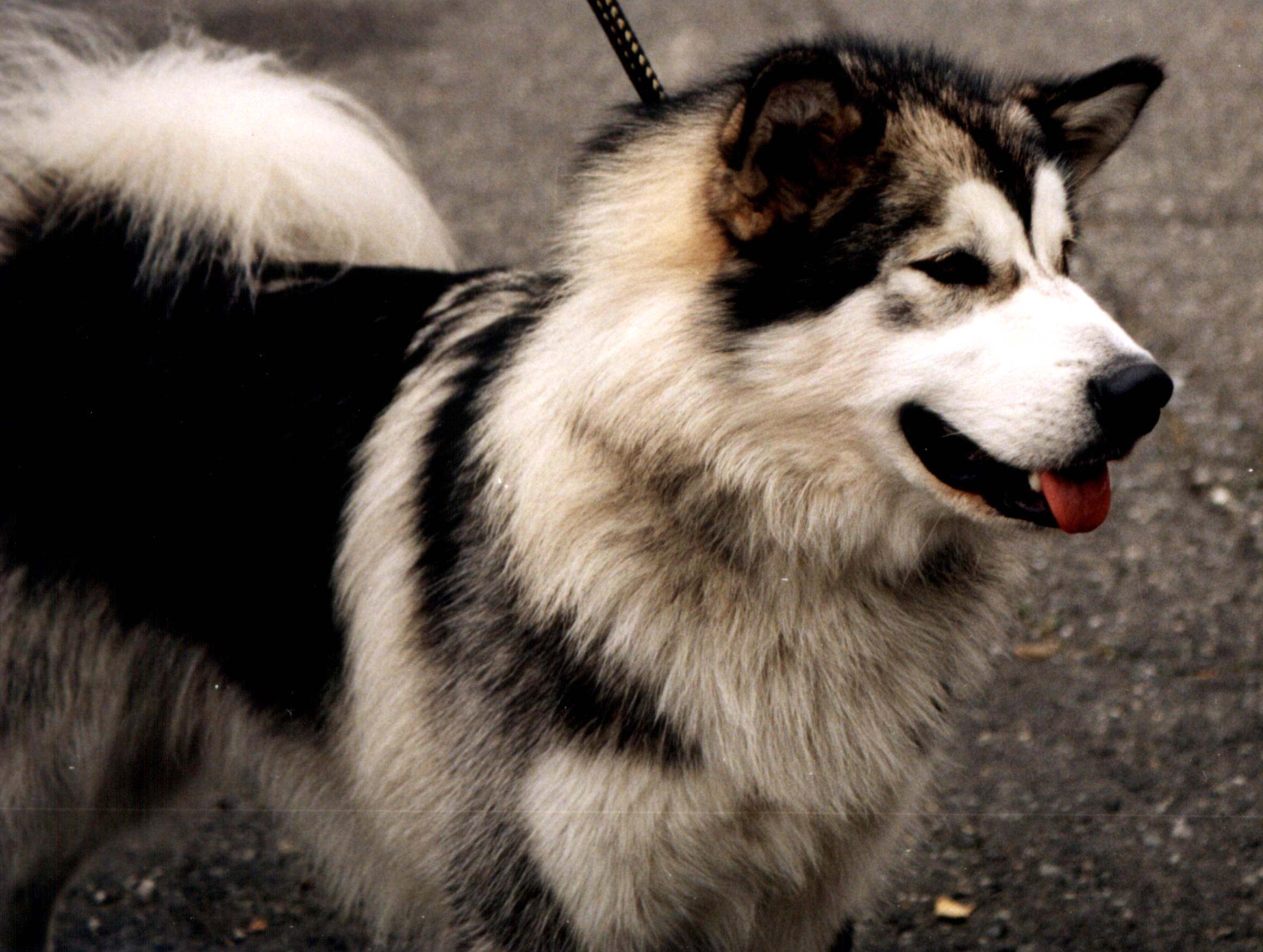
The American Kennel Club (AKC) breed standard describes a natural range of size, with a desired size of 23 in tall and 75 lb for females, 25 in tall and 85 lb for males. Heavier individuals (90 lb) and dogs smaller than 75 lb are commonly seen. There is often a marked size difference between males and females. Weights upwards of 100 lb are also seen.
The Alaskan Malamute is double coated. The undercoat has an oily and woolly texture and can be as thick as two inches. The outer guard coat is coarse and stands off the body longer at the withers but not more than one inch off the sides of the body. Ears are small in proportion to the head and stand firmly erect when at attention. The Alaskan Malamute is a heavy dog, with a more formidable nature and structure than the Siberian Husky, which is bred for speed. The Alaskan Malamute is bred for power and endurance, which is its original function and what the standard of the breed requires of Alaskan Malamute breeders.
The usual colors are various shades of grey and white, sable and white, black and white, seal and white, red and white, or solid white. There are a wide range of markings in the breed including face markings, blazes, a splash at the nape of the neck, and a collar or half collar. White is often the predominant color on the body, parts of the legs, feet, and part of the markings of the face. In terms of color variants, some Malamutes exhibit a dark grey to buff-colored undertone around their trimmings and white areas, presenting with a color-linked gene known as agouti. Two agouti alleles, with the possibility of a third, appear to be found in Malamutes: aw (agouti pattern or wolf/wild pattern), at (tan point pattern or black pattern), and awat (heterozygous agouti or dark agouti).
The eyes of the Alaskan Malamute are almond shaped and varied shades of brown; however, the darker eye is preferred. Purebred Alaskan Malamutes will not have blue eyes. The physical build of the Malamute is compact and strong with substance, bone and snowshoe feet.
According to the AKC breed standard, the Malamute's tail is well furred and is carried over the back like a waving plume. Corkscrew tails (commonly seen in the Akita) are occasionally seen but are faulted in the AKC breed standard. The Malamutes' well-furred tails aid in keeping them warm when they curl up in the snow. They are often seen wrapping the tail around their nose and face, which presumably protects them against such harsh weather elements as blowing snow. Their ears are generally upright, wedge shaped, small in proportion to the head, and set to the side of the skull. The muzzle is deep and broad, tapering slightly from the skull to the nose. Nose and gums are black, but some Malamutes have a snow nose, which is black with a pink undertone that can get darker or lighter, depending on the season.

Health

A 2024 UK study found an average life expectancy of 11.3 years, compared to an average of 12.7 for purebreeds and 12 for crossbreeds.
The most commonly reported health problems of Alaskan Malamutes, in the 2004 UK Kennel Club survey (based on a sample size of 64 dogs), were musculoskeletal (hip dysplasia) and hereditary cataracts. Additional health issues, the origins of which are unknown, include epilepsy, congenital heart disease, kidney problems, and skin disorders.
Other health issues in Malamutes include elbow dysplasia, inherited polyneuropathy, osteochondrodysplasia, cerebellar hypoplasia, heart defects, and eye problems (particularly cataract and progressive retinal atrophy). A growing problem among arctic dog breeds, including the Alaskan Malamute, is canine diabetes, with onset occurring typically in middle age (5 to 7 years).
Another health issue with Malamutes is zinc deficiency, as this breed cannot easily absorb zinc, which can lead to infections or skin and coat problems.
Thyroid disorders are the most common hormonal issue in dogs, and hypothyroidism is common in Malamutes.
History
thumb|An [[Inupiat]] family with a Malamute from 1915.The Alaskan Malamute had a prominent role with their human companions as a utilitarian dog, working, hunting, and living alongside humans. The dogs were renowned for their excellent hunting abilities and were used to hunt large predators such as bears. They also aided their owners in finding seals by alerting them to seal blowholes. The interdependent relationship between the Malamute and their dogs fostered prosperity among both and enabled them to flourish in the inhospitable land above the Arctic Circle.
For a brief period during the Klondike Gold Rush of 1896, the Malamute and other sled dogs became extremely valuable to recently landed prospectors and settlers and were frequently crossbred with imported breeds.
Losses from service in World War II all but eliminated the breed. In 1947 there were estimated to be only about 30 registered dogs left, so the studbook was reopened. Robert J. Zoller became involved in the breed and took this opportunity to combine M'’Loot and Hinman/Irwin dogs with selected Kotzebues to create what became the Husky-Pak line. All modern Malamutes are descended from the early strains and show combinations of characteristics to a greater or lesser degree. Thus the natural differences we see today. :— AKC}}
The Malamute dog has had a distinguished history; aiding Rear Admiral Richard Byrd to the South Pole, and the miners who came to Alaska during the Gold Rush of 1896, as well as serving in World War II primarily as search and rescue dogs in Greenland, although also used as freighting and packing dogs in Europe. This dog was never destined to be a racing sled dog; it was used for heavy freighting, pulling hundreds, perhaps thousands of pounds of supplies to villages and camps in groups of at least four dogs for heavy loads.
The University of Washington's husky mascot is an Alaskan Malamute. In 2010, the Alaskan Malamute was named the official state dog of Alaska. Lathrop High School in Fairbanks, Alaska uses a Malamute as its official mascot.
Footnotes
References
- (9 June 1999). "FCI-Standard N° 243: Alaskan Malamute".
- (October 2014). "The dog encyclopedia". DK Publishing, Inc..
- (2015). "Using multiple markers to elucidate the ancient, historical and modern relationships among North American Arctic dog breeds". Heredity.
- (2009). "Dog sledging in the eighteenth century: North America and Siberia". Polar Record.
- (2013). "Pre-Columbian origins of Native American dog breeds, with only limited replacement by European dogs, confirmed by mtDNA analysis". [[Proceedings of the Royal Society B: Biological Sciences]].
- (25 June 2020). "Sled dogs are closely related to 9,500-year-old 'ancient dog'".
- (2013). "Alaskan Malamute Breed Standard".
- "Breed Standard".
- (2024-02-01). "Longevity of companion dog breeds: those at risk from early death". Springer Science and Business Media LLC.
- (2004). "Report from the Kennel Club/British Small Animal Veterinary Association Scientific Committee: Summary results of the Purebred Dog Health Survey for the Alaskan Malamute breed".
- "Alaskan Malamute Club of America Health Committee".
- Loureiro, Regina. (30 January 2008). "Canine Diabetes".
- DACVD, Carlo Vitale DVM. "Canine zinc-responsive dermatosis".
- (2011-01-25). "Blackwell's Five-Minute Veterinary Consult Clinical Companion". Wiley-Blackwell.
- Bryan D. Cummins, 2002. First Nations, first dogs. Detselig Enterprises Ltd., Calgary, AB.
- Adney, Tappan. (1900). "Klondike Stampede". Harper & Bros.
- "Alaskan Malamute Illustrated Standard-History". AKC.
- "Washington Huskies".
- Dean, Josh. (April 17, 2012). ""The Great Dane's Head Resembles the Outline of the Commonwealth's Boundaries"".
- (April 10, 2010). "Sorry, huskies, Malamute now AK's state dog". Alaska Dispatch.
- "Lathrop High / Home".
This article was imported from Wikipedia and is available under the Creative Commons Attribution-ShareAlike 4.0 License. Content has been adapted to SurfDoc format. Original contributors can be found on the article history page.
Ask Mako anything about Alaskan Malamute — get instant answers, deeper analysis, and related topics.
Research with MakoFree with your Surf account
Create a free account to save articles, ask Mako questions, and organize your research.
Sign up freeThis content may have been generated or modified by AI. CloudSurf Software LLC is not responsible for the accuracy, completeness, or reliability of AI-generated content. Always verify important information from primary sources.
Report