From Surf Wiki (app.surf) — the open knowledge base
Aksai Chin
Part of Kashmir administered by China
Part of Kashmir administered by China
| Field | Value |
|---|---|
| name | Aksai Chin |
| type | Territory administered by China |
| other_name | Aksayqin |
| image_map | File:Kashmir region. LOC 2003626427 - showing sub-regions administered by different countries.jpg |
| map_alt | Map of the disputed Kashmir region showing areas of control by India, Pakistan, and China |
| map_caption | A map of the disputed Kashmir region showing the Chinese-administered territory of Aksai Chin in dark brown on the right. |
| mapframe | yes |
| mapframe-zoom | 4 |
| map_caption1 | Interactive map of Aksai Chin |
| coordinates | |
| area_total_km2 | 38000 |
| subdivision_type | Country |
| subdivision_name | * People's Republic of China (administered by) |
| subdivision_type1 | County or District |
| subdivision_name1 | * He'an County and Hekang County in Hotan Prefecture, Xinjiang |
| mapframe-zoom = 4
- India (claimed by)
- Rutog County in Ngari Prefecture, Tibet
- Leh district in Ladakh (claimed by India)
Aksai Chin is a region administered by China and constituting the easternmost portion of the larger Kashmir region that has been the subject of a dispute between India and China since 1959. China administers the region and claims it as part of the Xinjiang and Tibet autonomous regions. The application of the term "administered" to the various regions of Kashmir and a mention of the Kashmir dispute is supported by the tertiary sources (a) through (e), reflecting due weight in the coverage. Although "controlled" and "held" are also applied neutrally to the names of the disputants or to the regions administered by them, as evidenced in sources (h) through (i) below, "held" is also considered politicized usage, as is the term "occupied," (see (j) below).
(a) (subscription required) Quote: "Kashmir, region of the northwestern Indian subcontinent ... has been the subject of dispute between India and Pakistan since the partition of the Indian subcontinent in 1947. The northern and western portions are administered by Pakistan and comprise three areas: Azad Kashmir, Gilgit, and Baltistan, the last two being part of a territory called the Northern Areas. Administered by India are the southern and southeastern portions, which constitute the state of Jammu and Kashmir but are slated to be split into two union territories.";
(b) (subscription required) Quote: "Aksai Chin, Chinese (Pinyin) Aksayqin, portion of the Kashmir region, at the northernmost extent of the Indian subcontinent in south-central Asia. It constitutes nearly all the territory of the Chinese-administered sector of Kashmir that is claimed by India to be part of the Ladakh area of Jammu and Kashmir state.";
(c) C. E Bosworth, University of Manchester Quote: "KASHMIR, kash'mer, the northernmost region of the Indian subcontinent, administered partlv by India, partly by Pakistan, and partly by China. The region has been the subject of a bitter dispute between India and Pakistan since they became independent in 1947";
(d) Quote: "Jammu and Kashmir: Territory in northwestern India, subject to a dispute between India and Pakistan. It has borders with Pakistan and China."
(e) Quote: "We move from a disputed international border to a dotted line on the map that represents a military border not recognized in international law. The line of control separates the Indian and Pakistani administered areas of the former Princely State of Jammu and Kashmir.";
(f)
(g)
(h) Quote: "J&K: Jammu and Kashmir. The former princely state that is the subject of the Kashmir dispute. Besides IJK (Indian-controlled Jammu and Kashmir. The larger and more populous part of the former princely state. It has a population of slightly over 10 million, and comprises three regions: Kashmir Valley, Jammu, and Ladakh.) and AJK ('Azad" (Free) Jammu and Kashmir. The more populous part of Pakistani-controlled J&K, with a population of approximately 2.5 million.), it includes the sparsely populated "Northern Areas" of Gilgit and Baltistan, remote mountainous regions which are directly administered, unlike AJK, by the Pakistani central authorities, and some high-altitude uninhabitable tracts under Chinese control."
(i) Quote: "Kashmir’s identity remains hotly disputed with a UN-supervised “Line of Control” still separating Pakistani-held Azad (“Free”) Kashmir from Indian-held Kashmir.";
(j) Quote:"Some politicised terms also are used to describe parts of J&K. These terms include the words 'occupied' and 'held'." India meanwhile claims it as part of Leh district in the union territory of Ladakh.
Name
Aksai Chin was first mentioned by Muhammad Amin, the Yarkandi guide of the Schlagintweit brothers, who were contracted in 1854 by the British East India Company to explore Central Asia. Amin explained its meaning as "the great white sand desert". Linguist George van Driem states that the name intended by Amin was Aqsai Chöl (; ақсай чөл) which could mean "white ravine desert" or "white coomb desert". The word chöl for desert seems to have been corrupted in English transliteration into "chin".
Some sources have interpreted Aksai to have the Uyghur meaning "white stone desert", including several British colonial, modern Western, Chinese, and Indian sources. Some modern sources interpret it to mean "white brook" instead. At least one source interprets Aksai to mean "eastern" in the Yarkandi Uyghur dialect.
The word "Chin" was taken to mean "China" by some Chinese, Western, and Indian sources. At least one source takes it to mean "pass". Other sources omit "Chin" in their interpretations. Van Driem states that there is no Uyghur word resembling "chin" for China.
Amin's Aksai Chin was not a defined region, stretching indefinitely east into Tibet south of the Kunlun Mountains.: "The name 'Aksai Chin' occurred on a map captioned 'Rough sketch of caravan routes through the Pamir steppes and Yarkand, from information collected' from Mahomed Ameen Yarkandi [Mohammed Amin], 'late guide' to the well-known Schlagintweit brothers. This was compiled in the Quartermaster-General's office in 1862. The sketch, which offered no details this side of the Kunlun, had 'Aksai Chin' written right across the blank space south of the Kunlun range. Mahomed Ameen had noted that 'beyond the pass (north of the Chang Chenmo) lies the Aksai Chin. ... it extends to Chinese territory to the East.'" In 1895, the British envoy to Kashgar told the Chinese Taotai that Aksai Chin was a "loose name for an ill-defined, elevated tableland", part of which lay in Indian and part in Chinese territory.
The current meaning of the term is the area under dispute between India and China, having evolved in repeated usage since Indian independence in 1947.
History
Because of its 5000 m elevation, the desolation of Aksai Chin meant that it had no human importance. However, for military purposes the region was strategically important, as it lay on the only year-round passable route between the Tarim Basin and Tibet.
Ladakh was conquered in 1842 by the armies of Raja Gulab Singh (Dogra) under the suzerainty of the Sikh Empire. The British defeat of the Sikhs in 1846 resulted in the transfer of the Jammu and Kashmir region including Ladakh to the British, who then installed Gulab Singh as the Maharaja under their suzerainty. The British appointed a boundary commission headed by Alexander Cunningham to determine the boundaries of the state. Chinese and Tibetan officials were invited to jointly demarcate the border, but they did not show any interest. The British boundary commissioners fixed the southern part of the boundary up to the Chang Chenmo Valley, but regarded the area north of it as terra incognita.
The Johnson Line
Main article: Johnson Line (boundary)
William Johnson, a civil servant with the Survey of India proposed the "Johnson Line" in 1865, which put Aksai Chin in Kashmir. This was the time of the Dungan revolt, when China did not control most of Xinjiang, so this line was never presented to the Chinese. Johnson presented this line to the Maharaja of Kashmir, who then claimed the 18,000 square kilometres contained within, and by some accounts territory further north as far as the Sanju Pass in the Kun Lun Mountains. The Maharajah of Kashmir constructed a fort at Shahidulla (modern-day Xaidulla), and had troops stationed there for some years to protect caravans. Eventually, most sources placed Shahidulla and the upper Karakash River firmly within the territory of Xinjiang (see accompanying map). According to Francis Younghusband, who explored the region in the late 1880s, there was only an abandoned fort and not one inhabited house at Shahidulla when he was there – it was just a convenient staging post and a convenient headquarters for the nomadic Kirghiz. The abandoned fort had apparently been built a few years earlier by the Kashmiris. In 1878 the Chinese had reconquered Xinjiang, and by 1890 they already had Shahidulla before the issue was decided. By 1892, China had erected boundary markers at Karakoram Pass.
In 1897, a British military officer, Sir John Ardagh, proposed a boundary line along the crest of the Kun Lun Mountains north of the Yarkand River. At that time, Britain was concerned about the danger of Russian expansion as China weakened, and Ardagh argued that his line was more defensible. The Ardagh line was effectively a modification of the Johnson line, and became known as the "Johnson-Ardagh Line".
The Macartney–Macdonald Line
Main article: Macartney–MacDonald Line

In 1893, Hung Ta-chen, a senior Chinese official at St. Petersburg, gave maps of the region to George Macartney, the British consul general at Kashgar, which coincided in broad details. In 1899, Britain proposed a revised boundary, initially suggested by Macartney and developed by the Governor General of India Lord Elgin. This boundary placed the Lingzi Tang plains, which are south of the Laktsang range, in India, and Aksai Chin proper, which is north of the Laktsang range, in China. This border, along the Karakoram Mountains, was proposed and supported by British officials for a number of reasons. The Karakoram Mountains formed a natural boundary, which would set the British borders up to the Indus River watershed while leaving the Tarim River watershed in Chinese control, and Chinese control of this tract would present a further obstacle to Russian advance in Central Asia. The British presented this line, known as the Macartney–MacDonald Line, to the Chinese in 1899 in a note by Sir Claude MacDonald. The Qing government did not respond to the note. According to some commentators, China believed that this had been the accepted boundary.
1899 to 1947
Both the Johnson-Ardagh and the Macartney-MacDonald lines were used on British maps of India. Until at least 1908, the British took the Macdonald line to be the boundary, but in 1911, the Xinhai Revolution resulted in the collapse of central power in China, and by the end of World War I, the British officially used the Johnson Line. However they took no steps to establish outposts or assert actual control on the ground. In 1927, the line was adjusted again as the government of British India abandoned the Johnson line in favor of a line along the Karakoram range further south. However, the maps were not updated and still showed the Johnson Line.
From 1917 to 1933, the Postal Atlas of China, published by the Government of China in Peking had shown the boundary in Aksai Chin as per the Johnson line, which runs along the Kunlun Mountains. When British officials learned of Soviet officials surveying the Aksai Chin for Sheng Shih-tsai, warlord of Xinjiang in 1940–1941, they again advocated the Johnson Line. At this point the British had still made no attempts to establish outposts or control over the Aksai Chin, nor was the issue ever discussed with the governments of China or Tibet, and the boundary remained undemarcated at India's independence.
Since 1947
After Jammu and Kashmir acceded to the newly independent India in October 1947, the government of India used the Johnson Line as the basis for its official boundary in the west, which included the Aksai Chin. From the Karakoram Pass (which is not under dispute), the Indian claim line extends northeast of the Karakoram Mountains through the salt flats of the Aksai Chin, to set a boundary at the Kunlun Mountains, and incorporating part of the Karakash River and Yarkand River watersheds. From there, it runs east along the Kunlun Mountains, before turning southwest through the Aksai Chin salt flats, through the Karakoram Mountains, and then to Panggong Lake.
On 1 July 1954, Prime Minister Jawaharlal Nehru wrote a memo directing that the maps of India be revised to show definite boundaries on all frontiers. Up to this point, the boundary in the Aksai Chin sector, based on the Johnson Line, had been described as "undemarcated."
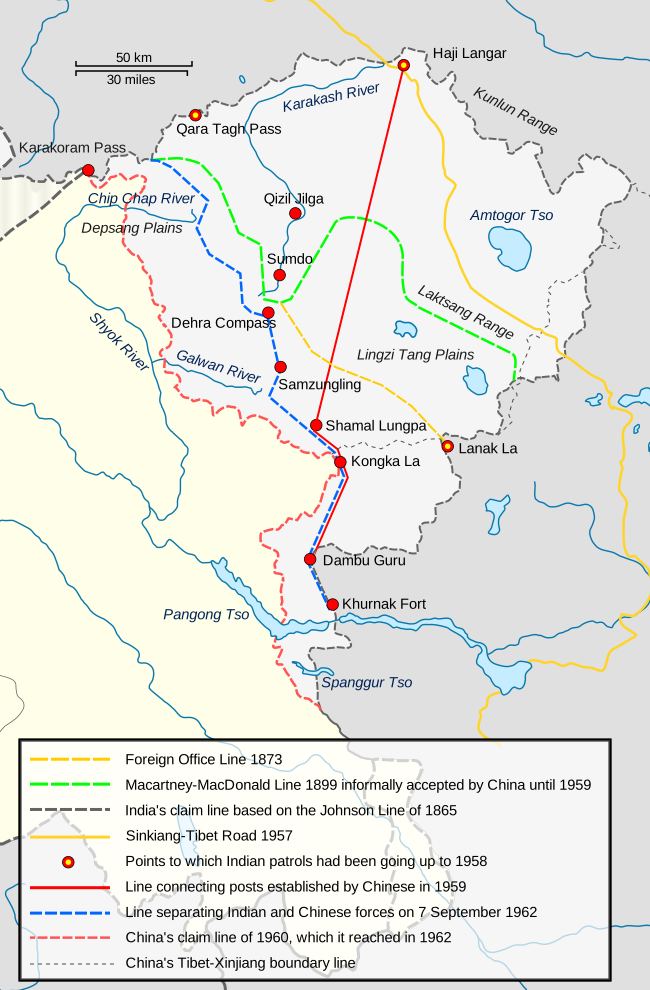
Despite this region being nearly uninhabitable and having no resources, it remains strategically important for China as it connects Tibet and Xinjiang. During the 1950s, the People's Republic of China built a 1,200 km (750 mi) China National Highway 219 connecting Xinjiang and western Tibet, of which 179 km (112 mi) ran south of the Johnson Line through the Aksai Chin region claimed by India. Aksai Chin was easily accessible to the Chinese, but was more difficult for the Indians on the other side of the Karakorams to reach. The Indians did not learn of the existence of the road until 1957, which was confirmed when the road was shown in Chinese maps published in 1958. The construction of this highway was one of the triggers for the Sino-Indian War of 1962.
The Indian position, as stated by Prime Minister Nehru, was that the Aksai Chin was "part of the Ladakh region of India for centuries" and that this northern border was a "firm and definite one which was not open to discussion with anybody".
The Chinese premier Zhou Enlai argued that the western border had never been delimited, that the Macartney-MacDonald Line, which left the Aksai Chin within Chinese borders was the only line ever proposed to a Chinese government, and that the Aksai Chin was already under Chinese jurisdiction, and that negotiations should take into account the status quo.
In June 2006, satellite imagery on the Google Earth service revealed a 1:500 scale terrain model of eastern Aksai Chin and adjacent Tibet, built near the town of Huangyangtan, about 35 km southwest of Yinchuan, the capital of the autonomous region of Ningxia in China. A visual side-by-side comparison shows a very detailed duplication of Aksai Chin in the camp. The 900 x model was surrounded by a substantial facility, with rows of red-roofed buildings, scores of olive-coloured trucks and a large compound with elevated lookout posts and a large communications tower. Such terrain models are known to be used in military training and simulation, although usually on a much smaller scale.
Local authorities in Ningxia claim that their model of Aksai Chin is part of a tank training ground, built in 1998 or 1999.
In August 2017, Indian and Chinese forces near Pangong Tso threw rocks at each other.
On 11 September 2019, People's Liberation Army troops confronted Indian troops on the northern bank of Pangong Lake.
A continued face-off in the 2020 China–India skirmishes of May and June 2020 between Indian and Chinese troops near Pangong Tso Lake culminated in a violent clash on 16 June 2020, with at least 20 deaths on the Indian side and no official reported deaths on the Chinese side. In 2021, Chinese state media reported four Chinese deaths. Both sides claimed provocation from the other.
Geography
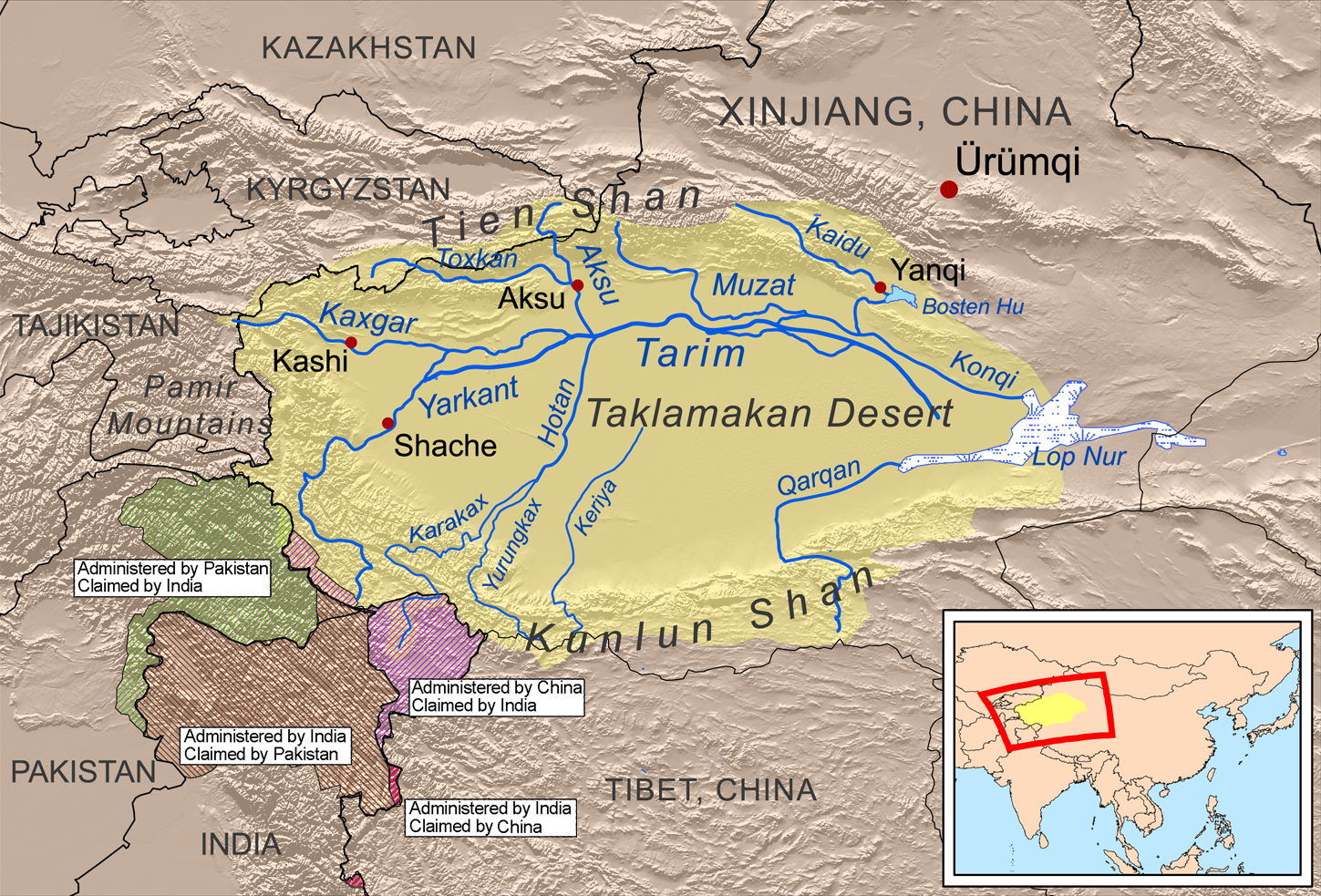


Aksai Chin is one of the two large disputed border areas between India and China. India claims Aksai Chin as the easternmost part of the union territory of Ladakh. China claims that Aksai Chin is part of the Xinjiang Uyghur Autonomous Region and Tibet Autonomous Region. The line that separates Indian-administered areas of Ladakh from Aksai Chin is known as the Line of Actual Control (LAC) and is concurrent with the Chinese Aksai Chin claim line.
The Aksai region is a sparsely populated region with few settlements such as Heweitan, Khurnak Fort, Tianshuihai and Dahongliutan and Kangxiwar which lays north of it, with the latter being the forward headquarters of the Xinjiang Military Command during the 1962 Sino-Indian War.
Aksai Chin covers an area of approximately 38000 km2. The area is largely a vast high-altitude desert with a low point (on the Karakash River) at about 4300 m above sea level. In the southwest, mountains up to 7000 m extending southeast from the Depsang Plains form the de facto border (Line of Actual Control) between Aksai Chin and Indian-controlled Kashmir.
In the north, the Kunlun Range separates Aksai Chin from the Tarim Basin, where the rest of Hotan Prefecture is situated. , no roads crossed the Kunlun Range within Hotan Prefecture, and only one track does so, over the Hindutash Pass.
Aksai Chin area has number of endorheic basins with many salt or soda lakes. The major salt lakes are Surigh Yilganing Kol, Tso Tang, Aksai Chin Lake, Hongshan Lake, etc. Much of the northern part of Aksai Chin is referred to as the Soda Plains, located near Aksai Chin's largest river, the Karakash, which receives meltwater from a number of glaciers, crosses the Kunlun farther northwest, in Hekang County and enters the Tarim Basin, where it serves as one of the main sources of water for Karakax and Hotan Counties.
The western part of Aksai Chin region is drained by the Tarim River. The eastern part of the region contains several small endorheic basins. The largest of them is that of the Aksai Chin Lake, which is fed by the river of the same name. The region as a whole receives little precipitation as the Himalayas and the Karakoram block the rains from the Indian monsoon.
The nearby Trans-Karakoram Tract is also the subject of ongoing dispute between China and India in the Kashmir dispute.
Demographics and economics
Prior to 1950, the visitors of Aksai Chin were, for the most part, the occasional explorers, hunters, and nomads who passed through the area.
Prior to European exploration in the 1860s, there were some jade mining operations on the Xinjiang side of Aksai Chin. They were abandoned by the time European explorers reached the area. In the 1860s to 1870s, in order to facilitate trade between the Indian subcontinent and Tarim Basin, the British attempted to promote a caravan route via the western side of Aksai Chin as an alternative to the difficult and tariffed Karakoram Pass. The route, referred to as the Chang Chenmo line after the starting point in Chang Chenmo River valley, was discussed in the House of Commons in 1874. In addition of being longer and higher elevation than Karakoram Pass, it also goes through the desolate desert of Aksai Chin. By 1890s, traders had mostly given up on this route.
In the 1958, India collected salt from various lakes in Aksai Chin to study the economic feasibility of salt mining operations in the area.
By the end of the 1950s, in addition to having constructed a road, numerous PLA Ground Force outposts were constructed in a few locations, including at Tianwendian, Kongka Pass, Heweitan and Tianshuihai. The road was later upgraded to the China National Highway 219. In the modern day, there are a few businesses along the highway serving motorists.
In the 2010s, geological surveys were conducted in the Western Kunlun region, which Aksai Chin is part of. Huoshaoyun, a major lead-zinc deposit, and numerous smaller deposits were discovered in the region. Huoshaoyun is a mountain located in Aksai Chin near the Tibetan border. The mining development for Huoshaoyun started in 2017.
Transportation
China National Highway 219 runs through Aksai Chin connecting Tibet (Ngari Prefecture) and Xinjiang (Hotan Prefecture).
In July 2022, Ministry of Transport of China published updated China National Highway Network Plan that includes China National Highway 695 which will go from Lhünzê Town, Lhünzê County, Tibet to Mazar Township, Yining County, Xinjiang travelling through Aksai Chin.
Notes
References
Bibliography
- Sino-Indian Border Defenses Chushul Area (CIA, 1963)
References
- "Aksai Chin {{!}} History, Conflict, & Map". [[Encyclopædia Britannica, Inc.]].
- Fareed, Rifat. "Why India's Ladakh is witnessing growing discontent". [[Al Jazeera]].
- Driem, George L. van. (25 May 2021). "Ethnolinguistic Prehistory: The Peopling of the World from the Perspective of Language, Genes and Material Culture". BRILL.
- Government of Punjab. (1862). "Report on the Trade and Resources of the Countries on the North-western Boundary of British India". Government Press.
- (1868). "Journal of the Asiatic Society of Bengal". Bishop's College Press.
- (23 September 2011). "India Today: An Encyclopedia of Life in the Republic [2 volumes]: An Encyclopedia of Life in the Republic". ABC-CLIO.
- (1966). "Naval War College Review". Naval War College.
- (1967). "Central Asia Atlas, Memoir on Maps: Index of geographical names, by D.M. Farquhar, G. Jarring and E. Norin". Sven Hedin Foundation, Statens etnografiska museum.
- Bertil Lintner. (25 January 2018). "China's India War: Collision Course on the Roof of the World". OUP India.
- (September 2009). 上海辞书出版社. [[Shanghai Lexicographical Publishing House]].. zh-hans. '''阿克赛钦''' 地名区。维吾尔语意即"中国的白石滩"。在新疆维吾尔自治区和田县南部、喀喇昆仑山和昆仑山间。
- {{lang. zh-hans. [[:zh:中华人民共和国国务院公报. 中华人民共和国国务院公报]] (Bulletin of the State Council of PRC). link. (15 November 1962). [[Zhou Enlai]] (Chou En-Lai). zh-hans. 在西段,印度政府提出爭議的传统习惯綫以东和以北的地区,历来是屬于中国的。这个地区主要包括中国新疆所屬的阿克賽欽地区和西藏阿里地区的一部分,面积共为三万三千平方公里,相当于一个比利时或三个黎巴嫩。这个地区虽然人烟稀少,却历来是联結新疆和西藏阿里的交通命脉。新疆的柯尔克孜族和維吾尔族的牧民經常在这一带放牧。阿克賽欽这个地名就是維吾尔語“中国的白石滩”的意思。这块地方一直到現在是在中国的管轄之下。. zh-hans. [[:zh:中华人民共和国中央人民政府门户网站. 中华人民共和国中央人民政府门户网站]]
- Gurdip Singh Kler. (1995). "Unsung Battles of 1962". Lancer Publishers.
- Sanjeev Kumar Bhasin. (2006). "Amazing Land Ladakh: Places, People, and Culture". Indus Publishing.
- Bob Butalia. (30 September 2015). "In the Shadow of Destiny". Partridge Publishing India.
- Geeta Kochhar. (19 March 2018). "China's Foreign Relations and Security Dimensions". Taylor & Francis.
- Harish Kapadia. (March 2002). "High Himalaya Unknown Valleys". Indus Publishing.
- (22 June 2010). "ئاقساي چىنمۇ ياكى ئاقساي چۆلمۇ؟". [[Radio Free Asia]].
- Maxwell, Neville. (1970). "India's China War". Pantheon.
- (2011). "Protracted Contest: Sino-Indian Rivalry in the Twentieth Century". University of Washington Press.
- The Sino-Indian Border Disputes, by Alfred P. Rubin, The International and Comparative Law Quarterly, Vol. 9, No. 1. (Jan. 1960), pp. 96–125, {{JSTOR. 756256.
- Mohan Guruswamy, Mohan, [http://www.rediff.com/news/2003/jun/20spec.htm "The Great India-China Game"] {{Webarchive. link. (30 September 2016 , [[Rediff.com). Rediff]], 23 June 2003.
- Younghusband, Francis E. (1896). ''The Heart of a Continent''. John Murray, London. Facsimile reprint: (2005) Elbiron Classics, pp. 223–224.
- Grenard, Fernand (1904). ''Tibet: The Country and its Inhabitants''. Fernand Grenard. Translated by A. Teixeira de Mattos. Originally published by Hutchison and Co., London. 1904. Reprint: Cosmo Publications. Delhi. 1974, pp. 28–30.
- Calvin, James Barnard. (April 1984). "The China-India Border War". Marine Corps Command and Staff College.
- Noorani, A.G.. (30 August – 12 September 2003). "Fact of History". The Hindu group.
- (2006). "Sino-Indian Border Dispute at Aksai Chin – A Middle Path For Resolution". Journal of Development Alternatives and Area Studies.
- (1963). "Himalayan Battleground: Sino-Indian Rivalry in Ladakh". Praeger.
- Orton, Anna. "India's Borderland Disputes: China, Pakistan, Bangladesh and Nepal". Epitome Books.
- [http://www.people.fas.harvard.edu/~johnston/garver.pdf China's Decision for War with India in 1962 by John W. Garver] {{webarchive. link. (26 March 2009)
- Guo, Rongxing. (2007). "Territorial Disputes and Resource Management". Nova Science Publishers.
- (5 August 2006). "From sky, see how China builds model of Indian border 2400 km away".
- [http://bbs.keyhole.com/ubb/showthreaded.php/Cat/0/Number/859782/page/0/vc/1 Google Earth Community posting] {{Webarchive. link. (8 December 2008 , 10 April 2007)
- (2006-07-23). "Chinese X-file not so mysterious after all". [[The Age]].
- Sushant Singh. (20 May 2020). "India-China conflict in Ladakh: The importance of the Pangong Tso lake".
- (12 September 2019). "Indian, Chinese Troops Face-off in Ladakh Ahead of Modi-Xi Summit, Army Says Tension De-escalated". [[News18]].
- link. (10 March 2020). zh-tw. 張雅涵. [[Radio Taiwan International]]
- (2021-02-19). "Ladakh: China reveals soldier deaths in India border clash". BBC News.
- "India China news live: At least 20 Indian Army personnel killed in violent face-off in Ladakh's Galwan Valley".
- Dinakar Peri. (10 May 2020). "Indian, Chinese troops face off in Eastern Ladakh, Sikkim". [[The Hindu]].
- link. (11 May 2020). [[Hong Kong Economic Times]]. {{lang. zh-hant. 費風. zh-hant. 消息指,第一起事件發生於5月5日至6日,在中印邊境的班公錯湖(Pangong Tso )地區,當時解放軍的「侵略性巡邏」(aggressive patrolling)被印度軍方阻攔。「結果發生了混亂,雙方都有一些士兵受傷。」{...}2017年8月,兩國軍隊曾於拉達克地區班公湖附近爆發衝突,當時雙方擲石攻擊對方,雙方均有人受傷,最終兩軍在半小時後退回各自據點。
- (19 May 2020). "Chinese military bolsters troops in Aksai Chin region in Sino-India border: Report". [[The Economic Times]].
- (25 May 2020). "Chinese, Indian troops engage in border conflicts".
- Drake Long. (22 May 2020). "India Voices Unusual Criticism of China's Conduct in South China Sea". [[Radio Free Asia]].
- (21 May 2020). "Transcript of Media Briefing by Official Spokesperson (May 21, 2020)". [[Ministry of External Affairs (India).
- (2013). "Aksai Chin".
- Xinjiang Uyghur Autonomous Region Road Atlas (中国分省公路丛书:新疆维吾尔自治区), published by 星球地图出版社 ''Xingqiu Ditu Chubanshe'', 2008, {{ISBN. 978-7-80212-469-1. Map of Hotan Prefecture, pp. 18–19.
- (15 March 1963). "Signing with the Red Chinese".
- (2015-10-21). "India, China and Sub-regional Connectivities in South Asia". SAGE Publications India.
- W.F. Van Eekelen. (11 December 2013). "Indian Foreign Policy and the Border Dispute with China". Springer.
- Steven A. Hoffmann. (20 April 2018). "India and the China Crisis". Univ of California Press.
- Lamb, Alastair. (1964). "The China-India Border: The Origins of the Disputed Boundaries". Oxford University Press.
- Robert Shaw. (1871). "Visits to High Tartary, Yârkand, and Kâshgar (formerly Chinese Tartary): And Return Journey Over the Karakoram Pass". J. Murray.
- Harish Kohli. (2000). "Across the Frozen Himalaya: The Epic Winter Ski Traverse from Karakoram to Lipu Lekh". Indus Publishing.
- (1874). "Accounts and Papers". House of Commons, British Parliament.
- A. E. Ward. (1896). "The Tourist's And—sportsman's Guide to Kashmir and Ladak, &c". Thacker, Spink.
- Brig Amar Cheema, VSM. (31 March 2015). "The Crimson Chinar: The Kashmir Conflict: A Politico Military Perspective". Lancer Publishers.
- Council of Scientific & Industrial Research (India). (1958). "Technical Report".
- (2 January 2016). "Indian, Chinese armies decide to improve ties at functional level".
- (17 September 2009). "在海拔5070米的空喀山口哨卡某边防团政委宗建明和官兵深情的拥抱". [[Sina Corp.
- 颜玮珏. (30 September 2013). "Keeping watch over highest mountain". [[China Daily]].
- (7 December 2016). "走进天路兵站甜水海 体会官兵生活的苦与乐". People's Liberation Army News and Dissemination Center.
- (18 November 2011). "新疆死人沟——窒息的环境 惊险的美". [[People's Daily]] Oversea Edition.
- 张作衡. (September 2017). "2017年矿产资源地质调查新进展". China Geological Survey.
- (2018). "Detection of Pb–Zn mineralization zones in west Kunlun using Landsat 8 and ASTER remote sensing data". Journal of Applied Remote Sensing.
- Ma, Echo. (24 February 2017). "Development starts on China's largest lead-zinc mine". Metal Bulletin.
- Geological Survey in China. (15 July 2019). "The Prospecting Space of Huoshaoyun lead-Zinc Mine in Xinjiang extends to the periphery by nearly 15 km-Shanghai Metals Market". [[Shanghai Metals Market]].
- Laura, Zhou. (20 July 2022). "China’s highway plans near border expected to spark concern in India". South China Morning Post.
- (2022-07-04). "国家公路网规划". Ministry of Transport of China.
This article was imported from Wikipedia and is available under the Creative Commons Attribution-ShareAlike 4.0 License. Content has been adapted to SurfDoc format. Original contributors can be found on the article history page.
Ask Mako anything about Aksai Chin — get instant answers, deeper analysis, and related topics.
Research with MakoFree with your Surf account
Create a free account to save articles, ask Mako questions, and organize your research.
Sign up freeThis content may have been generated or modified by AI. CloudSurf Software LLC is not responsible for the accuracy, completeness, or reliability of AI-generated content. Always verify important information from primary sources.
Report