From Surf Wiki (app.surf) — the open knowledge base
Aircraft fairing
Structure on an aircraft made to reduce drag

Structure on an aircraft made to reduce drag
An aircraft fairing is a structure whose primary function is to produce a smooth outline and reduce drag.
These structures are covers for gaps and spaces between parts of an aircraft to reduce form drag and interference drag, and to improve appearance.

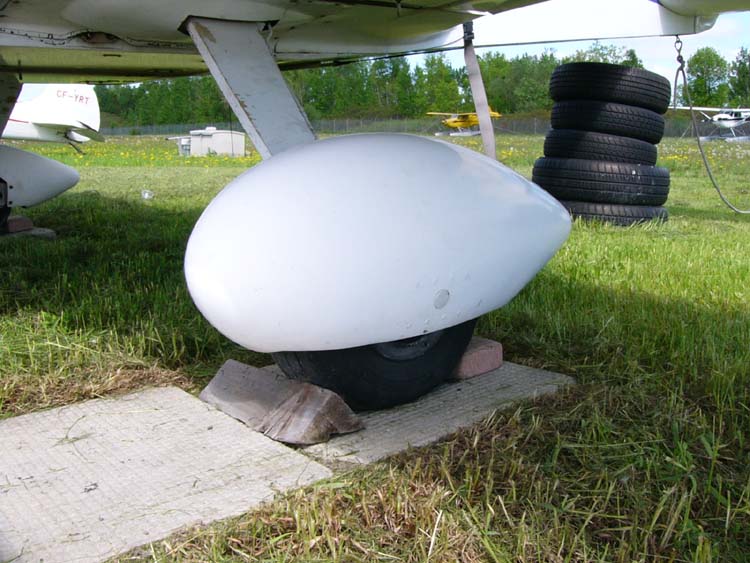
Types
On aircraft, fairings are commonly found on: ; Belly fairing : Also called a "ventral fairing", it is located on the underside of the fuselage between the main wings. It can also cover additional cargo storage or fuel tanks. ; Cockpit fairing : Also called a "cockpit pod", it protects the crew on ultralight trikes. Commonly made from fiberglass, it may also incorporate a windshield. ; Elevator and horizontal stabilizer tips : Elevator and stabilizer tips fairings smooth out airflow at the tips. ; Fin and rudder tip fairings: Fin and rudder tip fairings reduce drag at low angles of attack but also reduce the stall angle, so the fairing of control surface tips depends on the application. ; Fillets: Fillets smooth the airflow at the junction between two components, such as the fuselage and wing. ; Fixed landing gear junctions : Landing gear fairings reduce drag at these junctions. ; Flap track fairings : Fairings are needed to enclose the flap operating mechanism when the flap is up. They open up as the flap comes down and may also pivot to allow the necessary sideways movement of the extending mechanism which occurs on swept-wing installations. ; Spinner : To protect and streamline the propeller hub. ; Strut-to-wing and strut-to-fuselage junctions : Strut end fairings reduce drag at these junctions. ; Tail cones : Tail cones streamline the rear extremity of a fuselage by eliminating the base area, which is a source of base drag. ; Wing root : Wing roots are often faired to reduce interference drag between the wing and the fuselage. On the top and bottom of the wing, this consists of small rounded edges to reduce surface and friction drag. At the leading and trailing edge it consists of much larger taper and smooths out the pressure differences: high pressure at the leading and trailing edge, low pressure on top of the wing and around the fuselage.

; Wing tips : Wing tips are often formed as complex shapes to reduce vortex generation and so also drag, especially at low speed. ; Wheels on fixed gear aircraft : Wheel fairings are often called "wheel pants", "speed fairings" in North America or "wheel spats" or "trousers", in the United Kingdom, the latter enclosing both the wheel and landing gear leg. These fairings are a trade-off: they increase the frontal and surface area but provide a smooth surface and a faired nose and tail for laminar flow, in an attempt to reduce the turbulence created by the round wheel and its associated gear legs and brakes. They also serve the important function of preventing mud and stones from being thrown upwards against the wings or fuselage, or into the propeller on a pusher aircraft.
References
References
- Crane, Dale: ''Dictionary of Aeronautical Terms, Third Edition'', page 206. Aviation Supplies & Academics Inc, Newcastle Washington, 1997. {{ISBN. 1-56027-287-2
- Bingelis, Tony: ''The Sportplane Builder'', pages 261-265. [[Experimental Aircraft Association]] Aviation Foundation, 1979. {{ISBN. 0-940000-30-X
- Hitchens, Frank. (2015). "Belly fairing". Andrews UK.
- Cliche, Andre: ''Ultralight Aircraft Shopper's Guide'' 8th Edition, page C-17. Cybair Limited Publishing, 2001. {{ISBN. 0-9680628-1-4
- Molland, Anthony F. and Turnock, Stephen R.:"Marine Rudders and Control Surfaces: Principles, Data, Design and Applications" 1st Edition, section 5.3.2.11. Butterworth-Heineman, 2007. {{ISBN. 978-0-75-066944-3
- (June 21, 1934). "The Drag of Airplane Wheels, Wheel Fairings and Landing Gear I1 Nonretractable and Partially Retractable Landing Gear". Langley Memorial Aeronautical Laboratory.
- https://www.freepatentsonline.com/y2016/0340023.html, section 0003
- Bingelis, Tony: ''Bingelis on Engines'', pages 196-210. [[Experimental Aircraft Association]] Aviation Foundation, 1995. {{ISBN. 0-940000-54-7
- Bingelis, Tony: ''Firewall Forward'', pages 269-273. [[Experimental Aircraft Association]] Aviation Foundation, 1992. {{ISBN. 0-940000-93-8
- (December 1990). "Effects of a fillet on the flow past a wing body junction". AIAA.
- Met-Co-Aire. (2011). "Why They Work, The Hoerner Design".
- Bingelis, Tony: ''Sportplane Construction Techniques'', pages 125-130. [[Experimental Aircraft Association]] Aviation Foundation, 1986. {{ISBN. 0-940000-92-X
- Crane, Dale: ''Dictionary of Aeronautical Terms, third edition'', page 377. Aviation Supplies & Academics, 1997. {{ISBN. 1-56027-287-2
This article was imported from Wikipedia and is available under the Creative Commons Attribution-ShareAlike 4.0 License. Content has been adapted to SurfDoc format. Original contributors can be found on the article history page.
Ask Mako anything about Aircraft fairing — get instant answers, deeper analysis, and related topics.
Research with MakoFree with your Surf account
Create a free account to save articles, ask Mako questions, and organize your research.
Sign up freeThis content may have been generated or modified by AI. CloudSurf Software LLC is not responsible for the accuracy, completeness, or reliability of AI-generated content. Always verify important information from primary sources.
Report