From Surf Wiki (app.surf) — the open knowledge base
Ahuitzotl
Tlatoani of Tenochtitlan from 1486 to 1502
Tlatoani of Tenochtitlan from 1486 to 1502
| Field | Value |
|---|---|
| name | Ahuizotl |
| image | Ahuitzotl.jpg |
| caption | Ahuitzotl depicted in the *Codex Mendoza* |
| reign | 7 Rabbit (1486) – 10 Rabbit (1502) |
| successor | Moctezuma II |
| predecessor | Tizoc |
| issue | Chimalpilli II |
| Cuauhtémoc | |
| Unidentified daughter | |
| father | Tezozomoc |
| mother | Atotoztli II |
| birth_date | 15th century |
| death_date | 10 Rabbit (1502) |
| death_place | Tenochtitlan, Aztec Triple Alliance |
| image_size | 200px |
| succession | *Huey Tlatoani* of the Aztec Empire |
| *Tlatoani* of Tenochtitlan | |
| religion | Aztec polytheism |
| birth_place | Tenochtitlan, Aztec Triple Alliance |
Cuauhtémoc Unidentified daughter Tlatoani of Tenochtitlan
Ahuitzotl (, ) was the eighth Aztec ruler, the Huey Tlatoani of the city of Tenochtitlan, son of princess Atotoztli II. His name literally means "Water Thorny" and was also applied to the otter. It is also theorized that more likely, the animal called ahuitzotl is actually the water opossum, the hand symbolizing its prehensile tail, which otters notably lack.
Either Ahuitzotl or his predecessor Tizoc was the first tlatoani of Tenochtitlan to assume the title Huey Tlatoani ("supreme tlatoani") to make their superiority over the other cities in the Triple Alliance (Aztec Empire) clear. Ahuitzotl was responsible for much of the expansion of the Mexica domain, and consolidated the empire's power after emulating his predecessor. He took power as Emperor in the year 7 Rabbit (1486), after the death of his predecessor and brother, Tizoc.
He had two sons, the kings Chimalpilli II and Cuauhtémoc, and one daughter.
Biography
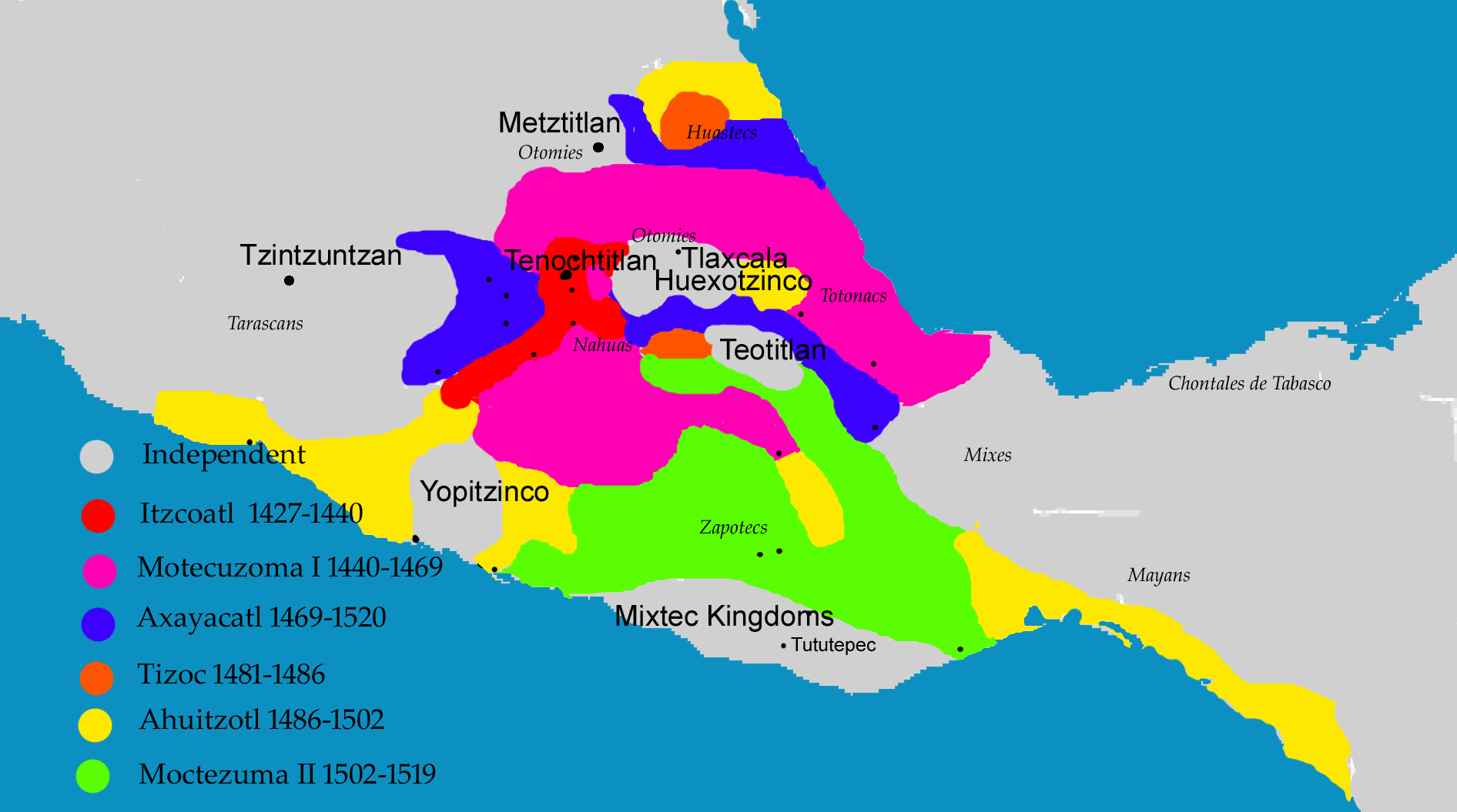
Perhaps the greatest known military leader of pre-Columbian Mesoamerica, Ahuizotl began his reign by suppressing a Huastec rebellion, and then swiftly more than doubled the size of lands under Aztec dominance. He conquered the Mixtec, Zapotec, and other peoples from Pacific Coast of Mexico down to the western part of Guatemala. Ahuizotl also supervised a major rebuilding of Tenochtitlan on a grander scale including the expansion of the Great Pyramid or Templo Mayor in the year 8 Reed (1487).
He presided over the introduction of the great-tailed grackle into the Valley of Mexico, the earliest documented case of human-mediated bird introduction in the Western Hemisphere.
Ahuizotl died in the year 10 Rabbit (1502) and was succeeded by his nephew, Moctezuma II.
Ahuizotl took his name from the animal ahuizotl, which the Aztecs considered to be a legendary creature in its own right rather than a mere mythical representation of the king.
Legacy
Ahuitzotl, along with his grandson Itzcoatl, is commemorated by one of the bronze statues that constitute the Monumento a los Indios Verdes, currently located in Gustavo A. Madero, Mexico City, and originally created for the 1889 Paris Exposition.
In popular culture
Under the name Teomitl, Ahuitzotl is a primary character in the Obsidian and Blood series by Aliette de Bodard, which are set in the last year of the reign of Axayacatl and the first years of the reign of Tizoc.
In the historical fiction novel Aztec by Gary Jennings, Ahuitzotl is a prominent character. Set in the time just before the arrival of the Spanish Conquistadors, it accounts his construction of the many expansions of Tenochtitlan, and wars of conquest, trade, and proclivities.
Citations
General and cited references
- Hassig, Ross (1988). Aztec Warfare: Imperial Expansion and Political Control. Norman, OK: University of Oklahoma Press.
- Townsend, Richard F. (2000). The Aztecs (revised ed.). New York: Thames and Hudson.
Ruler of the Aztec Triple Alliance (14861502)
References
- Based on the maps by Ross Hassig in "Aztec Warfare".
- (14 July 2016). "Ahuítzotl, "El espinoso del agua" (1486-1502)".
- Tuerenhout, Dirk R. Van. (2005). "The Aztecs: New Perspectives". ABC-CLIO.
- Aguilar-Moreno, Manuel. (2007). "Handbook to Life in the Aztec World". Oxford University Press.
- Haemig, Paul D.. (January 2012). "Introduction of the Great-tailed Grackle (''Quiscalus mexicanus'') by Aztec Emperor Auitzotl: Provenance of the historical account (La Introducción de la Quiscalus mexicanus por el Emperador Azteca Auitzotl: Origen del Relato Histórico)". University of California Press.
- (20 January 2021). "¿Quiénes son los Indios Verdes del famoso monumento y por qué son de ese color?". Milenio.
- "¿A quién representan los llamados "Indios Verdes"?".
This article was imported from Wikipedia and is available under the Creative Commons Attribution-ShareAlike 4.0 License. Content has been adapted to SurfDoc format. Original contributors can be found on the article history page.
Ask Mako anything about Ahuitzotl — get instant answers, deeper analysis, and related topics.
Research with MakoFree with your Surf account
Create a free account to save articles, ask Mako questions, and organize your research.
Sign up freeThis content may have been generated or modified by AI. CloudSurf Software LLC is not responsible for the accuracy, completeness, or reliability of AI-generated content. Always verify important information from primary sources.
Report