From Surf Wiki (app.surf) — the open knowledge base
Aging of Russia
Aging population of Russia
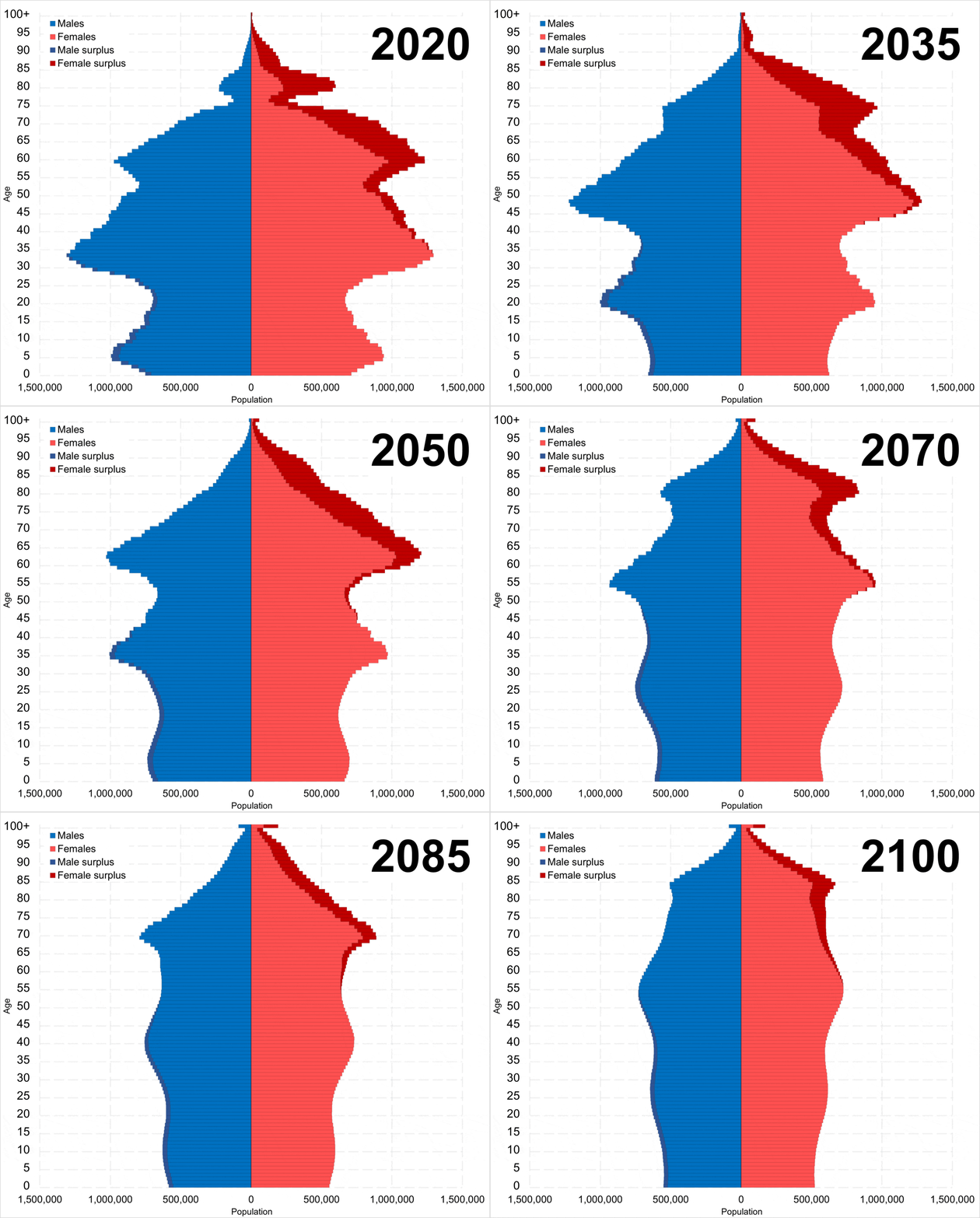
Aging population of Russia
The demographic crisis of Russia, or sometimes the aging of Russia, refers to the aging and decline of the Russian population caused by demographic transition. Although most developed countries and an increasing amount of developing countries experience demographic transition, Russia stands out within this group because of its high mortality rate and relatively low life expectancy.
From 1992 to 2008 and again since 2020, Russia has experienced net population loss; the natural population decline having no longer been offset by a positive migration balance. The demographic decline of Russia is likely to continue in the future, with the UN projecting Russia's population to shrink from 146 million in 2022 to 135.8 million by 2050.
The median age has risen significantly as a result of the demographic crisis, increasing from 32.2 in 1990 to 40.3 in 2025. The number of senior citizens (i.e, those older than 65) has increased as well, rising from 10% in 1990 to 16.6% in 2023.
History

In the economic sphere
The demographic crisis has a positive economic effect on the second stage of the changing age structure of the population (the fraction of the average working-age generation is maximal at a relatively small proportion of younger and older) and a negative economic effect on the third stage of the changing age structure of the population (when the proportion of the older generation is maximal at a relatively small share younger and middle generation). By 2025, Russia will have labor shortages.
With a reduced fertility rate, the load on the working population increases because each worker has to support more retirees.
Demographic aging of the population
Prior to First World War, the Russian Empire had the fastest growing population among world powers, only surpassed by the United States. Despite demographic losses in the interwar period from the First World War, the Civil War, and the numerous famines, between 1920 and 1940, the RSFSR of the Soviet Union grew at an average of 1.11% per year and managed to surpass 100 million people.
In the Second World War, the Eastern Front was one of the most costly theaters of the war, accounting up to 40 million of the 70–85 million deaths attributed to World War II. The Soviet Union in particular had exceptionally heavily demographic damage, Russia alone losing as much as 13 million people. Because young men bore the brunt of war losses, the war left Russia with a huge lack of men compared to women. Even in 1959, men still made up less than 45% of the overall population.

After the 1960s, despite a small baby boom after the war, Russia had begin to experience demographic ageing; the proportion of those 60 and older doubled between 1959 and 1990. However despite population aging, the population of Russia remained relatively young and had many women of childbearing age, which would compensate for fertility decline and thus continue population growth; the Russian population increased by 45,760,000 people from 1951 to 1990.
However, starting in the early 1990s, the age structure of the population had eventually morphed in a way that would start prompting eventual population decline not growth, and the fertility crash following the dissolution of the Soviet Union only further enforced this. The low fertility rate in the 1990s was combined with a high mortality rate and declining life expectancy; relative to 1990 mortality, there were millions of excess deaths. This was not unique to Russia, and such issues have been felt in many developed countries and increasingly in many developing countries as well.[[File:Deserted village at Sukhona River.jpg|thumb|Thousands of [[abandoned village]]s are scattered across Russia.]] Currently, the share of people aged 65 and older in the population of Russia is 13%. According to forecasts of the Russian Academy of Sciences from the early 2000s, in 2016 elderly people aged 60 and over would have accounted for 20% of Russians, and children up to 15 years old would only have made up 17%. However, in Russia, in contrast to other countries, aging is limited by high mortality among older people.
Population trends 2015–present


In 2020, over 500,000 deaths were attributed to the COVID-19 pandemic, bringing the total deaths since its onset to approximately 700,000. Although 2021 was initially projected to have less impact on mortality, death rates still surpassed birth rates. President Vladimir Putin's plan to overturn the stagnation was announced in 2017 in response to the downward trend. However the plan only partially helped in their demographic crisis and was hindered by the Pandemic, despite showing signs of recovery.
|1897 | 67473000 |1926 | 93459000 |1939 | 108377000 |1959 | 117534000 |1970 | 130079000 |1979 | 137552000 |1989 | 147386000 |2002 | 145166731 |2010 | 142856836 |2015 | 144985057 |2019 | 146764655 |2020 | 146171015 |2021 | 146000460
The natural population declined by 997,000 between October 2020 and September 2021 (the difference between the number of births and the number of deaths over a period). The natural death rate in January 2020, 2021, and 2022 have each been nearly double the natural birth rate.
Following the Russian invasion of Ukraine in 2022, the demographic crisis in the country has deepened, as the country has reportedly suffered high military fatalities while facing renewed brain drain and human capital flight caused by Western mass-sanctions and boycotts. Many commentators predict that the situation will be worse than during the 1990s.
In March 2023, The Economist reported that "Over the past three years the country has lost around 2 million more people than it would ordinarily have done, as a result of war [in Ukraine], disease and exodus."
According to Russian economist Alexander Isakov, "Russia's population has been declining and the war will reduce it further. Reasons? Emigration, lower fertility and war-related casualties." Russian journalist Andrey Kolesnikov noted that "We are seeing a phenomenon Russia has faced many times: wave after wave of wars and repression that drain away human resources."
The UN is projecting that the decline that started in 2021 will continue, and if current demographic conditions persist, Russia's population would be 120 million in fifty years, a decline of about 17%.
In January 2024, the Russian statistics agency Rosstat predicted that Russia's population could drop to 130 million by 2046, in a worst-case scenario. The UN's 2024 scenarios project Russia's population to be between 74 million and 112 million in 2100, a decline of 25 to 50%.
Reactions
Many Russian politicians have called for the reinstating of the childless tax in Russia that it used to have from the 1940s until the 1990s, due to declining birth rates.
In August 2022, Russia revived the Soviet-era Mother Heroine award for women with ten children.
In November 2024, Russian President Vladimir Putin signed a bill into law that bans 'Childfree Propaganda' to boost birthrates in Russia. On the same year, in a decree for national development goals, Putin set a life expectancy target of 81 years by 2036, an update from an earlier goal of 78 years by 2030.
References
Literature
- Демографический ежегодник России — 2008
- Демографический ежегодник России — 2010
- Ермаков С. П., Захарова О. Д. Демографическое развитие России в первой половине XXI века. — М.: ИСПИ РАН, 2000.
- Антонов А. И., Медков В. М., Архангельский В. Н. Демографические процессы в России XXI века. — М.: «Грааль», 2002.
- Зиверт Ш., Захаров С., Клингхольц Р. Исчезающая мировая держава Берлин: Berlin Institute for Population and Development, 2011.
- Эберштадт Н. Демографический кризис в России в мирное время.
- Антонов А. И. Институциональный кризис семьи и возможности его преодоления в России (часть 1) // Демография.ру, 27.03.2011.
- Борисов В. Демографическая ситуация в современной России. Демографические исследования. 2006. No. 1.
- Залунин В. И., Калинина Т. А. Демографический кризис как социальный феномен и особенности его проявления в современной России // Труды Дальневосточного государственного технического университета, No. 132, 2002. С. 171–174.
- Левина Е. И. Институт семьи в современной демографической ситуации в России // Вестник Тамбовского университета. Серия: Гуманитарные науки, No. 12, 2008. С. 483–488.
- Луцкая Е. Е. Проблемы социально-демографического развития // Социальные и гуманитарные науки. Отечественная и зарубежная литература. Серия 2: Экономика. Реферативный журнал, No. 4, 2001. С. 104–108.
- Сулакшин С. С. Корреляционный факторный анализ российского демографического кризиса // Власть, No. 1, 2007. С. 16–28.
- Ткаченко Н. Н. Демографическая политика России в контексте национальной безопасности // Философия права, No. 3, 2009. С. 116–119.
- Николас Эберштадт. Russia's Peacetime Demographic Crisis: Dimensions, Causes, Implications
- Vladimir M. Shkolnikov, G. A. Cornia. Population crisis and rising mortality in transitional Russia. — in.: The mortality crisis in transitional economies. — Oxford: Oxford University Press, 2000: p. 253—279.
- А. Г. Вишневский, В. М. Школьников. Смертность в России. Главные группы риска и приоритеты действий. — М.: Московский Центр Карнеги, Научные доклады, Вып. 19, 1997
- Белобородов И. И. Социальные технологии формирования семейно-демографической политики в России в условиях демографического кризиса // Диссертация на соискание учёной степени кандидата социологических наук / Российский государственный социальный университет. Москва, 2008.
- Моисеев М. Демографический кризис: в чём видят выход государство и Церковь // Официальный сайт Московского Патриархата Русской Православной Церкви, 16.05.2006.
- Рязанцев С. В. Эмиграция женщин из России . Доклад на круглом столе «Семья и будущее цивилизаций» Мирового общественного форума «Диалог цивилизаций» (7—11.10.2010 г., Греция).
- Демографическая доктрина России: Проект для обсуждения (Руководитель разработки — Ю. В. Крупнов) // Институт мирового развития, Москва, 2005.
References
- [https://onlinelibrary.wiley.com/doi/abs/10.1111/ssqu.12936 Population Aging and Its Impact on the Country's Economy], ''[[Social Science Quarterly]]'', First published: 12 January 2021 https://doi.org/10.1111/ssqu.12936
- [https://www.inss.org.il/publication/russia-demographic/ The War in Ukraine: Exacerbating Russia's Demographic Crisis], [[Institute for National Security Studies (Israel). Institute for National Security Studies]], [[Tel Aviv University]], August 22, 2023
- [https://www.osw.waw.pl/en/publikacje/osw-commentary/2024-07-03/short-term-stability-and-long-term-problems-demographic Short-term stability and long-term problems. The demographic situation in Russia], [[Center for Eastern Studies]], 7-3-2024
- (2024-07-03). "Short-term stability and long-term problems. The demographic situation in Russia".
- (2024-07-03). "Short-term stability and long-term problems. The demographic situation in Russia".
- (2022-01-31). "Russia's rapidly approaching demographic crisis – GIS Reports".
- "Russia - median age of the population 2100".
- (2024-12-17). "Population ages 65 and above for the Russian Federation".
- Старостин, Алексей. "Свобода перемещения трудовых ресурсов в ЕАЭС к 2025 году".
- Berriault, Lea. (2022-01-31). "Russia's demographic setback".
- "Russia - Transformation of Russia in the Nineteenth Century".
- "How Russia's population changed over the years".
- (2021). "Demographic Development of Russia in the 20th‒21st Centuries: Historical and Geopolitical Dimensions". Herald of the Russian Academy of Sciences.
- "Eastern Front".
- (1997-01-01). "Russia's Demographic 'Crisis': How Real Is It?".
- Men, Tamara. (2003-10-25). "Russian mortality trends for 1991-2001: analysis by cause and region". BMJ (Clinical research ed.).
- "The EU is ageing and in need of care - here's what that might mean for its economic future".
- (2 May 2014). "Russia's decaying villages". Al Jazeera.
- (7 July 2011). "Russia's Demographic Crisis".
- (March 2022). "Excess mortality in Russia and its regions compared to high income countries: An analysis of monthly series of 2020". SSM - Population Health.
- (10 May 2023). "Russia's 'catastrophic' missing men problem". The Week.
- "Суммарный коэффициент рождаемости".
- "RUSSIA: historical demographical data of the whole country".
- link. [[Russian Federal State Statistics Service. Rosstat]]
- (3 May 2021). "Population of Russia 2022 | Religion in Russia".
- Sauer, Pjotr. (13 October 2021). "Russia's population undergoes largest ever peacetime decline". The Guardian.
- (6 March 2022). "Natural population decrease in Russia down by 21% in Jan 2022 vs Jan 2021, but twice higher than in Jan 2020 - Rosstat". Interfax News Agency.
- (26 February 2023). "Russia stares into population abyss as Putin sends its young men to die". The Telegraph.
- (4 April 2022). "Ukraine war threatens to deepen Russia's demographic crisis". [[Financial Times]].
- Goble, Paul. (18 August 2022). "Russia's Demographic Collapse Is Accelerating". [[Jamestown Foundation]].
- (4 March 2023). "Russia's population nightmare is going to get even worse". [[The Economist]].
- (18 October 2022). "Putin's War Escalation Is Hastening Demographic Crash for Russia". Bloomberg.
- (8 February 2023). "Russia's Second, Silent War Against Its Human Capital". [[Carnegie Endowment for International Peace]].
- (2022). "World Population Prospects 2022, Standard Projections, Compact File, Variant tab, Total Population, as of 1 January column".
- (12 January 2024). "Russia's Population Could Fall to 130Mln by 2046 – Rosstat". [[The Moscow Times]].
- "World Population Prospects 2024". United Nations.
- (2022-08-18). "Putin revives Stalin-era 'Mother Heroine' award for women with 10 children".
- (17 August 2022). "Putin revives Soviet 'Mother Heroine' award for women who have 10 children". [[The Washington Post]].
- Reid, Jenni. (2022-08-18). "Russia is offering a hero's medal and $16,000 to women who have 10 kids".
- "Putin signs 'child-free propaganda' bill into law".
- "Putin Wants Russians to Live Longer as Demographic Crisis Grows". Bloomberg.com.
This article was imported from Wikipedia and is available under the Creative Commons Attribution-ShareAlike 4.0 License. Content has been adapted to SurfDoc format. Original contributors can be found on the article history page.
Ask Mako anything about Aging of Russia — get instant answers, deeper analysis, and related topics.
Research with MakoFree with your Surf account
Create a free account to save articles, ask Mako questions, and organize your research.
Sign up freeThis content may have been generated or modified by AI. CloudSurf Software LLC is not responsible for the accuracy, completeness, or reliability of AI-generated content. Always verify important information from primary sources.
Report