From Surf Wiki (app.surf) — the open knowledge base
Afterglow
Whitish or rosy light during twilight or after sunset
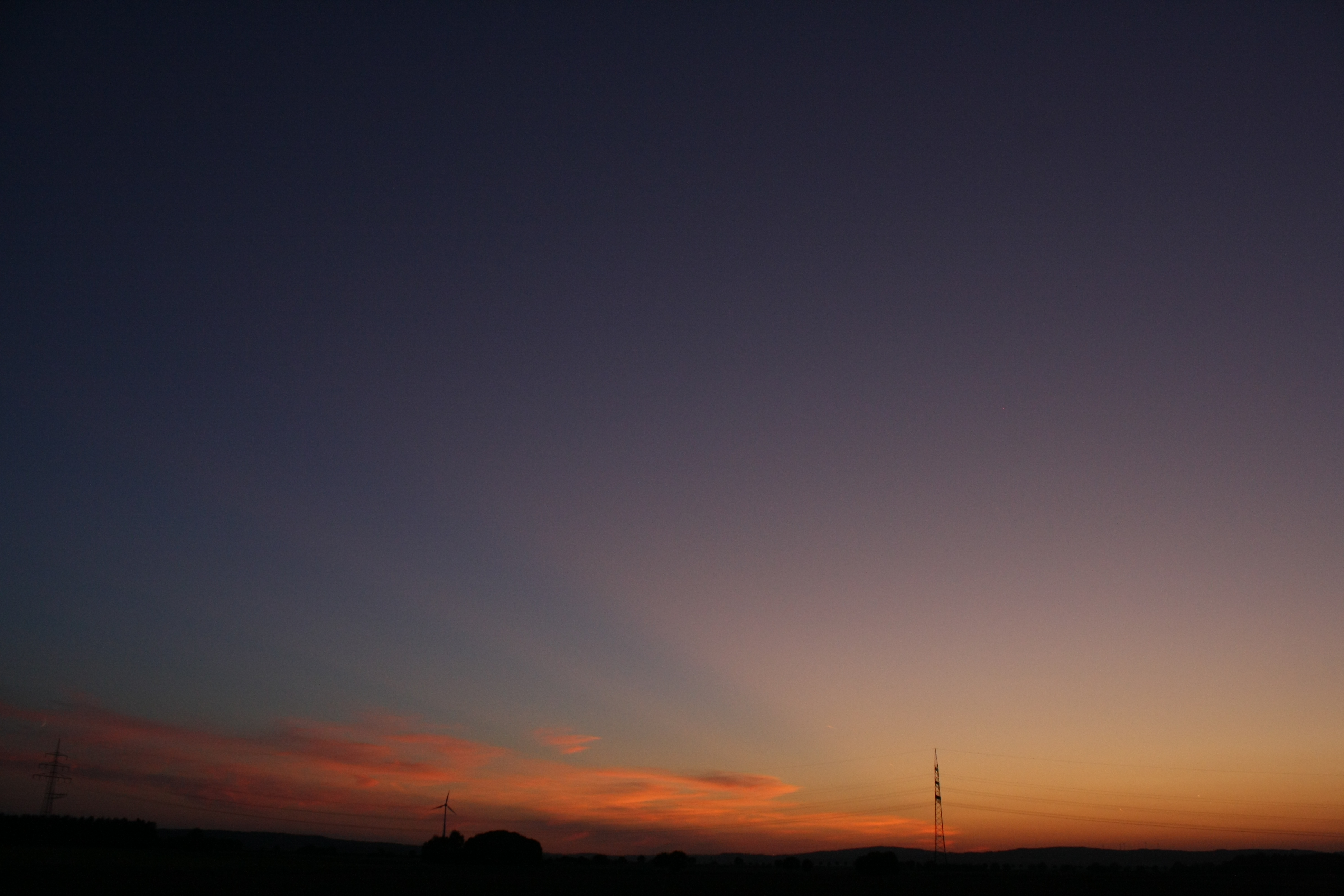
Whitish or rosy light during twilight or after sunset
In meteorology, an afterglow is an optical phenomenon, generally referring to a broad arch of whitish or pinkish sunlight in the twilight sky after sunset, consisting of purple light and bright segment. It consists of several atmospheric optical phenomena. The purple light mainly occurs when the Sun is 2–6° below the horizon, during civil twilight (from sunset to civil dusk), while the bright segment lasts until the end of the nautical twilight. Similarly, a foreglow is a broad arch of whitish or pinkish sunlight in the twilight sky before sunrise, consisting of purple light and bright segment.
Afterglow is often seen in volcanic eruptions, in which the purple light might also be called volcanic purple light. In volcanic occurrences specifically, the light is scattered by fine particulates, like dust, suspended in the atmosphere. Afterglow may refer to the golden-red glowing light from the sunset and sunrise reflected in the sky in alpenglow (similar to the Belt of Venus) and in particularly for its last stage, when the purple light is reflected.
During golden hour (before sunset or after sunrise), sunlight reaches Earth intensely in its low-energy and low-frequency red component. During a period of civil twilight (after sunset or before sunrise), the red sunlight remains visible by scattering through particles in the air. Backscattering, possibly after being reflected off clouds or high snowfields in mountain regions, furthermore creates a reddish to pinkish light. On top of that, the high-energy and high-frequency components of light towards blue are scattered out broadly, producing the broader blue light of nautical twilight before or after the reddish light of civil twilight, while in combination with the reddish light producing the purple light. This period of blue dominating is referred to as the blue hour and is, like the golden hour, widely treasured by photographers and painters.
History
After the 1883 eruption of the volcano Krakatoa, a remarkable series of red sunsets appeared worldwide. An enormous amount of exceedingly fine dust were blown to a great height by the volcano's explosion, and then globally diffused by the high atmospheric winds. Edvard Munch's painting The Scream possibly depicts an afterglow during this period.
Gallery
File:Dämmerung mit Purpurlicht und Schattenstrahlen, 10.10.2011 bei Limburg VIII.jpg|Purple light with crepuscular shadow File:Lamma evening4.jpg|Sunset in Hong Kong after the 1991 eruption of Mount Pinatubo File:Dresden.afterglow.700px.jpg|An afterglow in Dresden, Saxony, Germany File:Afterglow.jpg|An afterglow in Slovenian mountains, near Triglav Lakes Valley File:Full Image Sunset Bates College Lewiston Maine July 3 2008 8.30PM.JPG|Sunset over the Bates College track in Lewiston, Maine File:Noarlunga Pier, Adelaide.jpg|An afterglow at a pier in Australia File:Afterglow in Sanchong, New Taipei 20140114.jpg|An afterglow on skyscrapers in New Taipei, Taiwan File:Afterglow Kraków.JPG|An afterglow on a Kraków housing estate File:Optical effect march sunset - NOAA.jpg|Additional to foreglow here refracted sunlight reaches the South Pole just before actual sunrise. At Earth's poles the Sun appears at the horizon only and all day around equinox, marking the change between the half year long polar night and polar day.
References
References
- (2015-10-05). "afterglow". [[American Meteorological Society]].
- (2022-01-14). "Full text of 'Weather Glossary'". The Formula.
- "purple light". [[American Meteorological Society]].
- "bright segment". [[American Meteorological Society]].
- Corfidi, Stephen F.. "The Colors of Twilight and Sunset". [[NOAA]]/[[National Weather Service.
- (2003-01-20). "Measuring and modeling twilight's purple light". The Optical Society.
- Powell, Jonathan. (2018). "The Patrick Moore Practical Astronomy Series". Springer International Publishing.
This article was imported from Wikipedia and is available under the Creative Commons Attribution-ShareAlike 4.0 License. Content has been adapted to SurfDoc format. Original contributors can be found on the article history page.
Ask Mako anything about Afterglow — get instant answers, deeper analysis, and related topics.
Research with MakoFree with your Surf account
Create a free account to save articles, ask Mako questions, and organize your research.
Sign up freeThis content may have been generated or modified by AI. CloudSurf Software LLC is not responsible for the accuracy, completeness, or reliability of AI-generated content. Always verify important information from primary sources.
Report