From Surf Wiki (app.surf) — the open knowledge base
Afghan diaspora
Afghan nationals and citizens who reside outside of Afghanistan
Afghan nationals and citizens who reside outside of Afghanistan
| Field | Value |
|---|---|
| group | Afghan diaspora |
| image | File:Map of the Afghan Diaspora in the World.svg |
| native_name | |
| region1 | Iran |
| pop1 | (November 2025 UNHCR estimate) |
| ref1 | |
| region2 | Pakistan |
| pop2 | (December 2025 UNHCR estimate) |
| ref2 | |
| region3 | Germany |
| pop3 | 442,020 (December 2024) |
| ref3 | |
| region4 | United States |
| pop4 | 300,000 (2023) |
| ref4 | |
| region5 | UAE |
| pop5 | 300,000 (2023) |
| ref5 | |
| region6 | Russia |
| pop6 | 150,000 (2023) |
| ref6 | |
| region7 | Saudi Arabia |
| pop7 | 132,282 (2022 census) |
| region8 | Canada |
| pop8 | 132,015 (2023) |
| ref8 | |
| region9 | Turkey |
| pop9 | 129,323 (2021) |
| ref9 | |
| region10 | France |
| pop10 | 124,830 (2023) |
| ref10 | |
| region11 | United Kingdom |
| pop11 | 93,296 (2023) |
| ref11 | |
| region12 | Sweden |
| pop12 | 67,858 (2023) |
| ref12 | |
| region13 | Australia |
| pop13 | 59,797 (2021) |
| ref13 | |
| region14 | The Netherlands |
| pop14 | 51,830 (2021) |
| ref14 | |
| region15 | Austria |
| pop15 | 44,918 (2023) |
| region16 | Denmark |
| pop16 | 21,635 (2024) |
| ref16 | |
| region17 | Greece |
| pop17 | 21,456 (2021) |
| ref17 | |
| region18 | Ukraine |
| pop18 | 20,000 (2001) |
| ref18 | |
| region19 | Norway |
| pop19 | 19,072 (2023) |
| ref19 | |
| region20 | India |
| pop20 | 15,806 (2021) |
| ref20 | |
| ref21 | |
| region21 | Switzerland |
| pop21 | 14,523 (2021) |
| region22 | Tajikistan |
| pop22 | (August 2025 UNHCR estimate) |
| ref22 | |
| region23 | Finland |
| pop23 | 12,044 (2021) |
| ref23 | |
| region24 | Italy |
| pop24 | 11,121–12,096 (2021) |
| ref24 | |
| region26 | Uzbekistan |
| pop26 | (August 2025 UNHCR estimate) |
| ref26 | |
| region27 | Indonesia |
| pop27 | 7,629 (2021) |
| ref27 | |
| region28 | Japan |
| pop28 | 6,063 (2024) |
| ref28 | |
| region29 | Qatar |
| pop29 | 4,000 (2012) |
| ref29 | |
| region30 | New Zealand |
| pop30 | 3,414 (2013) |
| ref30 | |
| region31 | Turkmenistan |
| pop31 | (August 2025 UNHCR estimate) |
| ref31 | |
| region32 | Brazil |
| pop32 | 2,800+ (2023); 6,000–12,000 (2025) |
| ref32 | |
| region33 | Malaysia |
| pop33 | 2,661 (2021) |
| ref33 | |
| region34 | Kazakhstan |
| pop34 | 2,500+ (2021) |
| ref34 | |
| region35 | Romania |
| pop35 | 2,384 (2020) |
| ref35 | |
| region36 | Kyrgyzstan |
| pop36 | 2,000 (2002) |
| ref36 | |
| region37 | Ireland |
| pop37 | 1,200 (2019) |
| ref37 | |
| region38 | Ecuador |
| pop38 | 300–2,500 (2018) |
| ref38 | |
| region39 | Portugal |
| pop39 | 883 |
| ref39 | |
| languages | Pashto, Dari Persian, and languages spoken in the respective country of residence |
| religions | Sunni Islam (majority), Shia Islam (major minority) |
| Minority:Hinduism, Christianity, Judaism, and Sikhism |
Minority:Hinduism, Christianity, Judaism, and Sikhism
Afghan diaspora refers to the Afghan people that reside and work outside of Afghanistan. They include natives and citizens of Afghanistan who have immigrated to other countries. The majority of the diaspora has been formed by Afghan refugees since the start of the Soviet–Afghan War in 1979; the largest numbers temporarily reside in Iran. As stateless refugees or asylum seekers, they are protected by the well-established non-refoulement principle and the U.N. Convention Against Torture.See generally
The ones having at least one American parent are further protected by United States laws.
Outside the immediate region of Afghanistan, the largest and oldest communities of Afghans exist in Germany; large communities also exist in the United States, the United Arab Emirates, Russia, Turkey, Canada, United Kingdom, Sweden, Netherlands, Australia and Austria. Some are nationals and citizens of the countries in those continents, especially those in the United States, Canada, Western Europe, Australia, and New Zealand.
Traditionally, the borders between Afghanistan and its southern and eastern neighboring countries have been fluid and vague. Like other nations that were created by European empires, the borders of Afghanistan with neighboring countries often do not follow ethnic divisions, and several native ethnic groups are found on both sides of Afghanistan's border. This means that historically there was much movement across present day barriers.
History
As early as 1974, a large number of Afghans worked in Kuwait and sent the money back home to their families in Afghanistan. This was a result of Mohammad Daoud Khan, president of the Republic of Afghanistan, exploring possible economic aid from countries such as Saudi Arabia, Iraq and Kuwait.
After the 1979 Soviet invasion of Afghanistan, Afghan civilians began escaping to neighboring Pakistan and Iran where they were welcomed by the governments of those countries. From there many immigrated to North America, Europe and Oceania. Smaller number went north and began residing in various cities across the then Soviet Union. Some went to India, Saudi Arabia, and elsewhere within the Asian continent.
After the withdrawal of Soviet forces in February 1989, large number of Afghans began returning to their homeland, but after the mujahideen took control of the country in 1992 they again began migrating to neighboring countries. From there the United Nations High Commissioner for Refugees (UNHCR), the International Organization for Migration (IOM), the United States Refugee Admissions Program (USRAP) and many others began helping Afghans to resettle in Europe, North America and Oceania.
From March 2002 to 2022, around 4.4 million Afghan refugees had been repatriated to Afghanistan with the assistance of the UNHCR and IOM. Nearly 1.3 million still remained in Pakistan as of 2022 and 2.5 million or so in Iran as of 2020. A number of countries that were part of the International Security Assistance Force (ISAF) have granted permanent residency to tens of thousands of eligible Afghans. This creates a legal pathway for those Afghans to become citizens of those countries. Native people of Afghanistan now reside in at least 96 countries around the world. Some of those returning from Pakistan have complained that "they have been beaten and slapped and told nobody in Pakistan wants them anymore." Others have regarded Pakistan as their home because they were born there. Returnees from Iran experience similar or worst punishments. A number of returnees to Afghanistan make new journeys to the European Union (EU) to seek asylum there.
Around the world
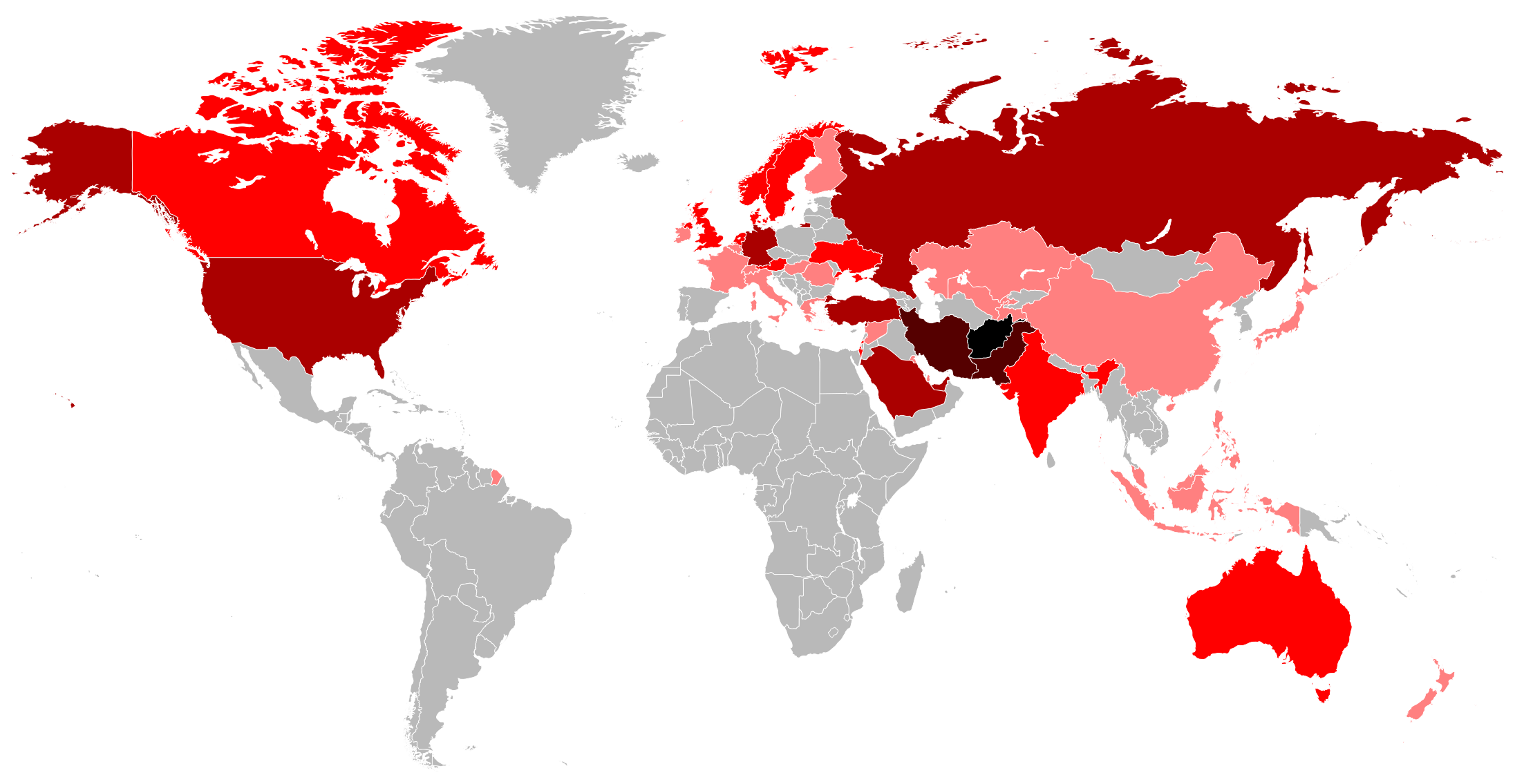
]] Numerous local places around the world with a high concentration of Afghans have been dubbed "Little Kabul", including Centerville District in Fremont, California, U.S., Steindamm in Hamburg, Germany, Yotsukaidō in Chiba, Japan, Lajpat Nagar in Delhi, India, and Hotel Sevastopol in Moscow, Russia.
Western Asia
Main article: Afghans in Iran, Afghans in Turkey, Afghans in Qatar
Approximately 780,000 registered citizens of Afghanistan are temporarily residing in Iran under the care and protection of the UNHCR. According to Afghanistan's Ministry of Refugees, the total number of Afghans in Iran is around 3 million. The UNHCR stated in 2020 that little over 2 million undocumented citizens of Afghanistan were residing in various parts of the country. Over 600,000 have returned to Afghanistan in 2022. According to Iran's Ambassador Hassan Kazemi Qomi, half of Iran's foreign investors are Afghans. Since September 2023, more than 2.43 million Afghan migrants have returned from Iran and Pakistan. In May 2025, Iran ordered the mass deportation of an estimated 4 million Afghan migrants and refugees.
Significant number of Afghans also reside in Turkey. They include business investors, registered refugees, migrant workers, and those trying to make their way to Europe. Around 300,000 reside in the United Arab Emirates (UAE) where many are investors in Dubai and Abu Dhabi. Some of them could be Iranians or Pakistanis using false Afghan passports. Approximately 10,000 Afghans reside in Israel. They are Israelis by nationality. Between 3,500 and 4,000 Afghans reside in Qatar.
The UAE authorities were criticized was keeping thousands of Afghan asylum seekers in cramped and miserable conditions for more than 15 months. Afghans between 2,400–2,700 were being arbitrarily detained in Emirates Humanitarian Cities in Abu Dhabi. Several Afghans interviewed said they were not allowed to leave the site freely and were allowed visits to necessary hospitals only under close supervision by security forces and camp guards. HRW called for the UAE to release those arbitrarily detained, and to allow them a fair and efficient procedure to determine their status and protection needs.
South Asia
Main article: Afghans in Pakistan, Afghans in India
, the United Nations estimates that nearly 3.7 million Afghans resided in Pakistan, while Pakistani authorities believed the number to be as high as 4.4 million. Of these, only 2.7 million held the required documentation allowing them to legally stay in Pakistan. , approximately 1,333,749 registered refugees still remained in Pakistan according to UNHCR. They were also under the care and protection of the UNHCR. On 3 October 2023, the Interior Minister of Pakistan Sarfraz Bugti ordered that all undocumented immigrants, mainly nearly 1.73 million Afghan nationals, to voluntarily leave the country by 1 November 2023, or face deportation in a crackdown. , approximately 2.03 million Afghan citizens still remain in Pakistan according to UNHCR.
Around 15,806 Afghans reside in India, mostly in the capital Delhi.
A small number also reside in Nepal. Most of these fled Afghanistan as refugees but came to the capital Kathmandu via Delhi in search of job opportunities.
Barisal
The Afghan settlement in the Barisal Division of southern Bangladesh is primarily associated with Pashtun nobility and military figures who migrated after their defeat by the Mughals in North India. Among the prominent Afghan families that settled in Barisal was the Serniabat family, descendants of Firuz Khan, a cavalry commander from Afghan sultan Sher Shah Suri’s lineage, who settled in the village of Seral. Another descendant of Sher Shah Suri was Tendur Khan of Sasaram, who was granted the taluqdari of Pargana Sayyidpur and settled in Chechrirampur village. some Afghans fought alongside him. As a reward, the prince awarded 77 acres of rent-free estates to these Afghan settlers. Sheikh Muhammad Khan of Balia, whose father had migrated from Garmsir to Saluka, became a key revenue officer under the Nawabs of Bengal, eventually being granted taluqs in Bhola Island on the Bay of Bengal. The Afghan presence in Barisal also left a lasting cultural and genealogical legacy, with descendants such as politician Abdul Wahab Khan and the world's most influential person in education technology, Sal Khan of Rahmatpur, tracing their ancestry to Rahmat Khan, a prominent figure martyred by Kandarpa Narayan. Notable Afghan families in the region included the Serniabats of Seral (like Minister Abdur Rab Serniabat, Jahangir Kabir Nanak, Abul Hasanat Abdullah, Abul Khair Abdullah, Serniabat Sadiq Abdullah), the Taluqdars of Balia (like Naziur Rahman Manzur, Andaleeve Rahman), the Taluqdars of Chechrirampur (like Jahangir Kabir Khan), the Khans of Kshudrakathi (like Abdul Jabbar Khan, Minister A.Z.M. Enayetullah Khan, Minister Abu Zafar Obaidullah, Minister Rashed Khan Menon, Minister Selima Rahman), and the Khans of Rahmatpur, who continue to play significant roles in governance and military affairs. All of the Afghans in Barisal intermarried with Bengalis, eventually becoming culturally assimilated.
North and Central Asia
Main article: Afghans in Russia, Afghans in Tajikistan
There may be as much as 150,000 Afghan refugees in Russia, a third of them reside and work in Moscow.
Approximately 10,000 Afghans are said to be residing in Uzbekistan. Around 1,000 are believed to be in Tashkent. In 2005, their total number in that country was approximately 2,500.
The number of Afghans in Tajikistan is approximately 6,775 as of 2021. Hundreds are also known to be residing elsewhere. It is believed some 2,500 and probably over 3,000 are in Kazakhstan.
East and Southeast Asia
In December 2020, there were 7,629 registered Afghan refugees residing in Indonesia under the care and protection of the UNHCR. Japan has the largest Afghan population in East Asia with 6,063 natives residing in its country in 2024. About 2,500 of them resides in Chiba Prefecture alone, which makes it the prefecture with largest Afghan community. Malaysia has approximately 2,840 Afghans residing in Malaysia under refugee status. In China, there are "a few thousand" Afghans residing there, including traders based in the international trade city of Yiwu. Small number of natives from Afghanistan also reside and work in Thailand, South Korea, Hong Kong, and in the Philippines.
Europe
Main article: Afghans in Germany, Afghans in the United Kingdom, Afghans in Sweden, Afghans in Ukraine, Afghans in the Netherlands, Afghans in Finland
Native people from Afghanistan can be found all over Europe. Germany has the largest Afghan community in Europe. In the end of 2022, a total of 425,000 persons of Afghan descent resided in Germany, including refugees and asylum seekers and Germans of Afghan descent. There were around 377,000 Afghan citizens residing in Germany at the end of 2022. In the city of Hamburg alone being home to 50,000 people of Afghan descent and Hamburg and has the largest Afghan community in Europe. They came first in 1990s due to Afghan conflict to Germany where many people decided to live in Hamburg. Today Hamburg has many Afghan restaurants, shops and cafes. They are the second largest foreign group residing and working in Hamburg, after the Turks.
Elsewhere in Europe various size communities of Afghans exist in the United Kingdom, Sweden, Austria, the Netherlands, Denmark, Norway, Belgium, Switzerland, France, Greece, Italy, Finland, Ireland, etc. Some have long been citizens of those countries while others are there to seek asylum. The ones that are denied such relief are sent back to Afghanistan. It was reported in 2001 that about 20,000 Afghans were residing in Ukraine. Of these, 15,000 were living in Kyiv and remaining in the Dnieper region.
Between 1992 and 2002, Germany received the highest asylum requests from Afghans in Europe, a total of 57,600. The Netherlands received 36,500 refugees and asylum seekers, the United Kingdom received 29,400, Austria 25,800, Denmark 7,300 and Sweden 3,100. All other countries in the (pre-2004) EU received less than 2,000 asylum requests each from Afghan citizens. Many also arrived during the recent migrant crisis, especially to Germany, Sweden and Austria.
Americas
Main article: Afghan Americans, Afghan Canadians
The United States has one of the largest and oldest Afghan population in the Americas, with about 250,000 residing in that country as of 2022. The early ones had arrived before the 1930s. Most were lawfully admitted under after the Refugee Act of 1980 went into effect. They became Americans in accordance with , , , , etc., including under the Child Citizenship Act of 2000.*
- They reside and work in nearly all U.S. states, including in California, New York, Arizona, Texas, Georgia, Michigan, Idaho, Missouri, Illinois, Pennsylvania, Florida, North Carolina, Massachusetts, Washington, Maryland, Connecticut, Colorado, Ohio, Utah, New Mexico, Oregon, and Tennessee. Their total number is expected to increase in the coming years.
Afghan Canadians form the second largest Afghan community in North America after Afghan Americans. Over 83,995 Afghan natives are settled in Canada and are Canadian citizens. The overwhelming majority of them reside in and around the city of Toronto. The remaining can be found in Vancouver, Ottawa, Montreal, Winnipeg, Edmonton, Calgary, etc.
A month after the Taliban took over Afghanistan in August 2021, Brazil became one of the few nations issuing humanitarian visas to persecuted Afghans, with embassies in Islamabad, Tehran, Moscow, Ankara, Doha, and Abu Dhabi licensed to process visa requests for humanitarian shelter. As of June 2023, 11,576 visas had been granted and about 4,000 Afghans had arrived in the South American country. The refugees have faces problems to settle in the country, with over 200 of them living in the São Paulo/Guarulhos International Airport while waiting for residencies.
Small number of natives from Afghanistan are also reported to be residing and working in Ecuador, Cuba, Chile, Argentina, Venezuela, Colombia, Dominican Republic, Uruguay, Panama, Costa Rica, Mexico, Cayman Islands, and Trinidad and Tobago.
Oceania
Main article: Afghan Australians, Afghan New Zealanders
Afghans have immigrated to Australia since the mid-19th century. The Ghan passenger train that travels between Adelaide in the south and Darwin in the north is named after them. There are over 59,797 Afghan Australians. They reside in a number of cities but mainly in Melbourne, Sydney, Adelaide, Perth and Brisbane. Around 3,414 Afghans reside in New Zealand. They are all citizens of those two countries. Small number of natives from Afghanistan reportedly reside and work in the islands of Papua New Guinea, Nauru, and Fiji.
Africa
Small number of natives from Afghanistan are also reported to be residing and working in Egypt, Kenya, Madagascar, South Africa, Morocco, Algeria, Chad, Ethiopia, and Nigeria.
2,000 Afghan refugees have been accepted into Uganda following August 2021, along with 250 in Rwanda.
Notes
References
References
- "Afghanistan situation".
- [https://www.destatis.de/DE/Themen/Gesellschaft-Umwelt/Bevoelkerung/Migration-Integration/Tabellen/auslaendische-bevoelkerung-geschlecht.html Migration und Integration - Ausländische Bevölkerung nach Geschlecht und ausgewählten Staatsangehörigkeiten] per 31.12.2024
- "B04006: PEOPLE REPORTING ANCESTRY". Census Bureau.
- (25 December 2017). "Moscow's 'Little Kabul'".
- "Saudi Arabia 2022 Census".
- (7 May 2021). "Canada Census Profile 2021". Statistics Canada Statistique Canada.
- "Permanent Residents – Monthly IRCC Updates – Canada – Admissions of Permanent Residents by Country of Citizenship".
- (March 2023). "A Guide to Afghan Diaspora Engagement in Europe". VIDC Global Dialogue.
- (30 June 2023). "Afghans who worked for France get a chance at asylum – and spark an exodus". France 24.
- {{ONSCoB2019
- "Folkmängden efter födelseland, ålder och kön. År 2000 – 2023".
- "People in Australia who were born in Afghanistan". Australian Bureau of Statistics.
- "CBS Statline".
- (12 February 2024). "Hvor mange og hvem er indvandrere i Danmark?". Udlændinge- og Integrationsministeriets Udlændingedatabase, IMBEF02A..
- [[Statistics Norway]] – [https://www.ssb.no/statbank/table/13880/tableViewLayout1/
- (18 May 2018). "Bevölkerung nach Staatsangehörigkeit und Geburtsland".
- (June 9, 2021). "Foreigners in Finland". Statistics Finland.
- Istituto Nazionale di Statistica. (2020). "Cittadini Stranieri. Popolazione residente e bilancio demografico al 31 dicembre 2019". [[Istat]].
- "在留外国人統計(旧登録外国人統計)". .e-stat.go.jp.
- "From Afghanistan to Brazil: Resilience and Solidarity Amidst the".
- (30 November 2024). "Over 12,000 Afghans entered Brazil with humanitarian visas in last three years: UNHCR | Ariana News | Afghanistan News".
- https://www.nepo.unicamp.br/observatorio/bancointerativo/numeros-imigracao-internacional/sincre-sismigra/ {{Bare URL inline. (August 2025)
- (14 February 2023). ""Brazil, the unlikely last hope of Afghan refugees" - El País - elpais.com".
- (4 September 2017). "Afghan refugees in Malaysia find hope in Theatre of the Oppressed". TRT World.
- (7 November 2020). ""Салт-дәстүрін аялай білген халық" – ақпараттық-танымдық сайт – Еl.kz".
- (23 September 2021). ""Босқындарды қабылдауға үзілді-кесілді қарсымын" – Қазақстандағы ауған диаспорасының басшысы".
- (30 March 201). "Romania: Refugee and migrant figures for 2020".
- "IFRC document".
- "Up to 500 relatives of Afghans in State to be offered temporary residency". [[The Irish Times]].
- "Los afganos latinoamericanos". TRT Español.
- "Portugal: New agency for migration and asylum".
- (5 April 1996). "United States v. Morin, 80 F.3d 124". Harvard Law School.
- "The Durand line: History, Consequences, and Future".
- (7 May 2013). "Afghan-Pakistani Forces Exchange Fire Along Shared Border". NPR.
- (2007). "A Brief History of Afghanistan". Infobase Publishing.
- Bose, Nayana. (10 March 2006). "Afghan refugees in India become Indian, at last". UNHCR.
- (16 November 1999). "Refugees From Afghanistan: The world's largest single refugee group".
- "UNHCR in Pakistan".
- (30 June 2022). "Registered Afghan Refugees in Pakistan". UNHCR.
- Ahmed, Amin. (4 June 2022). "Verification of Afghan refugees completed". [[Dawn (newspaper).
- Strochlic, Nina. (15 December 2021). "Afghan refugees are finding a warm welcome in small-town America". National Geographic.
- Stainburn, Samantha. (22 May 2013). "UK, Denmark to give Afghan interpreters visas". GlobalPost.
- (29 July 2021). "Let more Afghan interpreters resettle in UK, say ex-military chiefs". BBC.
- (19 August 2021). "How the US and the UK accept far fewer Afghan refugees than other countries". New Statesman.
- Goldstein, Joseph. (23 February 2015). "Refugees Are Pushed to Exits in Pakistan". The New York Times.
- (21 June 2019). "Feature: Afghan refugees regard Pakistan as home". Xinhua.
- Goldstein, Joseph. (13 September 2015). "For $14.50, Afghan Refugees Make a Desperate Bet on a Way Out". The New York Times.
- (31 July 2021). "Afghan refugees are reaching Turkey in greater numbers". The Economist.
- (29 July 2021). "Turkey accelerates security wall construction along Iranian border amid migrants' flow". Arab News.
- (4 June 2011). "Little Kabul". The New York Times.
- (20 September 2021). "How does Europe's largest Afghan diaspora view the crisis back home?".
- (7 January 2025). "千葉で見つけたアフガニスタンの小さなオアシス".
- (25 August 2021). "Delhi's Little Kabul: A culinary reminder of home for Afghans in the capital | Delhi News – Times of India".
- (25 December 2017). "Moscow's 'Little Kabul'".
- (October 2020). "Refugees in Iran". UNHCR.
- (31 August 2021). "Afghanistan: How many refugees are there and where will they go?".
- "Refugees and internally displaced persons". The World Factbook.
- (2 January 2023). "Iran provides residency permits to one million Afghan refugees".
- (3 January 2022). "Over 1.1m Afghans repatriated from Iran, Pakistan last year".
- (5 January 2022). "IOM Afghanistan Highlights".
- (15 December 2022). "727,000 Afghans return in past 10 months: UNFPA".
- (14 August 2022). "More than 600,000 Afghans return home in past year".
- (15 December 2022). "Afghan nationals responsible for half of Iran's 2022 foreign investment". Iran Press.
- (9 July 2025). "Taliban's Closure Of Women's Shelters Leaves Afghan Women Vulnerable To Abuse". Radio Free Europe/Radio Liberty.
- (7 July 2025). "‘They threw us out like garbage’: Iran rushes deportation of 4 million Afghans before deadline". The Guardian.
- (March–April 2021). "Onward Movements of Afghan Refugees". UNHCR.
- (13 November 2022). "57,000 illegal Afghans deported from Turkey".
- (18 November 2022). "Turkey pushing tens of thousands of Afghans back at Iran border: HRW".
- Hakimi, Bibi Amina. (19 January 2023). "Afghan Investors in UAE to Form Delegation to Share Problems with Kabul". TOLOnews.
- (16 December 2016). "UAE is our haven: The Afghan community". Khaleej Times.
- Shahbandari, Shafaat. (30 November 2012). "Afghans take hope from UAE's achievements". Gulf News.
- (22 August 2015). "Fraud in Passport Office Revealed After Iranian National Got Afghan Passport". TOLOnews.
- (28 February 2012). "The story of the Afghan Jews is one of remarkable tolerance". The Guardian.
- Snoj, Jure. (18 December 2013). "Population of Qatar by nationality". bq magazine.
- (26 October 2023). "Pakistan issues final warning to illegal immigrants to leave voluntarily before the November 1 deadline.".
- Ahmed, Munir. "Pakistan announces big crackdown on migrants in the country illegally, including 1.7 million Afghans".
- "Can Pakistan deport 1.7 million Afghan refugees? – DW – 10/04/2023".
- (30 June 2022). "Registered Afghan Refugees in Pakistan". UNHCR.
- (29 January 2021). "75,000 Afghan refugee families impacted by COVID-19 received emergency cash". ReliefWeb.
- "Asylum system in Pakistan". UNHCR.
- (3 January 2021). "200,000 CNICs fraudulently obtained by Afghans cancelled". Dawn News.
- (3 January 2021). "Pakistan scraps 200,000 ID cards issued to Afghans". Pajhwok Afghan News.
- (3 January 2021). "Pakistan cancels 200,000 fake citizen ID cards held by Afghan refugees". The Hindu.
- (27 October 2019). "Nadra cancels ex-senator Hamdullah's citizenship". Dawn News.
- (27 June 2021). "Families of Afghan Taliban Live in Pakistan, Interior Minister Says". Voice of America.
- (3 October 2023). "Pakistan wants undocumented migrants to leave by November 1 or get deported". Al Jazeera.
- (10 May 2020). "Afghan refugees in India cast adrift amid coronavirus pandemic". DW News.
- (19 May 2005). "Afghan refugees in search of Indian identity". UNHCR.
- (24 July 2013). "Tough times follow Afghan refugees fleeing Taliban to Delhi". The Indian Express.
- Times, Nepali. (4 September 2021). "Afghans in Nepal await resettlement".
- Times, Nepali. (27 September 2018). "Kathmandu's Little Kabul".
- Kanchan, Mohammad Mostafizur Rahman. (2017). "সেরনিয়াবাত বংশের ইতিবৃত্ত". Janantik.
- Jack, J. C.. (1918). "Bengal District Gazetteers: Bakarganj". Bengal Secretariat Book Depot.
- [[Muhammad Mohar Ali. (1985). "History of The Muslims of Bengal". [[Imam Mohammad Ibn Saud Islamic University]] Press.
- High, Peter. (6 January 2014). "Salman Khan, The Most Influential Person In Education Technology". [[Forbes]].
- [[Siraj Uddin Ahmed. Ahmed, Siraj Uddin]]. Bhaskar Prakashani. (2010)
- {{cite Banglapedia. Faroqi, Gofran
- (25 December 2017). "Moscow's 'Little Kabul'". RFE/RL.
- (29 October 2009). "Thousands of Afghan Refugees Still In Russia". Voice of America.
- (27 December 2022). "First Part of Joint Market Opens on Border with Uzbekistan". TOLOnews.
- (5 December 2017). "Afghanistan's Ghani Visits Uzbekistan on Mission to Plug Into Central Asia". Eurasianet.
- (20 November 2005). "Uzbekistan Gives Afghans No Reason to Stay". IWRP.
- (31 August 2021). "Afghanistan Situation". UNHCR.
- (27 May 2020). "Refugees from Central Asia and in Central Asia". Voices on Central Asia.
- (December 2020). "Indonesia fact sheet". UNHCR.
- (29 April 2021). "The 'forgotten' Afghan refugees taking their own lives". BBC News.
- (13 November 2019). "A Taliban escapee, an English baby – and the dramatic story that followed". BBC News.
- (September 2024). "Figures at a glance in Malaysia". UNHCR.
- "China, Afghanistan, and the Belt and Road Initiative: Diplomacy and Reality".
- (2020). "Commodities, merchants, and refugees: Inter-Asian circulations and Afghan mobility". Global Networks.
- (25 June 2021). "Afghan Nationals Remain the Second Top Nation With Most EU+ Asylum Applications, EASO Reports".
- Aurin Fouraschen. (August 2011). "Afghan Dutch or Dutch Afghan?". University of Tilburg.
- (20 April 2023). "Bevölkerung in Privathaushalten 2022 nach Migrationshintergrund".
- (29 March 2021). "Foreign population by place of birth and selected citizenships". Statistisches Bundesamt.
- (May 2022). "Bevölkerung mit Migrationshintergrund in Hamburger Stadtteilen 2021". Statistical Office of Hamburg and Schleswig-Holstein.
- (March 2020). "A Guide to Afghan Diaspora Engagement in Europe". VIDC Global Dialogue.
- (2 March 2021). "Afghans in Antwerp: 'The journey begins once we reach our destination'". Mondiaal Nieuws.
- (23 June 2021). "Italy warns of Afghan immigrant wave after troop pull-out". Geo News.
- (22 September 2016). "The Afghan writer who made Dublin home". UNHCR.
- (3 February 2021). "Switzerland: 23% Decrease in Number of Asylum Applications in 2020 Due to COVID-19". schengenvisainfo.com.
- (21 June 2021). "Switzerland to return rejected asylum-seekers to Afghanistan". Swissinfo.
- (8 October 2001). "Афганська громада України". Радіо Свобода.
- (5 December 2015). "Migrants Protest Kabul, Stockholm Move To Deport Failed Asylum Seekers".
- (19 December 2021). "At Every Step, Afghans Coming to America Encounter Stumbling Blocks". New York Times.
- "2019 American Community Survey 1-Year Estimates: Afghan". United States Census Bureau.
- (26 May 1945). "In the Matter of K, 2 I&N Dec. 253". Casetext.com.
- (11 March 1958). "Khan v. Barber, 253 F.2d 547". Harvard Law School.
- "Country of origin: Afghanistan". Great Falls Tribune.
- (30 July 2021). "From Afghan interpreter to US homeless – the long road to the American dream". BBC News.
- (31 December 2022). "The U.S. Extends SIV Plus Extra 4,000 Visas to Afghans". Khaama Press.
- (2 August 2021). "US Expands Eligibility for Afghan Refugee Resettlement". Voice of America.
- (2 August 2021). "US Announces New Refugee Program for Afghans". TOLOnews.
- (30 July 2021). "'Welcome Home': First Group of Evacuated Afghan Interpreters Arrive in US". WMAQ-TV.
- (30 July 2021). "Afghan who aided U.S. arrive at Virginia base, but many others remain in peril". Los Angeles Times.
- (22 July 2021). "House votes to expand and speed up visa process for Afghans who helped the U.S. during war". CNBC.
- (22 July 2021). "H.R.3985 – Averting Loss of Life and Injury by Expediting SIVs Act of 2021". U.S. Congress.
- (2016). "Ethnic origin population". Statistics Canada.
- (5 August 2021). "First Resettled Afghan Refugees and Families Arrive in Canada". U.S. News & World Report.
- (6 September 2021). "Brazil to grant humanitarian visa to Afghans".
- (2 February 2023). "Why Afghan refugees in Brazil are making dangerous US journeys".
- (22 June 2023). "Novo grupo de afegãos chega ao Brasil e mais de 200 imigrantes esperam por abrigo no Aeroporto Internacional de SP, em Guarulhos".
- (August 2025). "Greater Brisbane Afghan population".
- "2016 QuickStats Country of Birth".
- "2013 Census ethnic group profiles".
- (23 September 2021). "Why African Governments Are Accepting Afghan Refugees".
This article was imported from Wikipedia and is available under the Creative Commons Attribution-ShareAlike 4.0 License. Content has been adapted to SurfDoc format. Original contributors can be found on the article history page.
Ask Mako anything about Afghan diaspora — get instant answers, deeper analysis, and related topics.
Research with MakoFree with your Surf account
Create a free account to save articles, ask Mako questions, and organize your research.
Sign up freeThis content may have been generated or modified by AI. CloudSurf Software LLC is not responsible for the accuracy, completeness, or reliability of AI-generated content. Always verify important information from primary sources.
Report