From Surf Wiki (app.surf) — the open knowledge base
Administrative divisions of Chad
Political divisions for administration

Political divisions for administration
The administrative divisions of Chad are in three levels. Chad is divided into 23 provinces, 120 departments, and 454 sub-prefectures. The last major reform was on .
The divisions have often changed since 1900, when the territory was first created by France as part of its colonial empire, with the name Territoire Militaire des pays et protectorats du Tchad. The first subdivision took place in 1910, when 9 circumscriptions were made, named départements (departments) in 1935 and régions (regions) in 1947. As for the regions, they were further divided in districts.
In 1960, immediately before independence, the régions became préfectures (prefectures), and the districts instead sous-prefectures (sub-prefectures). The prefectures were in origin 11, later on raising to 14. In 1999 they were modified in 28 departments; this was ultimately changed in 2002, when 18 regions replaced them. Regions were divided into departments, while the latter were divided in sub-prefectures. In 2012 Ennedi Region was split into Ennedi-Est and Ennedi-Ouest, producing 23 regions. On , a new ordinance divided Chad into 23 provinces, 107 departments, and 377 communes. The names of the former regions remained the same but were now called provinces.
History
On September 5, 1900, a decree signed by the French President Émile Loubet officially created the Territoire militaire des pays et protectorats du Tchad as part of the growing French colonial empire. The new territory was placed under the command of a Commissioner who answered to the High Commissioner of the French Congo (called French Equatorial Africa (AEF) after 1910), of which Chad was a circumscription.
In 1906 Chad was merged with the Oubangui-Chari, becoming an autonomous territory within the Oubangui-Chari-Tchad colony, suppressed in 1916. In 1920 Chad was placed on an equal standing with the other AEF colonies (i. e. Gabon, Oubangui-Chari and Middle Congo).
It was only in 1958, when Chad was granted territorial autonomy, that the country was separated from the AEF. Two years later Chad was to come full independence under the government of François Tombalbaye and of the Chadian Progressive Party.
1910–19 circumscriptions
The first Governor-General of French Equatorial Africa, Martial Merlin, built in 1910 for all the colonies he administered a two levels structure. Chad was divided in 9 circonscriptions (circumscriptions), with Fort-Lamy (today N'Djamena) as capital; two years later, as an underdivision of the regions, the subdivisions were introduced. The Mayo-Kebbi circumscription disappeared in 1911 when the left bank of the Logone River was ceded to the German colony of Kamerun as part of the exchange for the French protectorate over Morocco. the area was retaken by France in World War I, and some years later, in 1922, the circumscription was restored and given back to Chad. On the other side Moyen-Chari was part of Oubangui-Chari from 1925 to 1933.
In 1914 a new circumscription was added with Borkou-Ennedi, renamed Borkou-Ennedi-Tibesti in 1930 when the Tibesti was passed from Niger to Chad.
| N° | Circumscription | Capital | ||
|---|---|---|---|---|
| 1 | ||||
| 2 | ||||
| 3 | ||||
| 4 | ||||
| 5 | ||||
| 6 | ||||
| 7 | ||||
| 8 | ||||
| 9 |
1934 departments
Centralization
In 1934 all the AEF was the object of a major administrative reorganization, known as Renard reform after the Governor-General Edouard Renard. Meant to cut down the maintainment costs and transform the AEF in a unitary colony divided in 4 regions. Chad was placed under a commandant de région who answered to the Governor-Delegate in Bangui, who instead was under the Governor-General in Brazzaville.
The circumscriptions of Chad took the name of departments and many of them were merged, while two departments, Logone (united with the Mayo-Kebbi) and Chari-Bangoran (Moyen-Chari and N'Délé) were separated from Chad and placed directly under Bangui's administration.
| N° | Department | |
|---|---|---|
| 1 | ||
| 2 | ||
| 3 | ||
| 4 |
Decentralization
The radicality of these centralization measures proved themselves unsustainable, causing their reversion on the return to the previous structure of the AEF in 1936. In that year Logone and Moyen-Chari were returned to Chad while both Kanem-Batha and Chari-Baguirmi were split restoring the original 10 subdivisions. In 1944 the departments were brought to 9, when Bas-Chari and Baguirmi were merged back to recreate Chari-Baguirmi.
In 1937 Chad was made fully independent from Bangui but the administrator was given the lesser rank of commandant. The following year his rank was increased to governeur (governor), reestablishing a full parity among the AEF colonies.
This is the situation of Chad on December 31, 1945, concerning departments and subdivisions:
| N° | Department | Subdivisions | ||
|---|---|---|---|---|
| 1 | ||||
| 2 | ||||
| 3 | ||||
| 4 | ||||
| 5 | ||||
| 6 | ||||
| 7 | ||||
| 8 | ||||
| 9 |
Entre 1947 et 1960 : 9 régions
| N° | Région | Chef-lieu | Districts | |||
|---|---|---|---|---|---|---|
| 1 | ||||||
| 2 | ||||||
| 3 | ||||||
| 4 | ||||||
| 5 | ||||||
| 6 | ||||||
| 7 | ||||||
| 8 | ||||||
| 9 |
(tableau en cours de saisie)
Entre 1960 et 1999 : 14 préfectures

| N° | Préfecture | Chef-lieu | Sous-préfectures | |||
|---|---|---|---|---|---|---|
| 1 | ||||||
| 2 | ||||||
| 3 | ||||||
| 4 | ||||||
| 5 | ||||||
| 6 | ||||||
| 7 | ||||||
| 8 | ||||||
| 9 | ||||||
| 10 | ||||||
| 11 | ||||||
| 12 | ||||||
| 13 | ||||||
| 14 |
Entre 1999 et 2002 : 28 départements
Période transitoire avec création de nouvelles entités administratives. Cependant, les régions prévues par la nouvelle constitution ne sont pas encore créées. Le statut et la place de la Ville de Ndjamena n'est pas précisée.
(Décret n° 355/PR/MISD/99 du 1er septembre 1999 portant création des Départements)
NB : ordre du décret
| N° | Département | Chef-lieu | Sous-préfectures | |||
|---|---|---|---|---|---|---|
| 1 | ||||||
| 2 | ||||||
| 3 | ||||||
| 4 | ||||||
| 5 | ||||||
| 6 | ||||||
| 7 | ||||||
| 8 | ||||||
| 9 | ||||||
| 10 | ||||||
| 11 | ||||||
| 12 | ||||||
| 13 | ||||||
| 14 | ||||||
| 15 | ||||||
| 16 | ||||||
| 17 | ||||||
| 18 | ||||||
| 19 | ||||||
| 20 | ||||||
| 21 | ||||||
| 22 | ||||||
| 23 | ||||||
| 24 | ||||||
| 25 | ||||||
| 26 | ||||||
| 27 | ||||||
| 28 |
Carte : http://perso.wanadoo.fr/micheljauniaux/tchad/carteadmi.jpg
Entre octobre 2002 et février 2008 : 18 régions
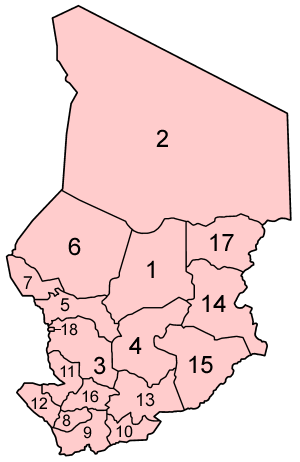
(Décret n° 419/PR/MAT/02 du 17 octobre 2002 portant création des Régions)
NB : liste des régions dans l'ordre du décret + n° sur la carte
| N° | Région | Chef-lieu | Départements | |||
|---|---|---|---|---|---|---|
| 1 | ||||||
| 3 | ||||||
| 5 | ||||||
| 17 | ||||||
| 2 | ||||||
| 4 | ||||||
| 6 | ||||||
| 7 | ||||||
| 8 | ||||||
| 9 | ||||||
| 10 | ||||||
| 11 | ||||||
| 12 | ||||||
| 13 | ||||||
| 14 | ||||||
| 15 | ||||||
| 16 | ||||||
| 18 |
(1) créés en 2004 / (2) créés en 2006
Depuis février 2008 : 22 régions
19 février 2008, création de nouvelles régions : Borkou, Ennedi, Tibesti par démembrement de la région Borkou-Ennedi-Tibesti, Sila par division de la région Ouaddaï, Barh El Gazel par division de la région Kanem.
| N° | Région | Chef-lieu | Départements | |||
|---|---|---|---|---|---|---|
| 1 | ||||||
| 2 | ||||||
| 3 | ||||||
| 4 | ||||||
| 5 | ||||||
| 6 | ||||||
| 7 | ||||||
| 8 | ||||||
| 9 | ||||||
| 10 | ||||||
| 11 | ||||||
| 12 | ||||||
| 13 | ||||||
| 14 | ||||||
| 15 | ||||||
| 16 | ||||||
| 17 | ||||||
| 18 | ||||||
| 19 | ||||||
| 20 | ||||||
| 21 | ||||||
| 22 |
--
Notes
References
References
- S. Decalo (1987); ''Historical Dictionary of Chad'', 2 ed. Metuchen: The Scarecrow Press. {{ISBN. 0-8108-1937-6, pp. 8, 309.
- B. Lanne (1998); ''Histoire politique du Tchad de 1945 à 1958'', Karthala. {{ISBN. 2-86537-883-7{{in lang. fr, pp. 11-12
- S. Decalo, pp. 30-32
- After a series of splits in 2008 the number of regions increased to 22.Ordonnance n° 002/PR/08 portant restructuration de certaines collectivités territoriales décentralisées
- Déby, Idriss. (4 September 2012). "Ordonnance No. 27/PR/2012". Republic of Chad.
- Law, Gwillim. "Regions of Chad".
- B. Lanne, pp. 9-11
- B. Lanne, p. 9
- S. Decalo, p. 10
- S. Decalo, p. 214
- J. Le Cornec (1963); ''Histoire politique du Tchad de 1960 à 1962'', Librairie générale de droit et jurisprudencie.{{in lang. fr, pp. 33-35
- J. Le Cornec, p. 35
- B. Lanne, pp. 10-11
- B. Lanne, p. 11
- [http://www.presidencedutchad.org/Activites/Actes/Odonanceno%20002du19fev08.htm Ordonnance n° 002/PR/08 portant restructuration de certaines collectivités territoriales décentralisées]
This article was imported from Wikipedia and is available under the Creative Commons Attribution-ShareAlike 4.0 License. Content has been adapted to SurfDoc format. Original contributors can be found on the article history page.
Ask Mako anything about Administrative divisions of Chad — get instant answers, deeper analysis, and related topics.
Research with MakoFree with your Surf account
Create a free account to save articles, ask Mako questions, and organize your research.
Sign up freeThis content may have been generated or modified by AI. CloudSurf Software LLC is not responsible for the accuracy, completeness, or reliability of AI-generated content. Always verify important information from primary sources.
Report