From Surf Wiki (app.surf) — the open knowledge base
Administrative division
Territorial entity for administration purposes
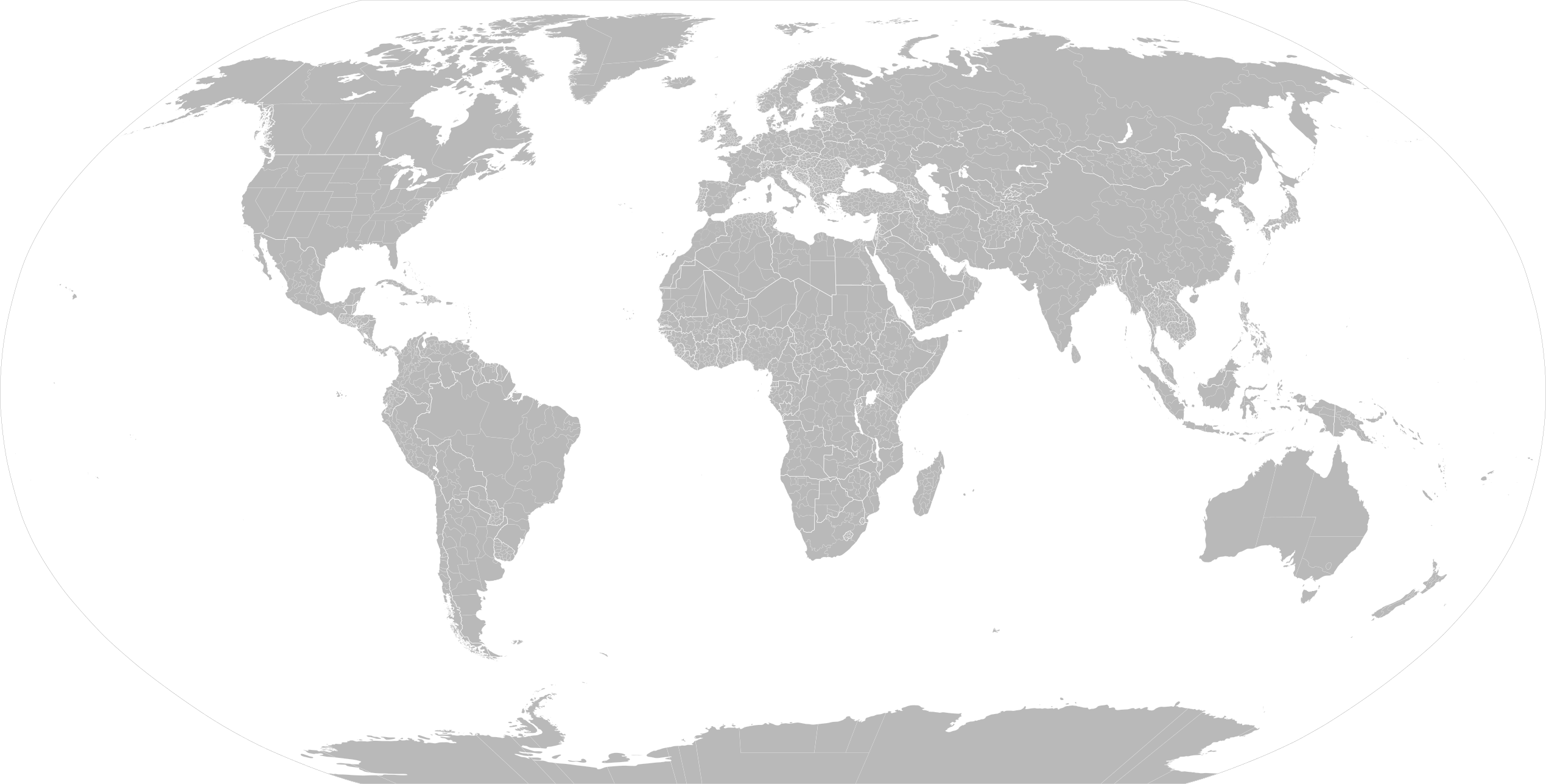
Territorial entity for administration purposes
Administrative divisions (also administrative units, administrative regions, subnational entities, or constituent states, as well as many similar generic terms) are geographical areas into which a particular independent sovereign state is divided. Such a unit usually has an administrative authority with the power to take administrative or policy decisions for its area. Administrative divisions are often used as polygons in geospatial analysis.
Description
Usually, sovereign states have several levels of administrative division. Common names for the principal (largest) administrative divisions include: states (subnational states, rather than sovereign states), provinces, lands, oblasts and regions. These in turn are often subdivided into smaller administrative units known by names such as comarcas, raions or districts, which are further subdivided into municipalities, communes or communities constituting the smallest units of subdivision (the local governments). Some administrative division names (such as departments, cantons, prefectures, counties or governorates) can be used for principal, second-level, or third-level divisions.
The levels of administrative divisions and their structure largely varies by country (and sometimes within a single country). Usually the smaller the country is (by area or population), the fewer levels of administrative divisions it has. For example, Vatican City does not have any administrative subdivisions, and Monaco has only one level (both are city-states), while such countries as France and Pakistan have five levels each. The United States is composed of states, possessions, territories, and a federal district, each with varying numbers of subdivisions.
The principal administrative division of a country is sometimes called the "first-level (or first-order) administrative division" or "first administrative level". Its next subdivision might be called "second-level administrative division" or "second administrative level" and so on. An alternative terminology is provided by the Nomenclature of Territorial Units for Statistics which terms the principal division as the second level or NUTS-2.
Communities united in a federation under a federal government are more specifically known as federated states. A federated state may be referred to as a province, region, canton, land, governorate, oblast, emirate, or country. Administrative units that are not federated or confederated but enjoy a greater degree of autonomy or self-government than other territories within the same country can be considered autonomous regions or de facto constituent states of that country. This relationship is by some authors called a federacy or asymmetric federalism. An example is the autonomous republic of Karakalpakstan within Uzbekistan.
Examples
Terminology
Due to variations in their use worldwide, consistency in the translation of terms from non-English to English is sometimes difficult to maintain. In many of the following terms originating from British cultural influence, areas of relatively low mean population density might bear a title of an entity one would expect to be either larger or smaller. There is no fixed rule, for "all politics is local" as is perhaps well demonstrated by their relative lack of systemic order.
In the realm of self-government, any of these can and does occur along a stretch of road—which for the most part is passing through rural, unsettled countryside. Since the terms are administrative political divisions of the local regional government, their exact relationship and definitions are subject to home rule considerations, tradition, as well as state statute law and local governmental (administrative) definition and control. In British cultural legacy, some territorial entities began with fairly expansive counties which encompass an appreciably large area, but were divided over time into a number of smaller entities.
Within those entities are the large and small cities or towns, which may or may not be the county seat. Some of the world's larger cities culturally, if not officially, span several counties, and those crossing state or provincial boundaries have much in common culturally as well, but are rarely incorporated within the same municipal government. Many sister cities share a water boundary, which quite often serves as a border of both cities and counties. For example, Cambridge and Boston, Massachusetts appear to the casual traveler as one large city, while locally they each are quite culturally different and occupy different counties.
List
Main article: List of terms for administrative divisions
- Area
- Autonomous community
- Banner
- Barangay
- Barony
- Capital city
- Canton
- Cantref
- County
- Community
- Constituency
- Crown Dependency
- Department
- District
- Division
- Duchy
- Federal subjects
- Governorate
- Hundred
- Kampong
- Kingdom
- Legal entity
- Local council
- Municipality
- Regional
- Regional county
- Rural
- Oblast
- Parish
- Prefecture
- Principality
- Province
- Public body
- Regency
- Region
- Republic
- Riding
- State
- Special administrative region
- Territory
- Theme
- Voivodeship
Urban or rural regions
General terms for these incorporated places include "municipality", "settlement", "locality", and "populated place".
- Borough, burgh or "boro"
- City
- Hamlet
- Local service district
- Shire
- Town
- Township
- Village
- Ward
Indigenous
- Tribe
- Indian reservation
- Indian reserve
- Band
- Ranchería
References
References
- "Administrative divisions - The World Factbook".
- "General maps {{!}} Geospatial, location information for a better world".
- "02003R1059-20191113".
- (August 26, 2004). "OECD Glossary of Statistical Terms - Administrative regions Definition".
- (January 2023). "Polygon Simplification for the Efficient Approximate Analytics of Georeferenced Big Data". Sensors.
- "Global Administrative Unit Layers (GAUL)". FAO.
- "Second Administrative Level Boundaries {{!}} Geospatial Information Section & Statistics Division {{!}} United Nations".
- (2009). "Overview: Constituent units risk lengthy dependency on federal aid".
- ''The Australian National Dictionary: Fourth Edition'', pg 1395. (2004) Canberra. {{ISBN. 978-0-19-551771-2.
- [https://www.britannica.com/EBchecked/topic/89503/California California] {{Webarchive. link. (2015-05-04 . [[Encyclopædia Britannica]]. Accessed 2009-11-01.)
- Stepan, Alfred. (April 2018). "Federalism and Democracy: Beyond the U.S. Model". Journal of Democracy.
- [http://www.unhchr.ch/tbs/doc.nsf/898586b1dc7b4043c1256a450044f331/8be9009ac37f2d75c1256f17004b6e68/$FILE/G0443118.doc International Covenant On Civil And Political Rights] {{Webarchive. link. (2017-10-10 , p 5. United Nations [[Human Rights Committee]]. Accessed 2009-11-01.)
This article was imported from Wikipedia and is available under the Creative Commons Attribution-ShareAlike 4.0 License. Content has been adapted to SurfDoc format. Original contributors can be found on the article history page.
Ask Mako anything about Administrative division — get instant answers, deeper analysis, and related topics.
Research with MakoFree with your Surf account
Create a free account to save articles, ask Mako questions, and organize your research.
Sign up freeThis content may have been generated or modified by AI. CloudSurf Software LLC is not responsible for the accuracy, completeness, or reliability of AI-generated content. Always verify important information from primary sources.
Report