From Surf Wiki (app.surf) — the open knowledge base
Acetylacetone
1=Organic chemical compound CH3–C(=O)–CH2–C(=O)–CH3
1=Organic chemical compound CH3–C(=O)–CH2–C(=O)–CH3
Pentane-2,4-dione (keto form) | NFPA-H = 2 | NFPA-F = 2 | NFPA-R = 0
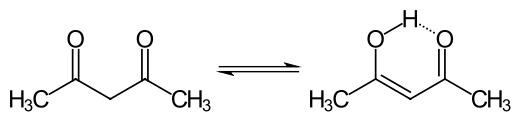
Acetylacetone is an organic compound with the chemical formula . It is classified as a 1,3-diketone. It exists in equilibrium with a tautomer . The mixture is a colorless liquid. These tautomers interconvert so rapidly under most conditions that they are treated as a single compound in most applications. Acetylacetone is a building block for the synthesis of many coordination complexes as well as heterocyclic compounds.
Properties
Tautomerism
| Solvent | Kketo→enol |
|---|---|
| Gas phase | 11.7 |
| Cyclohexane | 42 |
| Toluene | 10 |
| THF | 7.2 |
| [](deuterated-chloroform) | 5.7 |
| DMSO | 2 |
| Water | 0.23 |
The keto and enol tautomers of acetylacetone coexist in solution. The enol form has C2v symmetry, meaning the hydrogen atom is shared equally between the two oxygen atoms.{{cite journal
The equilibrium constant tends to be high in nonpolar solvents; when Kketo→enol is equal or greater than 1, the enol form is favoured. The keto form becomes more favourable in polar, hydrogen-bonding solvents, such as water. The enol form is a vinylogous analogue of a carboxylic acid.
Acid–base properties
| Solvent | T/°C | url=https://web.archive.org/web/20170619235720/http://www.acadsoft.co.uk/scdbase/scdbase.htm | date=2017-06-19}} A comprehensive database of published data on equilibrium constants of metal complexes and ligands |
|---|---|---|---|
| 40% ethanol/water | 30 | 9.8 | |
| 70% dioxane/water | 28 | 12.5 | |
| 80% DMSO/water | 25 | 10.16 | |
| DMSO | 25 | 13.41 |
Acetylacetone is a weak acid. It forms the acetylacetonate anion (commonly abbreviated ****):

In the acetylacetonate anion, both bonds are equivalent. Both central bonds are equivalent as well, with one hydrogen atom bonded to the central carbon atom (the atom numbered C3 according to the IUPAC nomenclature of organic chemistry). These equivalencies are because there is a resonance between the four bonds in the O−C2−C3−C4−O linkage in the acetylacetonate anion. Each of the four bonds in the linkage has a bond order of about 1.5, and the two oxygen atoms equally share the negative charge. The acetylacetonate anion is a bidentate ligand. IUPAC recommended pKa values for this equilibrium in aqueous solution at 25 °C are 8.99 ± 0.04 (I = 0), 8.83 ± 0.02 (I = 0.1 M ) and 9.00 ± 0.03 (I = 1.0 M ; I = Ionic strength). Values for mixed solvents are available. Very strong bases, such as organolithium compounds, will deprotonate acetylacetone twice. The resulting dilithium species can then be alkylated at the carbon atom at the position 1.
Preparation
Acetylacetone is prepared industrially by the thermal rearrangement of isopropenyl acetate.

Laboratory routes to acetylacetone also begin with acetone. Acetone and acetic anhydride () upon the addition of boron trifluoride () catalyst:
A second synthesis involves the base-catalyzed condensation (e.g., by sodium ethoxide ) of acetone and ethyl acetate, followed by acidification of the sodium acetylacetonate (e.g., by hydrogen chloride HCl):
Because of the ease of these syntheses, many analogues of acetylacetonates are known. Some examples are benzoylacetone, dibenzoylmethane and tert-butyl analogue 2,2,6,6-tetramethyl-3,5-heptanedione. Trifluoroacetylacetone and hexafluoroacetylacetonate are also used to generate volatile metal complexes.
Reactions
Condensations
Acetylacetone is a versatile bifunctional precursor to heterocycles because both keto groups may undergo condensation. For example, condensation with hydrazine produces pyrazoles while condensation with urea provides pyrimidines. Condensation with two aryl- or alkylamines gives NacNacs, wherein the oxygen atoms in acetylacetone are replaced by NR (R = aryl, alkyl).
Coordination chemistry
Main article: Metal acetylacetonates
Sodium acetylacetonate, Na(acac), is the precursor to many acetylacetonate complexes. A general method of synthesis is to treat a metal salt with acetylacetone in the presence of a base: :
Both oxygen atoms bind to the metal to form a six-membered chelate ring. In some cases the chelate effect is so strong that no added base is needed to form the complex.
Biodegradation
The enzyme acetylacetone dioxygenase cleaves a central carbon-carbon bond of acetylacetone, producing acetate and 2-oxopropanal. The enzyme is iron(II)-dependent, but it has been proven to bind to zinc as well. Acetylacetone degradation has been characterized in the bacterium Acinetobacter johnsonii. :
References
References
- "05581: Acetylacetone".
- Thomas M. Harris. (2001). "2,4-Pentanedione".
- (12 April 2016). "Measuring Structural and Electronic Effects on Keto–Enol Equilibrium in 1,3-Dicarbonyl Compounds". Journal of Chemical Education.
- Reichardt, Christian. (2003). "Solvents and Solvent Effects in Organic Chemistry". Wiley-VCH.
- [http://www.acadsoft.co.uk/scdbase/scdbase.htm IUPAC SC-Database] {{Webarchive. link. (2017-06-19 A comprehensive database of published data on equilibrium constants of metal complexes and ligands)
- (1982). "Critical evaluation of equilibrium constants involving acetylacetone and its metal chelates". Pure and Applied Chemistry.
- {{cite encyclopedia. Wiley-VCH. (2002)
- (1940). "Acetylacetone".
- O'Brien, Brian. "Co(tfa)3 & Co(acac)3 handout". Gustavus Adolphus College.
- (2003). "Acetylacetone-cleaving enzyme Dke1: a novel C–C-bond-cleaving enzyme from'' Acinetobacter johnsonii''". Biochemical Journal.
This article was imported from Wikipedia and is available under the Creative Commons Attribution-ShareAlike 4.0 License. Content has been adapted to SurfDoc format. Original contributors can be found on the article history page.
Ask Mako anything about Acetylacetone — get instant answers, deeper analysis, and related topics.
Research with MakoFree with your Surf account
Create a free account to save articles, ask Mako questions, and organize your research.
Sign up freeThis content may have been generated or modified by AI. CloudSurf Software LLC is not responsible for the accuracy, completeness, or reliability of AI-generated content. Always verify important information from primary sources.
Report