From Surf Wiki (app.surf) — the open knowledge base
Accessory fruit
Botanical category of fruit
Botanical category of fruit
An accessory fruit is a fruit that contains tissue derived from plant parts other than the ovary. In other words, the flesh of the fruit develops not from the floral ovary, but from some adjacent tissue exterior to the carpel (for example, from receptacles or sepal). As a general rule, the accessory fruit is a combination of several floral organs, including the ovary. In contrast, true fruit forms exclusively from the ovary of the flower.
Accessory fruits are usually indehiscent, meaning that they do not split open to release seeds when they have reached maturity.
Incorporated organs
The following are examples of accessory fruits listed by the plant organ from which the accessory tissue is derived:
| Organ | Fruit |
|---|---|
| Hypanthium | apple, pear, rose hip |
| Involucre | pineapple |
| Peduncle | cashew apple |
| Perianth | *anthocarps* of the Nyctaginaceae |
| Receptacle | fig, mulberry, pineapple, strawberry |
| Calyx | eastern teaberry, rose apple |
Fruit with fleshy seeds, such as pomegranate or mamoncillo, are not considered to be accessory fruits.
Examples
Apples and pears
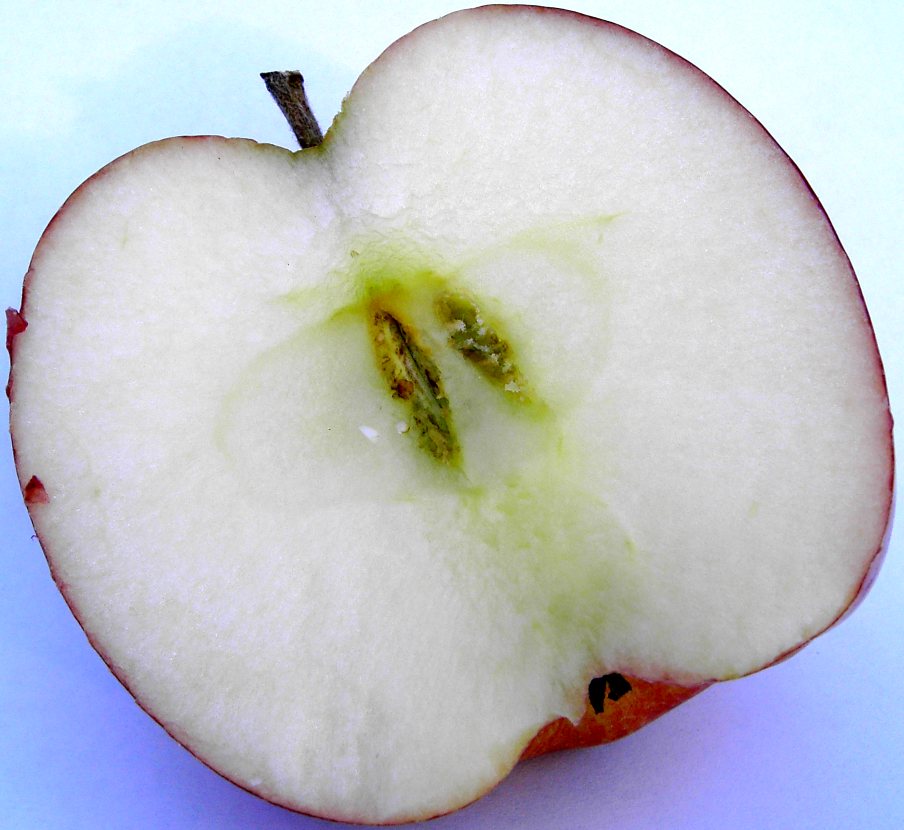
The part of apples and pears that is consumed is, in fact, the hypanthium. The ovary is the papery core that surrounds the apple seeds. As the hypanthium ripens it forms the edible tissues.
Roses
For roses, the hypanthium is the tissue that composes the edible part of rosehips. Roses and apples are both members of the Rosaceae family; the fact that they have similar fruit morphology is a major consideration in placing them in the same taxonomic family.
Strawberries
The edible part of the strawberry is formed, as part of the ripening process, from the receptacle of the strawberry flower. The true fruits (hence, containing the seeds) are the roughly 200 pips (which are, technically, achenes, a true fruit that contains a single seed from a single ovary). These pips dot the exterior of the strawberry.
Cashew apple
The cashew apple is an oval- or pear-shaped structure that develops from the pedicel and the receptacle of the cashew flower and is technically called a hypocarpium. It ripens into a yellow or red structure about 5–11 cm long. The true fruit of the cashew tree is a kidney–shaped drupe that grows at the end of the cashew apple; the seed inside this drupe is the cashew nut of commerce.
Pineapple

The pineapple is formed when 50 to 200 unpollinated flowers coalesce in a spiral arrangement— the flowers form individually and then fuse as a single 'multiple fruit'. The ovaries develop into berries and the fruit forms around an intercalary spike. The intercalary inflorescence (cluster of flowers) results when the terminal cluster of flowers are left behind by the growth of the main axis of the plant. Each polygonal area on the pineapple's surface is an individual flower.
Research
Current research has proposed that a single class of genes may be responsible for regulating accessory fruit formation and ripening. A study using strawberries concluded that hormone signaling pathways involving gibberellic acid and auxin affect gene expression, and contribute to the initiation of accessory fruit development. Metabolic modifications in different developing accessory fruit tissues are due to the varied distributions of compounds such as triterpenoids and steroids.
References
References
- Esau, K. 1977. ''Anatomy of seed plants''. John Wiley and Sons, New York.
- "Glossary Details – The William & Lynda Steere Herbarium".
- Merriam Webster Collegiate Dictionary entries for [http://www.merriam-webster.com/dictionary/syconium ''syconium''], [http://www.merriam-webster.com/dictionary/accessory_fruit ''accessory fruit''], [http://www.merriam-webster.com/dictionary/core ''core''], and [http://www.merriam-webster.com/dictionary/strawberry ''strawberry''], Merriam-Webster, Inc., 2006
- (2009). "Pomegranate: Botany, Horticulture, Breeding". John Wiley & Sons, Ltd.
- Michaels, Tom. (2022-06-20). "The Science of Plants".
- (1964). "Anatomy of the pseudocarp in ''Anacardium occidentale'' L.". Proceedings of the Indian Academy of Sciences, Section B.
- (1983). "''Anacardium occidentale'' L.". Handbook of Energy Crops. (unpublished); In: NewCROP, New Crop Resource Online Program, Center for New Crops and Plant Products, Purdue University.
- (7 April 2020). "Cashew". Encyclopedia Britannica.
- Morton. (1987). "Cashew apple, ''Anacardium occidentale'' L.". Center for New Crops and Plant Products, Department of Horticulture and Landscape Architecture, Purdue University.
- "Plant Details – Information about Ananas comosus Plant".
- (13 December 2012). "Apple SEPALLATA1/2-like genes control fruit flesh development and ripening". The Plant Journal.
- (March 2021). "Gibberellin and auxin signaling genes RGA1 and ARF8 repress accessory fruit initiation in diploid strawberry". Plant Physiology.
- (25 August 2021). "Distribution of Triterpenoids and Steroids in Developing Rugosa Rose (Rosarugosa Thunb.) Accessory Fruit". Molecules.
This article was imported from Wikipedia and is available under the Creative Commons Attribution-ShareAlike 4.0 License. Content has been adapted to SurfDoc format. Original contributors can be found on the article history page.
Ask Mako anything about Accessory fruit — get instant answers, deeper analysis, and related topics.
Research with MakoFree with your Surf account
Create a free account to save articles, ask Mako questions, and organize your research.
Sign up freeThis content may have been generated or modified by AI. CloudSurf Software LLC is not responsible for the accuracy, completeness, or reliability of AI-generated content. Always verify important information from primary sources.
Report