From Surf Wiki (app.surf) — the open knowledge base
Abu Karib
Himyarite King of Yemen (390–420 CE)
Himyarite King of Yemen (390–420 CE)
| Field | Value |
|---|---|
| name | Abu Karib As'ad al-Kamil |
| title | King of Saba', Dhu Raydan, Hadramawt, Yamnat and their Arabs, on Tawdum and Tihamat |
| type | King |
| succession | King of Himyarites |
| reign | 390–420 CE |
| predecessor | Malkikarib Yuhamin |
| successor | Hassan Yuha'min and Sharhabil Yafar |
| death_date | |
| death_place | Yemen |
| consort | no |
| full name | Abu Karib As'ad ibn Hassan Malikikarib Yuha'min |
| regnal name | Tubba' As'ad |
| father | Malkikarib Yuhamin |
| religion | *South Arabian polytheism and Judaism (formerly) |
| reign-type = | cor-type = | pre-type = | suc-type = | spouse-type = | house-type =
- Hanifism (until death) Abū Karib As’ad al-Kāmil (), called "Abū Karīb", sometimes rendered as As'ad Abū Karīb, full name: Abu Karib As'ad ibn Hassān Maliki Karib Yuha'min, was king (Tubba', ) of the Himyarite Kingdom (modern day Yemen). He ruled Yemen from 390 CE until 420 CE, beginning as a coregency with his father Malkikarib Yuhamin (r. 375–400) followed by becoming sole ruler in 400. although contemporary historians and pre-Islamic sources, such as Philostorgius have ascribed this transition to his father. He was traditionally regarded as the first one to cover the Kaaba with the kiswah.
Biography
Abu Karib As'ad was the son of Malikikarib Yuha'min. He first came to power as part of a co-regency with both his father Malikikarib Yuha'min and his brother Dhara' Amar Ayman in 375 CE. After the death of Malikikarib Yuha'min in 385 CE, only Abu Karib and his brother Dhara' Amar Ayman were left to rule. Around the year 400 CE, Dhara' Amar Ayman either retired or died, leaving Abu Karib as the sole ruler in power. His date of death is unknown, but Christian Robin places it at 440 CE.
Conversion to Judaism
While some sources agree that Abu Karib was the first of the Himyarite kings to convert to Judaism, the circumstances of his conversion are immersed in myth and legend. Historically, the Himyarite kings had accepted Judaism during the reign of Malikikarib Yuha'min around the year 384 CE. There is an inscription from that year which mentions the rejection of polytheism by Malikikarib Yuha'min, Abu Karib As'ad and Dhara' Amar Ayman, as well as another inscription which details Malikikarib Yuha'min and Abu Karib both authorizing the construction of a mikrab (Jewish prayer house) in Ma'rib.
The legend of Abu Karib's conversion to Judaism
According to the traditional account, Abu Karib undertook a military expedition to eliminate the growing influence of Byzantium in his northern provinces. His forces reached Medina, which was then known as "Yathrib". Not meeting any resistance, the Himyarites passed through the town, leaving one of the king’s sons behind as governor of the town. A few days later, however, the people of Yathrib killed their new governor, the king's son. Upon receiving the news, the king turned his troops back to avenge his son’s death, and destroy the town. He ordered that all palm trees around the town be cut down, because the trees were the main source of the town's inhabitants' income, and then laid siege to the town.
The Jews of Yathrib fought alongside their pagan Arab neighbors, trying to protect their town. During the siege, Abu Karib fell ill. Two local Rabbis, named Kaab and Assad, took the opportunity to travel to his camp, and persuaded him to lift the siege. The scholars also inspired in the King an interest in Judaism, and he converted in 390 CE, persuading his army to do likewise. Kaab and Assad later returned with Abu Karib to his kingdom, where they were tasked with converting the population. However, while some scholars say the population converted on a wholesale basis, others opine that only about half became converts, the rest maintaining their pagan beliefs and temples. Among those who converted to Judaism was Harith ibn 'Amr, a nephew of Abu Karib, who was then appointed as the Viceroy of the people of Ma'ad on the Red Sea, and headed the government of Mecca and Yathrib.
Opposition to the claim of Abu Karib's conversion
One dissenter from the view that Abu Karib Asad was a convert to Judaism is author J. R. Porter. Writing in the 1980s, Porter argued that the legendary accounts of Abu Karib's conversion first appear much later in the historical record and are therefore unreliable. Porter nonetheless acknowledged that a move toward Judaism on Abu Karib's part would be "entirely credible", given the presence of powerful Jewish tribes in Yathrib. Porter states that a later Himyarite ruler, Dhu Nuwas (517–530 CE) was "certainly" a convert to Judaism.
Family
Abu Karib As'ad was the son of Malikikarib Yuha'min, and the brother of Dhara' Amar Ayman. His full lineage is given as Abu Karib As'ad ibn Hassan Malikikarib Yuha'min ibn Tharan Yuha'nim ibn Dhamar Ali Yuhabirr. Arabian folklore also cites Abu Karib as having a nephew named Harith ibn 'Amr.
Abu Karib As'ad had five sons. Their names are attested to in the inscriptions as Hassan Yuha'min, Ma'dikarib, Marthad and Sharhabil Yafar. The historian Ibn al-Kalbi gives a similar list, except the names of Marthad and Sharhabil Yafar are replaced with the names Juhaal and 'Amr Mawthaban instead. Ibn Kathir claims that Abu Karib had two daughters as well, whose graves were found in the center of a city that was under construction during the time of the Rashidun Caliphate.
Some scholars held the view that Dhu Nuwas was the son of Abu Karib. Those who held the view include Wahb ibn Munabbih, Ibn Ishaq, Ibn Hisham and Ibn Kathir. However, Ibn al-Kalbi holds the view that Dhu Nuwas was the son of Hassan Yuha'min and hence the grandson of Abu Karib. Other scholars like Ibn al-Athir held the view that Dhu Nuwas was the son of an unspecified Sharhabil, theorised to have been Sharhabil Yakkuf.
Muslim-era sources
While Abu Karib As'ad is not mentioned in Muslim sources, exegesis scholar Ibn Kathir provides Islamic traditions regarding Abu Karib Asad. He is described as being the mysterious Tubba' who is mentioned in the Surah Ad-Dukhan of the Qur'an.
Ibn Kathir mentions that the Tubba' Abu Karib was formerly a polytheist king of Saba' and Himyar who intended to attack Medina, but was told off by two Jewish rabbis who warned him that Medina would be the final place of migration for an upcoming Prophet. The Tubba' went to Makkah and almost proceeded to destroy the Kaaba, but he was warned against doing so as well. He then felt an interest in Judaism and converted to the religion of Moses, which was described as the religion that which the rightly guided followed before the coming of Jesus. He brought the Rabbis back with him to Yemen, where they converted the population to Judaism, but after the death of the Tubba' the people went astray and so God sent down his wrath on them.
References
References
- Heinrich Graetz. (1902). "History of the Jews, Volume 3". [[Jewish Publication Society of America]].
- Kharif, Badr Al. (February 15, 2009). "Kiswah: The Covering of the Kaaba". Aawsat.com.
- M. Avrum Ehrlich (ed.): ''Encyclopedia of the Jewish Diaspora: Origins, Experiences, and Culture'', p. 793. ABC-CLIO, 2008.
- Robin, Christian Julien. (2012). "The Oxford handbook of late antiquity". Oxford University Press.
- "إسلام ويب - البداية والنهاية - ذكر أخبار العرب - قصة تبع أبي كرب- الجزء رقم3".
- "DASI: Digital Archive for the Study of pre-islamic arabian Inscriptions: Epigraph details".
- "Nouveaux jalons pour une géographie historique de la Yamama: les toponymes mentionnés dans les inscriptions Sudarabiques".
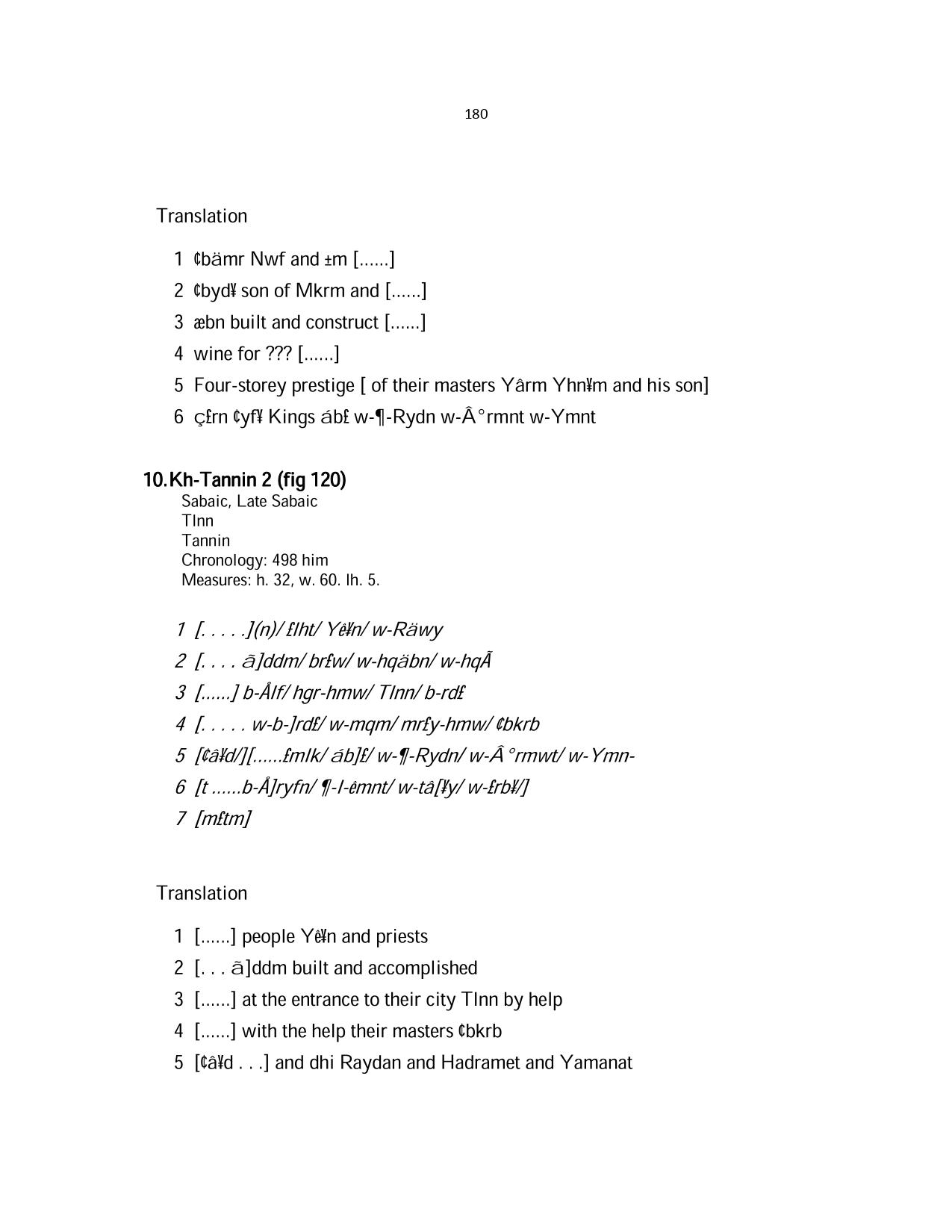
- "10.Kh-Tannin 2".
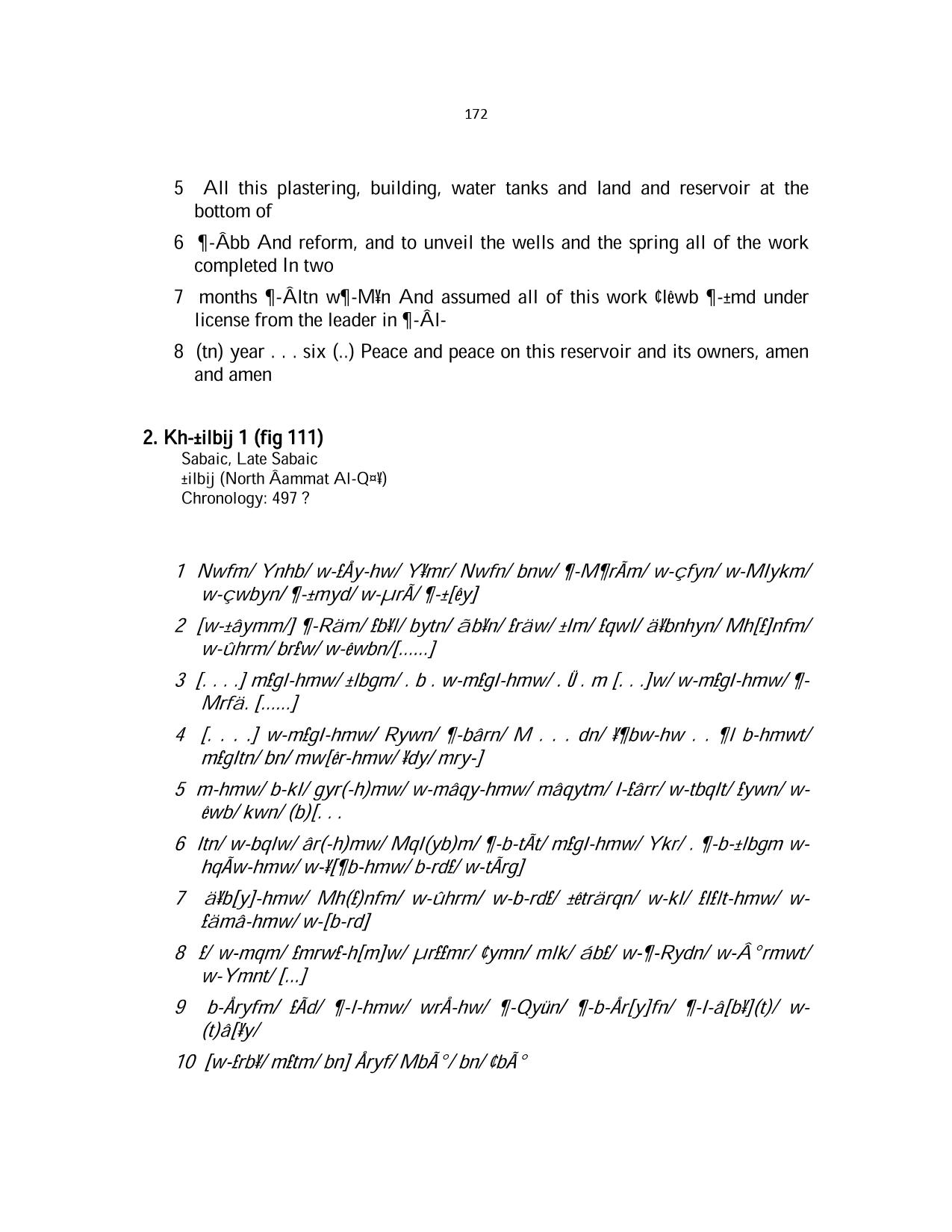
- "2. Kh-±ilbij 1".
- (2024-01-01). "Kings of Himyar in late antiquity".
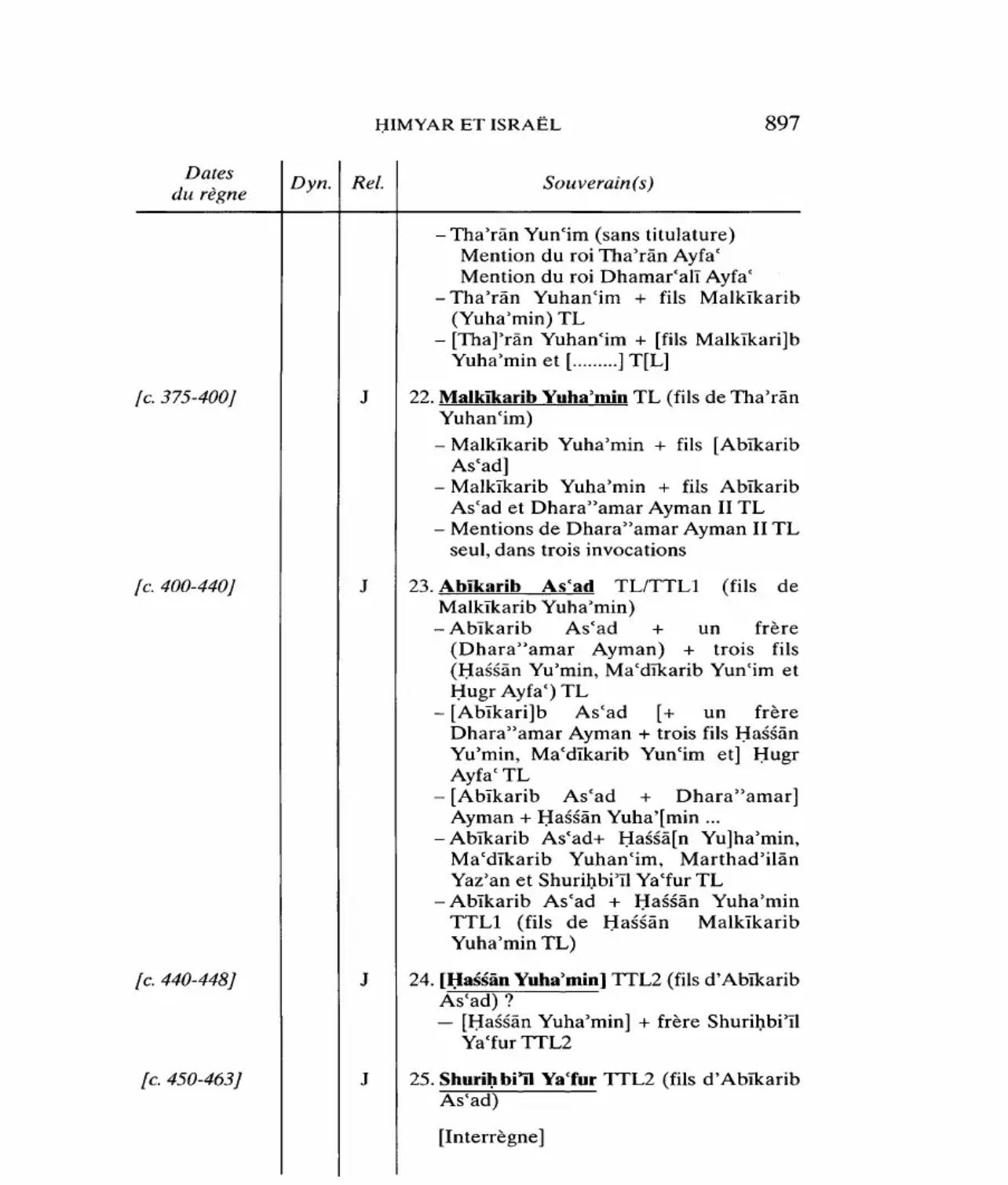
- (2023-07-09). "Himyar and Israel".
- Robin, Christian Julien. (2015). "Arabs and empires before Islam". Oxford University Press.
- Robin, Christian Julien. (2015). "Arabs and empires before Islam". Oxford University Press.
- Chaikin, Moses Avigdor. (1899). "The Celebrities of the Jews: A glance at the historical circumstances of the Jewish people from the destruction of Jerusalem to the present day. Part I. 70-1290". Pawson & Brailsford.
- Justin Paul Heinz. (August 2008). "The Origins of Muslim Prayer: Sixth and Seventh Century Religious Influences on the Salat Ritual".
- Sigmund Hecht. (1908). "Post-Biblical History: a compendium of Jewish history from the close of the biblical records to the present day, for the home and Sabbath-school". Bloch.
- Netton, Ian Richard (1986): ''Arabia and the Gulf: From Traditional Society to Modern States'', [[Croom Helm]] Ltd., p. 10, {{ISBN. 978-0-7099-1834-9.
- "المحبر - البغدادي، محمد بن حبيب - مکتبة مدرسة الفقاهة".
- يحي،, بلاذري، احمد بن. (1997). "انساب الاشراف". دار اليقظة،.
- "إسلام ويب - البداية والنهاية - ذكر أخبار العرب - قصة تبع أبي كرب- الجزء رقم3".
- AbdurRahman.org. (2014-01-31). "The Story of the Boy and the King (from Surah Burooj) : Ibn Kathir".
- Al-Munabbih, Wahb bin. (2009). "The Book of Crowns on the Kings of Himyar". Gorgias Press, LLC.
- "من هو تبع المذكور في القرآن الكريم ؟ - الإسلام سؤال وجواب".
- "Al-Quran Ibn Kathir Tafsir {{!}} Alim.org".
- Nehama C. Nahmoud. (January 1, 1998). "When We Were Kings; The Jews of Yemen, Part II".
- S.B. Segall. (2003). "Understanding the Exodus and Other Mysteries of Jewish History". Etz Haim Press.
- (1827). "The Oriental Herald and Journal of General Literature". London.
- Simon Dubnov. (1968). "History of the Jews: From the Roman Empire to the Early Medieval Period". Cornwall Books.


This article was imported from Wikipedia and is available under the Creative Commons Attribution-ShareAlike 4.0 License. Content has been adapted to SurfDoc format. Original contributors can be found on the article history page.
Ask Mako anything about Abu Karib — get instant answers, deeper analysis, and related topics.
Research with MakoFree with your Surf account
Create a free account to save articles, ask Mako questions, and organize your research.
Sign up freeThis content may have been generated or modified by AI. CloudSurf Software LLC is not responsible for the accuracy, completeness, or reliability of AI-generated content. Always verify important information from primary sources.
Report