From Surf Wiki (app.surf) — the open knowledge base
9th Combat Operations Squadron

| Field | Value | |
|---|---|---|
| unit_name | 9th Combat Operations Squadron | |
| image | Bergstrom AFB RF-4 flight of 2 - Hohenzollern Castle Germany circa 1976 - panoramio.jpg | |
| image_size | 300px | |
| caption | An RF-4 Phantom II from Bergstrom AFB flies by Hohenzollern Castle. Germany circa 1976 | |
| dates | 1943–1945; 1946–1947; 1953–1971; 1999–present | |
| country | ||
| branch | ||
| role | Space operations | |
| command_structure | Air Force Reserve Command | |
| garrison | Vandenberg Space Force Base, California | |
| nickname | Blackhawks | |
| motto | ||
| battles | European Theater of Operations | |
| decorations | Distinguished Unit Citation | |
| Air Force Outstanding Unit Award | ||
| Air Force Organizational Excellence Award | ||
| identification_symbol | [[File: 9SOPS2013.png | 150px]] |
| identification_symbol_label | 9th Combat Operations Squadron emblem | |
| identification_symbol_2 | [[File:9th tactical reconnaissance sq-patch.jpg | 150px]] |
| identification_symbol_2_label | 9th Reconnaissance Squadron emblem |
Air Force Outstanding Unit Award Air Force Organizational Excellence Award
The United States Air Force's 9th Combat Operations Squadron is an Air Force Reserve Command space operations unit located at Vandenberg Space Force Base, California. The 9th augments the 614th Air and Space Operations Center in operating the Joint Space Operations Center, performing combat operations, plans, strategy and intelligence assessments that enable the Commander, Joint Functional Component Command for Space to command and control space forces by providing worldwide space effects and theater support to combatant commanders.
The squadron was first activated in 1943 as the 761st Bombardment Squadron. After training in the United States, it deployed to the Mediterranean Theater of Operations, where it participated in the strategic bombing campaign against Germany, and it earned a Distinguished Unit Citation for its actions. Following V-E Day, the squadron moved to Brazil, where it became part of Air Transport Command, returning troops to the United States before it was inactivated on 26 September 1945.
The squadron was redesignated the 9th Reconnaissance Squadron and reactivated in the Far East in 1946. For the next two years, it performed mapping and reconnaissance missions, until it transferred its assets to another unit and was inactivated. It was activated again in 1953 as the 9th Tactical Reconnaissance Squadron, and in 1956, became the first squadron to fly the Douglas RB-66 Destroyer. During the Cuban Missile Crisis, the squadron flew photographic reconnaissance missions. It deployed equipment and personnel to Southeast Asia, although it remained in the United States as a training unit until inactivating in 1971.
The squadron was activated in the reserve in 1999 as the 9th Space Operations Squadron.
Mission
The 9th Combat Operations Squadron is an associate squadron to the 614th Air and Space Operations Center and augments the active duty center in day-to-day operations of the Joint Space Operations Center, a 24-hour operations center designed to provide commanders with assistance coordinating, planning, and conducting space operations.
Organization
The squadron is composed of four divisions that provide steady-state and surge support in the Combined Space Operations Center.
: The Combat Operations Division is charged with the effective employment of 58 tactical units and integration of five Joint Force Space Component Command operations centers.
: The Strategy Plans Division develops, disseminates, assesses, and refines the Space Operations Directive, Master Space Plan and Combined Space Staking Order in support of functional and geographic combatant commanders' operations. It validates space operations requirements against current and planned operations environments, analyzes space support requests to determine the optimal use of space systems to meet global needs.
: The Operations Support Division coordinates and documents initial, certification, and continuation training. It develops "lessons learned" for exercise support, requirements, and unit training, and evaluates their overall effectiveness.
: The Intelligence, Surveillance and Reconnaissance Division provides supported combat commands, the intelligence community and subordinate units with current and emerging enemy space capabilities, threats to US and Allied use of space, courses of action, and predictive intelligence through a dynamic space intelligence operation of the operational environment.
History
World War II
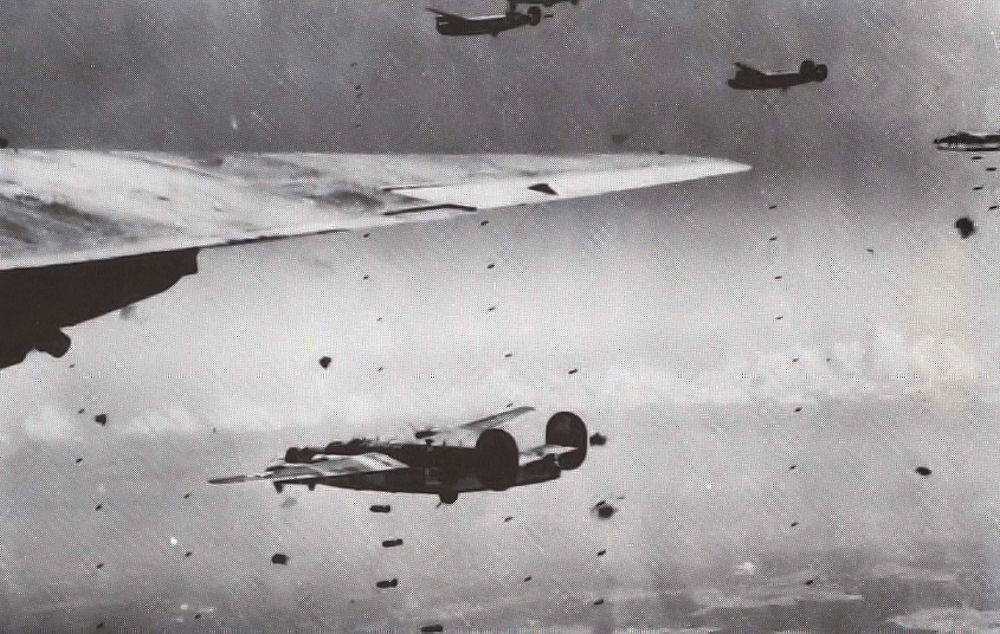
The squadron was first activated as the 761st Bombardment Squadron at Alamogordo Army Air Field, New Mexico on 1 July 1943 as one of the four original squadrons of the 460th Bombardment Group. A cadre of the unit's air echelon went to Orlando Army Air Base, Florida for specialized training with the Army Air Forces School of Applied Tactics. In August, the unit was filled out with ground personnel at Kearns Army Air Base, Utah, then moved to Chatham Army Air Field, Georgia to complete its training with Consolidated B-24 Liberator heavy bombers. Upon completing training, the squadron departed for the Mediterranean Theater of Operations in January 1944.
The squadron completed its deployment to Spinazzola Airfield, Italy by the middle of February 1944, and entered the strategic bombing campaign against Germany the following month, with an attack on a marshalling yard and docks at Metković, Yugoslavia. It attacked oil refineries and storage facilities, railroads, industrial areas, including aircraft manufacturing plants in Austria, Czechoslovakia, France, Germany, Greece, Hungary, Italy, Romania and Yugoslavia.
On 26 July 1944, the squadron was part of a 460th Group formation that led the 55th Bombardment Wing on an attack against an airfield and aircraft manufacturing plant at Zwolfaxing, Austria. It attacked the target through heavy enemy flak and adverse weather, for which it was awarded a Distinguished Unit Citation.
The squadron was occasionally diverted from the strategic bombing mission to perform air interdiction and close air support missions. In August 1944, it supported Operation Dragoon, the invasion of southern France by attacking submarine pens, marshalling yards and artillery batteries in the area of the amphibious landings. It struck lines of communications, railroads, ammunition dumps and other targets in connection with Operation Grapeshot, the allied offensive in Northern Italy. The squadron flew its last mission against a target in northern Italy on 26 April 1945.
After V-E Day, the 460th Group and its squadrons were transferred to the South Atlantic Division, Air Transport Command, moving to Parnamirim Field, near Natal, Brazil to participate in the Green Project. Green Project was aimed at transporting 50,000 military personnel a month from the European and Mediterranean Theaters back to the United States, with priority for those that plans called for redeploying to the Pacific. The squadron's combat veterans proved none too happy with this assignment, but continued supporting the project until inactivating on 26 September 1945.
Reconnaissance
In 1946, the 761st was redesignated the 9th Reconnaissance Squadron and assigned to the 314th Composite Wing, of Fifth Air Force, at Johnson Air Base and then Yokota Air Base, Japan. 9th airmen flew the Bell P-39 Airacobra, as well as the Consolidated F-7 Liberator, Boeing F-9 Flying Fortress, and Boeing F-13 Superfortress bombers retrofitted to perform photographic reconnaissance performing mapping missions over occupied Japan, Korea, Okinawa, Indochina, and other areas under Far East Air Forces' control after World War II. The squadron also flew classified missions over the Soviet Far East.
The squadron was inactivated in October 1947 and its personnel, equipment and mission were transferred to the 31st Reconnaissance Squadron. The squadron was reactivated at Shaw Air Force Base, South Carolina on 11 November 1953, as the 9th Tactical Reconnaissance Squadron, and was assigned to the 363d Tactical Reconnaissance Group.

In January 1956, the squadron was the first in the Air Force to receive jet powered Douglas RB-66B Destroyers, which added weather sampling capability. The unit later flew other upgraded models of the plane (RB-66C and WB-66D). The arrival of the B-66s enabled the squadron to retire its RB-26s as well as the Lockheed RT-33A Shooting Stars it had begun using for weather reconnaissance. When Tactical Air Command adopted the dual deputy organization, it inactivated the squadron's parent 363d Reconnaissance Group, and assigned the squadron directly to the 363d Tactical Reconnaissance Wing. In 1961, three of the squadron's WB-66s deployed to Clark Air Base in Operation Long Pass, a joint deployment exercise in the Philippines.
In 1962, 9th had a Navy squadron commander, Commander Chester E. Kingsbury, and flew classified film missions supporting the Cuban Missile Crisis starting in October 1962. Between 1963 and 1966, the 9th routinely deployed aircraft and crews to Southeast Asia and served as an Air Force training squadron for the upgraded B-66 Destroyer.
In 1969, the 9th moved to Bergstrom Air Force Base, Texas, where it became part of the 75th Tactical Reconnaissance Wing and flew McDonnell RF-4 Phantom IIs. On 31 August 1971, the squadron inactivated.
Reserve space operations
Since the early 1990s, the space command and control mission evolved rapidly. In 1994, 14th Air Force was activated at Vandenberg Air Force Base, California and became responsible for space operations. Between 1994 and 1998, United States Air Force reservists supported Fourteenth Air Force on various man-day tours, primarily as individual mobilization augmentees. In 1999, Captain Patrick Assayag led a team to discuss the possibility of activating a reserve squadron to support the 614th Space Operations Flight.
On 1 October 1999, the 9th Space Operations Squadron was activated as a reserve squadron with 37 billets and the responsibility of supporting the newly redesignated 614th Space Operations Squadron to build the weekly Space Tasking Order. Many reservists supporting Fourteenth Air Force were then reassigned to the 9th Squadron. At the unit activation ceremony, Major General Robert Hinson, commander of Fourteenth Air Force, stated "our ability to maintain our nation's superiority in space is dependent upon the Air National Guard and Air Force Reserve as critical contributors to part of a cohesive Total Force."
In 2002, the space mission transferred from United States Space Command to United States Strategic Command, as Space Command inactivated. Then in 2003, Strategic Command's Joint Force Component Command was developed, and the Joint Space Operations Center was activated under the command's Space and Global Strike.
In 2005, as the Fiscal Year 2008 Program Objective Memorandum was drafted, Air Force Space Command increased the squadron's manpower authorization from 37 to 126 billets, ensuring additional support to the 614th and the new 614th Space Intelligence Squadron. Also that year, the 1st Space Control Squadron moved to Vandenberg to become part of the 614th Space Operations Squadron. The 1st and 614th Space Operations Squadron combined to form the 614th Air and Space Operations Center in 2007.
In 2010, the command structure of the 9th was adjusted to bring it more in line with the host 614 AOC's O-6 led command and division chief structure.
The 9th was redesignated the 9th Combat Operations Squadron in a ceremony held on 3 June 2017 to follow the name standard of other reserve units associated with Air Operations Centers throughout the Air Force. Today, the 9th is a unit of over 100 space, intelligence and communications professionals, expanding the role of support of the 614th and the Combined Space Operations Center.
Lineage
- Constituted as the 761st Bombardment Squadron (Heavy) on 19 May 1943 : Activated on 1 Jul 1943 : Redesignated 761st Bombardment Squadron, Heavy on 29 September 1944 : Inactivated on 26 September 1945
- Redesignated 9th Reconnaissance Squadron, Very Long Range, Photographic on 29 April 1946 : Activated on 20 June 1946 : Inactivated on 20 October 1947
- Redesignated 9th Tactical Reconnaissance Squadron, Electronics and Weather on 21 July 1953 : Activated on 11 November 1953
- Redesignated 9th Tactical Reconnaissance Squadron, Photo-Jet on 15 May 1965
- Redesignated 9th Tactical Reconnaissance Squadron on 1 October 1966 : Inactivated on 31 August 1971
- Redesignated 9th Space Operations Squadron on 5 February 1999 : Activated in the reserve on 1 October 1999
- Redesignated 9th Combat Operations Squadron c. 3 June 2017
Assignments
- 460th Bombardment Group, 1 July 1943 – 26 September 1945
- 314th Composite Wing, 20 June 1946 – 20 October 1947 (attached to 3d Bombardment Group c. 25 Sep 1946; 71st Reconnaissance Group, 22 April 1947; 3d Bombardment Group after 7 May 1947)
- 363d Tactical Reconnaissance Group, 11 November 1953
- 363d Tactical Reconnaissance Wing, 8 February 1958
- 4402d Tactical Training Group, 1 July 1966
- 363 Tactical Reconnaissance Wing, 1 February 1967
- 75th Tactical Reconnaissance Wing, 1 September 1969
- 67th Tactical Reconnaissance Wing, 15 July–31 August 1971
- 310th Space Group, 1 October 1999
- 310th Operations Group, 7 March 2008 – present
Stations
- Alamogordo Army Air Field, New Mexico, 1 July 1943
- Kearns Army Air Base, Utah, 31 August 1943
- Chatham Army Air Field, Georgia, 29 October 1943 – 3 January 1944
- Spinazzola Airfield, Italy, c. 11 February 1944 – 6 June 1945
- Waller Field, Trinidad, 15 June 1945
- Parnamirim Airport, Brazil, 30 June 1945 – 26 September 1945
- Johnson Air Base, Japan, 20 June 1946
- Yokota Air Base, Japan, c. September 1946 – 20 October 1947
- Shaw Air Force Base, South Carolina, 11 Nov 1953
- Bergstrom Air Force Base, Texas, 1 Sep 1969 – 31 Aug 1971
- Vandenberg Space Force Base, California, 1 Oct 1999 – present
Systems operated
- Consolidated B-24 Liberator, 1943–1945
- Bell P-39 Airacobra, 1946–1947
- Consolidated F-7 Liberator, 1946–1947
- Beechcraft F-2, 1946–1947
- Boeing F-9 (later FB-17) Flying_Fortress, 1946–1947
- Boeing F-13 Superfortress, 1947
- Douglas RB-26 Invader, 1954–1956
- Lockheed RT-33A Shooting Star, 1955–1956
- Lockheed WT-33 Shooting Star, 1956
- North American TB-25 Mitchell, 1956
- Douglas RB-66 Destroyer, 1956–1966
- Douglas WB-66 Destroyer, 1957–1966
- McDonnell Douglas RF-4 Phantom II, 1965–1967, 1969–1971
- Functional (non-Falconer) Air Operations Center, 2000–Present
Awards and campaigns
| Campaign Streamer | Campaign | Dates | Notes | |
|---|---|---|---|---|
| [[Image:Streamer EAMEC.PNG | 200px]] | Air Offensive, Europe | c. 11 February 1944 – 5 June 1944 | 761st Bombardment Squadron |
| [[Image:Streamer EAMEC.PNG | 200px]] | Air Combat, EAME Theater | c. 11 February 1944 – 11 May 1945 | 761st Bombardment Squadron |
| [[Image:Streamer EAMEC.PNG | 200px]] | Rome-Arno | c. 11 February 1944 – 9 September 1944 | 761st Bombardment Squadron |
| [[Image:Streamer EAMEC.PNG | 200px]] | Central Europe | 22 March 1944 – 21 May 1945 | 761st Bombardment Squadron |
| [[Image:Streamer EAMEC.PNG | 200px]] | Normandy | 6 June 1944 – 24 July 1944 | 761st Bombardment Squadron |
| [[Image:Streamer EAMEC.PNG | 200px]] | Northern France | 25 July 1944 – 14 September 1944 | 761st Bombardment Squadron |
| [[Image:Streamer EAMEC.PNG | 200px]] | Southern France | 15 August 1944 – 14 September 1944 | 761st Bombardment Squadron |
| [[Image:Streamer EAMEC.PNG | 200px]] | North Apennines | 10 September 1944 – 4 April 1945 | 761st Bombardment Squadron |
| [[Image:Streamer EAMEC.PNG | 200px]] | Rhineland | 15 September 1944 – 21 March 1945 | 761st Bombardment Squadron |
| [[Image:Streamer EAMEC.PNG | 200px]] | Po Valley | 3 April 1945 – 8 May 1945 | 761st Bombardment Squadron |
| [[Image:Streamer AC.PNG | 200px]] | American Theater without inscription | 15 June 1945–25 September 1945 | 761st Bombardment Squadron |
References
Notes
; Explanatory notes
; Citations
Bibliography
References
- (27 December 2010). "Factsheet 9 Space Operations Squadron (AFRC)". Air Force Historical Research Agency.
- Maurer, ''Combat Squadrons'', pp. 741–742
- (2 November 1999). "Reserve activates two new space units". 302d Airlift Wing Public Affairs (mirrored at Federation of American Scientists web page).
- No byline. (October 2018). "310th Space Wing: 9th Combat Operations Squadron". 310th Space Wing Public Affairs.
- Maurer, ''Combat Units'', p. 335
- "460th Bombardment Group (H): History of the 460th Bombardment Group". 15af.com.
- "460th Bombardment Group (H): 460th Bombardment Group Targets 1944–1945". 15af.com.
- Heck, pp. 216–217
- Heck, p. 219
- Maurer, ''Combat Squadrons'', pp. 152–153
- Knaack, p. 419
- Knaack, p. 442, 452
- (March 2025). "9 Space Operations Squadron (AFRC)".
- Lineage through November 2010 in Kane, AFHRA Factsheet.
- Aircraft through March 1963 in Maurer, ''Combat Squadrons'', pp. 741–742
- World Airpower Journal. (1992). US Air Force Air Power Directory. Aerospace Publishing: London, UK. {{ISBN. 1-880588-01-3
This article was imported from Wikipedia and is available under the Creative Commons Attribution-ShareAlike 4.0 License. Content has been adapted to SurfDoc format. Original contributors can be found on the article history page.
Ask Mako anything about 9th Combat Operations Squadron — get instant answers, deeper analysis, and related topics.
Research with MakoFree with your Surf account
Create a free account to save articles, ask Mako questions, and organize your research.
Sign up freeThis content may have been generated or modified by AI. CloudSurf Software LLC is not responsible for the accuracy, completeness, or reliability of AI-generated content. Always verify important information from primary sources.
Report