From Surf Wiki (app.surf) — the open knowledge base
9th Air Refueling Squadron
US Air Force unit
US Air Force unit
| Field | Value | ||
|---|---|---|---|
| unit_name | 9th Air Refueling Squadron | ||
| image | Defense.gov News Photo 971229-N-2794R-008.jpg | ||
| image_size | 300px | ||
| caption | A Travis KC-10 Extender refuels Navy fighters during a deployment | ||
| dates | 1942–1945; 1951–1965; 1969–1982; 1982–present | ||
| country | |||
| branch | |||
| role | Aerial refueling | ||
| size | over 150 personnel | ||
| command_structure | Air Mobility Command | ||
| garrison | Travis Air Force Base | ||
| motto | Universal | ||
| battles | Southwest Pacific Theater | ||
| China-Burma-India Theater | |||
| War in Kosovo | |||
| decorations | Air Force Meritorious Unit Award | ||
| Air Force Outstanding Unit Award | |||
| commander1 | Lieutenant Colonel Andrew Baer | ||
| commander1_label | Current Commander | ||
| commander2 | Lt Col(sel) Barrett Meysembourg | ||
| commander2_label | Current Operations Officer | ||
| commander3 | MSgt Angelica Asaeli | ||
| commander3_label | First Sergeant | ||
| commander4 | CMSgt Gerald James | ||
| commander4_label | Current Squadron Superintendent | ||
| notable_commanders | General Arthur J. Lichte | ||
| General Paul Selva | |||
| Lieutenant General Michelle D. Johnson | |||
| aircraft_tanker | KC-10 Extender | ||
| identification_symbol | [[File: 9 ARS.jpg | 150px]] | |
| identification_symbol_label | 9th Air Refueling Squadron emblem | ||
| identification_symbol_2 | [[File:9 Air Refueling Sq emblem (1954).png | 150px]] | |
| identification_symbol_2_label | 9th Air Refueling Squadron emblem | ||
| identification_symbol_3 | [[File:9th Reconnaissance Squadron (World War II).png | 150px | World War II 9th Reconnaissance Squadron emblem]] |
| identification_symbol_3_label | unofficial 9th Photographic Reconnaissance Squadron emblem (World War II) | ||
| identification_symbol_4 | [[File:9th Photo Reconnaissance Squadron - WWII - Emblem.png | 150px | ]] |
| identification_symbol_4_label | unofficial 9th Photographic Squadron emblem (early World War II) |
China-Burma-India Theater War in Kosovo Air Force Outstanding Unit Award General Paul Selva Lieutenant General Michelle D. Johnson
The 9th Air Refueling Squadron is an active United States Air Force unit, stationed at Travis Air Force Base, California, where it operates the McDonnell Douglas KC-10 Extender as part of the 60th Operations Group.
The squadron was first active during World War II as the 9th Photographic Reconnaissance Squadron, serving in combat the China-Burma-India Theater from 1942 through 1945, primarily with Lockheed F-4 and F-5 Lightning reconnaissance aircraft.
The 9th Air Refueling Squadron was activated in 1951, and has operated the Boeing KB-29 Superfortress, Boeing KC-97, and Boeing KC-135 Stratotanker, prior to its current air refueling equipment. It has been deployed worldwide, assisting in wartime, humanitarian, and peacekeeping efforts in often remote areas.
Mission
The 9th Air Refueling Squadron mobilizes and deploys twelve KC-10 aircraft and over 140 personnel and equipment to worldwide forward operating locations. It generates 24-hour-a-day strategic airlift and air refueling sorties supporting U.S. and allied forces during contingency operations. It trains aircrews to support and sustain Joint Chiefs of Staff directed missions. The 9th executes an 8,000+ flying hour program and a $580,000 budget.
History
World War II
Training in the United States
The first predecessor of the squadron was organized in February 1942 at Mitchell Field, New York, as the 9th Photographic Squadron and was assigned directly to First Air Force. The unit began an intensive period of training for early deployment overseas with Lockheed F-4 Lightning aircraft. By March, its destination had been settled as the China-Burma-India Theater of Operations and it was assigned to Tenth Air Force, which was moving to that theater. The support elements of the squadron departed from the Charleston, South Carolina Port of Embarkation on the in May.
The squadron's aircrews remained behind to receive additional training at Peterson Field.
Combat in China, Burma and India
The squadron did not arrive in India until late July, by which time it had been renamed the 9th Photographic Reconnaissance Squadron. In the interim, the squadron's mechanics helped assemble Republic P-43 Lancer and Vultee P-66 Vanguard fighters for delivery to the Nationalist Chinese Air Force. However, this early in the war, techniques for sea transport of aircraft had not been developed and many of the squadron's aircraft had been damaged in preparing them for shipment. In particular, fuel tanks had not been fully drained causing severe deterioration of the self-sealing features, which resulted in the need for extensive work on the planes by the air depot at Agra.
In October, the squadron sent a detachment to Kunming Airport, China to build and operate a photographic processing laboratory for the China Air Task Force. The detachment was augmented by four Lightnings in November. The same month, the squadron moved to Chakulia Airfield, India, which was already the home of the 7th Bombardment Group, with the idea that the squadron could work with the 7th Group to provide prestrike and poststrike reconnaissance. On 12 December, nearly five months after its official arrival in theater, the squadron flew its first combat reconnaissance mission over Burma. Flights of squadron reconnaissance aircraft operated over a wide area of Burma, Thailand, and China until VJ Day, obtaining aerial photos and reconnaissance of enemy positions and targets for heavy bomber attacks in support of British and American forces.
.jpg)
In March 1943, a single Lightning and supporting personnel and equipment were detached to Dinjan Airfield, India. Combat attrition had seriously reduced the availability of the squadron's F-4s by this time, and two months later, the squadron began to fly a second type of plane, the North American B-25 Mitchell. The first Mitchell, formerly flown by the 7th Bombardment Group, arrived on 27 May. After modifying the B-25s to carry cameras the squadron flew its first combat mission with the B-25 on 10 June. Meanwhile, the squadron had begun receiving the newer F-5 reconnaissance version of the Lightning, and the first F-5 mission was flown later the same month. In July, the squadron transferred the personnel and equipment at its detachment at Kunming to the 21st Photographic Squadron, which had just arrived in the theater.
Tenth Air Force formed the provisional 5306th Photographic and Reconnaissance Group in October 1943 and attached the squadron to it. In December reconnaissance assets in India were centralized under Photo Reconnaissance Force, Eastern Air Command, a combined Army Air Forces and Royal Air Force headquarters. The provisional group was discontinued on 17 January 1944 and its components, including the 9th, returned to the control of Tenth Air Force.
In April 1944, the 8th Photographic Group arrived in theater and the squadron was assigned to it. Next month, the 20th Tactical Reconnaissance Squadron took over the reconnaissance mission at Dinjan, which the 9th had maintained since March 1943 with a brief pause, and squadron assets at Dinjan rejoined the squadron at Barrackpore Airfield. However the squadron maintained detachments at other locations in India and Burma, including Tingkawk Sakan Airfield, Myitkyina Airfield and Chittagong Airport. The Chittagong detachment augmented No. 224 Group RAF. Responsibility for this augmentation began to be transferred to the 40th Photographic Reconnaissance Squadron in November, and all 9th Squadron personnel had been withdrawn by the middle of December.
The squadron remained in India after the Japanese surrender, but left for the United States in mid-November 1945 aboard the . Upon its arrival at the port of embarkation in the United States in December 1945, it was inactivated.
Strategic Air Command
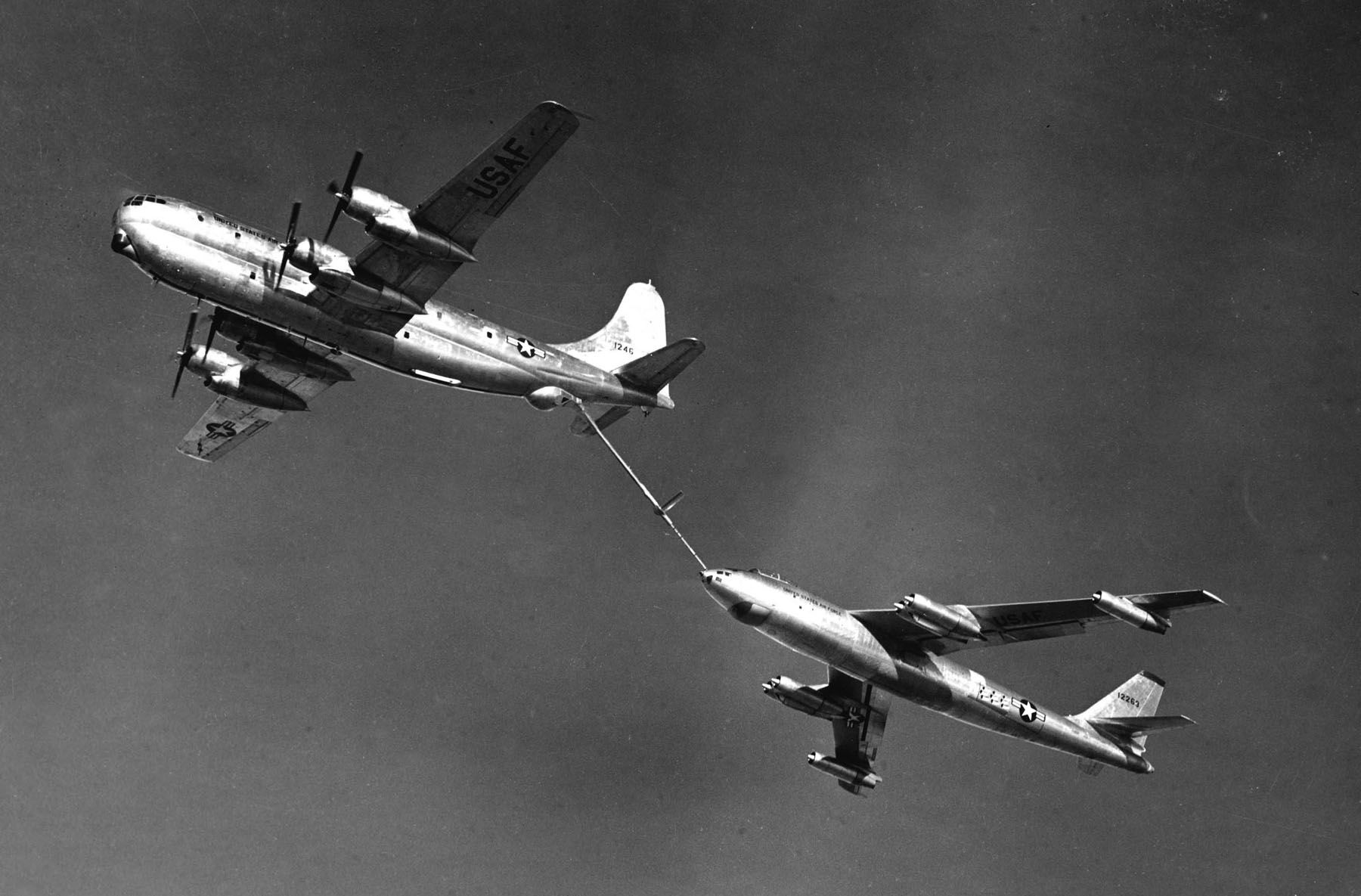
The 9th Air Refueling Squadron was activated on 1 August 1951 at Davis-Monthan Air Force Base, Arizona and equipped with Boeing KB-29M Superfortress aircraft. It was assigned to the 9th Bombardment Group until June 1952, then to the 9th Bombardment Wing. These headquarters were located at Travis Air Force Base, California, so the squadron was attached to various units at Davis-Monthan, while it trained on air refueling techniques. In 1953, the wing and squadron were finally united, when both moved to Mountain Home Air Force Base, Idaho. In July, the squadron became nonoperational while the wing was becoming a Boeing B-47 Stratojet unit. By early 1954, both the wing and squadron were again operational. By September 1954, the squadron had fully converted to the Boeing KC-97 Stratofreighter
From Mountain Home, the squadron deployed as a unit to Ben Guerir Air Base, French Morocco for three months in 1955 and later to Elmendorf Air Force Base, Alaska in 1956.

The squadron was reactivated on 1 January 1970, when it joined the 9th Wing at Beale Air Force Base, as the 456th Strategic Aerospace Wing expanded to include two tanker squadrons to support its own Boeing B-52 Stratofortresses and the Lockheed SR-71 Blackbirds of the 9th Wing. At Beale, the 9th flew the Boeing KC-135 Stratotanker. Twelve years later, in January 1982, the squadron was again inactivated.
The squadron began its current, and longest, active period a few months later, in August, at March Air Force Base, California, where it equipped with the McDonnell Douglas KC-10 Extender as part of the 22d Bombardment Wing. The following year, the squadron provided support for Operation Urgent Fury, the rescue of US students and replacement of the revolutionary government of Grenada with a constitutional one. On 19 September 1985, as part of a program to combine World War II combat units with those formed after the war, the 9th Air Refueling Squadron was consolidated with the 9th Photographic Reconnaissance Squadron.
In 1989, squadron assets assisted in Operation Just Cause, the 1989 incursion into Panama that ended Manuel Noriega's rule. The squadron supported deployments to Southwest Asia from 1990 to 1991 in Operations Desert Shield and Desert Storm. In September 1991, SAC implemented the Objective Wing organizational model and the squadron was transferred from the 22d Wing to its newly activated 22d Operations Group.
Air Mobility Command

In 1992, the Air Force reorganized its major commands, combining air refueling and airlift units under Air Mobility Command (AMC), with the 22d Air Refueling Wing becoming an element of the new command. Under AMC, the squadron flew humanitarian airlift missions to Somalia in support of Operation Restore Hope during 1992–1993. The 722d Air Refueling Wing was activated at March as a holding organization for the remaining regular Air Force units there on 1 January 1994, and the squadron became part of the 722d Wing until September 1994, when it moved to Travis Air Force Base, California and was assigned to the 60th Operations Group.
Although not deployed as a unit, crews and planes from the 9th supported Operation Southern Watch, enforcement of the no fly zone in southern Iraq through the 1990s by refueling marine aircraft deploying to Aviano Air Base, Italy. Its crews provided refueling for B-52s participating in Operation Desert Strike, cruise missile attacks on Iraqi forces in northern Iraq in September 1996 and Operation Desert Fox, later attacks on suspected Iraqi weapons sites. That same year, after terrorists sponsored by Libya struck a nightclub in Berlin, its crews supported Operation El Dorado Canyon, the retaliatory bombing of Libya. It aided Operation Allied Force, the NATO operation against Serbia in Kosovo in 1999 and Operation Deny Flight, enforcement of a no fly zone over Bosnia Herzegovina. It has provided airlift and refueling support for presidential travel.
In 1997, the 9th orchestrated the first sixteen-ship mixed-cell refueling formation in AMC history for Operation Centraz Bat, the longest airdrop mission in aviation history, in which eight Boeing C-17 Globemaster IIIs delivered 540 paratroopers and their supporting equipment over nearly 8,000 miles.
Lineage
; 9th Photographic Reconnaissance Squadron
- Constituted as the 9th Photographic Squadron on 19 January 1942 : Activated on 1 February 1942 : Redesignated 9th Photographic Reconnaissance Squadron on 9 June 1942 : Redesignated 9th Photographic Squadron (Light) on 6 February 1943 : Redesignated 9th Photographic Reconnaissance Squadron on 13 November 1943 : Inactivated on 4 December 1945 : Consolidated with the 9th Air Refueling Squadron as the 9th Air Refueling Squadron on 19 September 1985
; 9th Air Refueling Squadron
- Constituted as the 9th Air Refueling Squadron, Medium on 24 July 1951 : Activated on 1 August 1951 : Discontinued and inactivated on 15 December 1965
- Redesignated 9th Air Refueling Squadron, Heavy on 12 December 1969 : Activated on 1 January 1970 : Inactivated on 27 January 1982
- Activated on 1 August 1982
- Consolidated with the 9th Photographic Reconnaissance Squadron on 19 September 1985 : Redesignated 9th Air Refueling Squadron on 1 September 1991
Assignments
- First Air Force, 1 February 1942
- Tenth Air Force, 29 March 1942 (flight attached to Fourteenth Air Force, 10 March – 12 July 1943)
- Army Air Forces, India-Burma Sector, 30 October 1943 (attached to 5306th Photographic and Reconnaissance Group (Provisional), 30 October 1943; Tenth Air Force after 17 January 1944)
- Tenth Air Force, 7 March 1944
- 8th Photographic Group (later 8th Reconnaissance Group), 25 April 1944
- Army Air Forces, India-Burma Theater, c. October–4 December 1945
- 9th Bombardment Group, 1 August 1951 (attached to 43d Bombardment Wing, 1 August 1951; 36th Air Division, 4 September 1951; 303d Bombardment Wing after 15 January 1952)
- 9th Bombardment Wing (later 9th Strategic Aerospace Wing), 16 June 1952 – 15 December 1965 (attached to 303d Bombardment Wing until 30 April 1953; 5th Air Division, 18 April – 16 July 1955; SAC Liaison Team, 2 May – 1 July 1956)
- 456th Strategic Aerospace Wing (later 456th Bombardment Wing), 1 January 1970
- 17th Bombardment Wing, 30 September 1975
- 100th Air Refueling Wing, 30 September 1976 – 27 January 1982
- 22d Bombardment Wing (later 22d Air Refueling Wing), 1 August 1982
- 22d Operations Group, 1 September 1991
- 722d Operations Group, 1 January 1994
- 60th Operations Group, 1 September 1994 – present
Stations
- Mitchel Field, New York, 1 February 1942
- Bradley Field, Connecticut, 10 March 1942
- Felts Field, Washington, 16 April – 18 May 1942
- Karachi Air Base, India, 24 July 1942 : Flight at Kunming Airport, China, November 1942 – 12 July 1943 : Detachment operated from Kweilin Airfield, China, c. February–12 July 1943
- Chakulia Airfield, India, 30 November 1942 : Detachment operated from Dinjan Airfield, India, 18 March – July 1943
- Pandaveswar Airfield, India, 3 January 1943 : Detachment operated from Dinjan Airfield, India, September 1943 – 20 May 1944
- Barrackpore Airfield, India, 29 October 1943 : Detachment operated from Tingkawk Sakan Airfield, Burma, 16 August – 30 November 1944 : Detachment operated from Myitkyina Airfield, Burma, 27 November–c. 5 December 1944 : Detachment operated from Chittagong Airport, India, c. 9 October – 21 December 1944
- Myitkyina Airfield, Burma, c. 5 December 1944
- Piardoba Airfield, India, c. 1 May 1945
- Malir, India, c. October–c. 14 November 1945
- Camp Kilmer, New Jersey, 3–4 December 1945
- Davis-Monthan Air Force Base, Arizona, 1 August 1951
- Mountain Home Air Force Base, Idaho, 1 May 1953 – 15 December 1965 :: Deployed to Ben Guerir Air Base, French Morocco, 18 April – 16 July 1955; Elmendorf Air Force Base, Alaska, 2 May – 1 July 1956
- Beale Air Force Base, California, 1 January 1970 – 27 January 1982
- March Air Force Base, California, 1 August 1982
- Travis Air Force Base, California, 1 September 1994 – present
Aircraft
- Lockheed F-4 Lightning, 1942–1944
- Lockheed F-5 Lightning, 1943–1945
- North American B-25 Mitchell, 1943–1945
- Boeing KB-29 Superfortress, 1951–1954
- Boeing KC-97 Stratofreighter, 1954–1965
- Boeing KC-135 Stratotanker, 1970–1982
- McDonnell Douglas KC-10 Extender, 1982–2024
Awards and campaigns
| Campaign Streamer | Campaign | Dates | Notes | |
|---|---|---|---|---|
| [[Image:Streamer APC.PNG | 200px]] | Central Pacific | 24 July 1942 – 6 December 1943 | 9th Photographic Reconnaissance Squadron |
| [[Image:Streamer APC.PNG | 200px]] | China Defensive | 24 July 1942 – 4 May 1945 | 9th Photographic Reconnaissance Squadron |
| [[Image:Streamer APC.PNG | 200px]] | New Guinea | 24 January 1943 – 31 December 1944 | 9th Photographic Reconnaissance Squadron |
| [[Image:Streamer APC.PNG | 200px]] | India-Burma | 2 April 1943 – 28 January 1945 | 9th Photographic Reconnaissance Squadron |
| [[Image:Streamer APC.PNG | 200px]] | Central Burma | 29 January 1945 – 15 July 1945 | 9th Photographic Reconnaissance Squadron |
| [[Image:Streamer KC.PNG | 200px]] | Kosovo Air Campaign | 9th Air Refueling Squadron |
References
Notes
; Explanatory notes
; Citations
Bibliography
; Further reading
References
- (24 January 2023). "Factsheet 9 Air Refueling Squadron (AMC)". Air Force Historical Research Agency.
- Endicott, p. 401
- No byline. (25 July 2006). "Travis Air Force Base Fact Sheets: 9th Air Refueling Squadron". 60th Air Mobility Wing Public Affairs Office.
- Maurer, ''Combat Units'', p. 466
- No byline. (2005). "Chronology: 9th Photo Recon Squadron". 9th Photo Recon Squadron Online.
- (2001). "Duncan's Hot Rod". Air Classics.
- Maurer, ''Combat Units'', p. 48
- "Abstract (Unclassified), History 9 Strategic Aerospace Wing (Secret) Oct–Dec 1965". Air Force History Index.
- (June 2018}} In 2015, the squadron's boom operators were awarded the Albert Evans Trophy as the best refueling section in the USAF.{{cite web). "Gucci Standard: 9th ARS named Air Force's best section". 60th Air Mobility Wing Public Affairs Office.
This article was imported from Wikipedia and is available under the Creative Commons Attribution-ShareAlike 4.0 License. Content has been adapted to SurfDoc format. Original contributors can be found on the article history page.
Ask Mako anything about 9th Air Refueling Squadron — get instant answers, deeper analysis, and related topics.
Research with MakoFree with your Surf account
Create a free account to save articles, ask Mako questions, and organize your research.
Sign up freeThis content may have been generated or modified by AI. CloudSurf Software LLC is not responsible for the accuracy, completeness, or reliability of AI-generated content. Always verify important information from primary sources.
Report