From Surf Wiki (app.surf) — the open knowledge base
917th Air Refueling Squadron
| Field | Value | |
|---|---|---|
| unit_name | 917th Air Refueling Squadron | |
| image | Boeing KC-135A Stratotanker (717-148), USA - Air Force AN1142854.jpg | |
| image_size | 300 | |
| caption | Squadron Boeing KC-135A Stratotanker deploying to RAF Fairford | |
| dates | 1943; 1944–1947; 1958–1994 | |
| country | United States | |
| branch | ||
| role | Air Refueling | |
| motto | (After 1958) | |
| decorations | Air Force Outstanding Unit Award | |
| identification_symbol | [[File:617th Bombardment Squadron - Emblem.png | 180px]] |
| identification_symbol_label | 617th Bombardment Squadron emblem | |
| identification_symbol_2 | [[File:917th Air Refueling Squadron.PNG | 175px]] |
| identification_symbol_2_label | 917th Air Refueling Squadron emblem |
The 917th Air Refueling Squadron is an inactive United States Air Force unit. It was last active as a Geographically Separated Unit at Dyess Air Force Base, Texas, while assigned to the 43d Operations Group at Malmstrom Air Force Base, Montana, where it was inactivated on 1 July 1994.
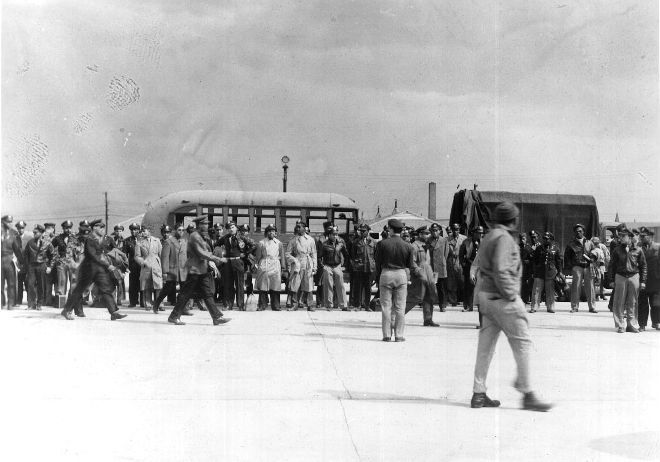
The squadron was first activated in 1943 as the 617th Bombardment Squadron, one of the four squadrons of the 477th Bombardment Group, but the squadron was soon inactivated. In 1944 the group was again activated as the first (and only) bombardment group in the United States Army Air Forces to include black pilots. Members of the squadron participated in the Freeman Field Mutiny, protesting racial segregation in the military. The squadron was inactivated in 1945 after the 477th became a composite group that included bombardment and fighter squadrons.
In May 1959, the 917th Air Refueling Squadron was activated at Biggs Air Force Base, Texas. Beginning in 1960, the squadron began to stand alert with its Boeing KC-135A Stratotankers. It continued to maintain an alert commitment at Biggs, and later at Dyess Air Force Base, Texas until the end of the Cold War.
On 19 September 1985, The 917th Air Refueling Squadron was consolidated with the 617th Bombardment Squadron. With the inactivation of Strategic Air Command in 1992, the squadron transferred to Air Mobility Command, but two years later it was inactivated.
History
World War II
The 617th Bombardment Squadron was activated in June 1943 at MacDill Field, Florida. but was never fully manned and was inactivated in August.
The 477th group was reactivated in January 1944 at Selfridge Field, Michigan as the "first colored bombardment group in the Army Air Forces" with personnel drawn from Selfridge and from Tuskegee Army Air Field, Alabama. It was the second combat group to be activated with African American personnel and would be the only African-American bombardment group. The group moved to Godman Field, Kentucky, just after 617th was activated in April.
Although designated a "colored" squadron, some officers, including the squadron leadership were white. The initial commander of the 477th group enforced racial segregation on the posts where the squadron was stationed. The squadron's members were involved in the civil rights action referred to as the Freeman Field Mutiny; the "mutiny" came about when African-American aviators became outraged enough by racial segregation in the military that they resorted to mass insistence that military regulations prohibiting discrimination be enforced. The Freeman Field Mutiny was a crucial event in the African-American struggle for equal civil rights.
In 1945 after the 477th became a composite group formed of the 99th Fighter Squadron and the 617th Bombardment Squadron, Colonel Benjamin O. Davis, Jr., a black officer, assumed command of the group. The squadron was inactivated in 1947 when the 477th was replaced by the 332d Fighter Group.
Cold War
The 917th Air Refueling Squadron was activated on 1 May 1959 by Strategic Air Command (SAC) at Biggs Air Force Base, Texas and equipped with KC-135 Stratotankers. This was part of SAC's program to disperse its Boeing B-52 Stratofortress bombers over a larger number of bases, thus making it more difficult for the Soviet Union to knock out the entire fleet with a surprise first strike. When the squadron was activated, the 95th wing was in the process of converting from the Convair B-36 Peacemaker to the B-52 and the 917th's tankers were briefly the only operational aircraft assigned to the wing. Starting in 1960, one third of the squadron's aircraft were maintained on fifteen-minute alert, fully fueled and ready for combat to reduce vulnerability to a Soviet missile strike. This was increased to half the squadron's aircraft in 1962. The 917th continued to maintain an alert commitment when not deployed until the end of the Cold War.
The squadron mission was to provide air refueling to the B-52 Stratofortress strategic bombers of its parent 95th Bombardment Wing and other USAF units as directed. This included support for Operation Chrome Dome missions. The squadron was also tasked from time to time to perform other missions, including emergency aeromedical evacuation flights. In its first year of operation, the squadron was named the best refueling unit in SAC at the annual bombing/navigation competition. The squadron supported reflex deployments to forward Tanker Task Forces beginning in 1960, including deployments to Eielson Air Force Base, Alaska and the Alaskan Task Force. The squadron also supported the European and Pacific Tanker Task Forces. During the Vietnam War, the squadron deployed to the Pacific to support Operation Arc Light and the Young Tiger Task Force.
In 1965, the 431st Air Refueling Squadron, a Tactical Air Command unit stationed at Biggs and flying Boeing KB-50J Superfortress aircraft was inactivated. To accommodate the loss of refueling capability caused by the inactivation of the 421st, the 917th's strength was increased by five additional KC-135As.
SAC had planned to move the squadron from Biggs almost as soon as it was activated. In 1960, plans were made to move the unit to Grand Forks Air Force Base, North Dakota, then to Glasgow Air Force Base, Montana. In 1961, it was to be moved to March Air Force Base, California. But each move was cancelled and the unit remained at Biggs. Finally, at the beginning of 1965, the 917th moved to Dyess Air Force Base, Texas and fifteen days later was reassigned to the 96th Strategic Aerospace Wing.
In 1985, the 96th wing converted from the B-52 to the B-1B Lancer and the unit focused on training on techniques for refueling the new bomber. Later that year, the 917th Air Refueling Squadron and the 617th Bombardment Squadron were consolidated.
Six of the squadron's aircraft and associated crews deployed to Southwest Asia in the fall of 1990 to support Operation Desert Shield.
In September 1991 SAC implemented the Objective Wing reorganization and the wing's operational squadrons, including the 917th, were assigned to the 96th Operations Group. although the squadron remained at Dyess until 1994, when it was inactivated.
Lineage
617th Bombardment Squadron
- Constituted as the 617th Bombardment Squadron (Medium) on 13 May 1943 : Activated on 1 June 1943 : Inactivated on 25 August 1943 : Activated on 15 May 1944 : Inactivated on 1 July 1947
- Consolidated with the 917th Air Refueling Squadron as the 917th Air Refueling Squadron on 19 September 1985
917th Air Refueling Squadron
- Constituted as the 917th Air Refueling Squadron, Heavy on 9 March 1959 : Activated on 1 May 1959
- Consolidated with the 617th Bombardment Squadron on 19 September 1985 : Redesignated 917th Air Refueling Squadron on 1 September 1991 : Inactivated on 1 July 1994
Assignments
- 477th Bombardment Group: 1 June 1943 – 25 August 1943
- 477th Bombardment Group (later 477th Composite Group): 15 May 44 – 1 July 1947
- 95th Bombardment Wing: 1 May 1959 (attached to 96th Strategic Aerospace Wing after 1 January 1965)
- 96th Strategic Aerospace Wing (later 96th Bombardment Wing): 15 January 1965
- 96th Operations Group, 1 September 1991
- 43d Operations Group, 1 June 1992 – 1 July 1994
Stations
- MacDill Field, Florida: 1 June 1943 – 25 August 1943
- Selfridge Field, Michigan: 15 April 1944
- Godman Field, Kentucky: 15 May 1944
- Sturgis Army Air Field, Kentucky: 22 July 1944
- Godman Field, Kentucky: 23 August 1944
- Freeman Field, Indiana: 6 March 1945
- Godman Field, Kentucky: 26 April 1945
- Lockbourne Army Air Base, Ohio: 13 March 1946 – 1 July 1947
- Biggs Air Force Base, Texas, 1 May 1959
- Dyess Air Force Base. Texas, 1 January 1965 – 1 July 1994
Aircraft
- Martin B-26 Marauder, 1943
- North American B-25 Mitchell, 1944–1947
- Boeing KC-135A, 1959–1994
Awards and campaigns
| Campaign Streamer | Campaign | Dates | Notes | |
|---|---|---|---|---|
| [[File:Streamer AC.PNG | 200px]] | American Theater without inscription | 1 June 1943 – 25 August 1943, 15 May 1944 – 2 March 1946 | 617th Bombardment Squadron |
References
Notes
; Explanatory notes
; Citations
Bibliography
- {{cite book |access-date=17 June 2014 |url-status=dead |archive-url=https://web.archive.org/web/20120127063736/http://www.afhra.af.mil/shared/media/document/AFD-100413-023.pdf |archive-date=27 January 2012
- AF Pamphlet 900-2, Unit Decorations, Awards and Campaign Participation Credits, Vol II Department of the Air Force, Washington, DC, 30 September 1976
References
- Maurer, ''Combat Squadrons'', p. 687
- as one of the four original [[squadron (aviation)
- Haulman, ''Tuskegee Airmen'', p. 28
- "Abstract, History 477 Bombardment Group Jan–Jul 1944". Air Force History Index.
- (August 9, 2017). "Factsheet 477 Fighter Group (AFRC)". Air Force Historical Research Agency.
- Moye, p. 133
- "Abstract, History 477 Bombardment Group Apr–Jul 1945". Air Force History Index.
- Maurer, ''Combat Units'', p. 213
- "Abstract (Unclassified), Vol 1, History of Strategic Air Command, Jan–Jun 1957 (Secret)". Air Force History Index.
- "Abstract, History 95 Bombardment Wing May 1959". Air Force History Index.
- (1 April 1975). "Abstract (Unclassified), History of the Strategic Bomber since 1945 (Top Secret, downgraded to Secret)". Air Force History Index.
- "Abstract, History 95 Wing Jul 1991 – Dec 1992". Air Force History Index.
- "Abstract, History 95 Bombardment Wing Jun 1963". Air Force History Index.
- "Abstract, History 95 Bombardment Wing Jan 1962". Air Force History Index.
- "Abstract, History 95 Bombardment Wing Oct 1959". Air Force History Index.
- "Abstract, History 95 Bombardment Wing Jul–Aug 1960". Air Force History Index.
- "Abstract, History 95 Bombardment Wing Mar 1962". Air Force History Index.
- "Abstract, Vol. 1 History 96 Bombardment Wing Jul–Sep 1985". Air Force History Index.
- "Abstract, Vol. 1 History 96 Strategic Aerospace Wing Jul–Sep 1969". Air Force History Index.
- "Abstract, History 95 Bombardment Wing May 1960". Air Force History Index.
- "Abstract, History 95 Bombardment Wing Feb 1961". Air Force History Index.
- Mueller, p. 121
- The squadron remained at Dyess until 1994 when the squadron's KC-135As were retired.''See'' Haulman, Factsheet, 43 Operations Group
- "Abstract, History 96 Bombardment Wing Oct 1985 – Mar 1986". Air Force History Index.
- Department of the Air Force/MPM Letter 662q, 19 September 85, Subject: Reconstitution, Redesignation, and Consolidation of Selected Air Force Tactical Squadrons
- "Abstract, Vol. 1 History 96 Bombardment Wing Jul–Dec 1991". Air Force History Index.
- (4 December 2007). "Factsheet 43 Operations Group (AMC)". Air Force Historical Research Agency.
- "Abstract, History 43 Air Refueling Wing Jul 1991 – Dec 1993". Air Force History Index.
- Lineage, including aircraft, stations and assignments from 1943 to 1945 in Maurer, ''Combat Squadrons'', p. 688
- Ravenstein, p. 134
- Ravenstein, p. 135
- AF Pamphlet 900-2, Unit Decorations, Awards and Campaign Participation Credits, Vol II, p. 94
- "Air Force Recognition Programs". Air Force Personnel Center.
This article was imported from Wikipedia and is available under the Creative Commons Attribution-ShareAlike 4.0 License. Content has been adapted to SurfDoc format. Original contributors can be found on the article history page.
Ask Mako anything about 917th Air Refueling Squadron — get instant answers, deeper analysis, and related topics.
Research with MakoFree with your Surf account
Create a free account to save articles, ask Mako questions, and organize your research.
Sign up freeThis content may have been generated or modified by AI. CloudSurf Software LLC is not responsible for the accuracy, completeness, or reliability of AI-generated content. Always verify important information from primary sources.
Report