From Surf Wiki (app.surf) — the open knowledge base
913th Air Refueling Squadron
| Field | Value | |
|---|---|---|
| unit_name | 913th Air Refueling Squadron | |
| image | Boeing KC-135 J57 takeoff.JPEG | |
| image_size | 300 | |
| caption | Boeing KC-135 on takeoff using water injection to increase thrust | |
| dates | 1940–1946; 1958–1981 | |
| country | ||
| branch | ||
| role | Air refueling | |
| nickname | The Thirsty Thirteenth (World War II) | |
| battles | Battle of Guadalcanal | |
| Battle of New Georgia | ||
| Battle of Vella Lavella | ||
| Battle of Bougainville | ||
| South West Pacific Theater of World War II | ||
| Philippines Campaign (1944-1945) | ||
| decorations | Distinguished Unit Citation | |
| Air Force Outstanding Unit Award | ||
| Navy Unit Commendation | ||
| Philippine Republic Presidential Unit Citation | ||
| identification_symbol | [[File:913th Air Refueling Squadron.PNG | 180px]] |
| identification_symbol_label | 913th Air Refueling Squadron Emblem | |
| identification_symbol_2 | [[File:13th troop carrier sq-patch.jpg | 165px]] |
| identification_symbol_2_label | 13th Troop Carrier Squadron patch |
Battle of New Georgia Battle of Vella Lavella Battle of Bougainville South West Pacific Theater of World War II Philippines Campaign (1944-1945) Air Force Outstanding Unit Award Navy Unit Commendation Philippine Republic Presidential Unit Citation
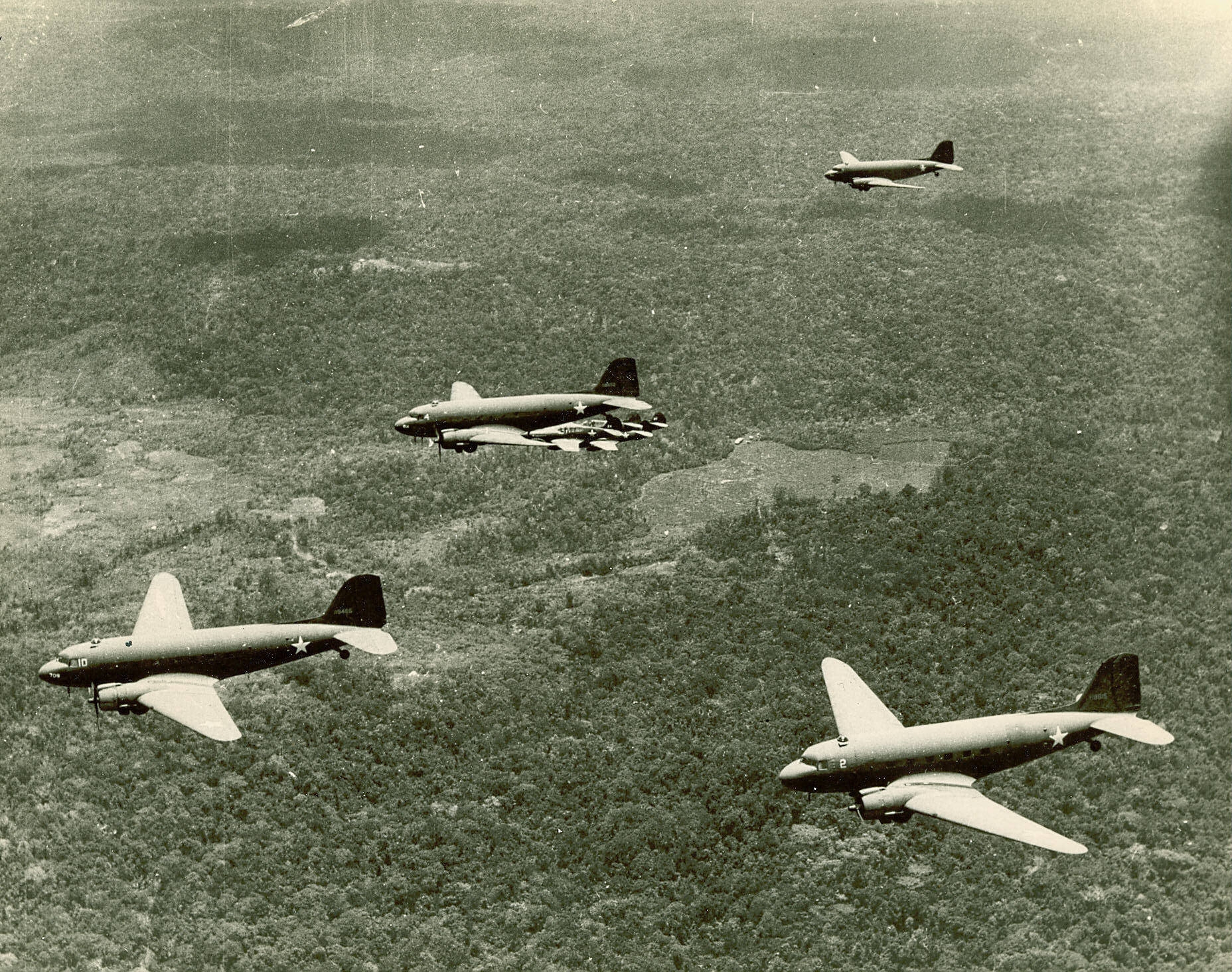
The first predecessor of the squadron was organized in 1940 as the 13th Transport Squadron. During World War II, as the 13th Troop Carrier Squadron, the squadron served in the South West Pacific Theater of World War II, earning two Distinguished Unit Citations, a Navy Unit Commendation and a Philippine Republic Presidential Unit Citation for its wartime actions. Its last assignment was with the 403d Troop Carrier Group at Nichols Field, Luzon, Philippines, where it was inactivated on 15 October 1946.
The 913th Air Refueling Squadron was activated by the United States Air Force in 1958 at Barksdale Air Force Base, Louisiana, where it was last assigned to the 2d Bombardment Wing. The squadron responded to the Cuban Missile Crisis and provided Boeing KC-135 Stratotanker aircraft and aircrews to support the Viet Nam War. It was inactivated on 1 November 1981 and replaced by a squadron flying McDonnell Douglas KC-10 Extenders.
The two squadrons were consolidated in September 1985 but the consolidated squadron has not been active since.
History
World War II
The 13th Transport Squadron was activated in late 1940 as one of the three original squadrons of the 61st Transport Group. Personnel for the squadron were drawn from the 5th Transport Squadron, located at Patterson Field, Ohio.
The headquarters and squadrons of the 61st were initially scattered at various depot bases, with the 13th at Patterson Field, The 61st was finally united with its component squadrons at Pope Field, North Carolina in May 1942. Shortly after this the group and squadrons were renamed Troop Carrier organizations. The squadron trained with the group in the southeast, using Douglas C-47 Skytrain and Douglas C-53 Skytrooper aircraft, but in the fall of 1942 the 13th deployed by itself to the Pacific.
Upon arrival in the theater, the squadron, operating from bases in New Caledonia, was attached to Marine Air Group 25 and began to transport vital ammunition and supplies to Guadalcanal and to evacuate wounded personnel on return trips. In November 1942 the squadron became part of the South Pacific Combat Air Transport Command (SCAT). For its actions during the Guadalcanal Campaign the squadron earned its first Distinguished Unit Citation.
In August 1943 the squadron was assigned to the 403d Troop Carrier Group and then moved to Espiritu Santo. It supported the New Guinea and Philippines campaigns by transporting men and cargo to combat areas. The 13th evacuated casualties and dropped or airlanded supplies to guerrilla forces in the Philippines. On 23 February 1945 the squadron dropped paratroopers into Laguna de Bay, Luzon to free civilians held prisoner by the Japanese. The unit moved to the Philippines in 1945 and remained after the Japanese surrender as part of Far East Air Forces. It flew occupation troops to Japan, evacuated prisoners of war and flew cargo and personnel between Australia and Japan. In early 1946 the squadron began to transition into Douglas C-54 Skymasters.
In October 1946 the 403d Troop Carrier Group was replaced by the 374th Troop Carrier Group. As a result, the 13th was inactivated and its mission, personnel and equipment were transferred to the 22d Troop Carrier Squadron.
Cold War
The 913th Air Refueling Squadron was activated in June 1958 by Strategic Air Command (SAC) at Barksdale Air Force Base, Louisiana. The squadron was equipped with Boeing KC-135 Stratotankers and assigned to the 4238th Strategic Wing as part of SAC's plan to disperse its Boeing B-52 Stratofortress units to make it more difficult for the Soviet Union to destroy the entire fleet with a first strike. The squadron mission was to provide air refueling to the B-52s of its parent wing and other USAF units as directed. Starting in 1960, one third of the squadron's aircraft were maintained on fifteen-minute alert, fully fueled and ready for combat to reduce vulnerability to a Soviet missile strike. This was increased to half the squadron's aircraft in 1962. The squadron trained for this mission until inactivation except for periods when its aircraft and crews were deployed with other SAC organizations conducting combat operations.
From October through November 1962 the squadron's training was interrupted as it assumed an increased alert posture during the Cuban Missile Crisis. After tensions eased, the unit resumed normal operations. The 913th transferred to the 2d Bombardment Wing in 1963 when SAC replaced its parent wing with an organization that had a more distinguished history and could continue its lineage.
In 1962, SAC established an airborne command post at Offutt Air Force Base, Nebraska, nicknamed Looking Glass, to ensure continuity of command and control of SAC forces in the event of a nuclear attack. Looking Glass was soon augmented by auxiliary aircraft stationed with the headquarters of SAC's three Numbered Air Forces. The 913th received Boeing EC-135C aircraft to operate SAC's Central Auxiliary Command Post's airborne element. The 913th continued to operate PACCS aircraft until 1 April 1970, when SAC reorganized its airborne command post aircraft and withdrew them from vulnerable bases near the coasts like Barksdale and assigned them to the 2d, 3d, and 4th Airborne Command and Control Squadrons, stationed at bases closer to the heartland of North America.
The 913th began supporting SAC operations in Southeast Asia in 1965, and increased its support of these operations over the following two years. From May to November 1972 all but four of the squadron's KC-135s and a handful of crews were on loan to other SAC units. Following the return of its assets, the squadron continued to support operations in Southeast Asia until 1975.
The 13th Troop Carrier Squadron was consolidated with the 913th Air Refueling Squadron in September 1985 but the consolidated squadron has not been active since.
Lineage
13th Troop Carrier Squadron
- Constituted as the 13th Transport Squadron on 20 November 1940 : Activated on 1 December 1940 : Redesignated the 13th Troop Carrier Squadron on 4 July 1942 : Inactivated on 15 October 1946
- Consolidated with 913th Air Refueling Squadron as the 913th Air Refueling Squadron on 19 September 1985 913th Air Refueling Squadron
- Constituted as the 913th Air Refueling Squadron, Heavy on 7 April 1958 : Activated on 1 June 1958 : Inactivated on 1 November 1981
- Consolidated with 13th Troop Carrier Squadron on 19 September 1985 (remained inactive)
Assignments
- 61st Transport Group (later 61st Troop Carrier Group), 1 December 1940
- Army Forces in South Pacific Area, c. 10 October 1942 (attached to South Pacific Combat Air Transport Command, 11 December 1942 – 3 July 1944)
- Thirteenth Air Force, c. 13 January 1943
- XIII Air Force Service Command, 1 July 1943
- 403d Troop Carrier Group, 22 August 1943 – 15 October 1946
- 4238th Strategic Wing, 1 June 1958
- 2d Bombardment Wing, 1 April 1963 – 1 November 1981
Stations
- Patterson Field, Ohio, 1 December 1940
- Drew Field, Florida, 13 July 1941
- Pope Field, North Carolina, 25 May 1942
- Lockbourne Army Air Base, Ohio, 8 August-22 September 1942
- Plaine Des Gaiacs Airfield, New Caledonia, 10 October 1942
- Tontouta Airfield, New Caledonia, 17 December 1942
- Luganville Airfield, Espiritu Santo, New Hebrides, 2 November 1943 : Operated from Los Negros Island, Admiralty Islands, 16 August-4 October 1944
- Mokmer Airfield, Biak, Netherlands East Indies, 21 September 1944 : Operated from Wakde Airfield, Wakde, Netherlands East Indies, 4–19 October 1944
- Dulag Airfield, Dulag, Leyte, Philippines, 17 July 1945
- Clark Field, Luzon, Philippines, 7 January 1946
- Nichols Field, Luzon, Philippines, 15 June 1946 – 15 October 1946
- Barksdale Air Force Base, Louisiana, 1 June 1958 – 1 November 1981
Aircraft
- Douglas C-47 Skytrain, 1941–1946
- Douglas C-53 Skytrooper, 1942
- Curtiss C-46 Commando, 1945–1946
- Douglas C-54 Skymaster, 1946
- Boeing KC-135 Stratotanker, 1958–1981
- Boeing EC-135C, c. 1964–1970
Awards and campaigns
| Campaign Streamer | Campaign | Dates | Notes | |
|---|---|---|---|---|
| [[File:Streamer APC.PNG | 200px]] | Guadalcanal | 10 October 1942 – 21 February 1943 | 13th Troop Carrier Squadron |
| [[File:Streamer APC.PNG | 200px]] | New Guinea | 24 January 1943 – 31 December 1944 | 13th Troop Carrier Squadron |
| [[File:Streamer APC.PNG | 200px]] | Northern Solomons | 23 February 1943 – 21 November 1944 | 13th Troop Carrier Squadron |
| [[File:Streamer APC.PNG | 200px]] | Bismarck Archipelago | 15 December 1943 – 27 November 1944 | 13th Troop Carrier Squadron |
| [[File:Streamer APC.PNG | 200px]] | Western Pacific | 17 April 1944 – 2 September 1945 | 13th Troop Carrier Squadron |
| [[File:Streamer APC.PNG | 200px]] | Leyte | 17 October 1944 – 1 July 1945 | 13th Troop Carrier Squadron |
| [[File:Streamer APC.PNG | 200px]] | Luzon | 15 December 1944 – 4 July 1945 | 13th Troop Carrier Squadron |
| [[File:Streamer APC.PNG | 200px]] | Southern Philippines | 27 February 1945 – 4 July 1945 | 13th Troop Carrier Squadron |
References
Notes
; Explanatory notes
; Citations
Bibliography
References
- Maurer, ''Combat Squadrons'', p. 75
- Maurer, ''Combat Units'', pp. 125–127
- "Abstract, History 13 Troop Carrier Squadron activation-Sep 1943". Air Force History Index.
- (1 January 1988). "Abstract, Henry H. Arnold personal document collection 1 Jan 1929-1 Jan 1930". Air Force History Index.
- Armstrong, William. (2017). ''Marine Air Group 25 and SCAT (Images of Aviation)''. Arcadia. {{ISBN. 1467127434; Washburne, Seth. (2011). ''The Thirsty 13th: The U.S. Army Air Forces 13th Troop Carrier Squadron, 1940 – 1945''. Thirsty 13th LLC. {{ISBN. 0615396755
- Maurer, ''Combat Units'', pp. 287–288
- "Abstract (Unclassified), Vol 1, History of Strategic Air Command, Jan–Jun 1957 (Secret)". Air Force History Index.
- (1 April 1975). "Abstract (Unclassified), History of the Strategic Bomber since 1945 (Top Secret, downgraded to Secret)". Air Force History Index.
- Ravenstein, ''Combat Wings'', pp. 7–9
- "Abstract, History 4238 Strategic Wing Nov 62". Air Force History Index.
- "A History of the Post Attack Command and Control System (PACCS)".
- "Abstract, History 2 Bombardment Wing Oct–Dec 1981". Air Force History Index.
- Department of the Air Force/MPM Letter 662q, 19 September 85, Subject: Reconstitution, Redesignation, and Consolidation of Selected Air Force Tactical Squadrons
- Lineage, including assignments, stations and aircraft in Maurer, ''Combat Squadrons'', p. 75
- Mueller, p. 22
- AF Pamphlet 900-2, 15 June 1971, p. 477
This article was imported from Wikipedia and is available under the Creative Commons Attribution-ShareAlike 4.0 License. Content has been adapted to SurfDoc format. Original contributors can be found on the article history page.
Ask Mako anything about 913th Air Refueling Squadron — get instant answers, deeper analysis, and related topics.
Research with MakoFree with your Surf account
Create a free account to save articles, ask Mako questions, and organize your research.
Sign up freeThis content may have been generated or modified by AI. CloudSurf Software LLC is not responsible for the accuracy, completeness, or reliability of AI-generated content. Always verify important information from primary sources.
Report