From Surf Wiki (app.surf) — the open knowledge base
9.45-inch heavy mortar
| Field | Value | |||
|---|---|---|---|---|
| name | ML 9.45 inch heavy trench mortar | |||
| image | AustraliansLoading9.45inchMortarColouredPostcard1916.jpg | |||
| image_size | 300px | |||
| caption | Colourised postcard showing Australian Army personnel loading a mortar near Pozières – in August 1916, according to the caption. The absence of a fuse and lack of concealment indicates this is a training or publicity photograph away from the front line. | |||
| origin | United Kingdom | |||
| type | Heavy trench mortar | |||
| is_ranged | yes | |||
| is_explosive | yes | |||
| is_artillery | yes | |||
| is_UK | yes | |||
| number | 712 | |||
| service | 1916–1918 | |||
| used_by | United Kingdom | |||
| Australia | ||||
| wars | World War I | |||
| designer | Dumezil-Batignolles | |||
| design_date | 1915 | |||
| part_length | 4 ft (Mk I) | |||
| 5 ft (Mk II–IV) | ||||
| crew | 7 | |||
| cartridge | HE 152 lb | |||
| caliber | 9.45 inch (240 mm) | |||
| rate | 1 round every 6 minutes | |||
| velocity | 475 ft/s max charge | |||
| range | 660 – | |||
| weight | {{plainlist | |||
| *Mk I: {{convert | 499 | lb | abbr | on}}, + 987 lb |
| *Mk II–IV: {{convert | 644 | lb | abbr | on}}, + 1169 lb}} |
| elevation | 75°–45° | |||
| traverse | 18° L & R | |||
| filling | Amatol or ammonal |
Australia 5 ft (Mk II–IV)
- Mortar & elevating gear, + body & bed
- Mk I: 499 lb, + 987 lb
- Mk II–IV: 644 lb, + 1169 lb}}
The ML 9.45 inch heavy trench mortar, nicknamed the "Flying Pig", was a large calibre mortar of World War I and the standard British heavy mortar from the autumn of 1916. It was a modification of an original French design, the Mortier de 240 mm developed by Batignolles Company of Paris and introduced in 1915. Britain manufactured the modified version under licence.
History
The British ML 9.45 in mortar was a design based on the 240 mm mortar in 1915 and introduced in 1916. The British version differed from the French LT weapon in that the propellant charge was loaded through the muzzle whereas the French 240 mm had the charge loaded through the breech in a brass cartridge case.
In June 1916, following unsatisfactory trials with the French model, Britain replaced them with 30 of its own model, firing a 150-pound bomb, followed by 200 more in December 1916.
The Mark I with 51 in barrel was introduced from June 1916. In 1917, the Mark II and Mark III followed with 69 in barrel, and small numbers of Mark IVs.
Combat use
The mortar was operated by crews of the Royal Garrison Artillery which was the part of the British Army that operated the heaviest artillery weapons, formed into batteries of four mortars attached to each division, designated "V/nn" where nn was the division number. From February 1918 they were reorganised and moved from divisional to corps control.
The weapon was dismantled for transport, requiring four carts for the barrel, base, carriage and ammunition.
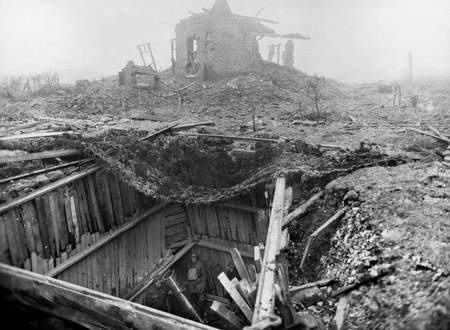
In action, a heavy timber platform was constructed embedded in the ground, on which the mortar base was immovably secured. The mortar carriage sat on the base and could traverse. The mortar barrel and breech were mounted on the carriage which provided elevation.
They were used in the "siege warfare" on the Western Front to destroy enemy strongpoints, bunkers and similar "hard" targets which were invulnerable to lighter mortars and field guns. The US Army handbook described it : "... the use for which it is primarily adapted is in the bombardment of strongly protected targets - dwellings, covered shelters, command posts, entrances to galleries, etc - or in the destruction of sectors of trenches, salients and the like.". Their effectiveness decreased late in the war as German policy changed to a lightly held front line, hence decreasing available targets, and they became redundant when the war of movement resumed late in 1918.
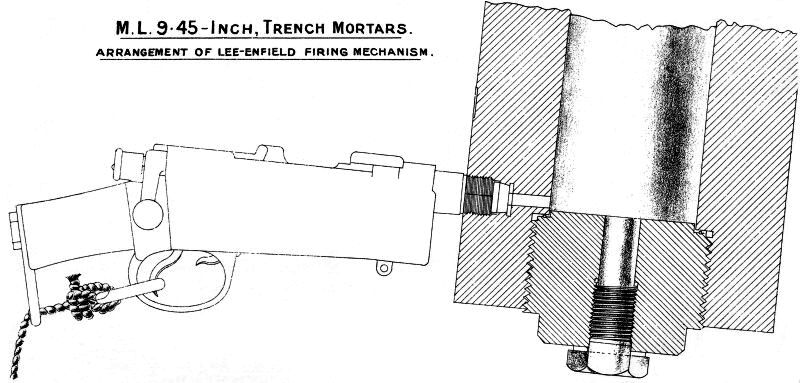
Both the propellant charge appropriate for the required range and the bomb were loaded via the muzzle. Usually a Lee–Enfield rifle's bolt action mechanism was screwed into the breech. A special blank rifle cartridge was loaded and was triggered by pulling a lanyard, and fired into an igniter at the base of the mortar chamber, igniting the propellant charge and launching the bomb.
Surviving examples
- British 9.45 mortar at Imperial War Museum Duxford
Bibliography
- General Sir Martin Farndale, History of the Royal Regiment of Artillery. Western Front 1914-18. London: Royal Artillery Institution, 1986.
- Handbook of the M.L. 9.45-In. Trench Mortars. Mks I, II and III. February 1918. War Office, UK. (Covers models in British service)
- "History of the Ministry of Munitions", 1922. Volume XI, Part I Trench Warfare Supplies. Facsimile reprint by Imperial War Museum and Naval & Military Press, 2008
References
- 712 total : 203 Mk I, 336 Mk II, 162 Mk III, 11 Mk IV. Ministry of Munitions 1922, pp 130–131
- Handbook of the M.L. 9.45 inch Trench Mortars. February 1918. War Office, UK.
- ML being "muzzle loading"
- The origin of the nickname "flying pig" is unclear. Some sources describe the bomb as looking like a small pig in flight; it may also refer to the English language term meaning an unlikely event (as in [[pigs fly. "pigs might fly"]]), deriving from the clumsy bulky appearance; it may be a mixture of both.{{cn. (April 2021)
- [http://cgsc.cdmhost.com/cdm4/item_viewer.php?CISOROOT=/p4013coll9&CISOPTR=133&CISOBOX=1&REC=2 "Manual for trench artillery, United States Army (provisional). Part I, Trench Artillery.". Prepared at Headquarters AEF, France, March 1918. page 8]
- Farndale 1986. Annex G, Trench Mortar Organization in France, page 367.
- ""Handbook of the 9.45-inch trench mortar matériel" United States Ordnance Department. December 1917. page 9".
- "'The Flying Pig'".
This article was imported from Wikipedia and is available under the Creative Commons Attribution-ShareAlike 4.0 License. Content has been adapted to SurfDoc format. Original contributors can be found on the article history page.
Ask Mako anything about 9.45-inch heavy mortar — get instant answers, deeper analysis, and related topics.
Research with MakoFree with your Surf account
Create a free account to save articles, ask Mako questions, and organize your research.
Sign up freeThis content may have been generated or modified by AI. CloudSurf Software LLC is not responsible for the accuracy, completeness, or reliability of AI-generated content. Always verify important information from primary sources.
Report