From Surf Wiki (app.surf) — the open knowledge base
783 series
Japanese train type

Japanese train type
| Field | Value |
|---|---|
| name | 783 series |
| image | Series783-CM1.jpg |
| imagesize | 300px |
| caption | Set CM1, August 2017 |
| service | March 1988–Present |
| manufacturer | JR Kyushu Kokura Works, Hitachi, Kinki Sharyo |
| family | Hyper Saloon |
| yearconstruction | 1988–1991 |
| refurbishment | 1994–2006 |
| numberbuilt | 90 vehicles |
| numberservice | 86 vehicles (20 sets) |
| numberscrapped | 4 vehicles |
| formation | 4/5 cars per trainset |
| fleetnumbers | CM1-5, CM11-15, CM21-25, CM31-35 |
| operator | JR Kyushu |
| depots | Minami-Fukuoka |
| carbody | Stainless steel |
| carlength | 21.05 m (end cars) |
| 20 m (intermediate cars) | |
| width | 2,950 mm |
| doors | 1 per side |
| maxspeed | 130 km/h |
| traction | Thyristor drive |
| electricsystem | 20 kV AC 60 Hz |
| collectionmethod | Overhead catenary |
| safety | ATS-SK, ATS-Dk |
| gauge |
20 m (intermediate cars)
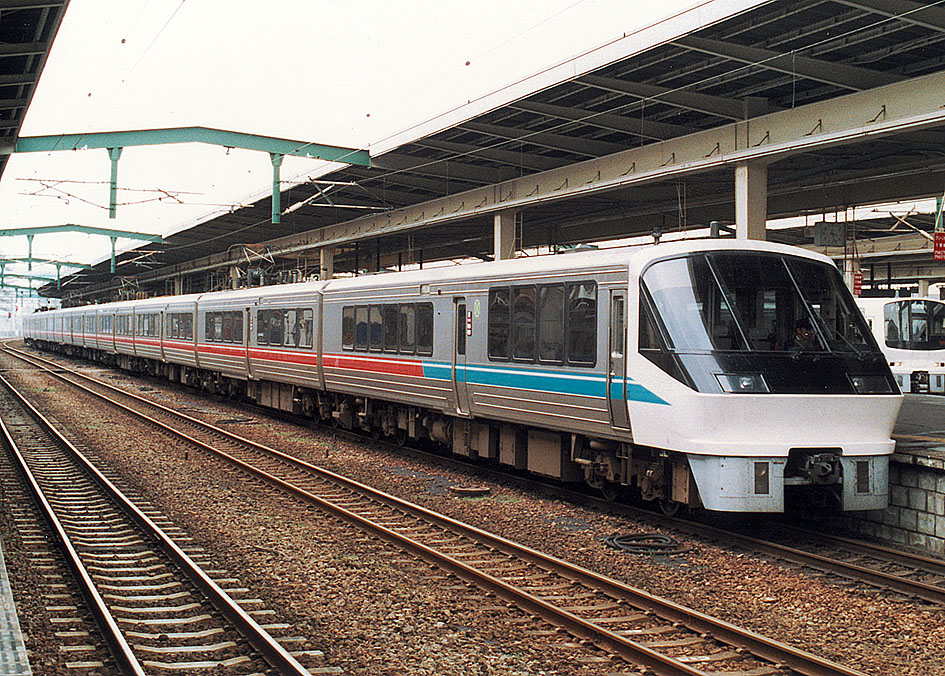
The 783 series is an AC electric multiple unit train type operated on limited express services by Kyushu Railway Company (JR Kyushu) in Japan since March 1988.
Design
The trains were built jointly by Hitachi, Kinki Sharyo, and JR Kyushu (at its Kokura factory).
Formations
5-car ''Kamome'' sets (CM1–5)
The 5-car sets used on Kamome services are formed as follows.
| Car No. | Designation | Numbering |
|---|---|---|
| 1 | 2 | 3 |
| Thsc | M'1 | T0 |
| KuRoHa 782 | MoHa 783 | SaHa 783 |
Cars 2 and 5 are each fitted with one scissors-type pantograph.
4-car ''Midori'' sets (CM11–15)
The 4-car sets used on Midori services are formed as follows.
| Car No. | Designation | Numbering |
|---|---|---|
| 11 | 12 | 13 |
| Thsc | T2 | M2 |
| KuRoHa 782-100 | SaHa 783-200 | MoHa 783-100 |
Car 14 is fitted with one scissors-type pantograph.
4-car ''Huis Ten Bosch'' sets (CM21–25)


The 4-car sets used on Huis Ten Bosch services are formed as follows.
| Car No. | Designation | Numbering |
|---|---|---|
| 7 | 8 | 9 |
| Thsc | M2 | M1 |
| KuRoHa 782-500 | MoHa 783-300 | MoHa 783-200 |
Car 9 is fitted with one scissors-type pantograph.
5-car ''Nichirin'' sets (CM31–35)
The 5-car sets used on Nichirin services are formed as follows.
| Car No. | Designation | Numbering |
|---|---|---|
| 1 | 2 | 3 |
| Thsc | M1 | T2 |
| KuRoHa 782-500 | MoHa 783 | SaHa 783-200 |
Cars 2 and 5 are each fitted with one scissors-type pantograph.
Set CM35 normally operates as a 4-car set.
Past formations
The following formations were used from introduction in 1988 until the fleet was refurbished and reformed in 2000.
9-car sets

- 9-car sets used on Hyper Kamome services from March 1990 until June 1994
| Car No. | Numbering |
|---|---|
| 1 | 2 |
| KuRo 782 | MoHa 783 |
Cars 2, 4, 6, and 9 were each fitted with one scissors-type pantograph.
8-car sets
- 8-car sets used on Hyper Kamome services from March 1990 until June 1994
| Car No. | Numbering |
|---|---|
| 1 | 2 |
| KuRo 782 | SaHa 783-100 |
Cars 3, 5, and 8 were each fitted with one scissors-type pantograph.
7-car sets
- 7-car sets used on Ariake and Hyper Ariake services during busy seasons from 1 April 1988
| Car No. | Numbering |
|---|---|
| 1 | 2 |
| KuRo 782 | MoHa 783 |
Cars 2, 4, and 7 were each fitted with one scissors-type pantograph.
- 7-car sets used on Hyper Kamome services from 18 March 1993
| Car No. | Numbering |
|---|---|
| 1 | 2 |
| KuRo 782 | MoHa 783 |
Cars 2, 4, and 7 were each fitted with one scissors-type pantograph.
6-car sets
- 6-car sets used on Hyper Nichirin services from 18 March 1993
| Car No. | Numbering |
|---|---|
| 1 | 2 |
| KuRoHa 782 | SaHa 783 |
Cars 3 and 6 were each fitted with one scissors-type pantograph.
5-car sets


- 5-car sets used on Ariake and Super Ariake services from 1 April 1988
| Car No. | Numbering |
|---|---|
| 1 | 2 |
| KuRo 782 | MoHa 783 |
Cars 2, and 5 were each fitted with one scissors-type pantograph.
- 5-car sets used on Hyper Ariake services from March 1990 until July 1992 and on Tsubame services from 15 July 1992
| Car No. | Numbering |
|---|---|
| 1 | 2 |
| KuRo 782 | MoHa 783 |
Cars 2, and 5 were each fitted with one scissors-type pantograph.
4-car sets
- 4-car sets used on Hyper Ariake services from March 1990 until July 1992 and on Ariake and Hyper Nichirin services from 15 July 1992
| Car No. | Numbering |
|---|---|
| 1 | 2 |
| KuRoHa 782 | SaHa 783 |
Car 5 was fitted with one scissors-type pantograph.
3-car sets
3-car sets used on Ariake and Super Ariake services from 1 April 1988 until 1990
| Car No. | Numbering |
|---|---|
| 1 | 2 |
| KuRoHa 782 | MoHa 783-100 |
Car 3 was fitted with one scissors-type pantograph.
History
The 783 series trains were first introduced from 13 March 1988, initially branded as "Hyper Saloon".
On 30 May 1989, the 783 series design was awarded the 1988 Laurel Prize by the Japan Railfan Club. A special award ceremony was held at platform 1 of Hakata Station on 26 August 1989.
All cars were made no-smoking from the start of the revised timetable on 18 March 2007.
References
References
- Kotsu Shimbunsha. (May 2017)
- (2009). "JR全車輌ハンドブック2009". Neko Publishing.
- Saka, Masahiro. (March 2014). "JR第1世代の車両・現況と概要". Tetsudō Daiya Jōhō Magazine.
- (May 2010). "JR電車編成表 2010夏". JRR.
- (March 2011). "JR九州 新幹線・特急列車の運転体系概要". Tetsudō Daiya Jōhō Magazine.
- Nishimura, Takao. (September 2011). "783系 「ハイパーサルーン」". [[Japan Railfan Magazine]].
This article was imported from Wikipedia and is available under the Creative Commons Attribution-ShareAlike 4.0 License. Content has been adapted to SurfDoc format. Original contributors can be found on the article history page.
Ask Mako anything about 783 series — get instant answers, deeper analysis, and related topics.
Research with MakoFree with your Surf account
Create a free account to save articles, ask Mako questions, and organize your research.
Sign up freeThis content may have been generated or modified by AI. CloudSurf Software LLC is not responsible for the accuracy, completeness, or reliability of AI-generated content. Always verify important information from primary sources.
Report