From Surf Wiki (app.surf) — the open knowledge base
727 Naval Air Squadron
Flying squadron of the Royal Navy's Fleet Air Arm

Flying squadron of the Royal Navy's Fleet Air Arm
| Field | Value |
|---|---|
| unit_name | 727 Naval Air Squadron |
| image | 727 NAS Badge.jpg |
| image_size | 150 |
| caption | 727 NAS Badge |
| dates | |
| country | |
| branch | |
| type | Fleet Air Arm Second Line Squadron |
| role | * Fleet Requirements Unit |
| command_structure | Fleet Air Arm |
| garrison | RNAS Yeovilton (HMS *Heron*) |
| garrison_label | Home station |
| motto | |
| colors | |
| colors_label | |
| equipment | * Grob Tutor T1 |
| equipment_label | Aircraft |
| website | |
| current_commander | Lieutenant Commander |
- Air Experience Unit
- RN Grading Flight
- See Aircraft flown section for full list. 727 Naval Air Squadron is a Fleet Air Arm (FAA) naval air squadron of the United Kingdom’s Royal Navy (RN). It was formed in 1943 as a Fleet Requirements Unit, being disbanded in December 1944. It was reformed twice in the 1940s and 1950s to provide flying experience for naval officers. The current squadron was created on 6 Dec 2001 from the Royal Naval Flying Training Flight. It operates the Grob Tutor, with its primary role to provide grading assessment and for Royal Navy and Royal Marine pilots prior to further flying training. It also supports the Royal Navy's "Flying Start" flying scholarship scheme.
History
Fleet Requirements Unit (1943-1944)
727 Naval Air Squadron was formed on 26 May 1943 at Gibraltar as a Fleet Requirements Unit covering the area from Bizerta to Algiers. The squadron was equipped with target-towing Boulton Paul Defiants, Fairey Swordfish and Hawker Hurricane IIc. The squadron was disbanded on 7 December 1944.
Air Experience Unit (1946-1960)
After World War II it was decided to provide air acquaint courses for junior Royal Navy and Royal Marines officers who were not aviation specialists. 727 NAS was reformed on 23 April 1946 at RNAS Lee-on-Solent with gliders, Tiger Moths, Supermarine Seafires, North American Harvards and a Fairey Firefly, disbanding on the 17 January 1950.
The squadron was reformed on 4 January 1956 as the Dartmouth Cadet Air Training Squadron. Now operating from RNAS Brawdy, Pembrokeshire, the squadron flew Boulton Paul Sea Balliols, De Havilland Sea Vampire T22s and a Percival Sea Prince T.1. Two Westland Dragonfly helicopters were provided in September 1958, but the squadron was disbanded on 16 December 1960.
RN Grading Flight (2001-present)
History of the Royal Naval Flying Training Flight

Since 1949 the Britannia Royal Naval College at Dartmouth has operated light aircraft for recreational flying, as well as running summer flying camps. Types flown have included De Havilland Tiger Moths, Auster and De Havilland Chipmunk. Miles Messenger and Miles Gemini aircraft were also introduced. After grading of potential aircrew was introduced, these aircraft were employed during the week for assessing future aircrew and at weekends for recreation. By this time the aircraft were based at Roborough Airport, on the outskirts of Plymouth. By 1966 the flight had been stabilised at 12 Chipmunk aircraft.
Commissioning the RNFTF as 727 NAS (2001 - present)
On 6 December 2001 the Royal Naval Flying Training Flight was commissioned as 727 Naval Air Squadron, at Plymouth City Airport, initially with the de Havilland Chipmunk and later with the Grob Tutor, and in January 2007 the squadron relocated to RNAS Yeovilton. The commissioning ceremony was attended by an original pilot member of 727, Geoffrey Harrington, who served with 727 in North Africa during WW2.
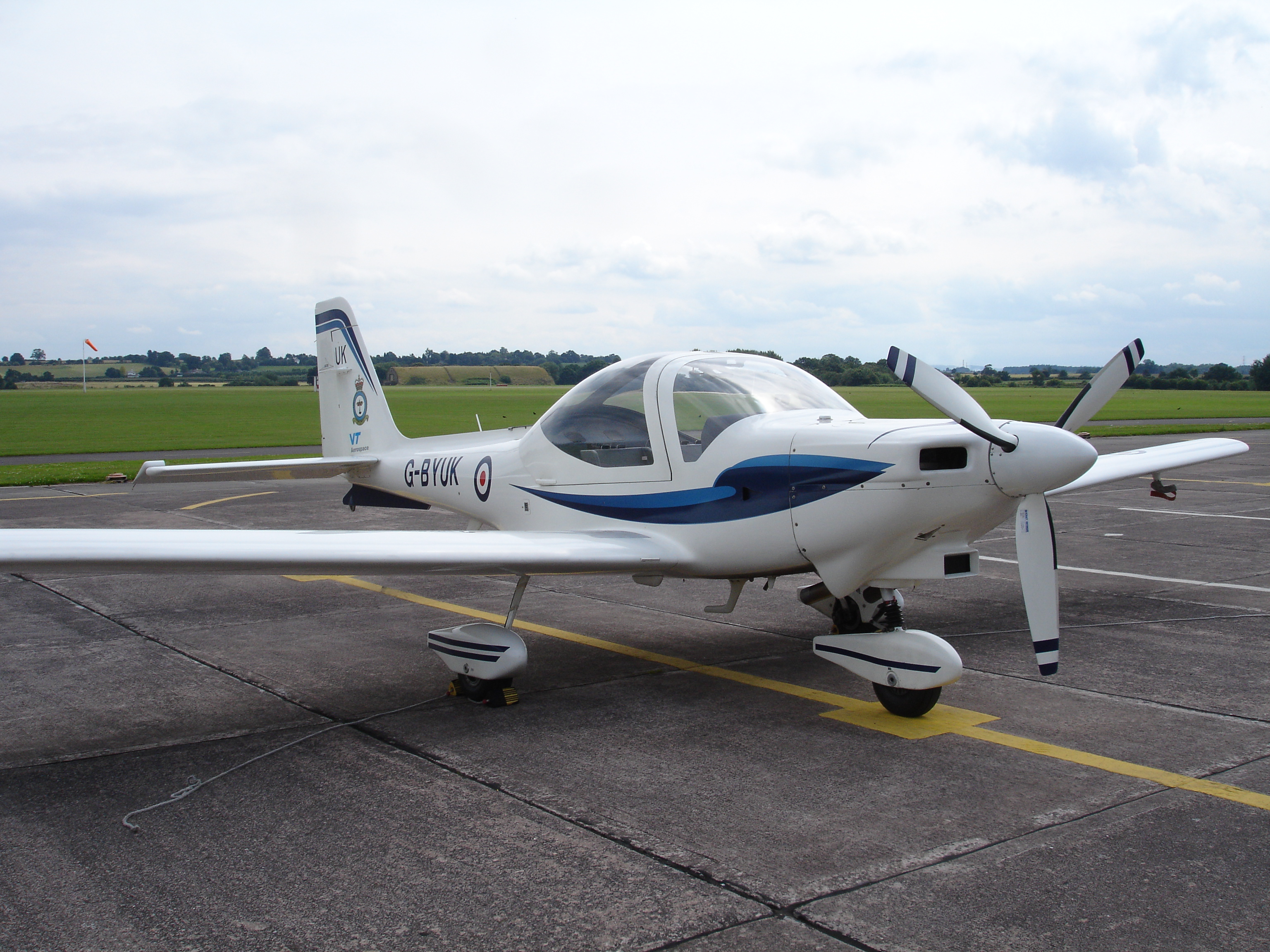
The squadron currently operates five Grob Tutor trainer aircraft under a private finance initiative with Babcock International's aerospace division. This, along with five Qualified Flying Instructors (QFIs), allow up to eight students to be accommodated with the squadron at any time.
Grading
Pre-selected prospective pilots are assessed for their suitability to start flight training. During RN Flying Grading, they fly an initial eleven hour syllabus with an instructor; fly a pre-intermediate handling test (IHT), often with a different instructor; then fly the test with the Squadron Commanding Officer. If successful they then fly about a further 20 hours of Instrument, Navigation and Composite flying before a Final Ability Test (FAT).
The aim of the IHT is to fly the aircraft unassisted whilst being assessed on a Departure, Climb, Level Off, Turns, Stall, Aerobatics, Recovery and 2 Circuits (Standard and Glide) sortie profile. The aim of the subsequent FAT, which is similar but incorporates additional skills, is to confirm the assessment at IHT and allow possible selection to the fixed wing RN fast jet stream. If the student performs satisfactory with limited prompting at IHT then he will pass at that stage however, FAT is designed to further assess the pilots continued rate of progress and temperament to ensure it matches the intense pace of military flying training. Those unsuccessful are considered for other duties within the Royal Navy with the ab-initio candidates retaining option to resign at this stage.
Special Flying Award and Air Experience Flying
The squadron also undertakes many other roles, one of which is the Special Flying Award. This scheme is open to any member of the public who has expressed an interest in joining the Fleet Air Arm as aircrew and have been put forward by their Careers Office. The course lasts up to two weeks with the aim of 10 hours in the cockpit. Air Experience Flying is also organised for members of the URNU and the CCF.
Elementary Flying Training
727 NAS has in the past, accommodated students who undertake Elementary Flying Training (EFT) on the Tutor, which saw them complete a course similar to the legacy EFT that was flown at 16 Squadron, RAF Wittering prior to the introduction of the UK's Military Flying Training System.
The Squadron Today
The squadron currently has just two full-time Naval personnel; the commanding officer and the training officer. Babcock employs five civilian QFI qualified instructors under their contract to teach the students. The squadron also has a number RNR and regular staff pilots who support Air Experience Flying and usually some holdover student pilots who are between flying training courses.
Maintenance of the Grob fleet is provided by a Babcock senior licensed engineer with engineering support staff. An aircraft handler provides aircraft handling, refuelling and assistance to aircrew. The squadron moved from Plymouth Airport to RNAS Yeovilton in early 2007, following the departure of the last Sea Harrier squadron from RNAS Yeovilton in 2006.
Aircraft flown
- Boulton Paul Defiant
- Fairey Swordfish
- Hawker Hurricane IIc
- Boulton Paul Sea Balliol
- De Havilland Sea Vampire T22
- Percival Sea Prince T1
- Westland Dragonfly
- Tiger Moth
- Auster
- De Havilland Chipmunk
- Miles Messenger
- Miles Gemini
- Grob Tutor T1
References
References
- "727 squadron at the Helicopter History website".
- "History of 727 NAS at the Royal Navy website".
- "Introduction to 727 NAS at the Royal Navy website".
- "Flying Grading {{!}} Royal Navy".
This article was imported from Wikipedia and is available under the Creative Commons Attribution-ShareAlike 4.0 License. Content has been adapted to SurfDoc format. Original contributors can be found on the article history page.
Ask Mako anything about 727 Naval Air Squadron — get instant answers, deeper analysis, and related topics.
Research with MakoFree with your Surf account
Create a free account to save articles, ask Mako questions, and organize your research.
Sign up freeThis content may have been generated or modified by AI. CloudSurf Software LLC is not responsible for the accuracy, completeness, or reliability of AI-generated content. Always verify important information from primary sources.
Report