From Surf Wiki (app.surf) — the open knowledge base
701 series
Japanese train type
Japanese train type
| Field | Value |
|---|---|
| name | 701 series |
| image | Series701-N9.jpg |
| imagesize | 300px |
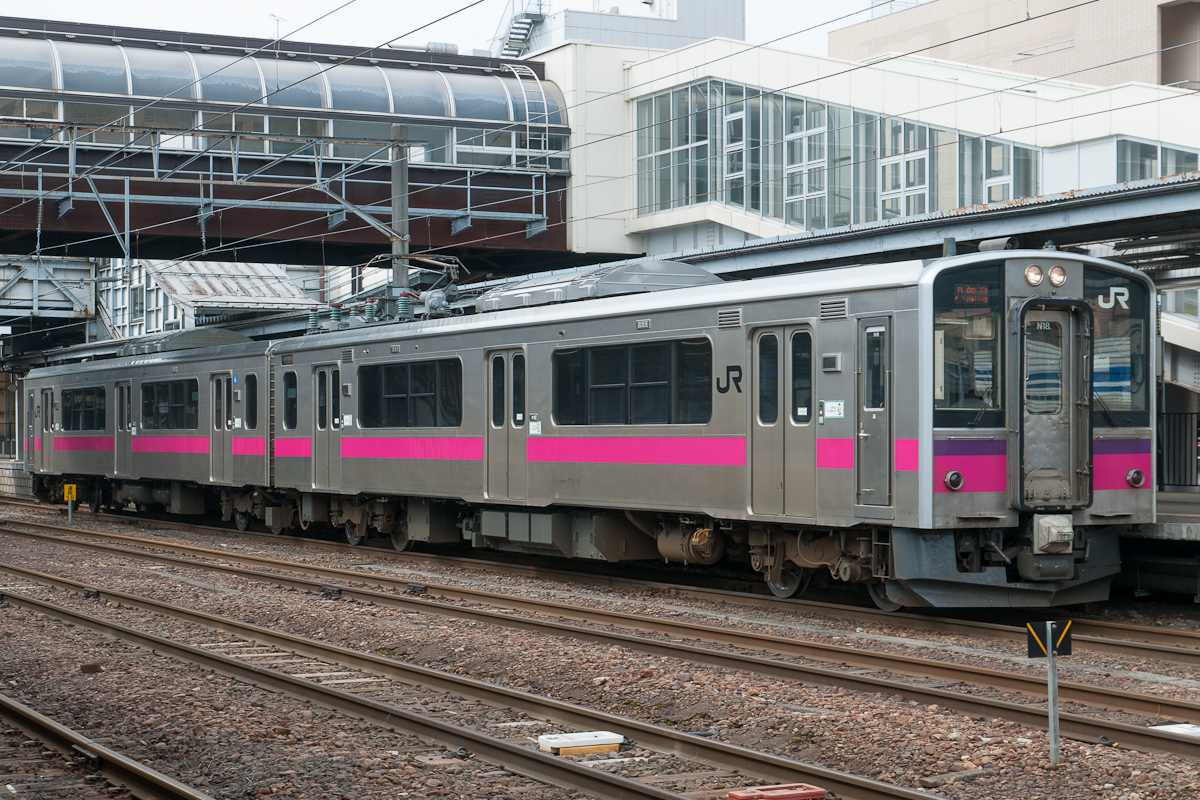
| caption | An Akita area 701-0 series in September 2020 |
| service | 1993–Present |
| manufacturer | JR East, Kawasaki Heavy Industries |
| replaced | , 715 series |
| yearconstruction | 1993–2001 |
| yearservice | 21 June 1993 |
| numberbuilt | 274 vehicles |
| numberservice | 274 vehicles |
| successor | E723 series (planned) |
| formation | 2, 3 or 4 cars per trainset |
| operator | JR East, Aoimori Railway, IGR |
| depots | Akita, Aomori, Morioka, Sendai, Yamagata |
| carbody | Stainless steel |
| carlength | 20000 mm |
| width | 2800 mm |
| height | 3620 mm |
| doors | 3 pairs per side |
| maxspeed | 110 km/h |
| traction | Variable frequency (Power transistor, IGBT) |
| electricsystem | 20 kV AC, 50 Hz |
| collectionmethod | Overhead catenary |
| safety | ATS-Ps (701-0/100/1000/1500), ATS-P (701-5000/5500) |
| multipleworking | E721 series |
| gauge | (701-0/100/1000/1500) |
| (701-5000/5500) |
(701-5000/5500)
The 701 series is an AC electric multiple unit (EMU) train type operated on local services by East Japan Railway Company (JR East), Aoimori Railway, and Iwate Galaxy Railway (IGR) in Japan. The design is derived from the 209 series commuter EMU, and was intended to replace locomotive-hauled trains formed of coaches in the north of Japan.
Variants
- 701-0 series: 2/3-car narrow-gauge sets based at Akita Depot
- 701-100 series: 2/3-car narrow-gauge sets based at Akita and Sendai Depot
- 701-1000 series: 2/4-car narrow-gauge sets based at Morioka and Sendai Depot
- 701-1500 series: 2-car narrow-gauge sets based at Sendai Depot
- 701-5000 series: 2-car standard-gauge sets based at Akita Depot
- 701-5500 series: 2-car standard-gauge sets based at Yamagata Depot
- Aoimori 701 series: 2-car narrow-gauge sets operated by the Aoimori Railway
- IGR 7000 series: 2-car narrow-gauge sets operated by the Iwate Galaxy Railway
701-0 series
89 701-0 series cars were delivered in 1993, formed as three-car sets (N1 to N13) and two-car sets (N14 to N38), all based at Akita Depot. Three two-car sets (N36 to N38) were later modified with some transverse seating, and from 2005, the entire fleet had the original PS104 scissors-type pantographs replaced with PS109 single-arm pantographs. Snowploughs were also added to the front ends at the same time.
These sets are used on the Uetsu Main Line between and , on the Ōu Main Line between and , and on the Tsugaru Line between and . The sets with transverse seating are mainly used on the Ōu Main Line between Shinjō and Akita.
Formations
3-car sets N1-N13
| Designation | Numbering |
|---|---|
| Mc | T |
| KuMoHa 701 | SaHa 701 |
The KuMoHa 701 car is fitted with one pantograph. The KuHa 700 car is fitted with a toilet and wheelchair space.
2-car sets N14-N38
| Designation | Numbering |
|---|---|
| Mc | Tc' |
| KuMoHa 701 | KuHa 700 |
The KuMoHa 701 car is fitted with one pantograph. The KuHa 700 car is fitted with a toilet and wheelchair space.
Interior
File:JRE 701-1-syanai.jpg|Interior view of Akita set N1 in July 2007, showing longitudinal seating
701-100 series

Thirteen 701-100 series cars were delivered in 1994, formed as one 3-car set and five 2-car sets. All sets were initially based at Akita Depot, but four of the 2-car sets were subsequently transferred to Sendai. The Akita-based sets had the original PS104 scissors-type pantographs replaced with PS109 single-arm pantographs between 2007 and 2008. Snowploughs were also added to the front ends at the same time. The Sendai-based sets had the original PS104 scissors-type pantographs replaced with lower-profile PS105 lozenge-type pantographs in 2002 to allow operation through limited-clearance tunnels on the Senzan Line.
The Sendai-based sets are normally used on the Joban Line between and , and on the Tohoku Main Line between Iwanuma and Sendai. They are also available for use on Senzan Line services if required. The Akita-based sets are used interchangeably alongside the 701-0 series sets.
Formations
3-car set N101
| Designation | Numbering |
|---|---|
| Mc | T |
| KuMoHa 701-100 | SaHa 701-100 |
The KuMoHa 701 car is fitted with one pantograph. The KuHa 700 car is fitted with a toilet and wheelchair space.
2-car sets N102 and F2-103–106
| Designation | Numbering |
|---|---|
| Mc | Tc' |
| KuMoHa 701-100 | KuHa 700-100 |
The KuMoHa 701 car is fitted with one pantograph. The KuHa 700 car is fitted with a toilet and wheelchair space.
701-1000 series


92 701-1000 series cars were delivered between 1994 and 1995 to Morioka and Sendai depots, formed as 2- and 4-car units. As of 2010, 14 cars (seven 2-car sets), 30 cars (fifteen 2-car sets) are based at Morioka, and 36 cars (four 4-car sets and ten 2-car sets) are based at Sendai. Eight of the original 2-car sets were transferred to the Iwate Galaxy Railway Line, becoming IGR 7000-0 series (see below), and one 2-car set was transferred to the Aoimori Railway, becoming Aoimori 700-0 series (see below). On 28 October 1999, one Aomori-based 2-car set (KuMoHa 701-1033 + KuHa 700-1033) was damaged by storm surge at Aomori Station. New bodies were manufactured for this set in 2000, and it was renumbered KuMoHa 701-1508 + KuHa 700-1508 and reallocated to Sendai depot.
A further seven 701-1000 series two-car sets were transferred to the Aoimori Railway during 2010, becoming Aoimori 700-0 series.
The Sendai-based sets are used on the Tohoku Main Line between and , including the branch line to , and on the Senzan Line. The Morioka-based sets are used on the Tohoku Main Line between and , and on the Iwate Galaxy Railway Line between Morioka and . The Aomori-based sets are used on the Tohoku Main Line between and .
Formations
4-car sets
| Designation | Numbering |
|---|---|
| Mc | T' |
| KuMoHa 701-1000 | SaHa 700-1000 |
The KuMoHa 701 and MoHa 701 cars are each fitted with one PS105 lozenge-type pantograph. The KuHa 700 car is fitted with a toilet and wheelchair space.
2-car sets
| Designation | Numbering |
|---|---|
| Mc | Tc' |
| KuMoHa 701-1000 | KuHa 700-1000 |
The KuMoHa 701 car is fitted with one PS105 lozenge-type pantograph. The KuHa 700 car is fitted with a toilet and wheelchair space.
701-1500 series
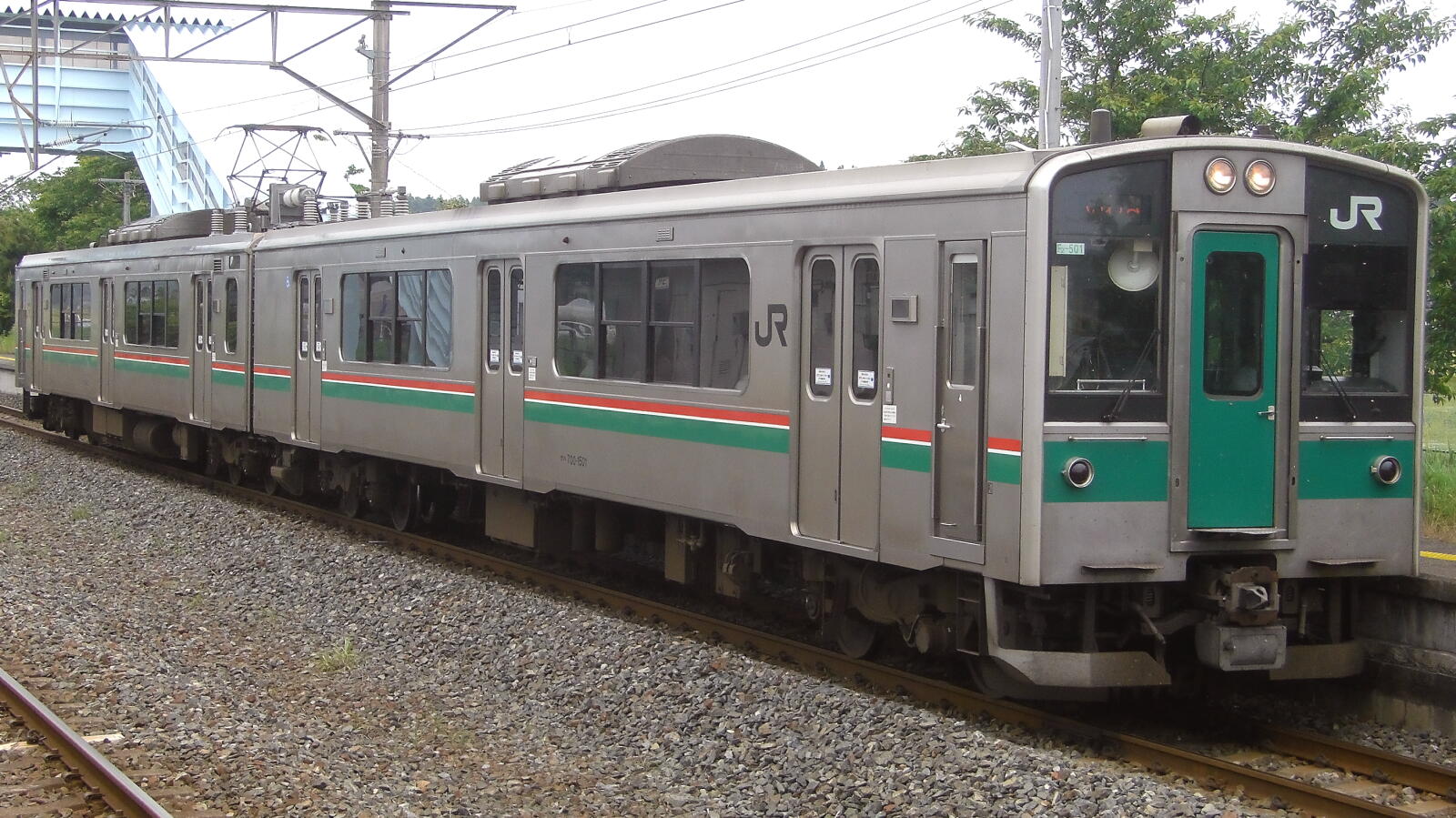
Eighteen two-car sets (numbered F2-501 to F2-518) were delivered to Sendai depot between 1998 and 2001, including set F2-508, which was rebuilt from an earlier damaged 701-1000 series unit. Sets from F2-509 onward were fitted with wheelchair spaces and ATS-Ps from new. They are used interchangeably with Sendai 701-1000 series sets.
Formation
| Designation | Numbering |
|---|---|
| Mc | Tc' |
| KuMoHa 701-1500 | KuHa 700-1500 |
The KuMoHa 701 car is fitted with one PS105 lozenge-type pantograph. The KuHa 700 car is fitted with a toilet and wheelchair space.
701-5000 series

Ten 2-car sets (numbered N5001 to N5010) were delivered to Akita depot between 1996 and 1997, entering service from 22 March 1997 on the sections of the Tazawako Line between and , and on the Ōu Main Line between Ōmagari and . These sets were based on the earlier 701-1000 series, with some transverse seating, PS106 single-arm pantographs, and ATS-P.
Formation
| Designation | Numbering |
|---|---|
| Mc | Tc' |
| KuMoHa 701-5000 | KuHa 700-5000 |
The KuMoHa 701 car is fitted with one PS105 lozenge-type pantograph. The KuHa 700 car is fitted with a toilet and wheelchair space.
Interior
File:Jreast 701 5000 inside.JPG|Interior view of KuMoHa 701-5002, showing mixed longitudinal and transverse seating
701-5500 series

Nine two-car sets (numbered Z1 to Z9) were delivered to Yamagata depot in 1999, ahead of the opening of the extension of the Yamagata Shinkansen to in November 1999. During 2001, the original PS105 lozenge-type pantographs were replaced with PS106B single-arm pantographs. Snowploughs were added to the front ends at the same time.
The fleet is used on the Ōu Main Line between and .
The fleet of nine trainsets underwent a programme of refurbishment between 2013 and 2016. Improvements included replacement of electrical converters and transformers with similar equipment to that used on the later E721 series trains, as well as new flooring material internally.
Formation
| Designation | Numbering |
|---|---|
| Mc | Tc' |
| KuMoHa 701-5000 | KuHa 700-5000 |
The KuMoHa 701 car is fitted with one PS105 lozenge-type pantograph. The KuHa 700 car is fitted with a toilet and wheelchair space.
Future plans
JR East announced on 26 November 2025 that this subseries would be replaced by new E723 series trainsets by late 2026.
Aoimori 701 series


The Aoimori Railway 701 series fleet consists of one 701-0 series set, which was originally a JR East 701-1000 series set transferred from Morioka in December 2002, and a newly built 701-100 series set delivered in September 2002. The 701-100 series set has some transverse seating.
A further seven two-car (former 701-1000 series) sets were transferred from JR East during 2010 ahead of the transfer of passenger operations from JR East on the section from Hachinohe to Aomori when the Tohoku Shinkansen extension to Shin-Aomori opened in December 2010. These units are modified with the addition of some transverse seating. The Aoimori Railway fleet was repainted into a new lighter blue livery incorporating the railway's "Mori" mascot logo.
Formation
| Designation | Numbering |
|---|---|
| Mc | Tc' |
| Aoimori 701 | Aoimori 700 |
The Aoimori 701 car is fitted with a PS105 lozenge-type pantograph. The Aoimori 700 car is fitted with a toilet and wheelchair space.
IGR 7000 series

The Iwate Galaxy Railway Line 7000 series fleet consists of four 7000-0 series sets, which were originally JR East 701-1000 series sets transferred from Morioka in December 2002, and three newly built 7000-100 series sets delivered in September 2002. The 7000-100 series sets have some transverse seating.
Formations
IGR 7000-0 series
| Designation | Numbering | Capacity (total/seated) |
|---|---|---|
| Mc | Tc' | |
| IGR 7001 | IGR 7000 | |
| 135/54 | 133/48 |
The IGR 7001 car is fitted with a PS105 lozenge-type pantograph. The IGR 7000 car is fitted with a toilet and wheelchair space.
IGR 7000-100 series
| Designation | Numbering | Capacity (total/seated) |
|---|---|---|
| Mc | Tc' | |
| IGR 7001-100 | IGR 7000-100 | |
| 133/56 | 125/46 |
The IGR 7001 car is fitted with a PS105 lozenge-type pantograph. The IGR 7000 car is fitted with a toilet and wheelchair space.
Livery variations
|
| - |
|---|
| ! Tazawako Line |
| (Standard gauge) |
|
|
| - |
|---|
| ! Akita |
|
|
| - |
|---|
| ! Sendai |
|
|
| - |
|---|
| ! Yamagata |
| (Standard gauge) |
|
|
| - |
|---|
| ! Aoimori Railway |
| (until 2010) |
|
||
| - |
|---|
| ! Iwate Galaxy Railway |
|
||
|- |}
References
References
- JRR. (June 2009)
- Neko Publishing. (2006)
- Tetsudō Daiya Jōhō Magazine. (December 2010)
- Shirato. Hiroyuki. [[Japan Railfan Magazine]]. (January 2010)
- JRR. (May 2010)
- link. (3 October 2016). Japan Railfan Magazine Online. Koyusha Co., Ltd.
- (26 November 2025). "JR東日本,奥羽本線にE723系5000番代を導入へ".
- Terada. Hirokazu. [[Japan Railfan Magazine]]. (October 2014)
- [[Japan Railfan Magazine]]. (November 2010)
This article was imported from Wikipedia and is available under the Creative Commons Attribution-ShareAlike 4.0 License. Content has been adapted to SurfDoc format. Original contributors can be found on the article history page.
Ask Mako anything about 701 series — get instant answers, deeper analysis, and related topics.
Research with MakoFree with your Surf account
Create a free account to save articles, ask Mako questions, and organize your research.
Sign up freeThis content may have been generated or modified by AI. CloudSurf Software LLC is not responsible for the accuracy, completeness, or reliability of AI-generated content. Always verify important information from primary sources.
Report