From Surf Wiki (app.surf) — the open knowledge base
7-Dehydrocholesterol
7-Dehydrocholesterol (7-DHC) is a zoosterol that functions in the serum as a cholesterol precursor, and is photochemically converted to vitamin D3 in the skin, therefore functioning as provitamin-D3. The presence of this compound in human skin enables humans to manufacture vitamin D3 (cholecalciferol). Upon exposure to ultraviolet UV-B rays in the sun light, 7-DHC is converted into vitamin D3 via previtamin D3 as an intermediate isomer. It is also found in the milk of several mammalian species. Lanolin, a waxy substance that is naturally secreted by wool-bearing mammals, contains 7-DHC which is converted into vitamin D by sunlight and then ingested during grooming as a nutrient. In insects 7-dehydrocholesterol is a precursor for the hormone ecdysone, required for reaching adulthood. 7-DHC was discovered by Nobel-laureate organic chemist Adolf Windaus.
Biosynthesis
It is synthesized from lathosterol by the enzyme lathosterol oxidase (lathosterol 5-desaturase). This is the next-to-last step of cholesterol biosynthesis. Defective synthesis results in the human inherited disorder lathosterolosis resembling Smith–Lemli–Opitz syndrome. Mice where this gene has been deleted lose the ability to increase vitamin D3 in the blood following UV exposure of the skin.
Location
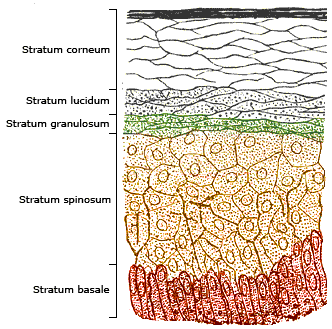
The skin consists of two primary layers: an inner layer, the dermis, comprising largely connective tissue, and an outer, thinner epidermis. The thickness of the epidermis ranges from 0.04 mm to greater than 0.6 mm. The epidermis comprises five strata; from outer to inner, they are the stratum corneum, stratum lucidum, stratum granulosum, stratum spinosum, and stratum basale. The highest concentrations of 7-dehydrocholesterol are found in the epidermal layer of skin—specifically in the stratum basale and stratum spinosum. The production of pre-vitamin D3 is, therefore, greatest in these two layers.
Radiation
Synthesis of pre-vitamin D3 in the skin involves UVB radiation, which effectively penetrates only the epidermal layers of skin. 7-Dehydrocholesterol absorbs UV light most effectively at wavelengths between 295 and 300 nm and, thus, the production of vitamin D3 will occur primarily at those wavelengths. The two most important factors that govern the generation of pre-vitamin D3 are the quantity (intensity) and quality (appropriate wavelength) of the UVB irradiation reaching the 7-dehydrocholesterol deep in the stratum basale and stratum spinosum. Light-emitting diodes (LEDs) can be used to produce the radiation.
Another important consideration is the quantity of 7-dehydrocholesterol present in the skin. Under normal circumstances, ample quantities of 7-dehydrocholesterol (about 25–50 μg/cm2 of skin) are available in the stratum spinosum and stratum basale of human skin to meet the body's vitamin D requirements. 7-DHC insufficiency has been proposed as an alternate cause for Vitamin D deficiency.
Sources
7-DHC can be produced by animals and plants via different pathways. It is not produced by fungi in significant amounts. It is made by some algae, but the pathway is poorly understood.
Industrially, 7-DHC generally comes from lanolin, and is used to produce vitamin D3 by UV exposure. Lichen (Cladonia rangiferina) is used to produce vegan D3.
7-DHC is used for vitamin D3 synthesis via lanosterol in land animals, via cycloartenol in plants, and in algae together with another provitamin D ergosterol for D2. In fungi solely ergosterol is used for synthesis of D2 via lanosterol.
Interactive pathway map
References
References
- (21 January 2007). "The American Heritage Stedman's Medical Dictionary". Houghton Mifflin Company.
- "7-dehydrocholesterol". Answers.com.
- (2012). "Thanks to one gene, this fly needs a cactus to escape Neverland". Not Exactly Rocket Science.
- (July 2003). "Lathosterolosis: an inborn error of human and murine cholesterol synthesis due to lathosterol 5-desaturase deficiency". Human Molecular Genetics.
- (July 2017). "Attenuation of UVR-induced vitamin D3 synthesis in a mouse model deleted for keratinocyte lathosterol 5-desaturase". The Journal of Steroid Biochemistry and Molecular Biology.
- (2022). "Epidermal thickness in healthy humans: a systematic review and meta-analysis". Journal of the European Academy of Dermatology and Venereology.
- (June 1998). "Sunlight, season, skin pigmentation, vitamin D, and 25-hydroxyvitamin D: integral components of the vitamin D endocrine system". The American Journal of Clinical Nutrition.
- (May 1982). "Spectral character of sunlight modulates photosynthesis of previtamin D3 and its photoisomers in human skin". Science.
- (September 2017). "Ultraviolet B Light Emitting Diodes (LEDs) Are More Efficient and Effective in Producing Vitamin D3 in Human Skin Compared to Natural Sunlight". Scientific Reports.
- (December 2019). "Provitamin D3 modulation through prebiotics supplementation: simulation based assessment". Scientific Reports.
- (2013). "Vitamin D in plants: a review of occurrence, analysis, and biosynthesis". Frontiers in Plant Science.
- (November 2005). "The vitamin D epidemic and its health consequences". The Journal of Nutrition.
- "Vitamin D".
- (1 July 2023). "Formulation of Lichen Based Pill a Natural Source of Vitamin D3 with a High Absorption Rate by Ambrosiya Neo-Medicine Pvt. Ltd". International Journal of Biomedical Investigation.
- (November 2018). "Vitamin D in Nature: A Product of Synthesis and/or Degradation of Cell Membrane Components". Biokhimiya (Moscow).
This article was imported from Wikipedia and is available under the Creative Commons Attribution-ShareAlike 4.0 License. Content has been adapted to SurfDoc format. Original contributors can be found on the article history page.
Ask Mako anything about 7-Dehydrocholesterol — get instant answers, deeper analysis, and related topics.
Research with MakoFree with your Surf account
Create a free account to save articles, ask Mako questions, and organize your research.
Sign up freeThis content may have been generated or modified by AI. CloudSurf Software LLC is not responsible for the accuracy, completeness, or reliability of AI-generated content. Always verify important information from primary sources.
Report