From Surf Wiki (app.surf) — the open knowledge base
6DJ8
Model of double triode vacuum tube
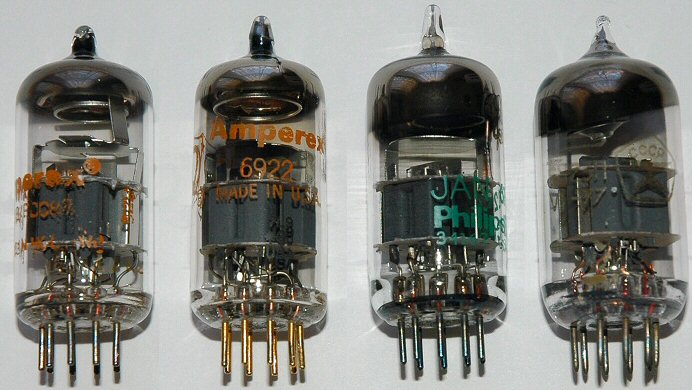
Model of double triode vacuum tube
The 6DJ8 is a miniature nine-pin medium-gain dual-triode vacuum tube. It is distinguished by its very high transconductance, mostly the result of its frame grid construction. Versions of the tube are named ECC88, E88CC, 6922, E188CC, CV4108, 7308, 6N1P and 6N23P.
Origins

The tube was developed by Philips in the Netherlands under European designation ECC88. The series-string version 7DJ8 / PCC88 was also introduced at the same time. The 6DJ8 was designed for use as a low-noise amplifier in VHF and UHF TV tuners, an improved successor to the usual 6BK7, but due to its high gain it was heavily used in high-end test equipment, for example, most high-quality oscilloscopes from the 1950s to the 1960s utilize a number of 6DJ8 tubes.
Audio

Although not originally designed for the purpose, it became popular in hi-fi audio amplifiers. European-produced version of the tube is designated ECC88. An industrial (improved/higher ratings) version of the tube was designated 6922 / E88CC between 1959 and 1961. Siemens introduced their own super ECC88 / 6DJ8 at the same time under CCa type. New Old Stock (NOS) 6DJ8s and ECC88s produced in the past by major American or West European vacuum tube manufacturers (such as Philips or Amperex) remain extremely popular with and highly sought by audiophiles. A version (direct equivalent) of this tube was also produced in the Soviet Union as 6N23P (Russian: 6Н23П).
the tube was being produced in three versions in Eastern Europe - Slovakia by JJ Electronic (ex-Tesla), and in Russia: 6DJ8 for Sovtek and 6922 for Electro-Harmonix.
References
http://tdsl.duncanamps.com/show.php?des=6DJ8 - 6DJ8 tube data at DuncanAmps.
This article was imported from Wikipedia and is available under the Creative Commons Attribution-ShareAlike 4.0 License. Content has been adapted to SurfDoc format. Original contributors can be found on the article history page.
Ask Mako anything about 6DJ8 — get instant answers, deeper analysis, and related topics.
Research with MakoFree with your Surf account
Create a free account to save articles, ask Mako questions, and organize your research.
Sign up freeThis content may have been generated or modified by AI. CloudSurf Software LLC is not responsible for the accuracy, completeness, or reliability of AI-generated content. Always verify important information from primary sources.
Report