From Surf Wiki (app.surf) — the open knowledge base
66391 Moshup
Binary near-Earth asteroid
Binary near-Earth asteroid
| Field | Value |
|---|---|
| minorplanet | yes |
| name | 66391 Moshup |
| background | #FFC2E0 |
| image | 1999kw4 vlt-eso1910.jpg |
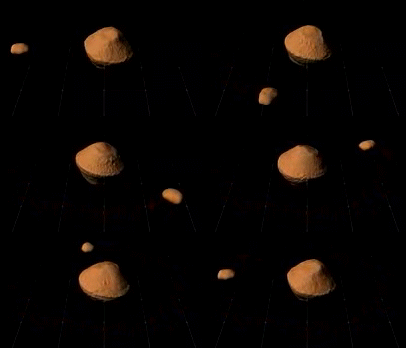
| caption | Moshup and its satellite Squannit imaged by the Very Large Telescope's SPHERE instrument |
| discovery_ref | |
| discovered | 20 May 1999 |
| discoverer | LINEAR |
| discovery_site | Lincoln Lab's ETS |
| alt_names | |
| pronounced | |
| named_after | Maushop |
| (native American legend) | |
| mp_category | AtenNEOPHA |
| Mercury-crosser | |
| Venus-crosser | |
| orbit_ref | |
| epoch | 4 September 2017 (JD 2458000.5) |
| uncertainty | 0 |
| observation_arc | 19.01 yr (6,942 days) |
| aphelion | 1.0845 AU |
| perihelion | 0.2000 AU |
| semimajor | 0.6422 AU |
| eccentricity | 0.6886 |
| period | 0.51 yr (188 days) |
| mean_anomaly | 359.03° |
| mean_motion | / day |
| inclination | 38.884° |
| asc_node | 244.91° |
| arg_peri | 192.62° |
| moid | 0.0138 AU5.4 LD |
| satellites | 1 (Squannit ) |
| dimensions | km |
| mean_diameter | |
| rotation | h |
| albedo | 0.26 (derived) |
| mass | |
| density | |
| spectral_type | SMASS=S |
| B–V= | |
| V–R= | |
| V–I= | |
| abs_magnitude | 16.5 |
(native American legend) Mercury-crosser Venus-crosser B–V= V–R= V–I=
66391 Moshup , provisional designation , is a binary asteroid, classified as a near-Earth object and potentially hazardous asteroid of the Aten group, approximately 1.3 kilometers in diameter. It was discovered on 20 May 1999, by Lincoln Near-Earth Asteroid Research (LINEAR) at the Lincoln Laboratory's Experimental Test Site in Socorro, New Mexico, United States. It is a Mercury-crosser that comes extremely close to the Sun at a perihelion of 0.2 AU.
Orbit
The asteroid orbits the Sun at a distance of 0.2–1.1 AU once every 6.18 months (188 days). Its orbit has an eccentricity of 0.69 and an inclination of 39° with respect to the ecliptic. A first precovery was taken by 2MASS at the Fred Lawrence Whipple Observatory in 1998, extending the body's observation arc by one year prior to its official discovery observation at Socorro.
As a potentially hazardous asteroid, it has an Earth minimum orbital intersection distance of 0.0138 AU, or 5.4 lunar distances. On 25 May 2036, it will pass 0.0155 AU from Earth.
Numbering and naming
This minor planet was numbered by the Minor Planet Center on 10 September 2003. It was named from Mohegan legend, after Moshup, a giant who lived in the coastal areas of New England. The asteroid's companion is named Squannit, after the wife of Moshup and a medicine woman of the Makiawisug (little people). The official was published by the Minor Planet Center on 27 August 2019 (M.P.C. 115894).
Physical characteristics
In the SMASS classification, the asteroid a characterized as a stony S-type asteroid.
Satellite
Main article: Squannit (moon)
Moshup has a minor-planet moon orbiting it. The moon, named Squannit , is approximately 360 metres in diameter, and orbits its primary every 16 hours at a mean distance of 2.6 kilometers. The presence of a companion was suggested by photometric observations made by Pravec and Šarounová and was confirmed by radar observations from Arecibo, announced on 23 May 2001 (also see below). Based on radar imaging, Squannit's dimensions are estimated to be meters.
Diameter and shape


According to radiometric observations from Arecibo Observatory, the asteroid has an effective mean diameter of 1.317 kilometers. The observations were taken from May 21–23, 2001, by Lance A. M. Benner, Steven J. Ostro, Jon D. Giorgini, Raymond F. Jurgens, Jean-Luc Margot and Michael C. Nolan.
The Collaborative Asteroid Lightcurve Link adopts a diameter of 1.3 kilometers and derives an albedo 0.26 with an absolute magnitude of 16.5.
The shapes of the two bodies and their dynamics are complex. With a dimension of approximately kilometers for a simple triaxial ellipsoid, the asteroid has an oblate shape, which is dominated by an equatorial ridge at the body's potential-energy minimum. This bizarre property of the equatorial region means that it is close to breakup: raising a particle a meter above the surface would put it into orbit. As seen in the image above, the gravitational effects between the moon and the asteroid create a gigantic mountain extending in the equatorial plane around the entire asteroid. It was the first asteroid to be described as "muffin-shaped", which is now understood to be a very common shape for asteroids in critical rotation, including 101955 Bennu and 162173 Ryugu.
Lightcurves
During 19–27 June 2000, a rotational lightcurve of this asteroid was obtained from photometric observations by Petr Pravec and Lenka Šarounová at Ondřejov Observatory. Lightcurve analysis gave a rotation period of 2.7650 hours with a brightness variation of 0.12 magnitude ().
References
- Margot, Jean-Luc, Radar observations of November 1999, retrieved July 2016
- Near-Earth Asteroid Is Two Chunks In One, NASA Jet Propulsion Laboratory, May 2001
- Asteroids with Satellites, Robert Johnston, johnstonsarchive.net
- 1999 KW4 orbit and observations at IAU Minor Planet Center
References
- NASA Jet Propulsion Laboratory [http://echo.jpl.nasa.gov/ Asteroid Radar Research] {{Webarchive. link. (2007-12-07 , retrieved May 3, 2007)
- (4 December 2006). "Scientist: Asteroid To Return In 2036".
- (2018). "The Nucleus of Active Asteroid 311P/(2013 P5) PANSTARRS". The Astronomical Journal.
This article was imported from Wikipedia and is available under the Creative Commons Attribution-ShareAlike 4.0 License. Content has been adapted to SurfDoc format. Original contributors can be found on the article history page.
Ask Mako anything about 66391 Moshup — get instant answers, deeper analysis, and related topics.
Research with MakoFree with your Surf account
Create a free account to save articles, ask Mako questions, and organize your research.
Sign up freeThis content may have been generated or modified by AI. CloudSurf Software LLC is not responsible for the accuracy, completeness, or reliability of AI-generated content. Always verify important information from primary sources.
Report