From Surf Wiki (app.surf) — the open knowledge base
65537-gon
Polygon with 65537 sides
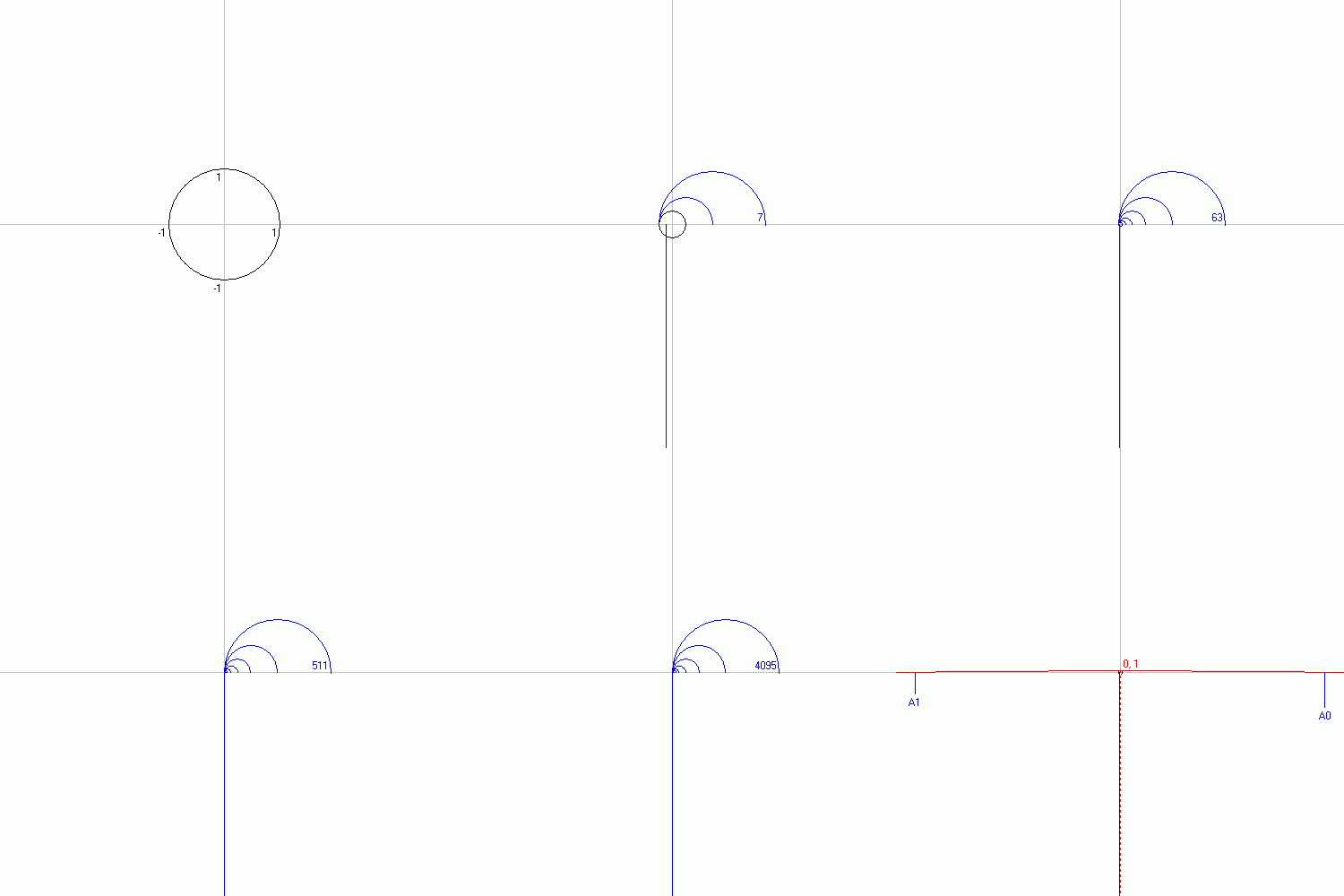
Polygon with 65537 sides
In geometry, a 65537-gon is a polygon with 65,537 (216 + 1) sides. The sum of the interior angles of any non-self-intersecting is 11796300°.
Regular 65537-gon
The area of a *regular * is (with ) :A = \frac{65537}{4} t^2 \cot \frac{\pi}{65537}
The perimeter of a regular differs from that of the circumscribed circle by about 15 parts per billion.
Construction
The regular 65537-gon (one with all sides equal and all angles equal) is of interest for being a constructible polygon: that is, it can be constructed using a compass and an unmarked straightedge. This is because 65,537 is a Fermat prime, being of the form 22n + 1 (in this case n = 4). Thus, the values \cos \frac{\pi}{65537} and \cos \frac{2\pi}{65537} are 32768-degree algebraic numbers, and like any constructible numbers, they can be written in terms of square roots and no higher-order roots.
Although it was known to Carl Friedrich Gauss by 1801 that the regular 65537-gon was constructible, the first explicit construction of a regular 65537-gon was given by Johann Gustav Hermes (1894). The construction is very complex; Hermes spent 10 years completing the 200-page manuscript. Another method involves the use of at most 1332 Carlyle circles, and the first stages of this method are pictured below. This method faces practical problems, as one of these Carlyle circles solves the quadratic equation x2 + x − 16384 = 0 (16384 being 214).
Symmetry
The regular 65537-gon has D65537 symmetry, order 131074. Since 65537 is a prime number there is one subgroup with dihedral symmetry: D1, and 2 cyclic group symmetries: Z65537, and Z1.
65537-gram
A 65537-gram is a 65,537-sided star polygon. As 65,537 is prime, there are 32,767 regular forms generated by Schläfli symbols {{65537}/{n}} for all integers 2 ≤ n ≤ 32768 as \left\lfloor \frac{65537}{2} \right\rfloor = 32768.
References
Bibliography
- Robert Dixon Mathographics. New York: Dover, p. 53, 1991.
- Benjamin Bold, Famous Problems of Geometry and How to Solve Them New York: Dover, p. 70, 1982.
- H. S. M. Coxeter Introduction to Geometry, 2nd ed. New York: Wiley, 1969. Chapter 2, Regular polygons
- Leonard Eugene Dickson Constructions with Ruler and Compasses; Regular Polygons Ch. 8 in Monographs on Topics of Modern Mathematics
- Relevant to the Elementary Field (Ed. J. W. A. Young). New York: Dover, pp. 352–386, 1955.
References
- Johann Gustav Hermes. (1894). "Über die Teilung des Kreises in 65537 gleiche Teile". Nachrichten von der Gesellschaft der Wissenschaften zu Göttingen, Mathematisch-Physikalische Klasse.
- DeTemple, Duane W.. (Feb 1991). "Carlyle circles and Lemoine simplicity of polygon constructions". The American Mathematical Monthly.
This article was imported from Wikipedia and is available under the Creative Commons Attribution-ShareAlike 4.0 License. Content has been adapted to SurfDoc format. Original contributors can be found on the article history page.
Ask Mako anything about 65537-gon — get instant answers, deeper analysis, and related topics.
Research with MakoFree with your Surf account
Create a free account to save articles, ask Mako questions, and organize your research.
Sign up freeThis content may have been generated or modified by AI. CloudSurf Software LLC is not responsible for the accuracy, completeness, or reliability of AI-generated content. Always verify important information from primary sources.
Report