From Surf Wiki (app.surf) — the open knowledge base
61 Virginis b
Hot super-Earth orbiting 61 Virginis
Hot super-Earth orbiting 61 Virginis
| Field | Value |
|---|---|
| name | 61 Virginis b |
| image | Artist concept 61vir b.png |
| caption | Artist's impression of 61 Virginis b as a hot super-Earth, with some sporadic volcanic activity. |
| discoverer | Vogt et al. |
| discovery_site | Keck Observatory |
| Anglo-Australian Observatory | |
| discovered | 14 December 2009 |
| discovery_method | Radial velocity |
| apsis | astron |
| aphelion | AU |
| perihelion | AU |
| semimajor | AU |
| eccentricity | |
| period | d |
| 101.16 h | |
| avg_speed | 130.01 |
| time_periastron | |
| arg_peri | |
| star | 61 Virginis |
| mass | ≥ 5.1 |
| mean_radius | ~1.6 |
| single_temperature | 1054 K |
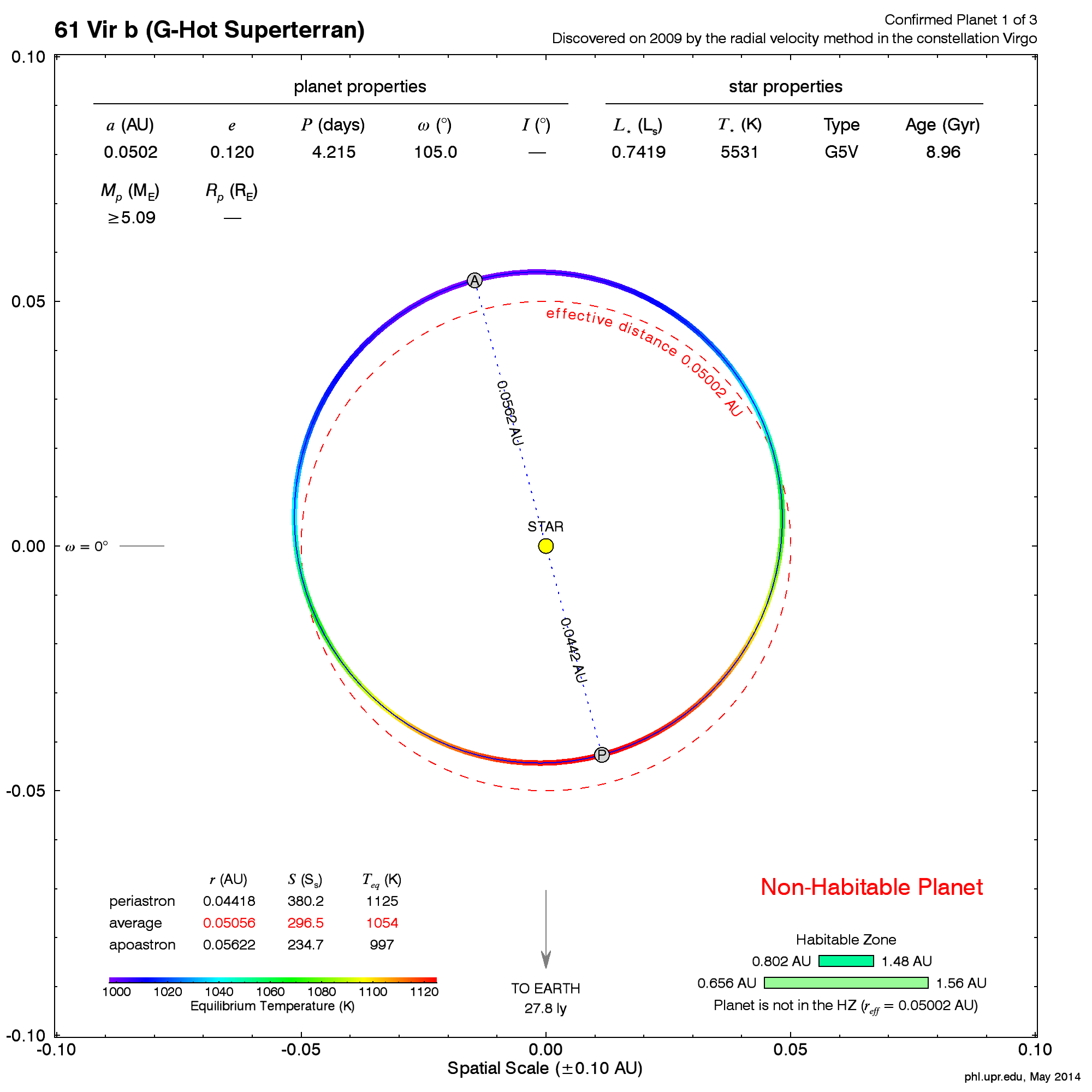
Anglo-Australian Observatory 101.16 h 61 Virginis b (abbreviated 61 Vir b) is an extrasolar planet, orbiting the 5th magnitude G-type star 61 Virginis, in Virgo. This planet has a minimum mass of 5.1 times that of Earth and is an example of a super-Earth planet. It orbits very close to the star, at a distance of 0.050201 AU with an eccentricity of 0.12. This planet was discovered on 14 December 2009 using the radial velocity method taken at Keck and Anglo-Australian Observatories.
Characteristics
Mass, radius and temperature
61 Virginis b is a super-Earth, an exoplanet with a radius and mass bigger than Earth, but smaller than that of the ice giants Neptune and Uranus. It has an equilibrium temperature of 1054 K. It has an estimated minimum mass of around 5.1 , and a potential radius of 1.6 , based on its mass.
Host star
The planet orbits a (G-type) star named 61 Virginis, orbited by a total of three planets. The star has a mass of 0.94 and a radius of 0.98 . It has a temperature of 5531 K and is about 8.96 billion years old. and has a temperature of 5778 K. The star has slightly less metals then the Sun, with a metallicity ([Fe/H]) of −0.03, or 94% of the solar amount. Its luminosity () is 80% that of the Sun.
The star's apparent magnitude, or how bright it appears from Earth's perspective, is 4.74. Therefore, it can be seen with the naked eye.
Orbit
61 Virginis b orbits its host star with an orbital period of 4.21 days at a distance of about 0.05 AU (compared to Mercury's from the Sun, which is 0.38 AU). It receives 296.5 times more sunlight that Earth does from the Sun.
The planet may be tidally locked meaning that there is a permanent day side and a permanent night side.
Discovery
The search for 61 Virginis b started when its host star was chosen an ideal target for a planet search using the radial velocity method (in which the gravitational pull of a planet on its star is measured by observing the resulting Doppler shift), as stellar activity would not overly mask or mimic Doppler spectroscopy measurements. It was also confirmed that 61 Virginis is neither a binary star nor a quickly rotating star, common false positives when searching for transiting planets.
Analysis of the resulting data found that the radial velocity variations most likely indicated the existence of a planet. The net result was an estimate of a 5.1 planetary companion orbiting the star at a distance of 0.05 AU with an eccentricity of 0.12.
An attempt to determine if the planet transits its host star using the Spitzer Space Telescope unfortunately failed due to technical issues related to the brightness of the star.
Look also at
- List of star systems within 25–30 light-years
References
References
- Vogt, Steven. (2010). "A Super-Earth and two Neptunes Orbiting the Nearby Sun-like star 61 Virginis". The Astrophysical Journal.
- Tim Stephens. (2009-12-14). "New planet discoveries suggest low-mass planets are common around nearby stars". UC Santa Cruz.
- (May 2014). "61 Vir b (G-Hot Spuerterran)".
- Fraser Cain. (16 September 2008). "How Old is the Sun?". [[Universe Today]].
- Fraser Cain. (15 September 2008). "Temperature of the Sun". Universe Today.
- (2017). "The Spitzer search for the transits of HARPS low-mass planets. II. Null results for 19 planets". Astronomy and Astrophysics.
This article was imported from Wikipedia and is available under the Creative Commons Attribution-ShareAlike 4.0 License. Content has been adapted to SurfDoc format. Original contributors can be found on the article history page.
Ask Mako anything about 61 Virginis b — get instant answers, deeper analysis, and related topics.
Research with MakoFree with your Surf account
Create a free account to save articles, ask Mako questions, and organize your research.
Sign up freeThis content may have been generated or modified by AI. CloudSurf Software LLC is not responsible for the accuracy, completeness, or reliability of AI-generated content. Always verify important information from primary sources.
Report