From Surf Wiki (app.surf) — the open knowledge base
6-APB
Psychoactive drug
Psychoactive drug
| Field | Value | |||
|---|---|---|---|---|
| Verifiedfields | changed | |||
| Watchedfields | changed | |||
| verifiedrevid | 477225566 | |||
| image | 6APB.svg | |||
| image_class | skin-invert-image | |||
| width | 250px | |||
| image2 | 6-APB molecule ball.png | |||
| image_class2 | bg-transparent | |||
| alt2 | Ball-and-stick model of the 6-APB molecule | |||
| width2 | 250px | |||
| routes_of_administration | Oral | |||
| class | Serotonin–norepinephrine–dopamine releasing agent; Serotonin [5-HT2 receptor](5-ht2-receptor) agonist; Entactogen; Stimulant; Psychedelic | |||
| legal_AU | S9 | |||
| legal_DE | Anlage II | |||
| legal_UK | Class B | |||
| legal_CA | Schedule III | |||
| legal_UN | Unscheduled | |||
| onset | 30–60 minutes | |||
| duration_of_action | 6–9 hours | |||
| CAS_number_Ref | ||||
| CAS_number | 286834-85-3 | |||
| CAS_supplemental | 286834-84-2 (HCl) | |||
| ATC_prefix | None | |||
| PubChem | 9794343 | |||
| ChemSpiderID_Ref | ||||
| ChemSpiderID | 7970110 | |||
| UNII_Ref | ||||
| UNII | 285VE60914 | |||
| synonyms | 6-(2-Aminopropyl)benzofuran | |||
| IUPAC_name | 1-(1-benzofuran-6-yl)propan-2-amine | |||
| C | 11 | H = 13 | N = 1 | O = 1 |
| SMILES | NC(C)CC1=CC(OC=C2)=C2C=C1 | |||
| StdInChI_Ref | ||||
| StdInChI | 1S/C11H13NO/c1-8(12)6-9-2-3-10-4-5-13-11(10)7-9/h2-5,7-8H,6,12H2,1H3 | |||
| StdInChIKey_Ref | ||||
| StdInChIKey | FQDAMYLMQQKPRX-UHFFFAOYSA-N |
| elimination_half-life =
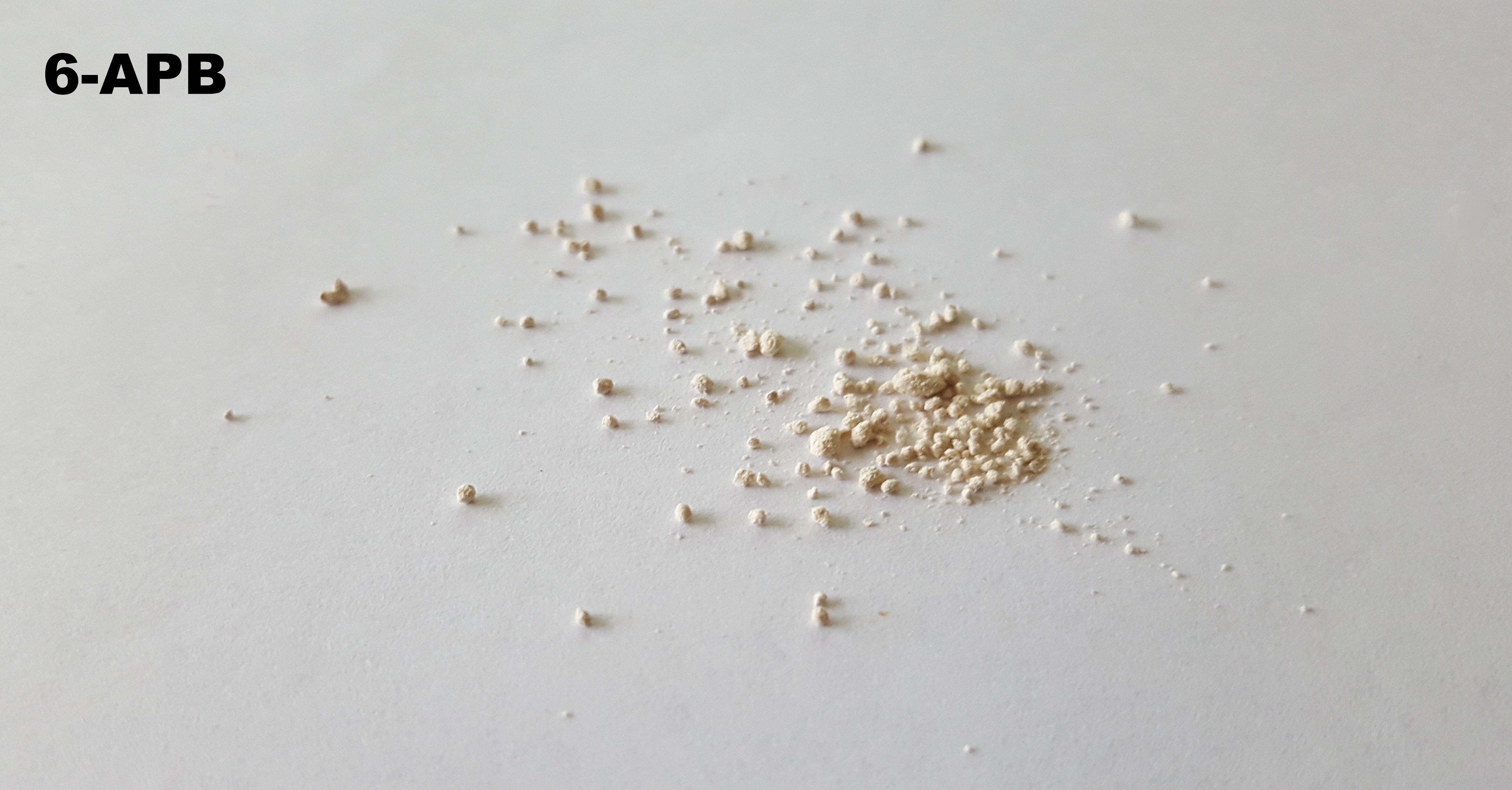
6-APB, also known as 6-(2-aminopropyl)benzofuran, is an entactogen of the phenethylamine, amphetamine, and benzofuran families. 6-APB and related drugs are sometimes informally called "Benzofury" in media reports. It is similar in structure to MDA, but differs in that the 3,4-methylenedioxyphenyl ring system has been replaced with a benzofuran ring. 6-APB is also the unsaturated benzofuran derivative of 6-APDB. It may appear as a tan or brown grainy powder.
While the drug never became particularly popular, it briefly entered the rave and underground clubbing scene in the UK before its sale and import were banned. It falls under the category of research chemicals, sometimes called "legal highs” if uncontrolled. Because 6-APB and other substituted benzofurans have not been explicitly outlawed in some countries, they are often technically legal, contributing to its popularity.
6-APB was first described in the scientific literature in 2000 and emerged as a novel designer drug in 2010.
Use and effects
6-APB is reported to produce entactogenic, stimulant, and mild psychedelic effects in humans.
Side effects
Acute psychosis has been associated with recreational use of 6-APB in combination with the synthetic cannabinoid JWH-122.
Interactions
Pharmacology
Pharmacodynamics
6-APB acts as a serotonin–norepinephrine–dopamine releasing agent (SNDRA), with values for monoamine release of 36nM for serotonin, 14nM for norepinephrine, and 10nM for dopamine in rat brain synaptosomes. Simultaneously, 6-APB is a serotonin–norepinephrine–dopamine reuptake inhibitor (SNDRI), with affinities (Ki) of 117nM for the norepinephrine transporter (NET), 150nM for the dopamine transporter (DAT), and 2,698nM for the serotonin transporter (SERT) as well as values for monoamine reuptake inhibition of 930nM for serotonin, 190nM for norepinephrine, and 3,300nM for dopamine.
In addition to actions at the monoamine transporters, 6-APB is a potent high-efficacy partial agonist or full agonist of the serotonin 5-HT2B receptor (Ki = 3.7nM; = 140nM; = 70%). It has higher affinity for this target than any other site. Moreover, unlike MDMA, 6-APB shows 100-fold selectivity for the serotonin 5-HT2B receptor over the serotonin 5-HT2A and 5-HT2C receptors in terms of affinity. It is notably both more potent and more selective as an agonist of the serotonin 5-HT2B receptor than the reference serotonin 5-HT2B receptor agonist, BW-723C86, which is commonly used for research into the serotonin 5-HT2B receptor. Although much more potent at the serotonin 5-HT2B receptor, 6-APB is also a partial agonist of the serotonin 5-HT2A receptor (EC50 = 5,900nM; Emax = 43%) and shows affinity for the serotonin 5-HT2C receptor (Ki = 270nM) and the serotonin 5-HT1A receptor (Ki = 1,500nM). It has been reported to act as an agonist of the serotonin 5-HT2C receptor similarly to the serotonin 5-HT2A and 5-HT2B receptors.
Besides the serotonin 5-HT2 receptors, 6-APB has been found to bind with high affinity to the α2C-adrenergic receptor (Ki = 45nM), although the significance of this action in humans is unknown. 6-APB showed little other affinity at a wide selection of other sites, with some exceptions like the rodent trace amine-associated receptor 1 (TAAR1).
The potent agonism of the serotonin 5-HT2B receptor makes it likely that 6-APB would be cardiotoxic with chronic or long-term use, as seen with other serotonin 5-HT2B receptor agonists such as the withdrawn serotonergic anorectic fenfluramine.
Pharmacokinetics
The pharmacokinetics of 6-APB have not been studied, however, some information can be extracted from user reports. These suggest a slow onset of 40 to 120minutes. The drugs peak effects last 7hours, followed by a comedown phase of approximately 2hours, and after effects for up to 24hours.
Metabolism
Although limited literature is available, there is some data on metabolism of 6-APB in rats. Its Phase I metabolism involves hydroxylation of the furan ring, then cleavage of the ring, followed by a reduction of the unsaturated aldehyde from the previous step. The resulting aldehyde may then take two paths. It is either oxidized to a carboxylic acid or reduced to an alcohol, and then hydroxylated. Phase II metabolism consists of glucuronidation. The most prevalent metabolites in rats were 3-carboxymethyl-4-hydroxyamphetamine and 4-carboxymethyl-3-hydroxyamphetamine.
Chemistry
6-APB, also known as 6-(2-aminopropyl)benzofuran, is a phenethylamine, amphetamine, and benzofuran and an analogue of 3,4-methylenedioxyamphetamine (MDA).
Synthesis

The chemical synthesis of 6-APB has been described. The synthesis by Briner and colleagues entailed refluxing 3-bromophenol with bromoacetaldehyde diethylacetal and sodium hydride to give the diethyl acetal, which then was heated with polyphosphoric acid to give a mixture of bromobenzofuran structural isomers: 4-bromo-1-benzofuran and 6-bromo-1-benzofuran. The isomers were separated by silica gel column chromatography, then converted to their respective propanone derivatives, and then reductively aminated to give 6-APB and 4-APB, both of which were converted to their HCl ion pairs for further examination.
Reagent results
6-APB and its structural isomer 5-APB have been tested with a series of agents including: Marquis, Liebermann, Mecke, and Froehde reagents. Exposing compounds to the reagents gives a colour change which is indicative of the compound under test.
| Compound | Marquis | Mecke | Mandelin | Liebermann | Froehde | Gallic | Ehrlich | Hofmann | Simon's | Folin |
|---|---|---|---|---|---|---|---|---|---|---|
| 6-APB | Purple | Purple to black | Purple to black | Black | Purple | Brown | Orange | Light orange | No reaction | Light orange |
| 6-APB succinate | Purple | Purple to black | Purple to black | Black | Purple | Brown | Faint orange | No reaction | No reaction | Light orange |
6-APB succinate is reported to be practically insoluble in CHCl3 as well as very minimally soluble in cold water. A batch seized by the DEA contained a 2:1 ratio of succinate to 6-APB.
Analogues
Analogues of 6-APB include MDA, 6-APDB, 6-MAPB, 5-APB, 6-APBT, and 6-API, among others.
History
6-APB, along with 5-APB, was first described in the scientific literature by Karin Briner and colleagues at Eli Lilly and Company in a patent in 2000. They were specifically studied as serotonin 5-HT2C receptor agonists for potential medical applications at this time. The description of 5-APB and 6-APB in the literature had followed the earlier work on 5-APDB and 6-APDB as serotonin releasing agents and entactogens by David E. Nichols and colleagues at Purdue University in 1993. 6-APB, along with 5-APB, emerged as a novel designer drug in 2010. 5-APB and 6-APB are often confused with 5-APDB and 6-APDB.
Society and culture
Legal status
Canada
In 1999, amphetamines were changed from Schedule III to Schedule I as a result of the Safe Streets Act. Some have speculated that 6-APB's structure qualifies it as a Schedule I drug as an analog of MDA.
In 2014, a study funded by the Canadian Institutes of Health Research noted that 6-APB "may or may not be legal in Canada depending on how one interprets the current Act" and that it could be purchased for academic purposes without an exemption from Health Canada. The study also noted how, unlike the MDMA it often serves as a replacement for in countries like the US, 6-APB's benzofuran structure does not make it a direct analogue of amphetamine despite similarities in effects.
China
6-APB has been a controlled substance in China since 1 July 2024
Finland
6-APB is scheduled in government decree on narcotic substances, preparations and plants and hence is illegal.
France
6-APB is illegal in France.
Germany
6-APB is illegal in Germany since the 17th of July, 2013, when it was added to Anlage II of the Betäubungsmittelgesetz.
Italy
6-APB is illegal in Italy.
Luxembourg
In Luxembourg, 6-APB is not cited in the list of prohibited substances. Therefore, it is still a legal substance.
Netherlands
6-APB, as well as multiple substances based on the phenylethamine structure, like most cathinones and amphetamines, are banned under the Opium Law since July 1st, 2025, following an amendment to deal with New Psychoactive Substances (NPS) in the Netherlands. Since this is a structural ban instead of a direct one, later substances that differ slightly but use the same skeleton will also be preemptively banned.
New Zealand and Australia
Certain countries contain a "substantially similar" catch-all clause in their drug law, such as New Zealand and Australia. This includes 6-APB as it is similar in chemical structure to the class A drug MDA, meaning 6-APB may be viewed as a controlled substance analogue in these jurisdictions.
Sweden
In Sweden, as of 27 December 2009 6-APB is classified as "health hazard" under the act Lagen om förbud mot vissa hälsofarliga varor (translated Act on the Prohibition of Certain Goods Dangerous to Health).
It is also classified as a narcotic substance since 2020.
United Kingdom
On June 10, 2013 6-APB and a number of analogues were classified as Temporary Class Drugs in the UK following an ACMD recommendation. This means that sale and import of the named substances are criminal offences and are treated as for class B drugs. On November 28, 2013 the ACMD recommended that 6-APB and related benzofurans should become Class B, Schedule 1 substances. On March 5, 2014 the UK Home Office announced that 6-APB would be made a class B drug on 10 June 2014 alongside every other benzofuran entactogen and many structurally related drugs.
United States
6-APB is not an explicitly controlled substance in the United States. However, it could be considered a controlled substance under the Federal Analogue Act if intended for human consumption.
References
References
- (May 2021). "Beyond ecstasy: Alternative entactogens to 3,4-methylenedioxymethamphetamine with potential applications in psychotherapy". J Psychopharmacol.
- Greene, Shaun L. (2013). "Novel Psychoactive Substances". Elsevier.
- Canal, Clinton E.. (2018). "New Psychoactive Substances". Springer International Publishing.
- (September 2013). "Acute psychosis associated with recreational use of benzofuran 6-(2-aminopropyl)benzofuran (6-APB) and cannabis". Journal of Medical Toxicology.
- (July 2015). "Pharmacological profile of novel psychoactive benzofurans". British Journal of Pharmacology.
- (January 2013). "Neurochemical profiles of some novel psychoactive substances". European Journal of Pharmacology.
- (January 2017). "2C receptor and the non-addictive nature of classic hallucinogens". Journal of Psychopharmacology.
- "Aminoalkylbenzofurans as serotonin (5-HT(2c)) agonists".
- "Aminoalkylbenzofurans as serotonin (5-HT(2c)) agonists".
- (December 2015). "Pharmacokinetics, pharmacodynamics and toxicology of new psychoactive substances (NPS): 2C-B, 4-fluoroamphetamine and benzofurans". Drug and Alcohol Dependence.
- "Results".
- (January 2012). "The Characterization of 6-(2-Aminopropyl)benzofuran and Differentiation from its 4-, 5-, and 7-Positional Analogues". Microgram Journal.
- (December 2020). "The psychoactive aminoalkylbenzofuran derivatives, 5-APB and 6-APB, mimic the effects of 3,4-methylenedioxyamphetamine (MDA) on monoamine transmission in male rats". Psychopharmacology (Berl).
- (August 2019). "Benzo fury: A new trend in the drug misuse scene". J Appl Toxicol.
- (April 2020). "Designer drugs: mechanism of action and adverse effects". Arch Toxicol.
- "Controlled Drugs and Substances Act : Definitions and Interpretations".
- (2014-04-16). "Ecstasy, legal highs and designer drug use: A Canadian perspective". [[Drug Science, Policy and Law]].
- National Medical Products Administration (NMPA) of China. (July 22, 2024). "关于将溴啡等46种物质列入《非药用类麻醉药品和精神药品管制品种增补目录》的公告".
- "Ajantasa".
- "Arrêté du 22 février 1990 fixant la liste des substances classées comme stupéfiants".
- "Nuove tabelle delle sostanze stupefacenti e psicotrope (DPR 309/90)". Ministero della Salute.
- "Loi du 19 février 1973 concernant la vente de substances médicamenteuses et la lutte contre la toxicomanie. - Legilux".
- (July 2025). "Lijst verboden Nieuwe Psychoactieve Stoffen (NPS) per 1 juli 2025".
- (7 November 2015). "Misuse of Drugs Act 1975". New Zealand Legislation.
- (24 November 2009). "Förordning (1999:58) om förbud mot vissa hälsofarliga varor". Lagbevakning med Notisum och Rättsnätet.
- "Förordning (1992:1554) om kontroll av narkotika".
- (4 June 2013). "Temporary class drug order on benzofury and NBOMe compounds - letter from ACMD". GOV.UK.
- (4 June 2013). "'NBOMe' and 'Benzofury' banned". Home Office.
- UK Home Office. (28 April 2014). "The Misuse of Drugs Act 1971 (Ketamine etc.) (Amendment) Order 2014". The National Archives.
- (January 2026). "Orange Book: List of Controlled Substances and Regulated Chemicals (January 2026)". U.S. [[Department of Justice]]: [[Drug Enforcement Administration]] (DEA): Diversion Control Division.
- (January 2011). "The characterization of 5-and 6-(2-aminopropyl)-2, 3-dihydrobenzofuran.". Microgram J..
This article was imported from Wikipedia and is available under the Creative Commons Attribution-ShareAlike 4.0 License. Content has been adapted to SurfDoc format. Original contributors can be found on the article history page.
Ask Mako anything about 6-APB — get instant answers, deeper analysis, and related topics.
Research with MakoFree with your Surf account
Create a free account to save articles, ask Mako questions, and organize your research.
Sign up freeThis content may have been generated or modified by AI. CloudSurf Software LLC is not responsible for the accuracy, completeness, or reliability of AI-generated content. Always verify important information from primary sources.
Report