From Surf Wiki (app.surf) — the open knowledge base
6
Natural number
Natural number
| Field | Value | |||||||
|---|---|---|---|---|---|---|---|---|
| number | 6 | |||||||
| numeral | senary | |||||||
| divisor | 1, 2, 3, 6 | |||||||
| roman | VI, vi, ↅ | |||||||
| greek prefix | hexa-/hex- | |||||||
| latin prefix | sexa-/sex- | |||||||
| lang1 | Greek | |||||||
| lang1 symbol | στ (or ΣΤ or ς) | |||||||
| lang2 | Arabic, Kurdish, Sindhi, Urdu | lang2 symbol= | ||||||
| lang3 | Persian | |||||||
| lang3 symbol | ||||||||
| lang4 | Amharic | |||||||
| lang4 symbol | ፮ | |||||||
| lang5 | Bengali | |||||||
| lang5 symbol | ||||||||
| lang6 | Chinese numeral | |||||||
| lang6 symbol | 六,陸 | |||||||
| lang7 | Devanāgarī | |||||||
| lang7 symbol | ||||||||
| lang8 | Santali | |||||||
| lang8 symbol | ||||||||
| lang9 | Gujarati | |||||||
| lang9 symbol | ||||||||
| lang10 | Hebrew | |||||||
| lang10 symbol | ||||||||
| lang11 | Khmer | |||||||
| lang11 symbol | ៦ | |||||||
| lang12 | Thai | |||||||
| lang12 symbol | ๖ | |||||||
| lang13 | Telugu | |||||||
| lang13 symbol | ౬ | |||||||
| lang14 | Tamil | |||||||
| lang14 symbol | ௬ | |||||||
| lang15 | Saraiki | |||||||
| lang15 symbol | ||||||||
| lang16 | Malayalam | |||||||
| lang16 symbol | ൬ | |||||||
| lang17 | Armenian | lang17 symbol=Զ | lang18=Babylonian numeral | lang18 symbol=𒐚 | lang19=Egyptian hieroglyph | lang19 symbol= | lang20=Morse code | lang20 symbol= |
the number
6 (six) is the natural number following 5 and preceding 7. It is a composite number and the smallest perfect number.
In mathematics
A six-sided polygon is a hexagon, one of the three regular polygons capable of tiling the plane. A hexagon also has 6 edges as well as 6 internal and external angles.
6 is the second smallest composite number. It is also the first number that is the sum of its proper divisors, making it the smallest perfect number. It is also the only perfect number that doesn't have a digital root of 1. 6 is the first unitary perfect number, since it is the sum of its positive proper unitary divisors, without including itself. Only five such numbers are known to exist. 6 is the largest of the four all-Harshad numbers.
6 is the 2nd superior highly composite number, the 2nd colossally abundant number, the 3rd triangular number, the 4th highly composite number, a pronic number, a congruent number, a harmonic divisor number, and a semiprime. 6 is also the first Granville number, or \mathcal{S}-perfect number. A Golomb ruler of length 6 is a "perfect ruler".
The six exponentials theorem guarantees that under certain conditions one of a set of six exponentials is transcendental. The smallest non-abelian group is the symmetric group \mathrm {S_{3}} which has 3! = 6 elements. 6 the answer to the two-dimensional kissing number problem.
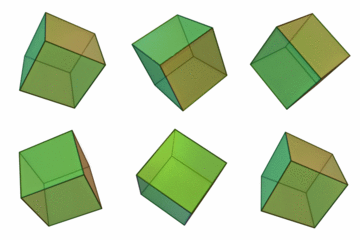
A cube has 6 faces. A tetrahedron has 6 edges. In four dimensions, there are a total of six convex regular polytopes.
In the classification of finite simple groups, twenty of twenty-six sporadic groups in the happy family are part of three families of groups which divide the order of the friendly giant, the largest sporadic group: five first generation Mathieu groups, seven second generation subquotients of the Leech lattice, and eight third generation subgroups of the friendly giant. The remaining six sporadic groups do not divide the order of the friendly giant, which are termed the pariahs (Ly, O'N, Ru, J4, J3, and J1).
6 is the smallest integer which is not an exponent of a prime number, making it the smallest integer greater than 1 for which there does not exist a finite field of that size.
List of basic calculations
| Multiplication | 1 | 2 | 3 | 4 | 5 | 6 | 7 | 8 | 9 | 10 | 11 | 12 | 13 | 14 | 15 | 16 | 17 | 18 | 19 | 20 | 25 | 50 | 100 | 1000 |
|---|---|---|---|---|---|---|---|---|---|---|---|---|---|---|---|---|---|---|---|---|---|---|---|---|
| '*6 × *x''''' | **6** | [12](12-number) | [18](18-number) | [24](24-number) | [30](30-number) | [36](36-number) | [42](42-number) | [48](48-number) | [54](54-number) | [60](60-number) | [66](66-number) | [72](72-number) | [78](78-number) | [84](84-number) | [90](90-number) | [96](96-number) | [102](102-number) | [108](108-number) | [114](114-number) | [120](120-number) | [150](150-number) | [300](300-number) | [600](600-number) | [6000](6000-number) |
| Division | 1 | 2 | 3 | 4 | 5 | 6 | 7 | 8 | 9 | 10 | 11 | 12 | 13 | 14 | 15 |
|---|---|---|---|---|---|---|---|---|---|---|---|---|---|---|---|
| '*6 ÷ *x''''' | **6** | 3 | 2 | 1.5 | 1.2 | 1 | 0. | 0.75 | 0. | 0.6 | 0. | 0.5 | 0. | 0. | 0.4 |
| ***x* ÷ 6** | 0.1 | 0. | 0.5 | 0. | 0.8 | 1 | 1.1 | 1. | 1.5 | 1. | 1.8 | 2 | 2.1 | 2. | 2.5 |
| Exponentiation | 1 | 2 | 3 | 4 | 5 | 6 | 7 | 8 | 9 | 10 | 11 | 12 | 13 |
|---|---|---|---|---|---|---|---|---|---|---|---|---|---|
| **6** | **6** | 36 | [216](216-number) | 1296 | 7776 | 46656 | 279936 | 1679616 | 10077696 | 60466176 | 362797056 | 2176782336 | 13060694016 |
| ***x*** | 1 | [64](64-number) | 729 | 4096 | 15625 | 46656 | 117649 | 262144 | 531441 | [1000000](1000000-number) | 1771561 | 2985984 | 4826809 |
Greek and Latin word parts
''{{lang|grc-Latn|Hexa}}''
Hexa is classical Greek for "six". Thus:
- "Hexadecimal" combines hexa- with the Latinate decimal to name a number base of 16
- A hexagon is a regular polygon with six sides
- L'Hexagone is a French nickname for the continental part of Metropolitan France for its resemblance to a regular hexagon
- A hexahedron is a polyhedron with six faces, with a cube being a special case
- Hexameter is a poetic form consisting of six feet per line
- A "hex nut" is a nut with six sides, and a hex bolt has a six-sided head
- The prefix "hexa-" also occurs in the systematic name of many chemical compounds, such as hexane which has 6 carbon atoms ().
The prefix ''sex-''
Sex- is a Latin prefix meaning "six". Thus:
- Senary is the ordinal adjective meaning "sixth"
- People with sexdactyly have six fingers on each hand
- The measuring instrument called a sextant got its name because its shape forms one-sixth of a whole circle
- A group of six musicians is called a sextet
- Six babies delivered in one birth are sextuplets
- Sexy prime pairs – Prime pairs differing by six are sexy, because sex is the Latin word for six.
The SI prefix for 10006 is exa- (E), and for its reciprocal atto- (a).
Evolution of the Hindu-Arabic digit
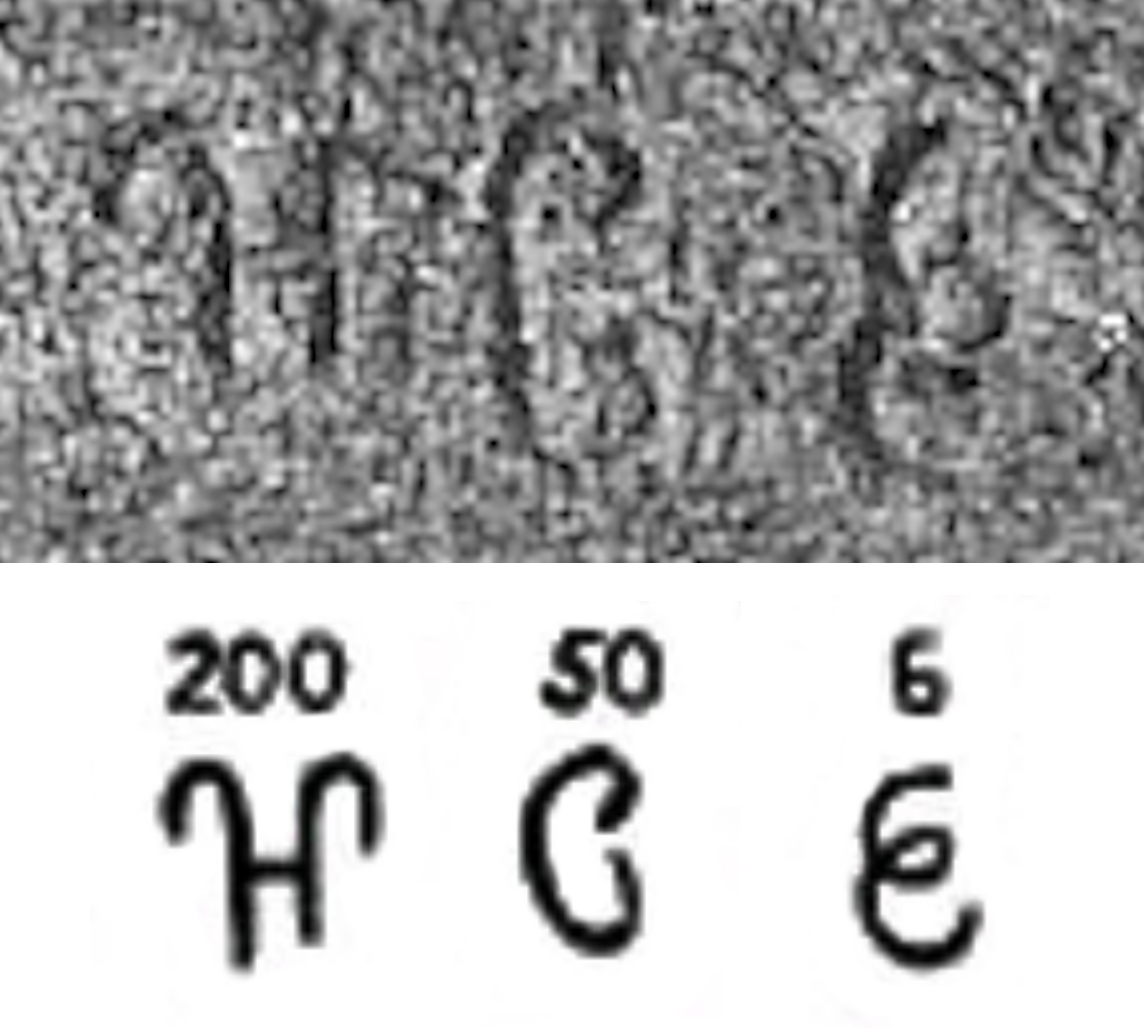
The evolution of the modern digit 6 appears to be more simple when compared with the other digits. The modern 6 can be traced back to the Brahmi numerals of India, which are first known from the Edicts of Ashoka . It was written in one stroke like a cursive lowercase e rotated 90 degrees clockwise. Gradually, the upper part of the stroke (above the central squiggle) became more curved, while the lower part of the stroke (below the central squiggle) became straighter. The Arabs dropped the part of the stroke below the squiggle. From there, the European evolution to our modern 6 was very straightforward, aside from a flirtation with a glyph that looked more like an uppercase G.
On the seven-segment displays of calculators and watches, 6 is usually written with six segments. Some historical calculator models use just five segments for the 6, by omitting the top horizontal bar. This glyph variant has not caught on; for calculators that can display results in hexadecimal, a 6 that looks like a "b" is not practical.
Just as in most modern typefaces, in typefaces with text figures the character for the digit 6 usually has an ascender, as, for example, in [[File:Text figures 036.svg|52px]].
This digit resembles an inverted 9. To disambiguate the two on objects and documents that can be inverted, the 6 has often been underlined, both in handwriting and on printed labels.
Chemistry
- The sixfold symmetry of snowflakes arises from the hexagonal crystal structure of ordinary ice.
Anthropology
- A coffin is traditionally buried six feet under the ground; thus, the phrase "six feet under" means that a person (or thing, or concept) is dead.
- Six is a lucky number in Chinese culture.
- "Six" is used as an informal slang term for the British Secret Intelligence Service, MI6.
Buddhism
Buddhism describes six realms of existence or realms into which beings can be reborn according to their deeds. They are visualised on the Tibetan wheel of life and illustrate the perpetual cyclical existence in samsara. The six perfections or "six paramitas" are among the best-known Buddhist symbols of the six. In Mahayana Buddhism, these are fundamental spiritual qualities on the path of the bodhisattva to achieve nirvana.
References
- {{cite journal
- A Property of the Number Six, Chapter 6, P Cameron, JH v. Lint, Designs, Graphs, Codes and their Links
- Wells, D. The Penguin Dictionary of Curious and Interesting Numbers London: Penguin Group. (1987): 67 - 69
References
- Weisstein, Eric W.. "6".
- Higgins, Peter. (2008). "Number Story: From Counting to Cryptography". Copernicus.
- Weisstein, Eric W.. "Perfect Number".
- {{Cite OEIS. A002827. Unitary perfect numbers
- Weisstein, Eric W.. "Harshad Number".
- "A002201 - OEIS".
- "A004490 - OEIS".
- "A000217 - OEIS".
- "A002182 - OEIS".
- "Sloane's A002378: Pronic numbers". OEIS Foundation.
- {{Cite OEIS. A003273. Congruent numbers
- "A001599 - OEIS".
- {{Cite OEIS. A001358. Semiprimes (or biprimes): products of two primes.
- Bryan Bunch, ''The Kingdom of Infinite Number''. New York: W. H. Freeman & Company (2000): 72
- Weisstein, Eric W.. "Six Exponentials Theorem".
- Weisstein, Eric W.. "Kissing Number".
- Griess, Jr., Robert L.. (1982). "The Friendly Giant". [[Inventiones Mathematicae]].
- (2009). "Abstract algebra". Wiley.
- Weisstein, Eric W.. "Hexadecimal".
- Weisstein, Eric W.. "Hexagon".
- Weisstein, Eric W.. "Hexahedron".
- Weisstein, Eric W.. "Base".
- (2009). "Prime Curios!: The Dictionary of Prime Number Trivia". CreateSpace Independent Publishing Platform.
- Weisstein, Eric W.. "Sexy Primes".
- (2014). "Makers of Mathematics". Courier Corporation.
- (2009). "The Britannica Guide to Theories and Ideas That Changed the Modern World". Britannica Educational Publishing.
- (2014). "Taming the Unknown: A History of Algebra from Antiquity to the Early Twentieth Century". Princeton University Press.
- (2002). "777 Mathematical Conversation Starters". MAA.
- Georges Ifrah, ''The Universal History of Numbers: From Prehistory to the Invention of the Computer'' transl. David Bellos et al. London: The Harvill Press (1998): 395, Fig. 24.66
- Negru, John. (1988). "Computer Typesetting". Van Nostrand Reinhold.
- (2004-05-25). "Out of this World: Colliding Universes, Branes, Strings, and Other Wild Ideas of Modern Physics". Springer Science & Business Media.
- Rimes, Wendy. (2016-04-01). "The Reason Why The Dead Are Buried Six Feet Below The Ground".
- "Chinese Numbers 1 to 10. maayot". ''maayot • Bite-size daily Chinese stories''. 2021-11-22. Retrieved 2025-01-17.
- Smith, Michael. (2011-10-31). "Six: The Real James Bonds 1909-1939". Biteback Publishing.
This article was imported from Wikipedia and is available under the Creative Commons Attribution-ShareAlike 4.0 License. Content has been adapted to SurfDoc format. Original contributors can be found on the article history page.
Ask Mako anything about 6 — get instant answers, deeper analysis, and related topics.
Research with MakoFree with your Surf account
Create a free account to save articles, ask Mako questions, and organize your research.
Sign up freeThis content may have been generated or modified by AI. CloudSurf Software LLC is not responsible for the accuracy, completeness, or reliability of AI-generated content. Always verify important information from primary sources.
Report