From Surf Wiki (app.surf) — the open knowledge base
586th Flight Test Squadron

| Field | Value | |
|---|---|---|
| unit_name | 586th Flight Test Squadron | |
| image | 586th Flight Test Squadron - C-12 Huron.jpg | |
| image_size | 300 | |
| caption | 586th Flight Test Squadron C-12 Huron | |
| dates | 1943-1946; 1982-present | |
| country | ||
| branch | ||
| role | Flight test | |
| command_structure | Air Force Materiel Command | |
| garrison | Holloman Air Force Base | |
| battles | European Theater of Operations | |
| decorations | Distinguished Unit Citation | |
| Air Force Meritorious Unit Award | ||
| Air Force Outstanding Unit Award | ||
| French Croix de Guerre w/ Palm | ||
| identification_symbol | [[File:586 Flight Test Sq emblem.png | 150px]] |
| identification_symbol_label | 586th Flight Test Squadron emblem | |
| identification_symbol_2 | [[File:6586 Test Sq emblem.png | 150px]] |
| identification_symbol_2_label | 6586th Test Squadron emblem | |
| identification_symbol_3 | [[File:586th Bombardment Squadron - Emblem.png | 150px]] |
| identification_symbol_3_label | 586th Bombardment Squadron emblem | |
| identification_symbol_4 | **H9** | |
| identification_symbol_4_label | World War II fuselage code |
Air Force Meritorious Unit Award Air Force Outstanding Unit Award French Croix de Guerre w/ Palm
The 586th Flight Test Squadron is a United States Air Force unit, stationed at Holloman Air Force Base, New Mexico.
The squadron's first predecessor is the 586th Bombardment Squadron, a Martin B-26 Marauder unit that was organized and trained in the United States during World War II. It flew combat missions in the European Theater of Operations, where it earned a Distinguished Unit Citation and a French Croix de Guerre with Palm. After V-E Day, it served with the occupation forces in Germany until returning to the United States and inactivating at Bolling Field, District of Columbia on 31 March 1946.
Its second predecessor is the 6586th Test Squadron, which was organized in December 1982 to perform flight testing with a number of electronic systems. In 1992, the two squadrons were consolidated as the 586th Test Squadron.
Mission
The squadron "plans, analyzes, coordinates and conducts flight tests of advanced weapons and avionics systems primarily on the White Sands Missile Range. It provides deployable operational support for test aircraft [operating from] Holloman Air Force Base. The squadron flight tests guidance systems, laser systems, air-to-air and air-to-ground systems, long-range and standoff weapons, live warheads, and provides target and photo/safety chase. It operates three highly modified Northrop AT-38B Talon and one Beechcraft C-12J Huron aircraft."
History
World War II

Training in the United States
The squadron's first predecessor, the 586th Bombardment Squadron, was activated at MacDill Field, Florida as one of the original four squadrons of the 394th Bombardment Group. It began to train with the Martin B-26 Marauder, performing most of its training at Kellogg Field, Michigan. It departed for the European Theater of Operations (ETO) in mid-February 1944.
Combat in Europe
The squadron was established at RAF Boreham, which was to be its station until after D-Day, in mid March, It helped prepare for the invasion of Normandy by participating in Operation Crossbow, striking V-1 flying bomb and V-2 rocket launch sites. It also carried out attacks on marshalling yards, bridges, gun emplacements and airfields. Not all targets were near the intended invasion landing areas. For example, in April, the squadron participated in a heavy attack on the marshalling yard at Mechlen, Belgium. Later that month, it encountered particularly heavy flak in an attack on Heuringhem, in which the airplane leading the group formation received 264 holes. However, bombing results were not as accurate as desired, and the squadron was removed from operations for a week for additional training. On D-Day it attacked gun emplacements at Cherbourg, afterwards striking lines of communications, fuel storage sites and enemy strong points.
The squadron moved to RAF Holmsley South on 24 July, in a general move by the units of the 98th Bombardment Wing to bases closer to the invasion area, and on the following day supported Operation Cobra, the breakout at Saint Lo. Between 7 and 9 August, the squadron made five attacks on strongly defended targets in northern France. This operation resulted in the award of the Distinguished Unit Citation to the squadron. Later that month, the squadron moved to its first base on the continent, Tour-en-Bessin Airfield, in France. From this base, the 586th attacked strong points at Brest, France and later began attacking targets in Germany from its bases on the continent. During the Battle of the Bulge, the squadron attacked lines of communications to prevent reinforcements from reaching the attacking German forces. it participated in Operation Clarion, intended to destroy the remaining elements of the German transportation system. In addition to attacking transportation and storage facilities, toward the end of the war, the squadron dropped propaganda leaflets over occupied territory, which included the squadron's last combat mission.
Occupation and inactivation
Following V-E Day, the squadron moved to Kitzingen Airfield, Germany, where it became part of the Army of Occupation. In December, it began to transition into the Douglas A-26 Invader. However, most personnel were rotating home for separation from the military, and in February, the squadron was transferred on paper to Bolling Field, District of Columbia and was inactivated there at the end of March.
Test operations
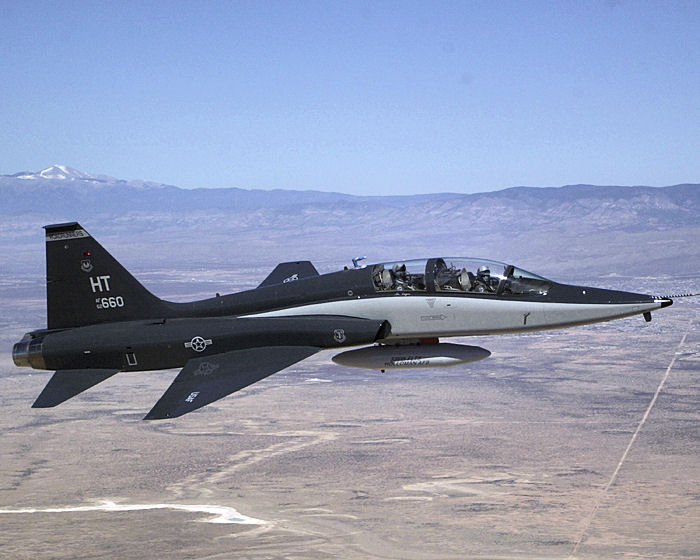
The second predecessor of the squadron was activated at Holloman Air Force Base in December 1982 as the 6586th Test Squadron. It provided operational and maintenance support for all Department of Defense (DOD) test aircraft staging out of Holloman Air Force Base from 1982 until 1990. Starting in 1991, it flew developmental test and evaluation missions and has supported DOD test flights on the White Sands Missile Range.
The squadron operates three AT-38B and one C-12J aircraft. The T-38s are modified for test, test support, target, and photo and safety chase missions. They are equipped with chaff, flares, Global Positioning System (GPS) navigation, precision data recording and telemetry and electronic countermeasures. They are equipped with an internal fighter instrumentation and navigation system which uses inertial navigation and GPS inputs. They can simulate towed targets, threat and cruise missiles. They have air combat maneuvering Instrumentation pods, and multiple format photographic capability. For specialized tests, test equipment can be mounted and installed in place of the rear ejection seat or externally in a pod. The centerline pylon can also carry operational stores.
The C-12J, a modified Beech 1900C, is a low cost testbed aircraft used for evaluating navigation and guidance components and systems. It also provides slow speed photo and safety chase. Its onboard time space position instrumentation provides a reference for systems under test. Electrical power is available for onboard test equipment. It can carry up to four fully powered, independent test racks with an operator for each rack. Each test rack is configurable with customer equipment. Antenna modifications include 2 controlled and 3 fixed Radiated Pattern Antennas, a C Band Beacon antenna, and a dedicated ultra high frequency antenna for test communication radio. It can deploy for off-station requirements.
In October 1992, the two squadrons were consolidated as the 586th Test Squadron. The squadron was renamed in 1994 as a flight test unit.
Lineage
; 586th Bombardment Squadron
- Constituted as the 586th Bombardment Squadron (Medium) on 15 February 1943 : Activated on 5 March 1943 : Redesignated 586th Bombardment Squadron, Medium on 9 October 1944 : Redesignated 586th Bombardment Squadron, Light on 3 December 1945 : Inactivated on 31 March 1946
- Consolidated with the 6586th Test Squadron on 1 October 1982
; 586th Test Squadron
- Designated as the 6586th Test Squadron on 15 December 1982 and activated
- Consolidated with the 586th Bombardment Squadron and redesignated 586th Test Squadron on 1 October 1992 : Redesignated 586th Flight Test Squadron on 15 March 1994
Assignments
- 394th Bombardment Group, 5 March 1943 - 31 March 1946
- 6585th Test Group (later 46th Test Group), 15 December 1982
- 96th Test Group, 1 October 2012
- 704th Test Group, 1 December 2016 – present
Stations
- MacDill Field, Florida, 5 March 1943
- Ardmore Army Air Field, Oklahoma, 12 July 1943
- Kellogg Field, Michigan, 19 August 1943 – 15 February 1944
- RAF Boreham (AAF-161), England c. 11 March 1944
- RAF Holmsley South (AAF-455), England, 24 July 1944
- Tour-en-Bessin Airfield (A-13), France, 25 August 1944
- Orleans/Bricy Airfield (A-50), France, 18 September 1944
- Cambrai/Niergnies Airfield (A-74), France, 8 October 1944
- Venlo Airfield (Y-55), Netherlands, 2 May 1945
- AAF Station Kitzingen (R-6), Germany, September 1945 – 15 February 1946
- Bolling Field, District of Columbia, 15 February 1946 – 31 March 1946
- Holloman Air Force Base, New Mexico, 15 Dec 1982 – present
Aircraft
- Martin B-26 Marauder, 1943-1945
- Douglas A-26 Invader, 1945-1946
- Northrop AT-38 Talon, 1991–present
- Beechcraft C-12J Huron, 1997–present
Awards and campaigns
| Campaign Streamer | Campaign | Dates | Notes | |
|---|---|---|---|---|
| [[Image:Streamer EAMEC.PNG | 200px]] | Air Offensive, Europe | 11 March 1944 – 5 June 1944 | 586th Bombardment Squadron |
| [[Image:Streamer EAMEC.PNG | 200px]] | Normandy | 6 June 1944 – 24 July 1944 | 586th Bombardment Squadron |
| [[Image:Streamer EAMEC.PNG | 200px]] | Northern France | 25 July 1944 – 14 September 1944 | 586th Bombardment Squadron |
| [[Image:Streamer EAMEC.PNG | 200px]] | Rhineland | 15 September 1944 – 21 March 1945 | 586th Bombardment Squadron |
| [[Image:Streamer EAMEC.PNG | 200px]] | Ardennes-Alsace | 16 December 1944 – 25 January 1945 | 586th Bombardment Squadron |
| [[Image:Streamer EAMEC.PNG | 200px]] | Central Europe | 22 March 1944 – 21 May 1945 | 586th Bombardment Squadron |
References
Notes
; Explanatory notes
; Citations
Bibliography
References
- (July 21, 2021). "Factsheet 586 Flight Test Squadron (AFMC)". Air Force Historical Research Agency.
- Endicott, p. 874
- Maurer, ''Combat Squadrons'', p. 674
- Watkins, p. 110
- No byline. (November 2, 2010). "Holloman AFB Fact Sheets: 586th Flight Test Squadron". 49th Fighter Wing Public Affairs.
- Maurer, ''Combat Units'', pp. 281-282
- Maurer, ''Combat Squadrons'', pp. 672-675
- Rust, p. 65
- Rust, p. 66
- Rust, p. 91
- Rust, p. 148
- Rust, p. 171
- Station number in Anderson, p. 22.
- Station number in Anderson, p. 31.
- Station number in Johnson, p. 14.
- Station number in Johnson, p. 18.
- Station number in Johnson, p. 21.
- Station number in Johnson, p. 30.
- Station number in Johnson, p. 35.
- Station information in Robertson, except as noted.
This article was imported from Wikipedia and is available under the Creative Commons Attribution-ShareAlike 4.0 License. Content has been adapted to SurfDoc format. Original contributors can be found on the article history page.
Ask Mako anything about 586th Flight Test Squadron — get instant answers, deeper analysis, and related topics.
Research with MakoFree with your Surf account
Create a free account to save articles, ask Mako questions, and organize your research.
Sign up freeThis content may have been generated or modified by AI. CloudSurf Software LLC is not responsible for the accuracy, completeness, or reliability of AI-generated content. Always verify important information from primary sources.
Report