From Surf Wiki (app.surf) — the open knowledge base
53rd (Welsh) Infantry Division
World War-era British Army formation
World War-era British Army formation
| Field | Value | |
|---|---|---|
| unit_name | Welsh Division | |
| 53rd (Welsh) Division | ||
| 53rd (Welsh) Infantry Division | ||
| image | 53 inf div -vector.svg | |
| caption | Formation patch of the 53rd (Welsh) Division, Second World War | |
| dates | 1908–1919 | |
| 1920–1945 | ||
| country | United Kingdom | |
| branch | [[File:Flag of the British Army.svg | 23px]] Territorial Army |
| type | Infantry | |
| size | Division | |
| garrison | Shrewsbury | |
| garrison_label | Peacetime HQ | |
| battles | ||
| battle_honours | First World War: | |
| notable_commanders | Archibald Montgomery-Massingberd | |
| Gerard Bucknall | ||
| Robert Knox Ross |
53rd (Welsh) Division 53rd (Welsh) Infantry Division 1920–1945
- First World War:
- Gallipoli Campaign
- First Battle of Gaza
- Second World War:
- Battle of Normandy
- Falaise Pocket
- Battle of the Bulge
- Battle of the Reichswald
- Battle of Gallipoli
- Battle of Sari Bair
- First Battle of Gaza
- Battle of Beersheba (1917)
- Battle of Mughar Ridge
- Battle of Jerusalem (1917)
- Battle of Megiddo (1918) Second World War:
- Battle of Normandy
- Battle of Falaise
- Battle of the Bulge
- Battle of the Reichswald
- Crossing of the Rhine Gerard Bucknall Robert Knox Ross The 53rd (Welsh) Infantry Division was an infantry division of the British Army that fought in both the First and Second World Wars. Originally raised in 1908 as the Welsh Division, part of the Territorial Force (TF), the division saw service in First World War, being designated 53rd (Welsh) Division in mid-1915, and fought in the Gallipoli Campaign and in the Middle East. Remaining active in the Territorial Army (TA) during the interwar period as a peacetime formation, the division again saw action in Second World War, fighting in North-western Europe from June 1944 until May 1945.
The 53rd Division was temporarily disbanded at the end of the war, but was reactivated in 1947 when the Territorial Army was reformed and reorganised. In 1968 the division was finally deactivated, but its 160th Brigade remains in service today. As the name suggests, the division recruited mainly in Wales, but also in Herefordshire, Shropshire and Cheshire.
Formation
The Territorial Force (TF) was formed on 1 April 1908 following the enactment of the Territorial and Reserve Forces Act 1907 (7 Edw.7, c.9) which combined and re-organised the old Volunteer Force, the Honourable Artillery Company and the Yeomanry. On formation, the TF contained 14 infantry divisions and 14 mounted yeomanry brigades. One of the divisions was the Welsh Division. In peacetime, the divisional headquarters was, from 1909, at 3 Belmont in Shrewsbury.
First World War
The Welsh Division was mobilised upon Britain's entrance into the First World War in early August 1914.
In 1915, the Welsh Division was numbered as the 53rd (Welsh) Division and the brigades became, respectively, the 158th (North Wales) Brigade the 159th (Cheshire) Brigade and the 160th (Welsh Border) Brigade. Some original battalions were detached early in the First World War to reinforce other divisions.
The division sailed from Devonport, bound for Gallipoli via Imbros (now Gökçeada) on 19 July 1915 and landed at Suvla Bay on the Gallipoli Peninsula on 9 August 1915. The division was evacuated from Gallipoli during December 1915 and moved to Egypt. The evacuation was forced by a combination of combat, disease and harsh weather which saw the division reduced to just 162 officers and 2,428 men, approximately 15% of full strength.
On 26 March 1917, the 53rd (Welsh) Division bore the brunt of the First Battle of Gaza where the three brigades, along with the 161st (Essex) Brigade of the 54th (East Anglian) Division, had to advance across exposed ground, withstanding shrapnel, machine gun and rifle fire, to capture the Turkish fortifications. Despite gaining the advantage towards the end of the day, the British commander, Lieutenant-General Philip Chetwode called off the attack so that the division's casualties, were suffered in vain.
Other division actions included the Battle of Romani in August 1916, the Battle of El Buggar Ridge in October 1917 and the action of Tell 'Asur in March 1918.
Between the wars
The division was disbanded after the war, along with the rest of the Territorial Force which was reformed in the 1920s as the Territorial Army, and created on a similar basis to the Territorial Force and the 53rd Division was reformed. The division saw a great change in its units between the wars.
Second World War
1939
The Territorial Army and the 53rd (Welsh) Division, commanded by Major-General Bevil Wilson serving under Western Command, was mobilised on 1 September 1939, the day the German Army invaded Poland, and two days later the Second World War officially began. The early days of the war for the 53rd Division were spent in training the divisions' 2nd Line duplicate, the 38th (Welsh) Infantry Division, created earlier in the year, and containing many former members and much equipment, of the 53rd Division. In October, just over a month after the war began, most of the 53rd Division was sent to Northern Ireland, coming under command of British Troops Northern Ireland.
1940–1941
After the British Expeditionary Force (BEF) in France and Belgium was evacuated from Dunkirk in mid-1940, the threat grew of a German invasion of Northern Ireland. The 61st Infantry Division arrived to help defend it, with the 53rd Division charged with responsibility for the southern half of Ulster and the 61st Division the northern. The divisions came under the command of III Corps. In March 1941, the garrison was reinforced with the 5th Infantry Division, a Regular Army formation that had fought in France in 1940. The 53rd Division took part in many exercises, training by battalion, brigade, division and corps level. "It was a very different 53rd Division which returned to near its own countryside in November 1941, from the comparatively untrained one which had moved to Ireland in driblets between October 1939 and April 1940." The 53rd Division, now commanded by Major-General Gerard Bucknall, returned to the Welsh Border counties again in November 1941, with the divisional HQ based in Whitchurch, Shropshire.
1942–1943
The division was again serving under Western Command. In April 1942 the division was sent to defend Kent in South-Eastern Command, under Lieutenant-General Bernard Montgomery, between 1942–1943, joining XII Corps ready to defeat a German invasion (Operation Sea Lion), serving with the 43rd (Wessex) Infantry Division and 46th Infantry Division. The 53rd Division was later earmarked to form part of the Second Army for the invasion of Europe.
In September 1942, the division received a new GOC (General Officer Commanding), Major-General Robert Knox "Bobby" Ross, an officer of the Queen's Royal Regiment (West Surrey) who arrived to replace Major-General Gerard Bucknall.
On 17 May 1942 the 53rd (Welsh) Division was reorganised, its 159th Infantry Brigade detaching to help form the 11th Armoured Division (The Black Bull), with the 31st Tank Brigade taking its place as part of an experiment with New Model Divisions (or Mixed Divisions) of one tank brigade and two infantry brigades. The experiment was abandoned in late 1943, being judged unsuitable for the terrain in North-western Europe and the 31st Tank Brigade was replaced by the 71st Infantry Brigade (containing the 1st East Lancashire Regiment, 1st Oxfordshire and Buckinghamshire Light Infantry and 1st Highland Light Infantry, nicknamed the Foreign or International Brigade) from the disbanded 42nd Armoured Division, in October.
The division spent the remaining period in the build-up to the Allied invasion of Normandy (Operation Overlord) in training. The intensity of training was stepped up in 1944. Early in the year 53rd (Welsh) Division was involved in two corps-level exercises. In March divisional HQ and the brigade and ancillary HQs took part in 'Exercise Shudder' to study 'thrust line' technique, then in April the whole division was engaged in 'Exercise Henry' on the South Downs training area; this included a river crossing and full-scale simulated attack. In May 'Exercise Bud' practised loading vehicles onto landing craft. Finally, in the last week of May, the division began moving into its concentration area at Herne Bay, ready for the invasion.
1944–1945
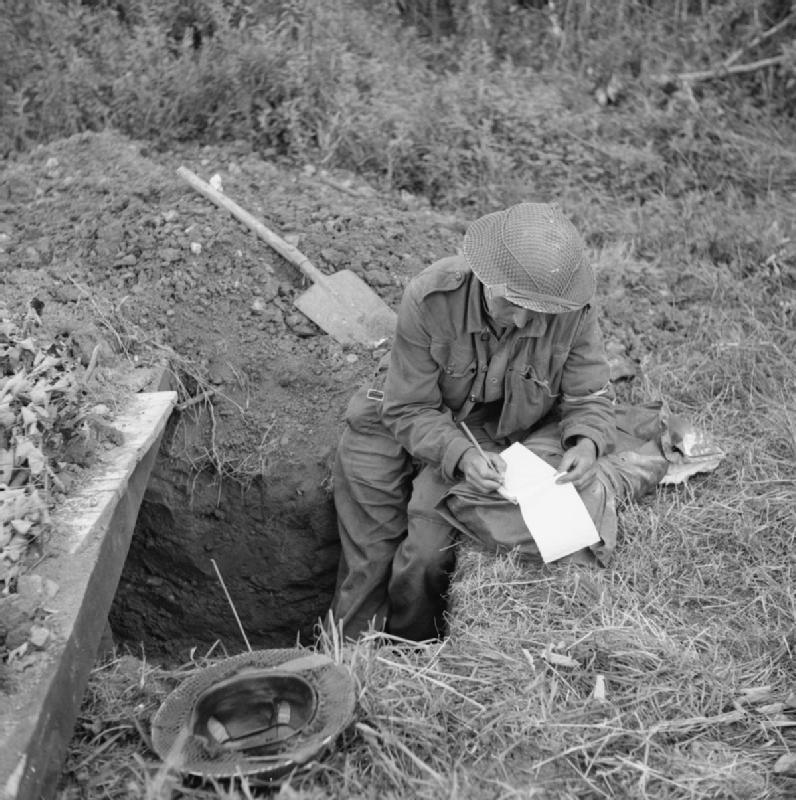
53rd (Welsh) Division landed in Normandy on 28 June 1944, the second last British infantry division to land and was placed under command of XII Corps, defending the Odon Valley position. The division was involved in much fighting in this area, with the 158th Brigade detached to fight with the 15th (Scottish) Infantry Division in the Second Battle of the Odon (Operation Greenline) before Operation Goodwood in mid-July. In August it began to push beyond the Odon and crossed the river Orne, helping to close the Falaise Pocket. It was during this fighting that Acting Captain Tasker Watkins, Officer Commanding (OC) B Company of the 1/5th Battalion, Welch Regiment was awarded the Victoria Cross, the first and only to be awarded to the regiment and division during the war, as well as the only Welshman of the British Army during the Second World War to be awarded the VC.
On 2 August, the GOC, Major-General Ross, decided that due to the casualties suffered by the division in Normandy and an acute lack of infantry replacements, the battalions of 158th Brigade (the 4th, 6th and 7th Battalions of the Royal Welch Fusiliers) were replaced and sent to other brigades of the division, the 4th RWF transferring to 71 Brigade and 6th RWF to 160 Brigade while the 7th RWF remained in 158 Brigade. "It was found that with three Battalions of one Regiment in the same Brigade – as in the case of the 158th Brigade with its three Battalions of Royal Welch Fusiliers – difficulties were experienced in providing reinforcements in the event of heavy casualties. This was particularly so with Officer reinforcements." The division had managed to capture over 3,800 prisoners of war (POWs).
The division took part in the Swan (swift advance) to Belgium where much fighting took place to secure an important bridgehead at the Junction Canal near Lommel. The 53rd Division then fought hard to expand the salient south of Eindhoven in conjunction with the Operation Market Garden, which ended in failure due to events at the Battle of Arnhem in late September, where the British 1st Airborne Division was virtually destroyed in severe fighting. Advancing into the Netherlands, 53rd (Welsh) Division liberated the city of 's-Hertogenbosch in four days of heavy fighting from 24 October.
In December 1944, attached to XXX Corps, it was one of the British divisions that took part in the mainly American Battle of the Bulge, helping to cut off the northern tip of the German salient. The Commanding Officer (CO) of the 1st Battalion, East Lancashire Regiment described the fighting in the forest as a "terribly wearing business for the men. Psychologically and mentally. It was nearly all bayonet, Sten and grenade fighting. The Bosch reserves fought very well, stubborn and had to be dug out with the bayonet." Throughout Veritable the 53rd Division suffered almost 2,500 casualties (including psychiatric casualties), roughly a quarter of what they suffered throughout the entire campaign, while capturing over 3,000 prisoners.
The division, now under command of XII Corps, under Lieutenant-General Neil Ritchie, took part in Operation Plunder, the crossing of the Rhine, and advancing into Germany, where they ended the war. Throughout its 10 months of almost continuous combat, the 53rd (Welsh) Division had suffered nearly 10,000 casualties: 113 officers and 1,396 other ranks killed, 387 officers and 7,221 other ranks wounded and 33 officers and 1,255 other ranks missing. Of those declared missing, 3 officers and 553 other ranks rejoined their units, bringing the total casualties for the division to 9,849 killed, wounded or missing. As with most divisions, the majority of these casualties were sustained by the average "Tommy" in the infantry–nicknamed the PBI or "Poor Bloody Infantry"–who had sustained more than 80 percent of the total losses. According to Ross the division "captured some 35,000 prisoners of war and probably accounted for the same amount in dead and wounded."
Post-war
The division ended the war in 1945 in Hamburg. It served later as a peacekeeping force in the Rhineland, then disbanded to reform the 2nd Infantry Division in Germany in early 1947. It was reactivated later that year, serving as part of the peacetime TA. In 1961 the division became a district headquarters as 53rd (Welsh) Division/District, and it was disbanded in 1967.
There remain a few remnants of the division in the TA. The 160th Brigade is the regional brigade responsible for the administration of all TA units in Wales, while 53 (Welsh) Signal Squadron is the descendant formation of 53rd (Welsh) Divisional Signal Regiment, and continues to serve in a very similar capacity, providing communications support to the 160th Brigade.
Victoria Cross recipients
- Captain Tasker Watkins, 1/5th Battalion, Welch Regiment, Second World War
- Refer to Monmouthshire Regiment section for Corporal Thomas Edward Chapman VC
General officers commanding
| Appointed | General officer commanding |
|---|---|
| April 1908 – January 1909 | Brigadier-General Augustus Hill |
| January 1909 – September 1913 | Major-General Francis Lloyd |
| 14 October 1913 – 19 August 1915 | Major-General John Lindley |
| 19–25 August 1915 | Major-General Herbert Lawrence (temporary) |
| 25 August – 9 September 1915 | Major-General William Marshall |
| 9–13 September 1915 | Brigadier-General W.J.C. Butler (acting) |
| 13 September – 23 December 1915 | Major-General William Marshall |
| 23–27 December 1915 | Brigadier-General R. O'B Taylor (acting) |
| 27 December 1915 – 11 January 1916 | Brigadier-General W.J.C. Butler (acting) |
| 11 January 1916 – 6 March 1916 | Major-General Alister Dallas |
| 8–11 March 1916 | Brigadier-General A.H. Short (acting) |
| 11 March – 20 May 1916 | Major-General Alister Dallas |
| 20 May – 28 June 1916 | Brigadier-General A.H. Short (acting) |
| 28 June 1916 – 10 April 1917 | Major-General Alister Dallas |
| 10 April 1917 – July 1919 | Major-General Stanley F. Mott |
| July 1919 – 1921 | Major-General Cyril Deverell |
| March 1922 – June 1923 | Major-General Archibald Montgomery |
| June 1923 – June 1927 | Major-General Thomas Marden |
| June 1927 – October 1928 | Major-General Thomas Cubitt |
| October 1928 – June 1930 | Major-General Charles Deedes |
| June 1930 – December 1932 | Major-General Charles Grant |
| December 1932 – June 1935 | Major-General James Dick-Cunyngham |
| June 1935 – June 1939 | Major-General Gervase Thorpe |
| June 1939 – 29 July 1941 | Major-General Bevil Wilson |
| 29 July 1941 – 12 September 1942 | Major-General Gerard Bucknall |
| 12 September 1942 – 16 February 1945 | Major-General Robert Knox Ross |
| 16 February – 10 March 1945 | Brigadier M. Elrington (acting) |
| 10 March – 27 May 1945 | Major-General Robert Ross |
| 27 May – 3 June 1945 | Brigadier Charles Coleman (acting) |
| 3 June – 26 August 1945 | Major-General Robert Ross |
| 26 August 1945 | Brigadier C.F.C. Coleman (acting) |
| 1945–1946 | Major-General Francis Matthews |
| 1946 | Major-General George Richards |
| 1946–1947 | Major-General Philip Balfour |
| 1 January – August 1947 | Major-General Christopher Woolner |
| August 1947 – March 1950 | Major-General George Wood |
| March 1950 – October 1952 | Major-General Ernest Down |
| October 1952 – March 1955 | Major-General Edric Bastyan |
| March 1955 – January 1958 | Major-General William Cox |
| January 1958 – February 1961 | Major-General Lewis Pugh |
| February 1961 – December 1963 | Major-General Richard Frisby |
| December 1963 – April 1967 | Major-General Douglas Darling |
Orders of battle
| 53rd (Welsh) Division (1914–1918) |
|---|
| 53rd (Welsh) Infantry Division (1939–1945) |
|---|
Notes
References
Bibliography
- {{cite book
- {{cite book
- {{cite book
- {{cite book
- {{cite book
- {{cite book
- Sir John Smyth, Bolo Whistler: The Life of General Sir Lashmer Whistler, London: Frederick Muller, 1967.
- Ward, Maj C.H. Dudley, History of the 53rd (Welsh) Division (T.F.) 1914–1918, Cardiff: Western Mail, 1927/Uckfield: Naval & Military, 2004, .
- Young, Lt-Col Michael, Army Service Corps 1902–1918, Barnsley: Leo Cooper, 2000, .
References
- {{harvnb. Westlake. 1992
- Conrad, Mark. (1996). "The British Army, 1914".
- Westlake, Ray. (2011). "The Territorials, 1908–1914: A Guide for Military and Family Historians". Pen & Sword.
- Baker, Chris. "The Royal Welsh Fusiliers". The Long, Long Trail.
- "Royal Welsh Fusiliers".
- Falls 1930 Vol. 1 p. 307
- (20 March 2016}}{{Dead link). "53 (Welsh) Division (1930-38)".
- Joslen, pp. 87–8
- Barclay, p. 26.
- "53rd (Welsh) Infantry Division".
- Delaforce, p. 13.
- Barclay, p. 36.
- Delaforce, p. 15.
- Barclay, p. 41.
- Barclay, p. 42.
- "Archived copy".
- "Commanding Officers". Queen's Royal Surreys.
- Barclay, p. 47.
- Barclay, p. 52.
- Delaforce, p. 23.
- Joslen, p. 302.
- Smyth, pp. 101–7.
- Barclay, p. 60.
- "16 August 1944: Tasker Watkins – First Welsh VC of the war".
- Barclay, pp. 66–67.
- (Curiously though, this did occur with the [[131st Infantry Brigade (United Kingdom). 131st (Queen's) Brigade]] of the [[7th Armoured Division (United Kingdom). 7th Armoured Division]]). By 31 August 1944 the 53rd (Welsh) Division had suffered many casualties; in just over two months of fighting 52 [[Officer (armed forces). officers]] and 533 [[Other ranks (UK). other ranks]] were killed, 145 officers were wounded, 18 missing, 2,711 other ranks wounded and 360 missing for a total of 3,819 casualties.Delaforce, p. 85.
- Barclay, p. 69.
- Barclay, p. 125.
- Delaforce, p. 160.
- Delaforce, p. 162.
- Barclay, p. 147.
- Delaforce, p. 219.
- Barclay, p. 178.
- "Wales District". Regiments.org.
- Paxton, J.. (1972). "The Statesman's Year-Book 1972-73: The Encyclopaedia for the Businessman-of-The-World". Palgrave Macmillan UK.
- (2004). "Royal Corps of Signals: Unit Histories of the Corps (1920–2001) and Its Antecedents". Helion & Company Limited.
- (1946). "Army Notes". Royal United Services Institution.
- Baker, Chris. "The 53rd (Welsh) Division in 1914-1918". The Long, Long Trail.
- ''Monthly Army List'', August 1914.
- Becke, pp. 117–23.
- [https://web.archive.org/web/20060219202408/http://home.comcast.net/~markconrad/BRIT14.html Conrad.]
- "53 (W) Division at Regimental Warpath.".
- Ward, pp. 10–12, 56–7
- Young, Annex D.
- {{harvnb. James. 1978
- {{harvnb. James. 1978
- Becke, p. 15.
- Becke, pp. 1–7.
- Joslen, p. 346.
- [http://www.recce.adsl24.co.uk/regts/53rd.htm 53rd (Welsh) Reconnaissance Regiment at Reconnaissance Corps website.]
- Joslen, p. 347.
- Joslen, p. 348.
- Joslen, p. 204.
- (2015). "Postmen at War: A History of the Army Postal Services from the Middle Ages to 1945". Stuart Rossiter Trust.
- Barclay, p. 199.
This article was imported from Wikipedia and is available under the Creative Commons Attribution-ShareAlike 4.0 License. Content has been adapted to SurfDoc format. Original contributors can be found on the article history page.
Ask Mako anything about 53rd (Welsh) Infantry Division — get instant answers, deeper analysis, and related topics.
Research with MakoFree with your Surf account
Create a free account to save articles, ask Mako questions, and organize your research.
Sign up freeThis content may have been generated or modified by AI. CloudSurf Software LLC is not responsible for the accuracy, completeness, or reliability of AI-generated content. Always verify important information from primary sources.
Report