From Surf Wiki (app.surf) — the open knowledge base
528th Bombardment Squadron

| Field | Value | |
|---|---|---|
| unit_name | 528th Bombardment Squadron | |
| image | General Dynamics FB-111A 69-6506.jpg | |
| image_size | 300 | |
| caption | [380th Bombardment Wing](380th-bombardment-wing) FB-111 at Plattsburgh AFB | |
| dates | 1942-1946; 1947–1951; 1955-1991 | |
| country | ||
| branch | ||
| role | Medium bomber | |
| battles | Southwest Pacific Theater | |
| decorations | Distinguished Unit Citation | |
| Air Force Outstanding Unit Award | ||
| Philippine Presidential Unit Citation | ||
| identification_symbol | [[File:528th Bombardment Squadron - Emblem.png | 165px]] |
| identification_symbol_label | 528th Bombardment Squadron emblem |
Air Force Outstanding Unit Award Philippine Presidential Unit Citation
The 528th Bombardment Squadron is an inactive United States Air Force unit. It was last assigned to the 380th Bombardment Wing at Plattsburgh Air Force Base, New York, where it was inactivated on 1 July 1991.
The squadron was first activated during World War II. After training as a heavy bomber unit in the United States, it moved to the Southwest Pacific Theater, entering combat in May 1943, flying combat missions from Australia while attached to the Royal Australian Air Force, earning two Distinguished Unit Citations and a Philippine Presidential Unit Citation. In 1945 it moved forward to the Philippines, then to Okinawa. Following V-J Day, the squadron returned to the Philippines and was inactivated there in February 1946.
The squadron was activated in the reserves in 1947, becoming a corollary unit in 1949. The squadron was called to active service in May 1951 for the Korean War and its personnel used to fill out other units.
The squadron was activated at Plattsburgh in July 1955 as a Strategic Air Command bomber unit. At Plattsburgh, it successively flew Boeing B-47 Stratojets, Boeing B-52 Stratofortresses and General Dynamics FB-111 Aardvarks until inactivating when its planes were transferred to Tactical Air Command and modified for conventional operations.
History
World War II
The squadron was activated at Davis-Monthan Field, Arizona on 3 November 1942 as one of the four original squadrons of the 380th Bombardment Group. After training with Consolidated B-24 Liberators, the squadron moved to the Southwest Pacific Theater in April 1943.
The air echelon arrived at Fenton Airfield in the Australian Northern Territory by the end of April. The ground echelon started out from Darwin, Australia by truck. For the remainder of its stay in Australia, the squadron and the rest of the 380th Group would be attached to the Royal Australian Air Force (RAAF). It trained RAAF crews on the operation of the Liberator. Its initial combat operations were in May, when it flew armed reconnaissance missions.
From its home at Fenton, the 528th attacked Japanese installations in the Netherlands East Indies and the Bismark Archipelago, including airfields, ground installations and factories. In August 1943, it participated in a series of raids on oil refineries in Balikpapan, Borneo in what at the time was the longest bombing mission flown by an Army Air Forces bomber unit. For this mission, the squadron was awarded the Distinguished Unit Citation (DUC). During April and May 1944, the unit conducted a series of raids on enemy airfields in western New Guinea to support landings in the Hollandia area, for which it was awarded a second DUC.
On 23 April 1944, on a bombing run over Noemfoor Island, five aircraft of the 528th participated in the wildest shooting spree of the war for the squadron. They were intercepted by twenty-five Japanese fighters and a very hot battle ensued for the next hour. The squadron claimed twelve of the enemy fighters destroyed. All five of the Liberators managed to make it back to Fenton, although heavily damaged. The squadron was not without losses though, one deadly and six wounded. This battle resulted in 21 Distinguished Flying Crosses and 10 Silver Stars being awarded to members of the 528th.
The squadron was relieved from attachment to the RAAF and moved to the Philippines in February 1945. Operating from Mindoro, the squadron provided air support for ground forces on Luzon, and attacked industrial targets in Formosa, ground installations along the China coast and transportation targets in French Indochina. It also continued its attacks on refineries in Borneo. In August 1945, the squadron moved to Okinawa. Following V-J Day, the squadron flew reconnaissance missions over Japan and flew prisoners of war from Japan to Manila. The squadron became nonoperational and moved to Fort William McKinley in November 1945. It was inactivated there in February 1946.
Air Force Reserves
The squadron was activated in the reserves at MacDill Field, Florida, where its training was supervised by the 465th AAF Base Unit (later the 2582d Air Force Reserve Training Center) of Air Defense Command (ADC). It is not clear whether or not the squadron was fully staffed or equipped at this time. In 1948 Continental Air Command assumed responsibility for managing reserve and Air National Guard units from ADC.
The May 1949 Air Force Reserve program called for a new type of unit, the corollary unit, which was a reserve unit integrated with an active duty unit. The plan was viewed as the best method to train reservists by mixing them with an existing regular unit to perform duties alongside the regular unit. The squadron became a corollary of the 307th Bombardment Wing and Strategic Air Command became responsible for its training. All reserve corollary units were mobilized for the Korean war, and the squadron was called to active duty in May 1951. Its personnel were used to bring other units up to strength, and the squadron was inactivated two weeks later.
Strategic Air Command
B-47 era
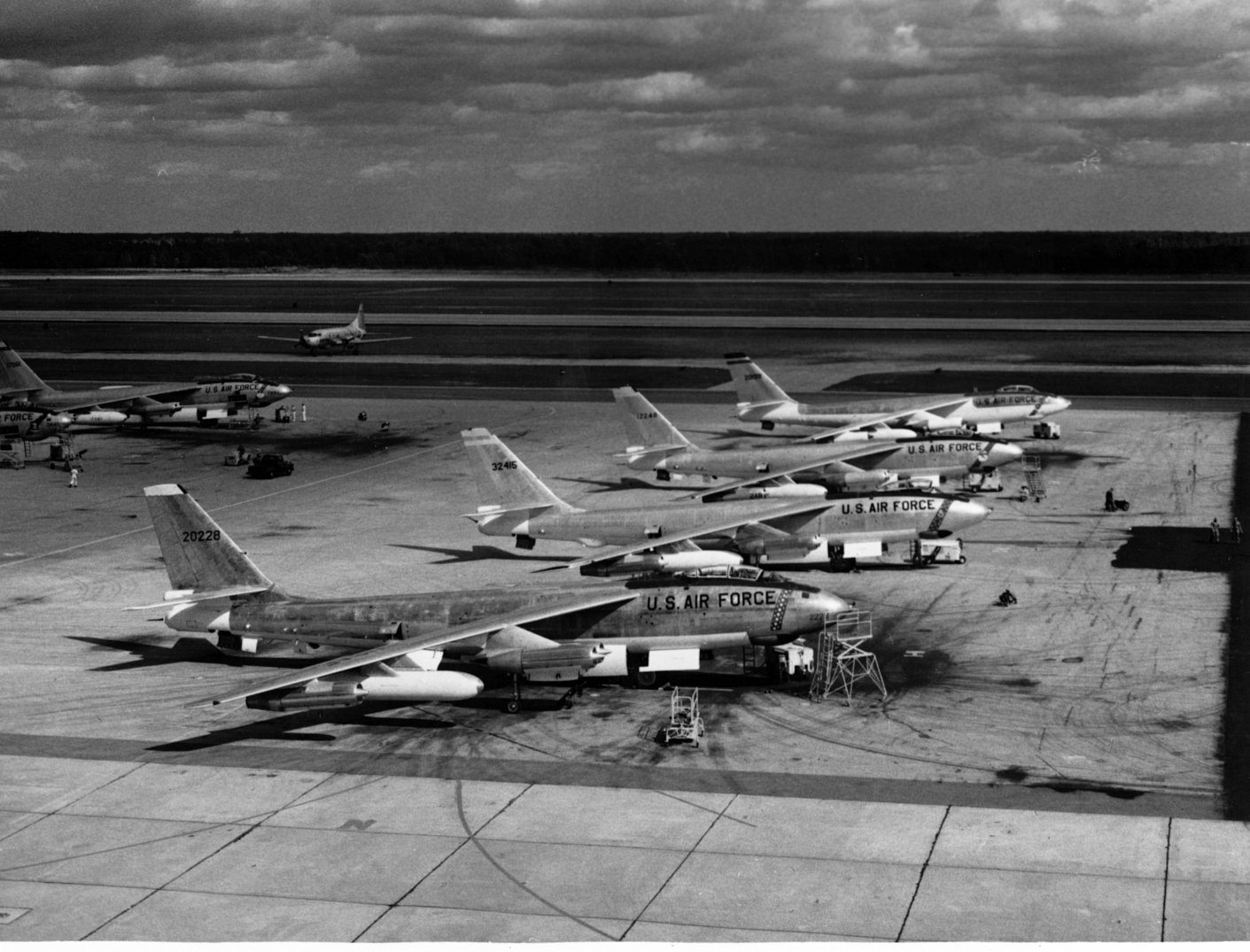
The squadron was again activated at Plattsburgh Air Force Base, New York in July 1955 as part of the 380th Bombardment Wing and equipped with Boeing B-47 Stratojets. Reflex placed Stratojets and Boeing KC-97s at bases closer to the Soviet Union for 90 day periods, although individuals rotated back to home bases during unit Reflex deployments The percentage of SAC planes on fifteen minute ground alert, fully fueled and ready for combat to reduce vulnerability to a Soviet missile strike gradually grew over the next three years to reach the goal of 1/3 of SAC’s force on alert by 1960.
From 1958, the Stratojet wings of SAC began to assume an alert posture at their home bases, reducing the amount of time spent on alert at overseas bases.
After the detection of Soviet missiles in Cuba, SAC dispersed its B-47s on 22 October 1962. Most dispersal bases were civilian airfields with AF Reserve or Air National Guard units. Squadron B-47s were configured for execution of the Emergency War Order as soon as possible after dispersal. On 24 October 1962, SAC went to DEFCON 2, placing all its combat aircraft on alert. As tensions eased, on 15 November 1/6 of the dispersed B-47s were recalled to their home bases. On 21 November, SAC went to DEFCON 3. Dispersed B-47s and supporting tankers were recalled on 24 November. On 27 November the squadron returned to its normal alert posture.
B-52 era
_copy_(7257055754).jpg)
The squadron flew the B-47 Until 1965, when the medium bomber began to be phased out of SAC's inventory. Ground alert for B-47s was terminated on 11 February 1966. The squadron began to send its Stratojets to the Aerospace Maintenance and Regeneration Center at Davis-Monthan Air Force Base for retirement. It began receiving Boeing B-52G Stratofortresses in June 1966, The squadron continued to fly the B-52 until January 1971.
FB-111 era
Main article: 380th Air Expeditionary Wing
In 1969, it was announced that the 528th would be receiving the General Dynamics FB-111A Aardvark medium bomber. As its B-52s departed in 1971, the squadron became combat ready with the FB-111 in July. At the annual SAC bombing and navigation competition in 1974 a 528th crew won top honors and helped to bring the Fairchild Trophy to the 380th Wing. In 1975, another 528th team took the best crew award. With three of the four 380th crews coming from the squadron, an unprecedented second consecutive Fairchild Trophy was won in 1976. The 528th was recognized as the best bombardment squadron in SAC in 1976 and earned the Air Force Outstanding Unit Award in 1978..
In 1991, the squadron began transferring its aircraft to be modified as F-111G fighter-bombers. With the exception of museum aircraft, the last FB-111 was gone by July 1991, and the squadron was inactivated.
Lineage
- Constituted as the 528th Bombardment Squadron (Heavy) on 28 October 1942 : Activated on 3 November 1942 : Redesignated 528th Bombardment Squadron, Heavy on 26 August 1944 : Inactivated on 20 February 1946
- Redesignated 528th Bombardment Squadron, Very Heavy on 13 May 1947 : Activated in the reserve on 29 May 1947 : Redesignated 528th Bombardment Squadron, Medium on 26 June 1949 : Ordered to active service on 1 May 1951 : Inactivated on 16 May 1951
- Activated on 11 July 1955 : Redesignated 528th Bombardment Squadron, Heavy on 25 June 1966 : Redesignated 528th Bombardment Squadron, Medium on 1 January 1971 : Inactivated on 1 July 1991
Assignments
- 380th Bombardment Group, 3 November 1942 – 20 February 1946
- Fourteenth Air Force, 29 May 1947
- 380th Bombardment Group, 16 June 1947 – 16 May 1951
- 380th Bombardment Wing, 11 July 1955 – 1 July 1991
Stations
- Davis-Monthan Field, Arizona, 3 November 1942
- Biggs Field, Texas, 2 December 1942
- Lowry Field, Colorado, 4 March-19 April 1943
- Fenton Airfield, Australia, 28 April 1943
- RAAF Base Darwin, Australia, c. 20 August 1944
- San Jose, Mindoro, Philippines, c. 21 February 1945
- Motobu Airfield, Okinawa, 8 August 1945
- Fort William McKinley, Luzon, Philippines, c. 28 November 1945 – 20 February 1946
- MacDill Field (later MacDill Air Force Base), Florida, 29 May 1947 – 16 May 1951
- Plattsburgh Air Force Base, New York, 11 July 1955 – 1 July 1991
Aircraft
- Consolidated B-24 Liberator, 1942–1945
- Boeing B-29 Superfortress, 1949–1951
- Boeing B-47 Stratojet, 1955–1965
- Boeing B-52 Stratofortress, 1966–1971
- General Dynamics FB-111A Aardvark, 1971–1991
Awards and campaigns
| Campaign Streamer | Campaign | Dates | Notes | |
|---|---|---|---|---|
| [[Image:Streamer APC.PNG | 200px]] | Air Offensive, Japan | 28 April 1943 – 2 September 1945 | |
| [[Image:Streamer APC.PNG | 200px]] | New Guinea | 28 April 1943 – 31 December 1944 | |
| [[Image:Streamer APC.PNG | 200px]] | Bismarck Archipelago | 15 December 1943 – 27 November 1944 | |
| [[Image:Streamer APC.PNG | 200px]] | Luzon | 15 December 1944 – 4 July 1945 | |
| [[Image:Streamer APC.PNG | 200px]] | China Defensive | 21 February 1945 – 4 May 1945 | |
| [[Image:Streamer APC.PNG | 200px]] | Southern Philippines | 27 February 1945 – 4 July 1945 | |
| [[Image:Streamer APC.PNG | 200px]] | China Offensive | 5 May 1945 – 2 September 1945 | |
| [[Image:Streamer APC.PNG | 200px]] | Western Pacific | 17 April 1945 – 2 September 1945 |
References
Notes
; Explanatory notes
; Citations
Bibliography
References
- Maurer, ''Combat Squadrons'', p. 634
- Maurer, ''Combat Units'', pp. 267-268
- ''See'' Maurer, ''Combat Squadrons'', p. 634 (no aircraft listed as assigned to the squadron at this time.)
- (27 December 1961). "Abstract, Mission Project Closeup, Continental Air Command". Air Force History Index.
- Cantwell, p. 73
- Cantwell, p. 87
- Narducci, p. 2
- Narducci, p. 3
- Schake, p. 220 (note 43)
- (1 April 1975). "Abstract (Unclassified), History of the Strategic Bomber since 1945 (Top Secret, downgraded to Secret)". Air Force History Index.
- Kipp, ''et al''., p. 49
- Kipp, ''et al''., p. 35
- Kipp. ‘’et al.’’, p. 53
- Kipp, ''et al''., p. 61
- Narducci, p. 14
- receiving its aircraft from the inactivating [[70th Bombardment Squadron]] at [[Loring Air Force Base]], Maine.{{citation needed. (February 2020 It trained in strategic bombardment missions, and stood ground alert with its Stratofortresses. it also periodically flew "airborne alert indoctrination" missions, but accidents at [[1966 Palomares B-52 crash). Palomares]] in January 1966 and [[Thule Air Base#B-52 nuclear bomber crash. Thule]] in January 1968 contributed to the end of [[Operation Chrome Dome]], as did rapidly rising costs of the program and the use of strategic bombers for non-nuclear missions, but the primary reason was the availability of a survivable [[intercontinental ballistic missile]] force.Narducci, p. 17
- (4 December 2001). "Lineage and Honors History of the 380th Air Expeditionary Wing (ACC)". Air Force Historical Research Agency.
- ''See'' Endicott (redesignation of 380th Group)
- Lineage, including aircraft, assignments and stations, through March 1963 in Maurer, ''Combat Squadrons'', p. 634, except as noted.
- Strategic Air Command Special Order G--48, 28 March 1966
- ''See'' Endicott (end of assignment of squadron to 380th Wing.)
- Assignment through September 1977 in Ravenstein, pp.205-206
- ''See'' Endicott (bomber aircraft assigned to 380th Wing).
- "Air Force Personnel Services: Unit Awards". Air Force Personnel Center.
This article was imported from Wikipedia and is available under the Creative Commons Attribution-ShareAlike 4.0 License. Content has been adapted to SurfDoc format. Original contributors can be found on the article history page.
Ask Mako anything about 528th Bombardment Squadron — get instant answers, deeper analysis, and related topics.
Research with MakoFree with your Surf account
Create a free account to save articles, ask Mako questions, and organize your research.
Sign up freeThis content may have been generated or modified by AI. CloudSurf Software LLC is not responsible for the accuracy, completeness, or reliability of AI-generated content. Always verify important information from primary sources.
Report