From Surf Wiki (app.surf) — the open knowledge base
500 Series Shinkansen
Japanese high speed train type
Japanese high speed train type
| Field | Value | ||||
|---|---|---|---|---|---|
| name | 500 series | ||||
| image | JRW-500-nozomi.jpg | ||||
| designer | Alexander Neumeister | ||||
| imagesize | 300px | ||||
| caption | 16-car 500 series on a *Nozomi* service, May 2008 | ||||
| service | – present | ||||
| manufacturer | Hitachi, Kawasaki Heavy Industries, Kinki Sharyo, Nippon Sharyo | ||||
| replaced | [0 series](0-series-shinkansen) | ||||
| yearconstruction | 1995–1998 | ||||
| yearservice | 1997 | ||||
| refurbishment | 2008–2010 | ||||
| numberbuilt | 144 vehicles (9 sets) | ||||
| numberservice | 48 vehicles (6 sets) | ||||
| numberpreserved | 2 vehicles | ||||
| numberscrapped | 78 vehicles | ||||
| formation | 8 (originally 16) cars per trainset | ||||
| fleetnumbers | {{Plainlist | ||||
| capacity | {{Plainlist | ||||
| operator | |||||
| depots | Hakata | ||||
| lines | {{plainlist | ||||
| *{{Ric | JR West | ss | name | y}} | |
| *{{Ric | JR Central | ts | name | y}} (1997–2010) | |
| carbody | Aluminium alloy, Honeycomb structure | ||||
| carlength | {{Plainlist | ||||
| * {{Convert | 25 | m | ftin | abbr | on}} (intermediate cars) |
| * {{Convert | 27 | m | ftin | abbr | on}} (end cars) |
| width | 3380 mm | ||||
| height | 3690 mm | ||||
| doors | Two plug doors per side (intermediate cars) | ||||
| One plug door per side (end cars) | |||||
| maxspeed | {{Plainlist | ||||
| * W set: {{Convert | 270 | km/h | 0 | abbr | on}} (Tōkaidō) |
| 300 km/h (Sanyō) | |||||
| * V set: {{Convert | 285 | km/h | 0 | abbr | on}} |
| * Design speed: {{Convert | 320 | km/h | 0 | abbr | on}} |
| acceleration | 1.6 km/h/s | ||||
| <br /> (High acceleration mode)<ref name | "journal200709"/ | ||||
| deceleration | 2.7 km/h/s | ||||
| traction | (AC) WMT204 64 × 285 kW (set W1)/275 kW (set W2 onward) | ||||
| poweroutput | 18.24 MW (set W1), 17.60 MW (set W2 onward) | ||||
| electricsystem | 25 kV AC, 60 Hz overhead catenary | ||||
| collectionmethod | {{Plainlist | ||||
| safety | ATC-NS | ||||
| gauge | |||||
| notes |
- As built: W1–W9
- As refurbished: V2–V9
- 16-car W set: 1,324 (200 Green + 1,124 Standard)
- 8-car V set: 608
- (1997–2010)
- 25 m (intermediate cars)
- 27 m (end cars) One plug door per side (end cars)
- W set: 270 km/h (Tōkaidō) 300 km/h (Sanyō)
- V set: 285 km/h
- Design speed: 320 km/h
1.92 km/h/s (High acceleration mode)
- W set: "T"-style current collector
- V set: Pantograph
The 500 series is a Shinkansen high-speed train type operated by West Japan Railway Company (JR-West) in Japan on the Tōkaidō Shinkansen line from 1997 until 2010, and the San'yō Shinkansen line since 1997. They were designed to be capable of 320 km/h but operated at 300 km/h, until they were retired from the primary Nozomi service in 2010. The trainsets were then refurbished and downgraded to the all-stations Kodama service between and .
Overview
The general design concept was overseen by German industrial designer Alexander Neumeister. The running gear utilizes computer-controlled active suspension for a smoother, safer ride, and yaw dampers are fitted between cars for improved stability. All sixteen cars in each original trainset were powered, giving a maximum of 18.24 MW. Each train cost an estimated 5 billion yen, and only nine were built. It used biomimicry to reduce energy consumption by 15%, increase speeds by 10% and reduce noise levels while increasing passenger comfort. This was done by designing the train's front to mimic the shape of a kingfisher's beak.
6-car 500-900 WIN350 set
Main article: WIN350
This was a prototype for the Series 500.
16-car W sets
First announced by JR-West in September 1994, the first set was delivered for testing in 1995, entering passenger service in March 1997. The entire fleet of nine sets was delivered by 1998. It was the first Shinkansen train in Japan to operate at a maximum speed of 300 km/h in regular passenger service. Besides the premium Nozomi services, 16-car trains were also used on Hikari Rail Star services during the busy holiday periods.
With the steady increase in the number of N700 Series Shinkansen since 2007, the 500 series were gradually retired from the Nozomi services. The last 500 series Nozomi run took place on 28 February 2010.
Formation
| Car No. | 1 | 2 | 3 | 4 | 5 | 6 | 7 | 8 | 9 | 10 | 11 | 12 | 13 | 14 | 15 | 16 | Designation | Numbering | Seating capacity |
|---|---|---|---|---|---|---|---|---|---|---|---|---|---|---|---|---|---|---|---|
| Mc | M1 | Mp | M2 | M' | M1 | Mp | Ms2 | Ms | M1s | Mpkh | M2 | M' | M1 | Mp | M2c | ||||
| 521-xx | 526-xx | 527-xx | 528-xx | 525-xx | 526-xx | 527-4xx | 518-xx | 515-xx | 516-xx | 527-7xx | 528-7xx | 525-xx | 526-xx | 527-xx | 522-xx | ||||
| 53 | 100 | 90 | 100 | 95 | 100 | 75 | 68 | 64 | 68 | 63 | 100 | 95 | 100 | 90 | 63 |
Cars 8 to 10 were "Green" (first class) cars. Cars 5 and 13 each had one "T"-style current collector.
Interior
File:500 Series Shinkansen inside.jpg|Standard-class car interior view File:Blue Seat of JR 500.JPG|Standard-class seating File:Green Car's Seat of JR 500.JPG|Green car seating
8-car V sets (500-7000 series)
Eight of the original nine 500 series sets were modified and shortened to eight cars between 2008 and 2010, and were cascaded to Sanyo Shinkansen Kodama workings, replacing the earlier 0 series sets (V2 to V9). The first reformed eight-car set was unveiled to the press on 28 March 2008, and the trains entered service on twelve daily Kodama runs from 1 December 2008.
The maximum operating speed of these trains has been reduced to 285 km/h.
Formation
, the fleet consists of six eight-car sets (V2–V4, V7–V9) formed as follows, with car 1 at the Hakata end.
| Car No. | 1 | 2 | 3 | 4 | 5 | 6 | 7 | 8 | Designation | Numbering | Formerly | Seating capacity |
|---|---|---|---|---|---|---|---|---|---|---|---|---|
| Mc | M1 | Mp | M2 | M | M1 | Mpkh | M2c | |||||
| 521-70xx | 526-70xx | 527-70xx | 528-70xx | 525-70xx | 526-72xx | 527-77xx | 522-70xx | |||||
| 521 (car 1) | 526 (car 2) | 527 (car 3) | 528 (car 4) | 525 (car 13) | 516 (car 10) | 527-700 (car 11) | 522 (car 16) | |||||
| 53 | 100 | 78 | 100 | 95 | 68 | 51 | 63 |
Cars 2 and 7 each have one single-arm pantograph.
Interior
Passenger accommodation consists of 3+2 abreast unidirectional seating, with 2+2 abreast seating in car 6 (former Green car). Between October and December 2013, cars 4 and 5 are also scheduled to have the original seating removed and replaced with new 2+2 abreast seating, the same as used in the Hikari Rail Star 700 series trainsets.
All passenger saloons on the 8-car 500 series trains are no-smoking, with new smoking compartments installed in cars 3 and 7. Cars 1, 3, 5, and 7 are equipped with toilets.
File:JRW series500 ordinarycar-inside (Non-Reserved seat).JPG|Non-reserved seating car in May 2012 File:JRW series500 ordinarycar-inside (Reserved seat).JPG|Reserved seating car (car 6) in May 2012 File:JRW series500 smokingroom.JPG|Smoking compartment in car 7 in May 2012 File:JR West 500 giziuntendai2.jpg|Mock-up of the driver's cab in an 8-car 500 series trainset
Future plans
In announcement made on 14 February 2024, JR West outlined plans to retire four of the six remaining 500 series sets from revenue service by the end of 2026. The plan is to shorten four existing 16-car N700 series sets into eight-car sets to replace the 500 series sets. On 24 July 2024, JR West announced plans to retire the last two 500 series sets by 2027.
Special liveries

500 Type Eva
On 7 November 2015, set V2 began operating in a special "500 Type Eva" livery as part of the "Shinkansen:Evangelion Project" tie-up project to mark the 40th anniversary of the Sanyo Shinkansen and the 20th anniversary of Neon Genesis Evangelion. Initially planned to operate until March 2017, this livery was extended until 13 May 2018. Set V2 was then transformed to the Hello Kitty Shinkansen in June 2018.
From 24 February until 7 May 2018, the 500 series car preserved at the Kyoto Railway Museum was exhibited in the "500 Type Eva" livery. File:EVA521-7002.JPG|521-7002 (Car 1) File:EVA526-7002.JPG|526-7004 (Car 2) File:EVA527-7002.JPG|527-7003 (Car 3) File:EVA528-7002.JPG|528-7002 (Car 4) File:EVA525-7002.JPG|525-7004 (Car 5) File:EVA526-7202.JPG|526-7202 (Car 6) File:EVA527-7702.JPG|527-7702 (Car 7) File:EVA522-7002.JPG|522-7002 (Car 8)
Interior
File:JRW-500 V2 20160320 TYPE EVA 526-7004 inside.jpg|The interior of car 2 in March 2016 File:JRW-500 V2 20160320 TYPE EVA 526-7004 waitingseat.jpg|Seats in car 2 designated for passengers waiting to use car 1 File:JRW-500 V2 20160320 TYPE EVA 521-7002 inside Evangelion cockpit.jpg|The Evangelion cockpit mockup in car 1
Hello Kitty

File:JRW-500 V2 521-7002 HelloKitty Shinkansen in Himeji.jpg|521-7002 (Car 1) JRW-500 V2 525-7004 HelloKitty Shinkansen in Himeji.jpg|526-7004 (Car 2) JRW-500 V2 527-7003 HelloKitty Shinkansen in Himeji.jpg|527-7003 (Car 3) JRW-500 V2 528-7002 HelloKitty Shinkansen in Himeji.jpg|528-7002 (Car 4) JRW-500 V2 525-7004 HelloKitty Shinkansen in Himeji.jpg|525-7004 (Car 5) JRW-500 V2 526-7202 HelloKitty Shinkansen in Himeji.jpg|526-7202 (Car 6) JRW-500 V2 527-7702 HelloKitty Shinkansen in Himeji.jpg|527-7702 (Car 7) JRW-500 V2 522-7002 HelloKitty Shinkansen in Himeji.jpg|522-7002 (Car 8)
Preserved examples
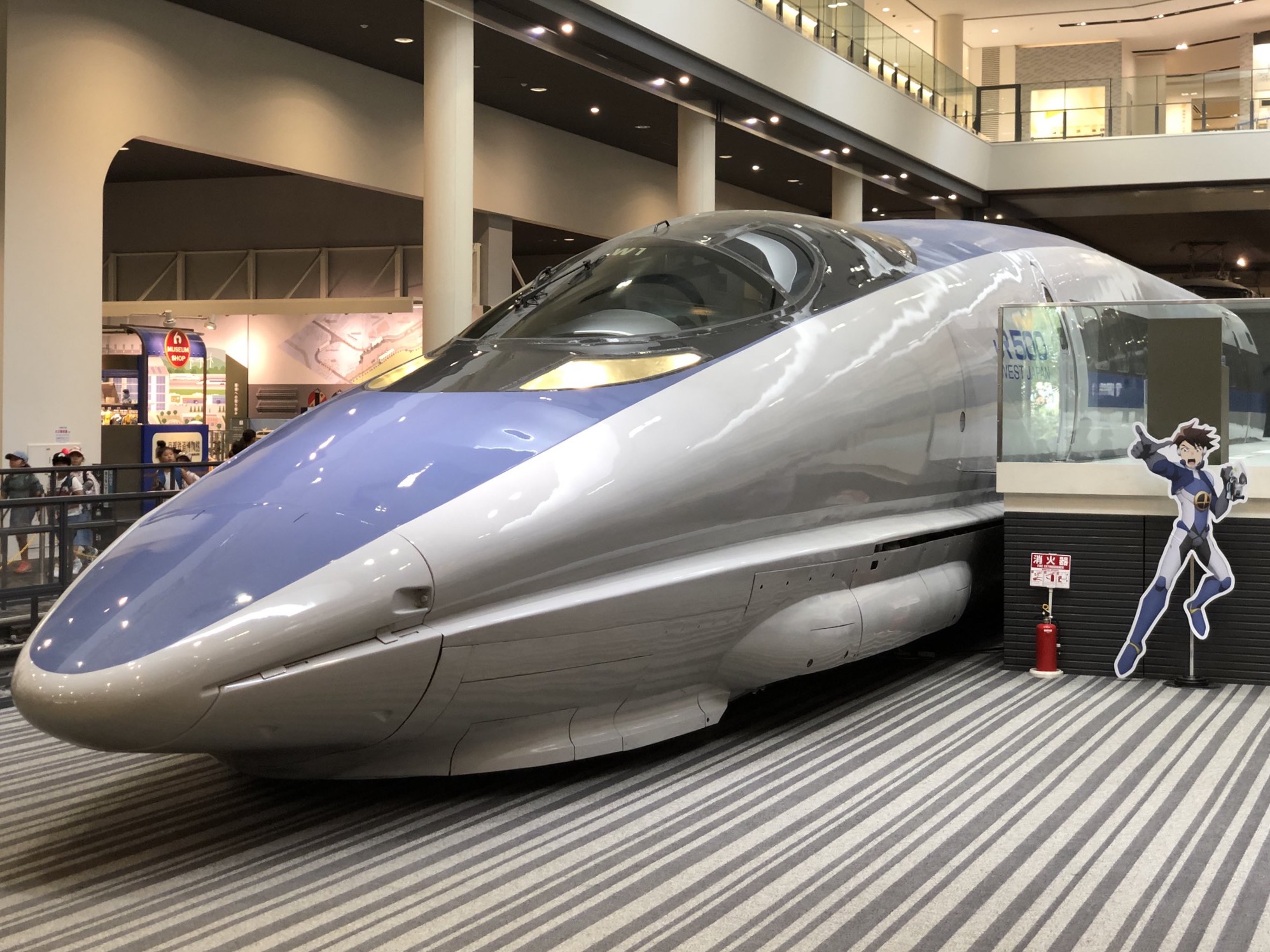

As of 2023, two 500 Series cars have been preserved, both from the same set. Car 521–1, formerly the front car of set W1, is preserved at the Kyoto Railway Museum, which opened in April 2016. This car was exhibited in the "500 Type Eva" livery between 24 February and 7 May 2018. Car 522–1, formerly the end car of set W1, is preserved at the Hitachi Rail Kasado factory in Kudamatsu, Yamaguchi, in Autumn 2015.
In popular culture
The 500 Series Shinkansen served as basis for Liner Gao in Japanese mecha anime series The King of Braves GaoGaiGar.
The Shinkansen Henkei Robo Shinkalion franchise would feature the 500 series as one of its many titular mecha. In addition to the standard livery, the Evangelion and Hello Kitty-wrapped versions also appeared in both the toyline and anime.
The anime Transformers: Robots in Disguise features the Autobot character Railspike, who transforms into a 500 Series Shinkansen.
References
References
- (September 2007). "none". Railway Journal.
- (May 2008). "none". Railway Journal.
- (November 2011). "新幹線 車両大全". Ikaros Publications Ltd..
- (1 January 2003). "Semi-Active Suspension System". Railway Technology Avalanche.
- Warson, Skipper Chong. (2 January 2018). "Looking deeper into biomimicry: how nature inspires design".
- Semmens, Peter. (1997). "High Speed in Japan: Shinkansen - The World's Busiest High-speed Railway". Platform 5 Publishing.
- (1 March 2010). "Train fans bid farewell to Nozomi bullet train service". Japan Today.
- Kotsu Shimbunsha. (May 2010)
- "Tetsudō Daiya Jōhō" magazine February 2008 issue, p74
- link. West Japan Railway. (17 October 2008)
- link. West Japan Railway. (2009)
- "山陽新幹線500系7000番台編成表 - JR編成表、配置表".
- (20 May 2016). Kotsu Shimbunsha
- link. (26 August 2013). Yomiuri Online. The Yomiuri Shimbun. (January 2014{{cbignore)
- link. (22 November 2013). Press Release. West Japan Railway Company
- (14 February 2024). "JR西日本、N700系16両編成を8両編成化 - 500系は4編成を用途廃止に".
- (24 July 2024). "JR西日本、新幹線500系が27年引退へ 車両の共通化進む". The Nikkei.
- (2024-07-25). "JR West to retire 500 series Shinkansen in 2027".
- link. (8 November 2015). Japan Railfan Magazine Online. Koyusha Co., Ltd.
- link. Yasuhiro. Sasaki. (16 September 2016). Mynavi News. Mynavi Corporation
- link. (19 January 2018). Tetsudo Hobidas. Neko Publishing Co., Ltd.
- (2018-03-23). "". link. Koyusha Co., Ltd.
- . (15 March 2018). ["Hello Kitty bullet train to debut on Sanyo Line this summer"](https://www.japantimes.co.jp/news/2018/03/15/business/hello-kitty-bullet-train-debut-sanyo-line-summer/#.WqzC1TVl2Hc). *The Japan Times*.
- (18 May 2018). "Hello Kitty bullet train to debut in Japan on June 30". The Japan Times.
- . (May 2019). "Süße Katzen auf Erfolgsschiene". *Geramond Verlag*.
- (30 October 2025). "JR西日本「ハローキティ新幹線」「ハローキティはるか」運行終了へ".
- (16 January 2026). "2026 年【 春 】の臨時列車の運転について".
- {{cite magazine. Koyusha Co., Ltd.. (June 2016)
- Abe, Ryutaro. (19 February 2018). "Evangelion bullet train to go on show in Kyoto rail museum". The Asahi Shimbun.
- (6 June 2023). "MECHANICS".
This article was imported from Wikipedia and is available under the Creative Commons Attribution-ShareAlike 4.0 License. Content has been adapted to SurfDoc format. Original contributors can be found on the article history page.
Ask Mako anything about 500 Series Shinkansen — get instant answers, deeper analysis, and related topics.
Research with MakoFree with your Surf account
Create a free account to save articles, ask Mako questions, and organize your research.
Sign up freeThis content may have been generated or modified by AI. CloudSurf Software LLC is not responsible for the accuracy, completeness, or reliability of AI-generated content. Always verify important information from primary sources.
Report