From Surf Wiki (app.surf) — the open knowledge base
500 BC
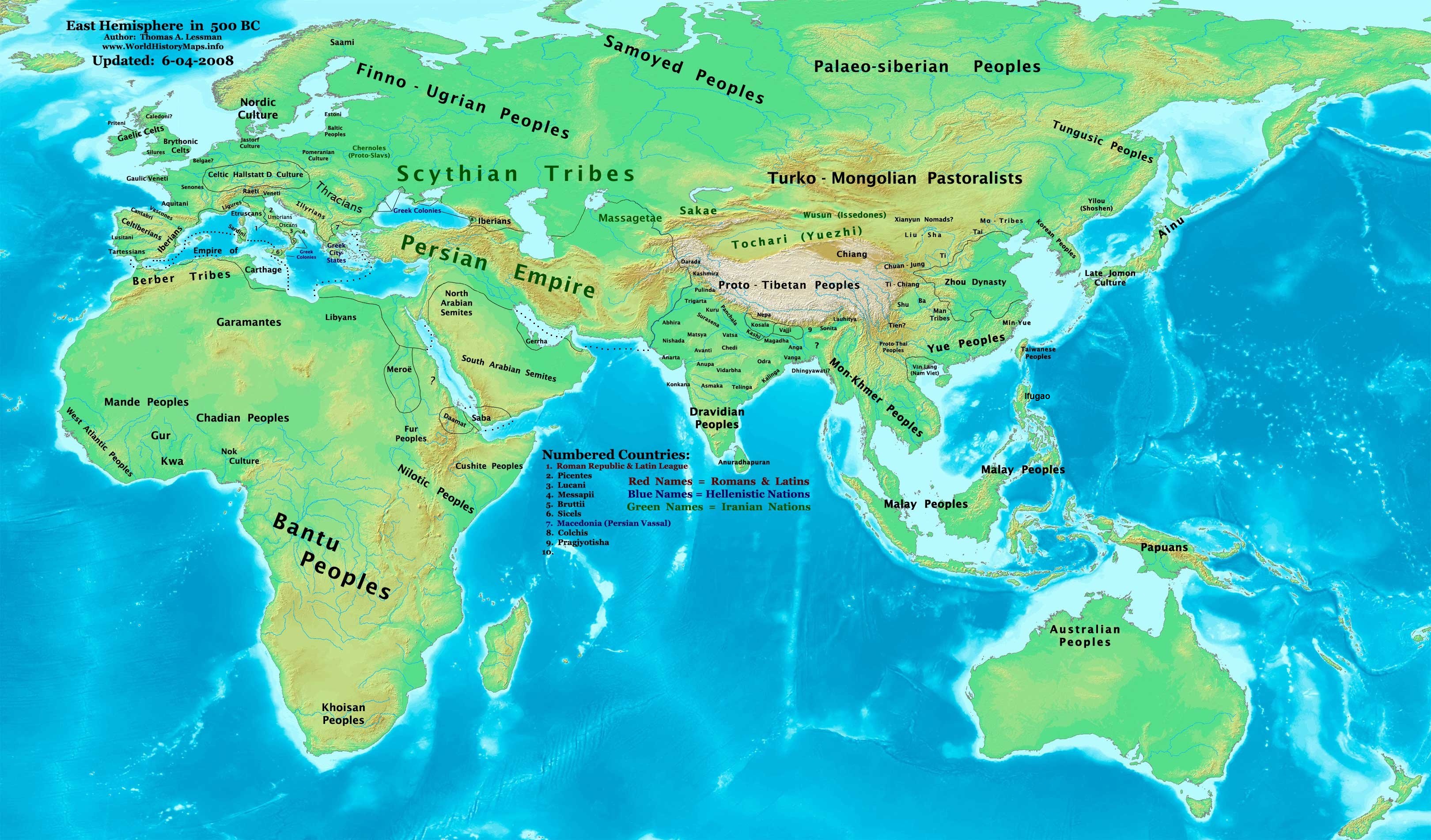
NOTOC The year 500 BC was a year of the pre-Julian Roman calendar. In the Roman Republic it was known as the Year of the Consulship of Camerinus and Longus (or, less frequently, '*year 254 * Ab urbe condita'''''). when the Anno Domini calendar era became the prevalent method in Europe for naming years.
Events
By place
Europe
- Vulca makes Apollo of Veii, from Portonaccio Temple, now kept at Museo Nazionale di Villa Giulia, Rome.
- The Nordic Bronze Age civilization ends and the Pre-Roman Iron Age begins in Scandinavia, according to the Oscar Montelius periodization system (approximate date).
- Refugees from Teos resettle Abdera.
Middle East
- Darius I of Persia proclaims that Aramaic will be the official language of the western half of his empire.
Africa
- Bantu-speaking people migrate into south-west Uganda from Central Africa. (approximate date)
- The Hutu tribe emerges around this time, in Middle and Southern Africa. (approximate date)
- Hanno the Navigator's naval exploration of the western coast of Africa could have reached as far south as Gabon.
Asia
- The first republic in Vaishali, Bihar, India, is founded.
- States in existence include the Kingdom of Pratipalapura (centred on modern Bhattiprolu, in Guntur district, Andhra Pradesh).
- According to the records of Shankara Mutts, a proponent of the Advaita Vedanta Sri Adi Shankaracharya was born in this century
- Early Pandyan Kingdom was ruled by the Pandyas during the second Sangam period.
- Yayoi period starts in Ancient Japan (approximate date).
Mesoamerica
- The oldest known Zapotec writing appears (approximate date).
- The Olmec established Monte Albán, the sacred city, and continued building pyramids. Founded toward the end of the Middle Formative period at around 500 BCE, by the Terminal Formative (ca.100 BCE–CE 200) Monte Albán soon became the capital of a large-scale expansionist polity that dominated much of the Oaxacan highlands and interacts with other Mesoamerican regional states, such as Teotihuacan to the north (Paddock 1983; Marcus 1983).
By topic
Demographics
- The world population reaches 100,000,000—85,000,000 in the Eastern Hemisphere and 15,000,000 in the Western Hemisphere, primarily Mesoamerica and northern South America (Mexico, Central America, Colombia, Peru, Venezuela).
Arts and culture
- The She-wolf, with late 15th century or early 16th century additions (twins), is made. It is now kept at the Museo Capitolino in Rome (approximate date).
Inventions, discoveries, introductions
- Mesoamerican calendars are developed by the Olmec civilisation
Births
- Anaxagoras, Pre-Socratic Greek philosopher (approximate date) (d. 428 BCE)
References
References
- (1888). "The Civilisation of Sweden in Heathen Times". Macmillan and Co..
- an average of figures from different sources as listed at the US Census Bureau's [https://www.census.gov/population/international/data/worldpop/table_history.php Historical Estimates of World Population]
- (2009). "Mathematics in Historical Context". MAA.
This article was imported from Wikipedia and is available under the Creative Commons Attribution-ShareAlike 4.0 License. Content has been adapted to SurfDoc format. Original contributors can be found on the article history page.
Ask Mako anything about 500 BC — get instant answers, deeper analysis, and related topics.
Research with MakoFree with your Surf account
Create a free account to save articles, ask Mako questions, and organize your research.
Sign up freeThis content may have been generated or modified by AI. CloudSurf Software LLC is not responsible for the accuracy, completeness, or reliability of AI-generated content. Always verify important information from primary sources.
Report