From Surf Wiki (app.surf) — the open knowledge base
5-MeO-AMT
Chemical compound

Chemical compound
| Field | Value | |||
|---|---|---|---|---|
| Verifiedfields | verified | |||
| verifiedrevid | 477224876 | |||
| image | 5-methoxy-α-methyltryptamine.svg | |||
| width | 225px | |||
| image_class | skin-invert-image | |||
| image2 | 5-MeO-AMT 3D.png | |||
| image_class2 | bg-transparent | |||
| width2 | 200px | |||
| routes_of_administration | Oral | |||
| class | Serotonin receptor agonist; Serotonin [5-HT2A receptor](5-ht2a-receptor) agonist; Serotonergic psychedelic; Hallucinogen | |||
| legal_AU | Schedule 9 | |||
| legal_BR | F2 | |||
| legal_BR_comment | ||||
| legal_CA | Unscheduled | |||
| legal_DE | NpSG | |||
| legal_UK | Class A | |||
| legal_US | *The DEA considers 5-MeO-AMT a controlled substance analogue.* | |||
| legal_status | Illegal in Sweden and Florida | |||
| duration_of_action | 12–18 hours | |||
| CAS_number_Ref | ||||
| CAS_number | 1137-04-8 | |||
| ATC_prefix | None | |||
| PubChem | 36906 | |||
| ChemSpiderID_Ref | ||||
| ChemSpiderID | 33864 | |||
| ChEMBL_Ref | ||||
| ChEMBL | 31115 | |||
| UNII_Ref | ||||
| UNII | U5XOB9AQ15 | |||
| ChEBI | 125422 | |||
| synonyms | 5-MeO-AMT; 5-Methoxy-α-methyltryptamine; α,*O*-Dimethylserotonin; α,*O*-DMS; Alpha-O | |||
| IUPAC_name | 1-(5-methoxy-1*H*-indol-3-yl)propan-2-amine | |||
| C | 12 | H = 16 | N = 2 | O = 1 |
| SMILES | N[C@@H](C)CC1=CNC(C=C2)=C1C=C2OC | |||
| StdInChI_Ref | ||||
| StdInChI | 1S/C12H16N2O/c1-8(13)5-9-7-14-12-4-3-10(15-2)6-11(9)12/h3-4,6-8,14H,5,13H2,1-2H3 | |||
| StdInChIKey_Ref | ||||
| StdInChIKey | OGNJZVNNKBZFRM-UHFFFAOYSA-N | |||
| melting_point | 216 | |||
| melting_high | 218 |
| elimination_half-life =
5-MeO-αMT, also known as 5-methoxy-α-methyltryptamine or as α,O-dimethylserotonin (α,O-DMS or Alpha-O), is a psychedelic drug of the tryptamine, α-alkyltryptamine, and 5-methoxytryptamine families. It is a derivative of α-methyltryptamine (αMT) and an analogue of 5-MeO-DMT. The drug is said to be the most potent psychedelic of the simple indolealkylamines (i.e., tryptamines). It is taken orally and is used at doses of 2 to 4mg.
Use and effects
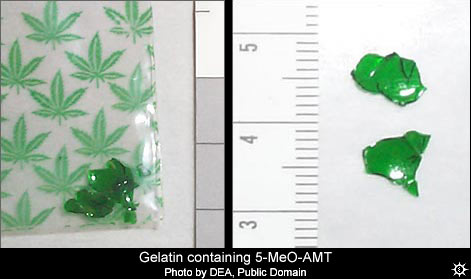
In his book TiHKAL (Tryptamines I Have Known and Loved), Alexander Shulgin lists the dose range of 5-MeO-AMT as 2.5 to 4.5mg and its duration as 12 to 18hours. However, a wider dose range of 0.5 to 15mg has also been reported.
5-MeO-AMT has supposedly been sold as 4mg tablets by the street name Alpha-O and taken as a recreational drug. Since the DEA arrests of the makers of a huge percentage of the United States' LSD in 2000, 5-MeO-AMT may have occasionally been sold under the guise of LSD in liquid, sugar cube, or blotter form, though this may be due to DEA reports of finding it on sugar cubes and blotters like LSD.
Shulgin has described the effects of 5-MeO-AMT in TiHKAL.
Overdose
If misrepresented as LSD, 5-MeO-AMT can be extremely dangerous; users may take a number of "hits" of 5-MeO-AMT, assuming that it is LSD. Unlike LSD, which is very safe in overdose, 5-MeO-AMT can be very harmful or fatal. Particularly sensitive individuals can experience symptoms of overdose at dosages in the normal (for most users) range — as low as 20 mg. This has led to at least a few hospitalizations and possibly more than one death. It is likely that the overdose potential of the compound is due to its sympathomimetic effects, as the side effects noted in overdose cases include cardiac arrhythmia and seizure. It also seems that oral consumption is safer than insufflation.
Gloria Discerni, 18, died after overdosing on a drug initially believed to be LSD. Authorities learned months later that the drug wasn't LSD but a "designer drug" identified as 5-MeO-AMT.
Interactions
Pharmacology
Pharmacodynamics
| Target | Affinity (Ki, nM) |
|---|---|
| [5-HT1A](5-ht1a-receptor) | 46–194 (Ki) |
| 680 () | |
| 101% () | |
| [5-HT1B](5-ht1b-receptor) | 417 (rat) |
| [5-HT2A](5-ht2a-receptor) | 3.1–34 (Ki) |
| 2–8.4 (EC50) | |
| 84% (Emax) | |
| [5-HT2B](5-ht2b-receptor) | 4 (EC50) |
| [5-HT2C](5-ht2c-receptor) | 90 |
| α1A | 12,000 |
| α2A | 11,000 |
| D1 | 25,000 |
| D2 | 25,000 |
| D3 | 25,000 |
| H1 | 25,000 |
| TAAR1 | 1,100 (Ki) (rat) |
| 4,800 (Ki) (mouse) | |
| 10,000 (EC50) (human) | |
| 8,270–12,000 (Ki) | |
| 1,980–17,000 () | |
| 460 (EC50) | |
| 22,000 (Ki) | |
| 37,000–78,000 (IC50) | |
| 8,900 (EC50) | |
| 26,000 (Ki) | |
| 2,690–43,000 (IC50) | |
| 1,500 (EC50) | |
| 31,000 (IC50) | |
| **Notes:** The smaller the value, the more avidly the drug binds to the site. All proteins are human unless otherwise specified. **Refs:** |
5-MeO-AMT acts as a non-selective serotonin receptor agonist, including of the serotonin 5-HT1A, 5-HT2A, and 5-HT2B receptors, among others. Its at the serotonin 5-HT2A receptor has been found to be 2 to 8.4nM. In relation to this, it is an extremely potent agonist of the serotonin 5-HT2A receptor in vitro, showing the highest potency of any other tryptamine assessed in one study. Its potency in activating the serotonin 5-HT2A receptor was 38-fold higher than that of dimethyltryptamine (DMT) and 361-fold higher than that of psilocin in the same study. It is also a highly potent agonist of the serotonin 5-HT2B receptor, with an EC50 of 4nM.
Whereas tryptamine, serotonin (5-hydroxytryptamine), and αMT show potent activity as monoamine releasing agents, including of serotonin, norepinephrine, and/or dopamine, the monoamine-releasing activity of 5-methoxylated tryptamine derivatives, like 5-methoxytryptamine, 5-MeO-NMT, and 5-MeO-DMT among others, is dramatically reduced or abolished. Accordingly, whereas the EC50 values of αMT for induction of monoamine release are 22 to 68nM for serotonin, 79 to 112nM for norepinephrine, and 79 to 180nM for dopamine, the EC50 values in the case of 5-MeO-AMT are 460nM for serotonin, 8,900nM for norepinephrine, and 1,500nM for dopamine. Similarly, it is of very low potency as a monoamine reuptake inhibitor ( values 1,000nM). Considering the very high potency of 5-MeO-AMT in activating the serotonin 5-HT2A receptor, its weak activities as a monoamine releasing agent and reuptake inhibitor are of questionable significance.
5-MeO-AMT is a weak monoamine oxidase A (MAO-A) inhibitor, with an IC50 of 31,000nM. For comparison, the IC50 of AMT for MAO-A inhibition was 380nM (~82-fold more potent than 5-MeO-AMT) and the IC50 values of amphetamine (and its enantiomers) for MAO-A inhibition have been reported to be 11,000 to 70,000nM.
5-MeO-AMT produces the head-twitch response, a behavioral proxy of psychedelic effects, in rodents, and this is reversed by the serotonin 5-HT2A receptor antagonist ketanserin. It substitutes for other psychedelics such as DOM and LSD in animal drug discrimination tests, but does not substitute for entactogens like MDMA or psychostimulants like dextromethamphetamine or cocaine. In contrast to other psychedelics, 5-MeO-AMT has been found to not fully substitute for other psychedelics including DOM, LSD, and dimethyltryptamine (DMT), but did partially generalize to LSD (67% responding). This is analogous to findings with 5-MeO-DMT, which has a major serotonin 5-HT2A receptor-mediated component to its discriminative stimulus properties. 5-MeO-AMT does not produce locomotor hyperactivity, behavioral sensitization, conditioned place preference, or self-administration, further indicating a lack of psychostimulant-like effects as well as misuse potential. Instead, 5-MeO-AMT produces hypolocomotion. 5-MeO-AMT is known to produce sympathomimetic effects, but these effects likely depend on serotonin 5-HT2A receptor activation rather than on monoamine release or reuptake inhibition. Other serotonergic psychedelics are also well known to produce sympathomimetic effects.
Chemistry
5-MeO-AMT, also known as 5-methoxy-α-methyltryptamine, is a substituted tryptamine derivative. It is a derivative of tryptamine (T), 5-methoxytryptamine (5-MeO-T or 5-MT), and α-methyltryptamine (AMT or αMT) and is an analogue of other tryptamines like α-methylserotonin (5-HO-AMT) and 5-MeO-DMT. Some derivatives of 5-MeO-AMT include α,N-dimethyl-5-methoxytryptamine (5-MeO-α-Me-NMT or α,N,O-TMS) and α,N,N-trimethyl-5-methoxytryptamine (5-MeO-α-Me-DMT or α,N,N,O-TMS). As noted by Alexander Shulgin, the α-methylated tryptamines can be seen at as the tryptamine homologues of the amphetamines (α-methylated phenethylamines).
Properties
5-MeO-AMT is soluble in water and ethanol but not in ether.
Synthesis
The chemical synthesis of 5-MeO-AMT has been described.
Analogues
Analogues of 5-MeO-AMT include α-methyltryptamine (AMT), 4-HO-AMT, α-methylserotonin (5-HO-AMT), 5-EtO-AMT, 5-AlO-AMT, 5-fluoro-AMT, 5-chloro-AMT, α,N,O-TMS (5-MeO-N-Me-AMT), α,N,N,O-TeMS (5-MeO-α,N,N-TMT), 5-MeO-DMT, 5-MeO-DPT, 5-MeO-DiPT, O-methyl-AL-34662 (indazole-5-MeO-AMT), and zalsupindole ((R)-N,N-dimethyl-5-MeO-isoAMT), among others.
History
5-MeO-AMT was first synthesized and described in the scientific literature in 1958. Its psychedelic effects in humans were first observed in 1976 and were described by Alexander Shulgin and David E. Nichols and colleagues by 1978.
Society and culture
Legal status
Australia
5-MeO-AMT is considered a Schedule 9 prohibited substance in Australia under the Poisons Standard (October 2015). A Schedule 9 substance is a substance which may be abused or misused, the manufacture, possession, sale or use of which should be prohibited by law except when required for medical or scientific research, or for analytical, teaching or training purposes with approval of Commonwealth and/or State or Territory Health Authorities.
Canada
5-MeO-AMT is not a controlled substance in Canada as of 2025.
Finland
5-MeO-AMT is scheduled in the "government decree on psychoactive substances banned from the consumer market".
Sweden
Sveriges riksdags health ministry Statens folkhälsoinstitut classified 5-MeO-αMT as "health hazard" under the act Lagen om förbud mot vissa hälsofarliga varor (translated Act on the Prohibition of Certain Goods Dangerous to Health) as of Oct 1, 2004, in their regulation SFS 2004:696 listed as 5-metoxi-alfametyltryptamin (5-MeO-AMT), making it illegal to sell or possess.
United Kingdom
5-MeO-αMT was made illegal in the United Kingdom as of 7 January 2015, along with 5-MeO-DALT. This was following the events of 10 June 2014 when the Advisory Council on the Misuse of Drugs recommended that 5-MeO-αMT be scheduled as a class A drug by updating the blanket ban clause on tryptamines.
United States
5-MeO-AMT is unscheduled at the federal level in the United States. However, it may be considered a controlled substance under the Federal Analogue Act as an analogue of schedule psychedelics like AMT and 5-MeO-DMT, but only if it is intended for human consumption.
Florida
5-MeO-AMT is a Schedule I controlled substance in the state of Florida, making it illegal to buy, sell, or possess.
References
References
- Anvisa. (2023-07-24). "RDC Nº 804 - Listas de Substâncias Entorpecentes, Psicotrópicas, Precursoras e Outras sob Controle Especial". [[Diário Oficial da União]].
- (January 1, 2006). "5-MeO-AMT; Fast Facts".
- (1994). "Synthesis of trans-2-(indol-3-yl)cyclopropylamines: Rigid tryptamine analogues".
- {{CiteTiHKAL
- (October 2018). "Monoamine Transporter and Receptor Interaction Profiles in Vitro Predict Reported Human Doses of Novel Psychoactive Stimulants and Psychedelics". Int J Neuropsychopharmacol.
- (May 2020). "Correlation between the potency of hallucinogens in the mouse head-twitch response assay and their behavioral and subjective effects in other species". Neuropharmacology.
- (January–June 2003). "The Identification of 5-Methoxy-alpha-methyltryptamine (5-MeO-AMT)". [[Drug Enforcement Administration]].
- "Police Reports of 5-MeO-AMT". Erowid Vault.
- (July 2007). "Reported LSD-Related death was not LSD". Erowid Vault.
- (January 2007). "5-MeO-AMT Hospitalizations & Possible Deaths". Erowid Vault.
- (13 December 2006). "Charges dropped in drug death". The Spokesman-Review.
- (1988). "BindingDB BDBM50227458 CHEMBL2093088". Journal of Medicinal Chemistry.
- (August 2016). "Receptor interaction profiles of novel psychoactive tryptamines compared with classic hallucinogens". European Neuropsychopharmacology.
- (March 2023). "Structure-Activity Relationship and Evaluation of Phenethylamine and Tryptamine Derivatives for Affinity towards 5-Hydroxytryptamine Type 2A Receptor". Biomol Ther (Seoul).
- (April 2016). "In Vitro Characterization of Psychoactive Substances at Rat, Mouse, and Human Trace Amine-Associated Receptor 1". J Pharmacol Exp Ther.
- (July 2011). "Abuse liability profile of three substituted tryptamines". J Pharmacol Exp Ther.
- (October 2014). "Interaction of psychoactive tryptamines with biogenic amine transporters and serotonin receptor subtypes". Psychopharmacology (Berl).
- (October 2014). "Alpha-ethyltryptamines as dual dopamine-serotonin releasers". Bioorg Med Chem Lett.
- (2006). "Therapeutic potential of monoamine transporter substrates". Curr Top Med Chem.
- (March 2007). "The effects of non-medically used psychoactive drugs on monoamine neurotransmission in rat brain". European Journal of Pharmacology.
- (2019). "Amphetamine Derivatives as Monoamine Oxidase Inhibitors". Front Pharmacol.
- (April 2017). "In vitro monoamine oxidase inhibition potential of alpha-methyltryptamine analog new psychoactive substances for assessing possible toxic risks". Toxicol Lett.
- (February 2019). "5-Methoxy-α-methyltryptamine (5-MeO-AMT), a tryptamine derivative, induces head-twitch responses in mice through the activation of serotonin receptor 2a in the prefrontal cortex". Behav Brain Res.
- (January 2006). "1-((S)-2-aminopropyl)-1H-indazol-6-ol: a potent peripherally acting 5-HT2 receptor agonist with ocular hypotensive activity". J Med Chem.
- (April 1983). "A comparison of the behavioral properties of (+/-)-, (-)-, and (+)-5-methoxy-alpha-methyltryptamine". Biol Psychiatry.
- (March 2022). "A narrative synthesis of research with 5-MeO-DMT". J Psychopharmacol.
- (October 2010). "Psychedelic 5-methoxy-N,N-dimethyltryptamine: metabolism, pharmacokinetics, drug interactions, and pharmacological actions". Curr Drug Metab.
- (January 2000). "The paradox of 5-methoxy-N,N-dimethyltryptamine: an indoleamine hallucinogen that induces stimulus control via 5-HT1A receptors". Pharmacol Biochem Behav.
- (December 2023). "Cardiovascular safety of psychedelic medicine: current status and future directions". Pharmacol Rep.
- (2024). "Effects of hallucinogenic drugs on the human heart". Front Pharmacol.
- (October 2023). "Comparative acute effects of mescaline, lysergic acid diethylamide, and psilocybin in a randomized, double-blind, placebo-controlled cross-over study in healthy participants". Neuropsychopharmacology.
- (1958). "Derivati indolici. III. Preparazione di alpha-alchil e alpha-ariltriptamine". Farmaco Sci.
- (1978). "The Psychopharmacology of Hallucinogens". Elsevier.
- (1979). "Profiles of Psychedelic Drugs: α-O-DMS". Journal of Psychedelic Drugs.
- (April 1980). "5-Methoxy-α-Methyltryptamine (α,O-Dimethylserotonin), A Hallucinogenic Homolog of Serotonin". Biol Psychiatry.
- (October 2015). "Poisons Standard". Australian Government.
- "Controlled Drugs and Substances Act".
- "Valtioneuvoston asetus kuluttajamarkkinoilta kielletyistä psykoaktiivisista aineista | 1130/2014 | Lainsäädäntö | Finlex".
- (19 August 2004). "Förordning om ändring i förordningen (1999:58) om förbud mot vissa hälsofarliga varor". Swedish Code of Statutes.
- "§1308.11 Schedule I.". Drug Enforcement Administration, U.S. Department of Justice.
- "Chapter 893 - Drug Abuse Prevention and Control". Florida Statutes.
This article was imported from Wikipedia and is available under the Creative Commons Attribution-ShareAlike 4.0 License. Content has been adapted to SurfDoc format. Original contributors can be found on the article history page.
Ask Mako anything about 5-MeO-AMT — get instant answers, deeper analysis, and related topics.
Research with MakoFree with your Surf account
Create a free account to save articles, ask Mako questions, and organize your research.
Sign up freeThis content may have been generated or modified by AI. CloudSurf Software LLC is not responsible for the accuracy, completeness, or reliability of AI-generated content. Always verify important information from primary sources.
Report