From Surf Wiki (app.surf) — the open knowledge base
49er (dinghy)
Olympic sailing class

Olympic sailing class
| Field | Value |
|---|---|
| image | 49er skiff.svg |
| class_image | 49er black.svg |
| crew | 2 (double trapeze) |
| loa | 4876 mm |
| beam | without wings: |
| 1752 mm | |
| with wings: | |
| 2743 mm | |
| draft | 1447 mm |
| hull | 94 kg |
| mainsailandjib | 19.97 m2 |
| spinnaker | 37.16 m2 |
| d-pn | 68.2 |
| rya-pn | 710 |
| olympic | current |
1752 mm with wings: 2743 mm |d-pn = 68.2 |rya-pn = 710 The 49er is a double-handed skiff-type high-performance sailing dinghy. The two crew work on different roles with the helm making many tactical decisions, as well as steering, and the crew doing most of the sail control. Both of the crew are equipped with their own trapeze and sailing is done while cantilevered over the water to the fullest extent to balance against the sails.
The 49er was designed by Julian Bethwaite (the son of Frank Bethwaite) and developed by a consortium consisting of Bethwaites, Performance Sailcraft Japan, Peter Johnston, and Ovington boats. The boat has been an Olympic class since it was selected by the International Sailing Federation to be the men's high performance double handed dinghy Sydney Summer Games of 2000. Its derivative featuring a re-designed rig, the 49er FX, was selected by World Sailing to be the women's high performance double-hander at the Rio Summer Olympics of 2016.
History
The 49er's name comes from its hull length of 4.99 m. It incorporates ideas developed in Julian Bethwaite's 18ft Skiffs, notably the Prime Computer series of boats, which were double handers.
To handle a large and powerful sail area, the mast uses a square topped sail that causes the upper main to twist off and flatten, allowing a controllable sail with fast gust response and reducing the heeling moment. The use of solid wings, rather than tubes as on similar boats (RS800 etc.), makes it easier for the crew to run across the deck from gunwale to gunwale during maneuvers.
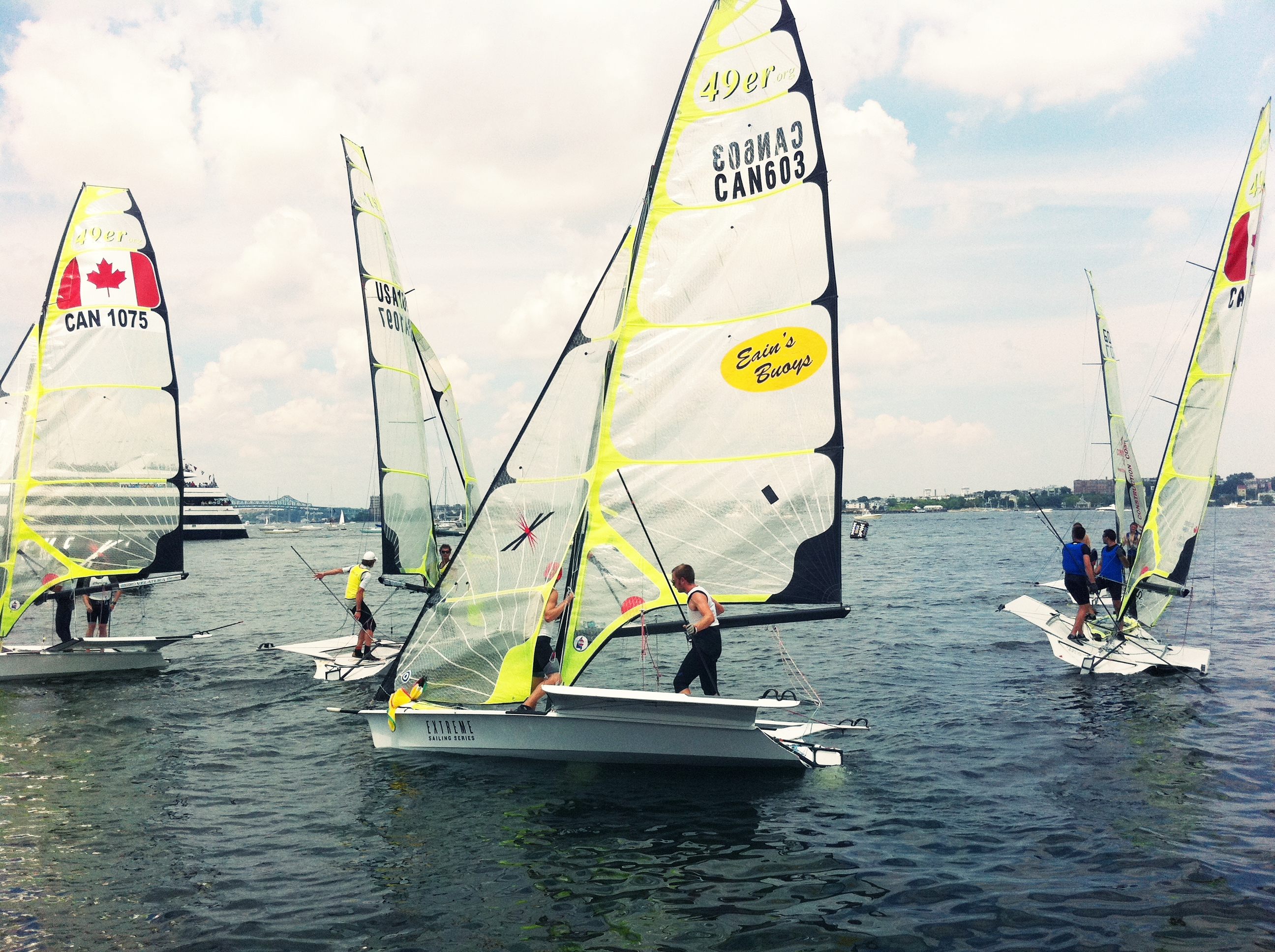
The 49er made its first Olympic appearance at the Sydney Olympics in 2000 and has continued to grow in popularity ever since.
With a Portsmouth yardstick Handicap of 740 the 49er is the fastest two person one-design monohull dinghy.
In 2009 the boat received a new rig design, including a larger fully carbon mast (replacing the aluminum mast) and square top (roach) mainsail.
Construction
As a one design class, the 49er has two licensed suppliers, Mackay Boats in Oceania and Ovington in Europe.
Hull
The hull is made of Epoxy GRP and foam sandwich laminate with carbon fibre in high load areas. It includes two solid wings, also called racks, that clip into the side to increase righting moment of the trapezing crew. Its length was fixed at 4.99 metres because the ISAF brief for the high performance Olympic class dinghy called for a 5-metre boat, but Tokao Otani, a member of the development consortium, pointed out that there was a tariff in Japan for boats over 5 metres long. It has a fine entry to efficiently transition between the low speed displacement, and high speed planing modes. According to the International 49er class rules, the minimum hull weight including all permanent fittings can not be less than 94.0 kg.

Spars
Southern Spars, part of the North Technology Group, is the licensed supplier of the 49er mast. It is a three piece male-moulded assembly made from 100% standard modulus carbon. It is 7.0 metres tall and capable of supporting a combined crew weight up to 165 kg from its dual trapeze. The mast is braced by three sets of shrouds that connect to a fitting on the side of the boat. The crew is able to adjust them by tightening or loosening them, depending on the wind speed and sea states.
The boom is made from an aluminium alloy extrusion.
Foils
The rudder and daggerboard are made from a composite of epoxy, carbon and glass, covered by a hard gelcoat surface. The head of each class legal foil carries the embossed 49er logo and the ICA label.
Sails
The 49er carries three sails: a mainsail, jib, and spinnaker. The main and jib combined are 20 square metres, fully battened and made of reinforced Mylar (film polyester). The main was redesigned in 2007 from a full, curved roach plan to having a square on top in order to provide more sail area and to control more shape adjustment. The spinnaker is 38 square metres in a tri-radial asymmetric shape.
Events
Olympics
Men's 49er
Women's 49er FX
World Championships
Main article: 49er & 49er FX World Championships
Men's 49er
Women's 49er FX
References
References
- "Centerboard Classes". US Sailing.
- "Portsmouth Number List 2017". Royal Yachting Association.
- (20 February 2015). "Prime Computer Skiff".
- "49er Class".
- "49er shop".
- Bethwaite, Frank. (2008). "Higher performance sailing". Adlard Coles Nautical.
- (26 May 2023). "Design Elements".
- (2016). "International 49er Class Rules".
- (2010). "49er Mast Users Manual". SouthernSpars.
- "49er".
This article was imported from Wikipedia and is available under the Creative Commons Attribution-ShareAlike 4.0 License. Content has been adapted to SurfDoc format. Original contributors can be found on the article history page.
Ask Mako anything about 49er (dinghy) — get instant answers, deeper analysis, and related topics.
Research with MakoFree with your Surf account
Create a free account to save articles, ask Mako questions, and organize your research.
Sign up freeThis content may have been generated or modified by AI. CloudSurf Software LLC is not responsible for the accuracy, completeness, or reliability of AI-generated content. Always verify important information from primary sources.
Report