From Surf Wiki (app.surf) — the open knowledge base
498th Fighter-Interceptor Squadron

| Field | Value | |
|---|---|---|
| unit_name | 498th Fighter-Interceptor Squadron | |
| image | 498th Fighter-Interceptor Squadron-F-106-row-1968.jpg | |
| image_size | 300 | |
| caption | Aircraft, pilots and support crews of the 498th line up in their final formation before moving to McChord AFB in 1963 | |
| dates | 1942–1944; 1955–1968 | |
| country | ||
| branch | ||
| role | Fighter interceptor | |
| nickname | Geiger Tigers (1955–1963), Megas Gatas | |
| identification_symbol | [[File:498th Fighter-Interceptor Squadron - Emblem.jpg | 165px]] |
| identification_symbol_label | 498th Fighter-Interceptor Squadron emblem |
The 498th Fighter-Interceptor Squadron is an inactive United States Air Force unit. Its last assignment was with Air Defense Command stationed at Hamilton Air Force Base, California, where it was inactivated on 30 September 1968.
The squadron was first activated in 1942 as the 303rd Bombardment Squadron and served as a training unit for single engine bomber crews, and later as the 498th Fighter-Bomber Squadron, for fighter pilots until being disbanded in 1944 in a general reorganization of Army Air Forces training units.
It was reconstituted in 1955 as the 498th Fighter-Interceptor Squadron and served as an air defense unit in the western United States.
History
World War II
The squadron was activated in 1942 as the **303rd Bombardment Squadron ** (Light) at Savannah Air Base, Georgia, and equipped with Douglas A-24 Banshee dive bombers as one of the original squadrons of the 84th Bombardment Group. It received its initial cadre and equipment from the 3d Bombardment Group. It operated briefly with Vultee V-72 (A-31 Vengeance) aircraft, but its operations showed this aircraft was unsuitable for dive bombing. The squadron served as an Operational Training Unit (OTU), equipping with A-24 Banshees and Bell P-39 Airacobras.
The OTU program involved the use of an oversized parent unit to provide cadres to “satellite groups " The OTU program was patterned after the unit training system of the Royal Air Force. After forming the satellite groups, the parent unit assumed responsibility for satellite training and oversaw its expansion with graduates of Army Air Forces Training Command schools to become effective combat units. Phase I training concentrated on individual training in crewmember specialties. Phase II training emphasized the coordination for the crew to act as a team. The final phase concentrated on operation as a unit. The squadron contributed to the 84th Group's role as the parent for elements of several light bombardment groups.
In August 1943, the squadron was redesignated the 498th Fighter-Bomber Squadron

In October 1943, the squadron moved to Harding Field, Louisiana, where it became a Replacement Training Unit (RTU) and also participated occasionally in demonstrations and maneuvers. The squadron was, therefore, disbanded in April 1944
Cold War Air defense
In 1955, Air Defense Command (ADC) implemented Project Arrow, which was designed to bring back on the active list fighter units which had compiled memorable records in the two world wars and restore squadrons to the groups they were associated with during World War II. In this reorganization, the 84th Fighter Group was activated at Geiger Field, Washington to replace the 530th Air Defense Group. As part of this reorganization, the squadron was redesignated the 498th Fighter-Interceptor Squadron and activated on 18 August 1955, The squadron was initially equipped with North American F-86D Sabres, which were equipped with airborne intercept radar and armed with FFAR rockets.
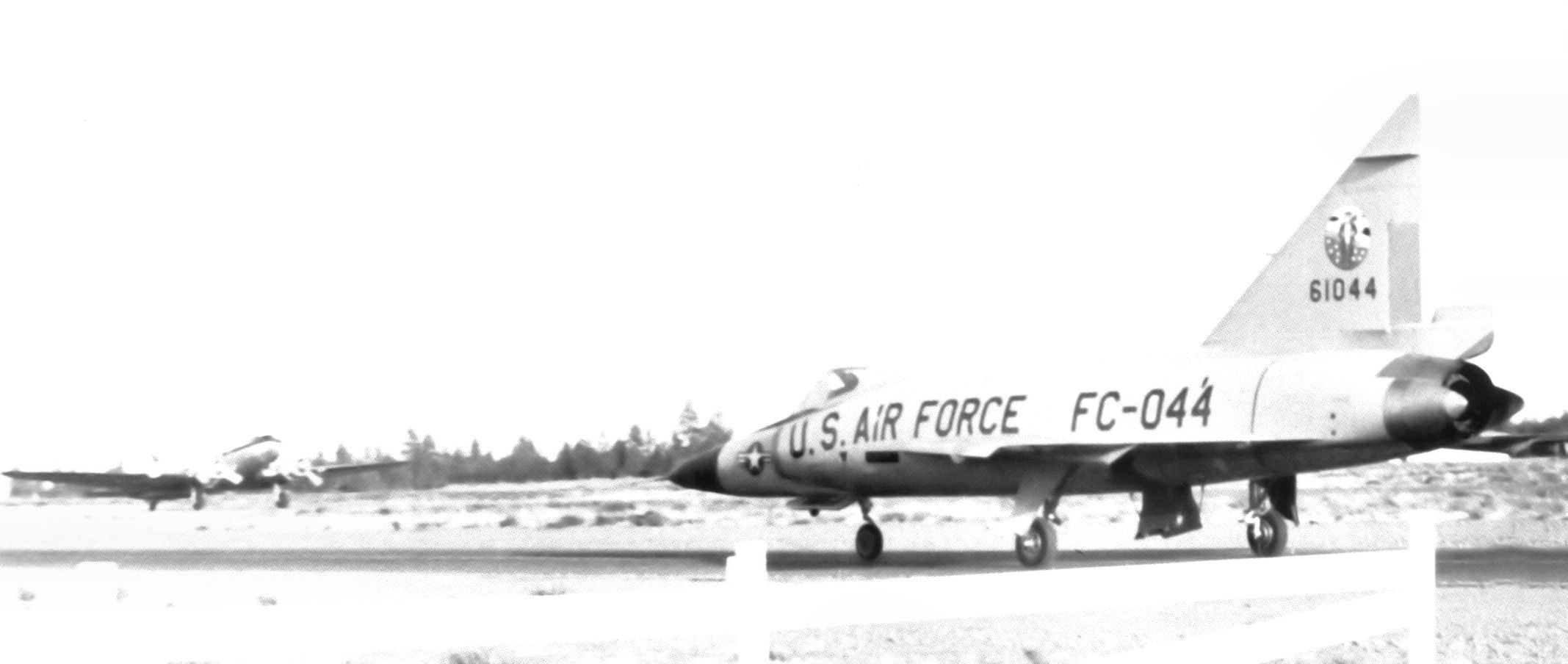
It upgraded to Convair F-102A Delta Daggers in July 1957 and then to Convair F-106A Delta Darts in February 1959. Although the number of ADC interceptor squadrons remained almost constant in the early 1960s, attrition (and the fact that production lines closed in 1961) caused a gradual drop in the number of planes assigned to a squadron, from 24 to typically 18 by 1964. In February 1962, ADC increased the alert requirement for its units. In addition to the two aircraft the squadron had been maintaining on five minute alert, one third of the unit’s aircraft were placed on fifteen minute alert.
On 22 October 1962, before President John F. Kennedy told Americans that missiles were in place in Cuba, ADC went to DEFCON 5 Delta, which put all planes on 5 minute alert, continuing until 27 November. the squadron dispersed one third of its force, equipped with nuclear tipped missiles to Paine Air Force Base. Dispersed aircraft were armed with their primary armament, including nuclear missiles. Personnel and aircraft were rotated to dispersal sites during the crisis. These planes returned to Geiger Field after the crisis.

The squadron moved to McChord Air Force Base in July 1963. The response to this intrusion was to deploy ten F-106s from the squadron and its sister unit, the 318th Fighter-Interceptor Squadron to Alaska in what was called Operation White Shoes. However, maintaining these aircraft for an extended period of time put a strain on the 325th wing's combat readiness back at McChord, and eventually a detachment of maintenance personnel was established to maintain the planes in Alaska. The unit got relief from this commitment while it was upgrading its F-106s from the 1st Fighter Wing, which relieved it from March to June 1964. Operation White Shoes terminated in 1965 and the unit's planes returned home.
In June 1966, the 64th Fighter-Interceptor Squadron deployed to Clark Air Base, Philippines to reinforce air defenses in Southeast Asia. The squadron moved to Paine Field, Washington to replace it in July, and was assigned to the 57th Fighter Group there.
On 30 September 1968, the squadron moved to Hamilton Air Force Base, California. Upon its arrival, it was inactivated and its personnel and equipment were transferred to the 84th Fighter-Interceptor Squadron, which used the 498th's F-106s to replace their McDonnell F-101 Voodoos.
Lineage
- Constituted as the 303d Bombardment Squadron (Light) on 13 January 1942 : Activated on 10 February 1942 : Redesignated 303d Bombardment Squadron (Dive) on 27 July 1942 : Redesignated 498th Fighter-Bomber Squadron on 10 August 1943 : Disbanded on 1 April 1944
- Reconstituted and redesignated 498th Fighter-Interceptor Squadron on 20 June 1955 : Activated on 18 August 1955 : Inactivated on 30 September 1968
Assignments
- 84th Bombardment Group (later 84th Fighter-Bomber Group), 10 February 1942 – 1 April 1944
- 84th Fighter Group, 18 August 1955
- 325th Fighter Wing, 1 July 1963
- 57th Fighter Group, 25 June 1966
- 78th Fighter Wing, 30 September 1968
Stations
- Savannah Air Base, Georgia, 10 February 1942
- Drew Field, Florida, 8 February 1943
- Harding Field, Louisiana, 4 October 1943
- Hammond Army Air Field, Louisiana, c. 11 October 1943
- Abilene Army Air Field, Texas, 11 February – April 1944
- Geiger Field, Washington (later Spokane International Aiirport), 18 August 1955
- McChord Air Force Base, Washington, 1 July 1963
- Paine Field, Washington, 14 June 1966
- Hamilton Air Force Base California, 30 September 1968
Aircraft
- Vultee V-72 Vengeance, 1942
- Douglas A-24 Banshee, 1942–1943
- Bell P-39 Airacobra, 1943
- Republic P-47 Thunderbolt, 1943–1944
- North American F-86D Sabre, 1955–1957
- Convair F-102A Delta Dagger, 1957–1959
- Convair F-106A Delta Dart, 1959–1968
Campaigns
| Campaign Streamer | Campaign | Dates | Notes | |
|---|---|---|---|---|
| [[File:World War II - American Campaign Streamer (Plain).png | 200px]] | American Theater without inscription | 10 February 1942–1 April 1944 | 303rd Bombardment Squadron (later 498th Fighter-Bomber Squadron) |
References
Notes
; Explanatory notes
; Citations
Bibliography
- Buss, Lydus H.(ed), Sturm, Thomas A., Volan, Denys, and McMullen, Richard F., History of Continental Air Defense Command and Air Defense Command July to December 1955, Directorate of Historical Services, Air Defense Command, Ent AFB, CO, (1956)
- :
- :
- (Secret- Restricted Data, redacted version declassified 20 June 1996)
- (Top Secret NOFORN declassified 9 March 1996) ; Further reading
References
- Maurer, ''Combat Squadrons'', pp. 600-01
- Maurer, ''Combat Units'', p. 150
- "Abstract, History 84 Fighter-Bomber Group to Jul 1943". Air Force History Index.
- Craven & Cate, Introduction, p. xxxvi
- Goss, p. 74
- Greer, p. 601
- Greer, p. 606
- RTUs were also oversized units, but with the mission of training individual [[aviators
- Buss, ''et al.'', p. 6
- Air Defense Command Historical Data 1946-1973, Air Defense Command Office of History, Vol. II, p. 104
- Cornett & Johnson, p. 130
- No byline. "History of the F-106A Delta Dart". F106ADeltaDart.com.
- McMullen, pp. 41, 43-45
- Ray, p 50
- McMullen, pp. 10–12
- NORAD/CONAD Participation in the Cuban Missile Crisis, p. 16
- NORAD/CONAD Participation in the Cuban Missile Crisis, p. 17
- NORAD/CONAD Participation in the Cuban Missile Crisis, , p. 26
- McMullen, pp. 28–29
- McMullen, pp. 32–34
- Cornett & Johnson, p. 120
- Lineage information, including aircraft, assignments and stations, through March 1963 in Maurer, ''Combat Squadrons'', pp. 600-01
This article was imported from Wikipedia and is available under the Creative Commons Attribution-ShareAlike 4.0 License. Content has been adapted to SurfDoc format. Original contributors can be found on the article history page.
Ask Mako anything about 498th Fighter-Interceptor Squadron — get instant answers, deeper analysis, and related topics.
Research with MakoFree with your Surf account
Create a free account to save articles, ask Mako questions, and organize your research.
Sign up freeThis content may have been generated or modified by AI. CloudSurf Software LLC is not responsible for the accuracy, completeness, or reliability of AI-generated content. Always verify important information from primary sources.
Report