From Surf Wiki (app.surf) — the open knowledge base
496th Tactical Fighter Squadron

| Field | Value | |
|---|---|---|
| unit_name | 496th Tactical Fighter Squadron | |
| image | 496th Tactical Fighter Squadron - General Dynamics F-16C Block 25E Fighting Falcon - 84-1315.jpg | |
| image_size | 290px | |
| caption | 496th TFS F-16 Fighting Falcon | |
| dates | 1942–1944; 1949–1951; 1953–1991 | |
| country | ||
| branch | ||
| role | Fighter | |
| motto | ||
| decorations | Air Force Outstanding Unit Award | |
| identification_symbol | [[Image:496 tactical fighter sq-image.jpg | 165px]] |
| identification_symbol_label | 496th Tactical Fighter Squadron emblem | |
| identification_symbol_2 | [[File:496th Fighter-Interceptor Squadron - Emblem.png | 165px]] |
| identification_symbol_2_label | Patch with 496th Fighter-Interceptor Squadron emblem |
The 496th Tactical Fighter Squadron is an inactive United States Air Force unit, last assigned to the United States Air Forces in Europe, 50th Tactical Fighter Wing, at Hahn Air Base, Germany, where the squadron was inactivated on 15 May 1991.
The unit was first activated as the 301st Bombardment Squadron in 1942, and served until April 1944 as a replacement and operational training unit for light bombardment and. later, as the 496th Fighter-Bomber Squadron, fighter-bomber units and crews. It was disbanded in a reorganization of training units by the Army Air Forces, It was again active as the 496th Fighter All-Weather Squadron, a reserve unit, from 1949 to 1951, flying the aircraft of the regular 52d Fighter-All Weather Group until it was called to active duty for the Korean War and its personnel used to fill out other units.
Its longest period of active duty started in 1953, when it was activated as the 496th Fighter-Interceptor Squadron. After training in the Western United States, it moved to Germany, serving in the air defense of Western Europe until 1968, when it became the 496th Tactical Fighter Squadron and added the tactical fighter mission.
History
World War II
The squadron was activated in 1942 as the **301st Bombardment Squadron ** (Light) at Savannah Air Base, Georgia, and equipped with Douglas A-24 Banshee dive bombers as one of the original squadrons of the 84th Bombardment Group. It received its initial cadre and equipment from the 3d Bombardment Group. It operated briefly with Vultee V-72 (A-31 Vengeance) aircraft, but its operations showed this aircraft was unsuitable for dive bombing. The squadron served as an Operational Training Unit (OTU), equipping with Douglas A-24 Banshees and Bell P-39 Airacobras.
The OTU program involved the use of an oversized parent unit to provide cadres to “satellite groups " The OTU program was patterned after the unit training system of the Royal Air Force. After forming the satellite groups, it assumed responsibility for their training and oversaw their expansion with graduates of Army Air Forces Training Command schools to become effective combat units. Phase I training concentrated on individual training in crewmember specialties. Phase II training emphasized the coordination for the crew to act as a team. The final phase concentrated on operation as a unit. It contributed to the 84th Group's role as the parent for elements of several light bombardment groups.
In August 1943, the squadron was redesignated the 496th Fighter-Bomber Squadron

The squadron then became a Replacement Training Unit (RTU) and also participated occasionally in demonstrations and maneuvers. However, the AAF found that standard military units, based on relatively inflexible tables of organization were not proving well adapted to the training mission. Accordingly, it adopted a more functional system in which each base was organized into a separate numbered unit. The squadron was, therefore, disbanded in April 1944
Air reserve
The May 1949 Air Force Reserve program called for a new type of unit, the corollary unit, which was a reserve unit integrated with an active duty unit. The plan called for corollary units at 107 locations. It was viewed as the best method to train reservists by mixing them with an existing regular unit to perform duties alongside the regular unit. As part of this program, the squadron was reconstituted as the 496th Fighter Squadron, All Weather and activated at Mitchel Air Force Base, New York in the air reserve to train as a fighter corollary unit of the 52d Fighter Group of the regular Air Force, moving with the 52d to McGuire Air Force Base, New Jersey a few months later. The squadron was apparently undermanned and thus performed very little training. In February 1950, it was redesignated 496th Fighter All-Weather Squadron.
Interceptor operations
The squadron was redesignated the 496th Fighter-Interceptor Squadron and activated in March 1953 at Hamilton Air Force Base, California in early 1953.
The squadron was assigned to Twelfth Air Force, but attached to the 86th Fighter-Bomber Wing) on 1 July 1954 and arrived at Landstuhl Air Base, Germany on 4 July. In December, United States Air Forces Europe (USAFE) formed the 7486th Air Defense Group at Landstuhl and the squadron was assigned to it. In July 1955, the 7486 became an air base group, but the squadron remained assigned to it until January 1956, when the 496th became part of the 86th Fighter-Interceptor Group. In November 1956, the squadron moved to Hahn Air Base, Germany.

The 86th Fighter-Interceptor Group was inactivated in March 1958, and the squadron was reassigned to the 86th Fighter-Interceptor Wing. In 1959, the squadron began to transition from its Sabres to the Convair F-102A Delta Dagger, which was equipped with data link for interception control and armed with AIM-4 Falcon missiles. It completed the changeover in 1960.
Tactical fighter operations
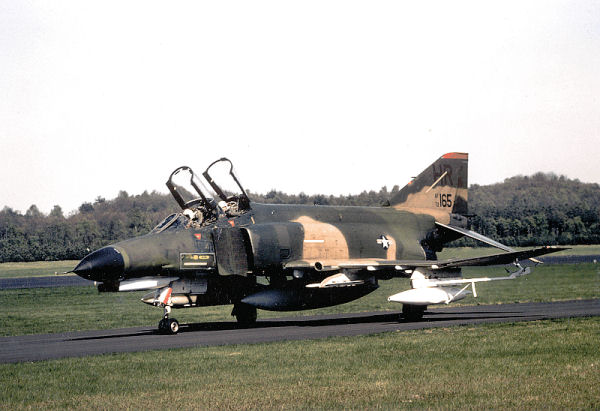
On 1 November 1968, the squadron became the 496th Tactical Fighter Squadron, and two weeks later was assigned to the 50th Tactical Fighter Wing, which was flying McDonnell F-4D Phantom IIs. The squadron began returning its F-102s to the United States, where they were transferred to the 194th Fighter-Interceptor Squadron, in 1970 and became the first squadron in the 50th Wing to equip with the F-4E model of the Phantom II. Despite its change of name and aircraft, the squadron retained air defense as its primary mission until 1977, when the 50th Wing was entirely equipped with the F-4E and became dedicated to the tactical fighter mission.
In December 1981, the 50th Wing became the first USAFE unit to upgrade to the General Dynamics F-16 Fighting Falcon, completing the transition in June 1982. Between March 1985 and December 1987, the wing upgraded its Block 15 F-16As and F-16Bs to Block 25 F-16Cs and F-16Ds. Although the squadron did not participate in the Gulf War as a unit, it deployed personnel and equipment to support it.
The squadron was inactivated in May 1991 as the 50th Tactical Fighter Wing began to draw down at Hahn in preparation for its inactivation with the termination of Hahn as an operational base in September.
Lineage
- Constituted as the 301st Bombardment Squadron (Light) on 13 January 1942 : Activated on 10 February 1942 : Redesignated 301st Bombardment Squadron (Dive) on 27 July 1942 : Redesignated 496th Fighter-Bomber Squadron on 10 August 1943 : Disbanded on 1 April 1944
- Reconstituted, and redesignated 496th Fighter Squadron, All Weather on 16 May 1949 : Activated in the reserve on 1 June 1949 : Redesignated 496th Fighter-All Weather Squadron on 1 March 1950 : Ordered to active service on 1 June 1951 : Inactivated on 2 June 1951
- Redesignated 496th Fighter-Interceptor Squadron on 11 February 1953 : Activated on 20 March 1953 : Redesignated 496th Tactical Fighter Squadron, 1 November 1968 : Inactivated 15 May 1991
Assignments
- 84th Bombardment Group (later 84th Fighter-Bomber Group), 10 February 1942 – 1 April 1944
- 84th Fighter Group, 1 June 1949 – 2 June 1951
- 566th Air Defense Group, 20 March 1953
- Twelfth Air Force (attached to 86th Fighter-Bomber Wing), 1 July 1954
- 7486th Air Defense Group (later 7486th Air Base Group), 2 December 1954
- 86th Fighter-Interceptor Group, 3 January 1956
- 86th Fighter-Interceptor Wing (later 86th Air Division), 8 March 1958 (attached to 50th Tactical Fighter Wing after 1 November 1968)
- 50th Tactical Fighter Wing, 25 November 1968 – 15 May 1991
Stations
- Savannah Air Base (later Hunter Field), Georgia, 10 February 1942
- Drew Field, Florida, 8 February 1943
- Harding Field, Louisiana, 4 October 1943
- Hammond Army Air Field, Louisiana, 9 November 1943
- Abilene Army Air Field, Texas, 11 February – 1 April 1944
- Mitchel Air Force Base, New York, 1 June 1949
- McGuire Air Force Base, New Jersey, 10 October 1949 – 2 June 1951
- Hamilton Air Force Base, California, 20 March 1953
- Landstuhl Air Base, Germany, 4 July 1954
- Hahn Air Base, Germany, 8 November 1956 – 15 May 1991
Aircraft
- Vultee V-72 Vengeance, 1942
- Douglas A-24 Banshee, 1942–1943
- Bell P-39 Airacobra, 1943
- Republic P-47 Thunderbolt, 1943–1944
- North American F-82 Twin Mustang
- North American F-51 Mustang, 1953
- North American F-86D Sabre, 1953–1960
- Convair F-102 Delta Dagger, 1959–1970
- McDonnell F-4 Phantom II, 1970–1982
- General Dynamics F-16 Fighting Falcon, 1982–1991
Awards and campaigns
| Campaign Streamer | Campaign | Dates | Notes | |
|---|---|---|---|---|
| [[File:World War II - American Campaign Streamer (Plain).png | 200px]] | American Theater without inscription | 10 February 1942–1 April 1944 | 302nd Bombardment Squadron (later 496th Fighter-Bomber Squadron) |
References
Notes
; Explanatory notes
; Citations
Bibliography
- :
- :
- (renumbered AF Pamphlet 36-2801, Vol. I)
- (renumbered AF Pamphlet 36-2801, Vol. II) ; Further reading
- (link is to Amazon listing of book)
References
- Maurer, ''Combat Squadrons'', p. 598
- Maurer, ''Combat Units'', p. 150
- "Abstract, History 84 Fighter-Bomber Group to Jul 1943". Air Force History Index.
- Craven & Cate, Introduction, p. xxxvi
- Goss, p. 74
- Greer, p. 601
- Greer, p. 606
- RTUs were also oversized units, but with the mission of training individual [[aviators. pilots]] or aircrews.Craven & Cate, introduction, p. xxxvi
- Craven & Cate, Vol. VI, p. 75
- Cantwell, p. 73
- (4 April 2018). "Factsheet 86 Operations Group (USAFE)". Air Force Historical Research Agency.
- (20 November 2008). "Factsheet 50 Space Wing (AFSPC)". Air Force Historical Research Agency.
- No byline. (10 November 2018). "496th Tactical Fighter Squadron". Air Force Order of Battle.
- No byline=. "Abstract, History 50th Tactical fighter Wing, Jan-Mar 1970, Vol. I". Air Force History Index.
- Lineage, including assignments, stations and aircraft through 1963 in Maurer, ''Combat Squadrons'', p. 598.
- AF Pamphlet 900-2, p. 407
- AF Pamphlet 900-2, Vol. II, p. 77
- "Air Force Personnel Services: Unit Awards". Air Force Personnel Center.
This article was imported from Wikipedia and is available under the Creative Commons Attribution-ShareAlike 4.0 License. Content has been adapted to SurfDoc format. Original contributors can be found on the article history page.
Ask Mako anything about 496th Tactical Fighter Squadron — get instant answers, deeper analysis, and related topics.
Research with MakoFree with your Surf account
Create a free account to save articles, ask Mako questions, and organize your research.
Sign up freeThis content may have been generated or modified by AI. CloudSurf Software LLC is not responsible for the accuracy, completeness, or reliability of AI-generated content. Always verify important information from primary sources.
Report