From Surf Wiki (app.surf) — the open knowledge base
489th Attack Squadron
| Field | Value | |
|---|---|---|
| unit_name | 489th Attack Squadron | |
| image | First MQ-9 Reaper taxies at Creech AFB 2007.jpg | |
| image_size | 300px | |
| caption | MQ-9 Reaper at Creech AFB | |
| dates | 1917–1919; 1925–1942; 1942–1945; 1947–1949; 1958–1962; 2011-2015; 2016-present | |
| country | ||
| branch | ||
| role | Unmanned aerial vehicle attack | |
| command_structure | Air Combat Command | |
| garrison | Creech Air Force Base | |
| battles | Mediterranean Theater of Operations | |
| decorations | Distinguished Unit Citation | |
| Air Force Meritorious Unit Award | ||
| Air Force Outstanding Unit Award | ||
| identification_symbol | [[File:489 Attack Sq emblem.png | 150px]] |
| identification_symbol_label | 489th Attack Squadron emblem | |
| identification_symbol_2 | [[File:489 Reconnaissance Squadron.jpg | 150px]] |
| identification_symbol_2_label | 489th Reconnaissance Squadron emblem | |
| identification_symbol_3 | [[File:489 Reconnaissance Sq emblem.png | 165px]] |
| identification_symbol_3_label | 489th Bombardment Squadron emblem | |
| identification_symbol_4 | [[File:489th Bombardment Squadron - Emblem.png | 150px]] |
| identification_symbol_4_label | 489th Bombardment Squadron emblem (World War II) |
Air Force Meritorious Unit Award Air Force Outstanding Unit Award
The 489th Attack Squadron is an active United States Air Force unit, stationed at Creech Air Force Base, Nevada, and operating General Atomics MQ-1 Predator and General Atomics MQ-9 Reaper unmanned aerial vehicles. It was active at Beale Air Force Base, California as the 489th Reconnaissance Squadron from 2011 to 2015.
The squadron was first activated as the 77th Aero Squadron in 1917. Redesignated as the 489th Aero Squadron, it served as a construction unit in France during World War I before returning to the US and being demobilized in 1919.
Through most of its existence, the squadron was named the 489th Bombardment Squadron. It served under this name from 1925 to 1942 in the Organized Reserve. The squadron served in the Mediterranean Theater of Operations during World War II, earning two Distinguished Unit Citations for actions in North Africa and Sicily. Inactivated after the war, it served briefly in the reserves a second time between 1947 and 1949. When Strategic Air Command reorganized its Boeing B-47 Stratojet wings as four squadron units the squadron was activated at Whiteman Air Force Base, Missouri, remaining active until 1962.
Mission
The squadron flies launch and recovery remotely piloted aircraft operations for General Atomics MQ-1 Predators and General Atomics MQ-9 Reapers. After launching these aircraft, they are handed off to the aircrew who execute the assigned mission, before returning them to the squadron for recovery operations.
History
World War I
The squadron was activated as the 77th Aero Squadron at Kelly Field, Texas in August 1917, and commanded by Capt. H. L. Mumma. In November 1917 the 77th moved to the Air Depot at Garden City, New York for deployment to the American Expeditionary Forces. On 4 December 1917, the squadron moved to the Philadelphia Port of Embarkation and boarded the transport . On the Northland were 9 Aero Squadrons with 70 officers and 1,339 enlisted men. These 9 Squadrons were the 10th, 12th, 13th, 16th, 19th, 75th, 76th, 77th and 101st.
In January 1918 a new numbering scheme for aero squadrons was set up. The numbers 400 through 599 were reserved for Aero Squadrons (Construction). The 77th was redesignated as the 489th Aero Squadron (Construction). It served in France building facilities. The 489th returned to the States in February 1919 and went to Camp Stuart, Virginia. In March 1919 it was demobilized at Camp Lee, Virginia.
Organized Reserve

The first 489th Bombardment Squadron was constituted in the Organized Reserve in March 1924 and allotted to the Ninth Corps Area. The squadron was manned in 1925 at Boeing Field, near Seattle, Washington. It was assigned to the 349th Bombardment Group from 22 October 1925 until c. June 1929 for mobilization as part of the General Headquarters Reserve. The 489th was one of the few Air Corps units in the Organized Reserve that possessed facilities, equipment and, aircraft between the wars, including Curtiss B-2 Condor bombers. In June 1932, the 489 Aero Squadron was reconstituted and consolidated with the 489 Bombardment Squadron. The unit typically conducted its inactive training at Pearson Field or in Seattle. It performed its summer training at various Air Corps installations in the Pacific coastal region. The squadron was disbanded, along with all other Organized Reserve Air Corps units on 31 May 1942 and its remaining personnel were called to active duty individually.
World War II
Initial organization and training
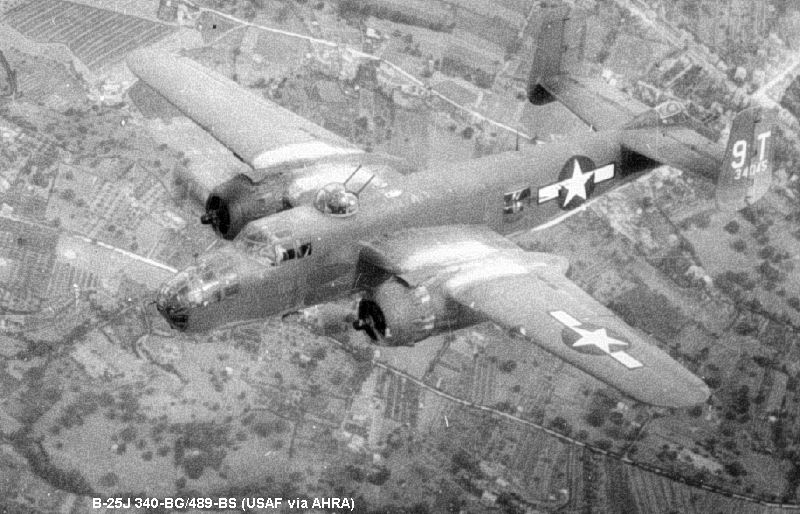
The second 489th Bombardment Squadron was activated at Columbia Army Air Base, South Carolina on 20 August 1942 as one of the four original squadrons of the 340th Bombardment Group. However, it was not until September that the squadron received its initial cadre, mostly drawn from the 309th Bombardment Group. It completed Phase I and Phase II training at Columbia with North American B-25 Mitchells, then moved to Walterboro Army Air Field, South Carolina in November, where it completed Phase III training and departed for the Mediterranean Theater of Operations at the end of January 1943.
The squadron's ground echelon travelled by train to Camp Stoneman, California, where it boarded the USS West Point (AP-23) for the combat zone via the Pacific and Indian Oceans. The air echelon travelled by train to Kellogg Field, Michigan, where it received new B-25s to ferry across the Atlantic. It departed Morrison Field, Florida on 25 February 1943.
Combat operations
The squadron arrived at its first combat base, RAF Kabrit, Egypt in March 1943, with the air echelon arriving between 10 and 20 March and the ground echelon on 29 March. It began combat operations from Medenine Airfield, Tunisia in April, where the 340th Group flew its initial seven missions with the 12th Bombardment Group. Shortly thereafter, it moved to Sfax Airfield, Tunisia and began operations on its own. The 487th engaged primarily in air support and interdiction operations, targeting airfields, roads, bridges, road junctions, supply depots and marshalling yards. It participated in Operation Corkscrew, the reduction of defenses in Pantelleria and Lampedusa in June 1943. Although the squadron's operations were hindered by primitive living conditions at its base and unfavorable weather, the squadron supported the British Eighth Army in Tunisia and Allied forces in Operation Husky, the invasion of Sicily. For these actions, it was awarded a Distinguished Unit Citation (DUC).

As the Germans retreated from Sicily, the squadron attacked their evacuation beaches near Messina the following month. In September, it supported Operation Avalanche, the invasion of Italy near Salerno. During the first six months of 1944, it provided air support for the Allied drive on Rome. In March 1944, Mount Vesuvius erupted, covering 340th Group aircraft at Pompeii Airfield with volcanic ash. As a result, the squadron was forced to move to Gaudo Airfield. In April, it moved to Alesan Airfield, on Corsica.
The squadron sometimes bombed strategic targets as well. It operated against factories in Albania, Austria, Bulgaria, France, Greece, Italy, Tunisia and Yugoslavia. After September 1944, these targets included German lines of communication, particularly in the Alps, where it conducted raids on targets in the Brenner Pass. It also engaged in psychological warfare operations, dropping propaganda leaflets behind enemy lines. The squadron received a second DUC for action on 23 September 1944. The Italian Navy was attempting to block access to the heavily defended harbor of La Spezia by sinking a cruiser to block the entrance to the harbor. The squadron attacked and sank the cruiser before it could be maneuvered into position.
Just prior to V-E Day, the squadron returned to Italy, leaving for the United States in July 1945. The air echelon ferried its Mitchells, turning them in upon arrival in the United States, while the ground echelon returned by ship, leaving Naples on 28 July and arriving at Hampton Roads, Virginia on 7 August. It arrived at Seymour Johnson Field, North Carolina in August, although its personnel were granted leave and the squadron only began to reassemble in September. It returned to Columbia in October, but was inactivated in November.
Return to reserve status
The 489th was reactivated as a reserve unit under Air Defense Command (ADC) at Davis Field, Oklahoma on 10 November 1947. In 1948 Continental Air Command assumed responsibility for managing air reserve and Air National Guard units from ADC. President Truman’s reduced 1949 defense budget required reductions in the number of units in the Air Force, and the 489th was inactivated in June 1949
Strategic Air Command

From 1958, the Boeing B-47 Stratojet wings of Strategic Air Command (SAC) began to assume an alert posture at their home bases, reducing the amount of time spent on alert at overseas bases. The SAC alert cycle divided itself into four parts: planning, flying, alert, and rest to meet General Thomas S. Power's initial goal of maintaining one-third of SAC's planes on fifteen-minute ground alert, fully fueled and ready for combat to reduce vulnerability to a Soviet missile strike. To implement this new system B-47 wings reorganized from three to four squadrons. The two 489th Squadrons were consolidated as a single unit, which was activated at Whiteman Air Force Base as the fourth squadron of the 340th Bombardment Wing. The alert commitment was increased to half the squadron's aircraft in 1962 and the four squadron pattern no longer met the alert cycle commitment, so the squadron was inactivated on 1 January 1962.
Reconnaissance operations
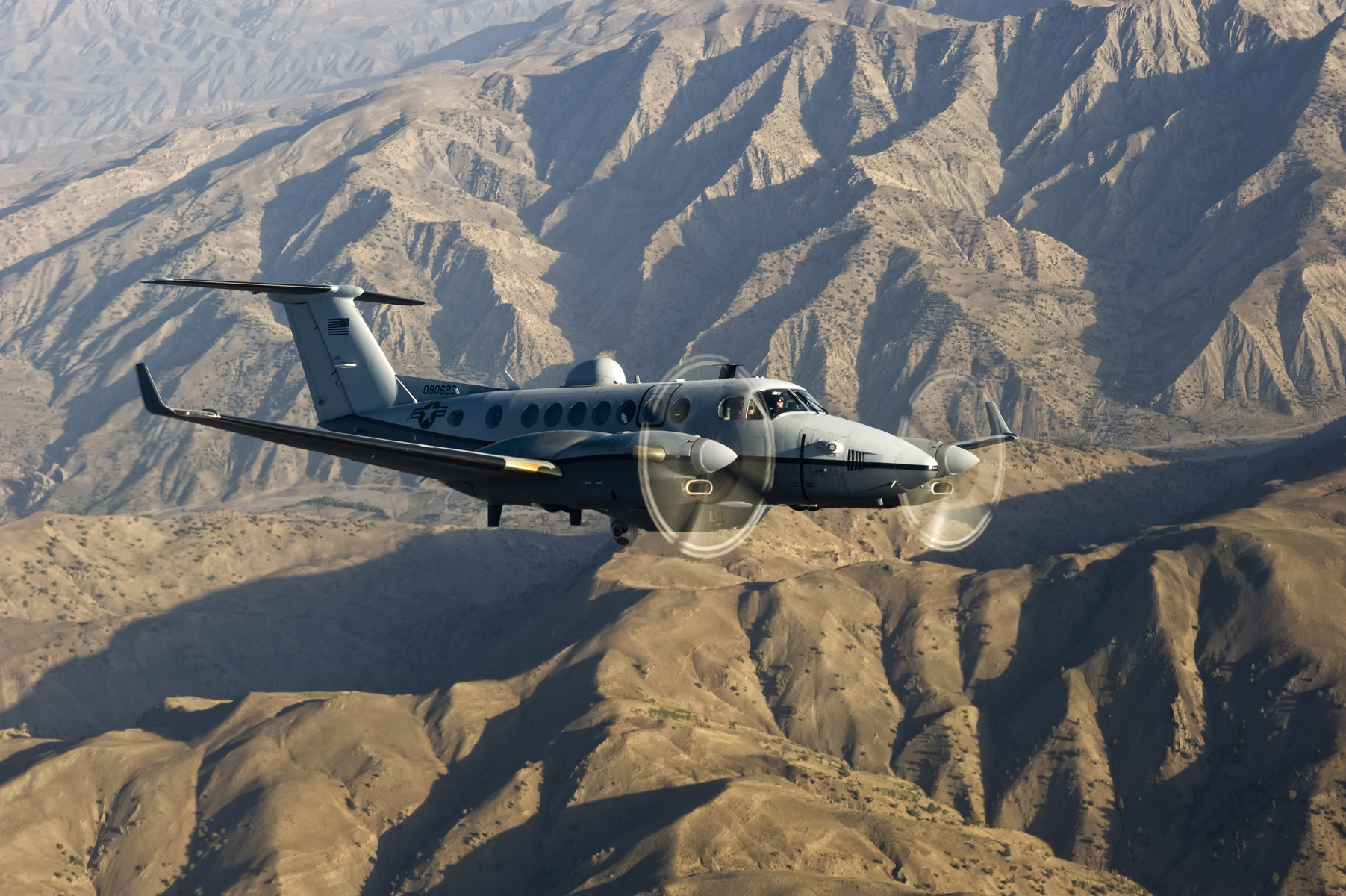
The squadron was activated as the 489th Reconnaissance Squadron on 26 August 2011 at Beale Air Force Base near Marysville, California as a component of the 9th Operations Group, flying Beechcraft MC-12W Liberty aircraft. It was inactivated on 10 May 2015. In 2015, all aircraft were transferred to United States Southern Command, the Army, and other US government agencies.
489th Attack Squadron
The squadron was redesignated as the 489th Attack Squadron at Creech Air Force Base under the 432d Operations Group, on 2 December 2016. Members of the unit deploy to meet mission needs, while other members stay at Creech to meet home station requirements such as training, professional development and personal readiness.
Lineage
; 489th Aero Squadron
- Organized as the 77th Aero Squadron on 13 August 1917 : Redesignated 489th Aero Squadron (Construction) on 1 February 1918 : Demobilized on 6 March 1919
- Reconstituted and consolidated with the 489th Bombardment Squadron in June 1932
; 489th Bombardment Squadron
- Constituted as the 489th Bombardment Squadron on 31 March 1924 and allotted to the reserve : Activated, date unknown (personnel assigned in January 1925)
- Consolidated with the 489th Aero Squadron in June 1932 : Disbanded on 31 May 1942
- Consolidated with the 489th Bombardment Squadron, Medium on 11 August 1958
; 489th Attack Squadron
- Constituted as the 489th Bombardment Squadron (Medium) on 10 August 1942 : Activated on 20 August 1942 : Redesignated 489th Bombardment Squadron, Medium c. 20 August 1943 : Inactivated on 7 November 1945
- Redesignated 489th Bombardment Squadron, Light on 24 October 1947 : Activated in the reserve on 10 November 1947 : Inactivated on 27 June 1949
- Redesignated 489th Bombardment Squadron, Medium on 11 August 1958 and consolidated with the 489th Bombardment Squadron : Activated on 1 October 1958 : Discontinued and inactivated on 1 January 1962
- Redesignated 489th Reconnaissance Squadron on 14 June 2011 : Activated on 26 August 2011 : Inactivated on 10 May 2015
- Redesignated 489th Attack Squadron on 1 December 2016 : Activated on 2 December 2016
Assignments
- Unknown, 13 August 1917 – February 1918
- Air Service Production Center No. 2, February–December 1918
- Unknown, December 1918 – 6 March 1919
- Ninth Corps Area, 1925 – 31 May 1942 (349th Bombardment Group for mobilization until c. June 1929)
- 340th Bombardment Group, 20 August 1942 – 7 November 1945
- 340th Bombardment Group, 10 November 1947 – 27 June 1949
- 340th Bombardment Wing, 1 October 1958 – 1 January 1962
- 9th Operations Group, 26 August 2011 – 10 May 2015
- 432nd Operations Group, 2 December 2016 – present
Stations
- Kelly Field, Texas, 13 August 1917
- Garden City, New York, 5 November–4 December 1917
- St. Maixent, France, 1 January 1918
- Romorantin, France, 13 February 1918
- Brest, France, c. 4 January 1919-unknown
- Camp Stuart, Virginia, c. 8 February 1919
- Camp Lee, Virginia, February-6 March 1919
- Boeing Field, Washington, c. 1924-31 May 1942.
- Columbia Army Air Base, South Carolina, 20 August 1942
- Walterboro Army Air Field, South Carolina 30 November 1942 – 30 January 1943
- RAF Kabrit, Egypt 29 March 1943
- Medenine Airfield, Tunisia 13 April 1943
- Sfax Airfield, Tunisia 26 April 1943
- Hergla Airfield, Tunisia 3 June 1943
- Comiso Airfield, Sicily, Italy, 2 August 1943
- Catania Airport, Sicily, Italy, 27 August 1943
- San Pancrazio Airfield, Italy, 15 October 1943
- Salsola Airfield (Foggia Satellite III), Italy 25 November 1943
- Pompeii Airfield, Italy 5 January 1944
- Gaudo Airfield, Italy 24 March 1944
- Alesan Airfield, Corsica, France 19 April 1944
- Rimini Airfield, Italy 4 April-16 July 1945
- Seymour Johnson Field, North Carolina, 9 August 1945
- Columbia Army Air Base, South Carolina 2 October – 7 November 1945
- Davis Field, Oklahoma, 10 November 1947 – 27 June 1949
- Whiteman Air Force Base, Missouri, 1 October 1958 – 1 January 1962
- Beale Air Force Base, California, 26 August 2011 - 10 May 2015
- Creech Air Force Base, Nevada, 2 December 2016 – present
Aircraft
- Curtiss B-2 Condor, 1930–1934
- North American B-25 Mitchell, 1942–1945
- Boeing B-47 Stratojet, 1958–1962
- Beechcraft MC-12W Liberty, 2011–2015
- General Atomics MQ-1 Predator, 2016–present
- General Atomics MQ-9 Reaper, 2016–present
Awards and campaigns
| Campaign Streamer | Campaign | Dates | Notes | |
|---|---|---|---|---|
| [[File:World War I War Service Streamer without inscription.png | 200px]] | Theater of Operations (France) | 1 January 1918–c. 4 January 1919 | 489th Aero Squadron |
| [[Image:Streamer EAMEC.PNG | 200px]] | Tunisia | c. 12 April 1943 – 13 May 1943 | 489th Bombardment Squadron |
| [[Image:Streamer EAMEC.PNG | 200px]] | Sicily | 14 May 1943 – 17 August 1943 | 489th Bombardment Squadron |
| [[Image:Streamer EAMEC.PNG | 200px]] | Naples-Foggia | 18 August 1943 – 21 January 1944 | 489th Bombardment Squadron |
| [[Image:Streamer EAMEC.PNG | 200px]] | Anzio | 22 January 1944 – 24 May 1944 | 489th Bombardment Squadron |
| [[Image:Streamer EAMEC.PNG | 200px]] | Rome-Arno | 22 January 1944 – 9 September 1944 | 489th Bombardment Squadron |
| [[Image:Streamer EAMEC.PNG | 200px]] | Southern France | 15 August 1944 – 14 September 1944 | 489th Bombardment Squadron |
| [[Image:Streamer EAMEC.PNG | 200px]] | North Apennines | 10 September 1944 – 4 April 1945 | 489th Bombardment Squadron |
| [[Image:Streamer EAMEC.PNG | 200px]] | Po Valley | 3 April 1945 – 8 May 1945 | 489th Bombardment Squadron |
| [[Image:Streamer EAMEC.PNG | 200px]] | Air Combat, EAME Theater | c. 12 April 1943 – 11 May 1945 | 489th Bombardment Squadron |
References
Notes
; Explanatory notes
; Citations
Bibliography
References
- "Air Force Personnel Services: Unit Awards". Air Force Personnel Center.
- (8 August 2017). "Factsheet 489 Attack Squadron (ACC)". Air Force Historical Research Agency.
- "Beale Air Force Base: Art: 489th Reconnaissance Squadron". 9th Reconnaissance Wing Public Affairs.
- Maurer, ''Combat Squadrons'', pp. 587-588
- Watkins, p. 84
- (August 16, 2017). "A legacy of valor: 489th ATKS achieves centennial". 432d Wing Public Affairs.
- Clay, p. 1523
- Clay, p. 1339
- Alley, p. 50
- Maurer, ''Combat Squadrons'', pp. 585-588
- Squadron S-2. "History, 487th Bombardment Squadron, Aug 1942-Aug 1943". 57th Bomb Wing Association.
- (2015). "The Voyage". 486th Bomb Squadron 340th Bomb Group.
- 489 Squadron S-1. "486th Bombardment Squadron Outline History 20 August 1942 – 31 December 1943". 57th Bomb Wing Association.
- "489th Bombardment Squadron Outline Histories, July-August 1945". Air Force History Index.
- (27 December 1961). "Abstract, Mission Project Closeup, Continental Air Command". Air Force History Index.
- Knaack, p. 25
- Schake, p. 220 (note 43)
- (1 April 1975). "Abstract (Unclassified), History of the Strategic Bomber since 1945 (Top Secret, downgraded to Secret)". Air Force History Index.
- No byline. (March 15, 2012). "Liberty’s Red Flag". Air and Space Force Magazine.
- (10 November 2014). "USAF outlines divestiture plans for MC-12W Liberty aircraft". IHS Jane's Defence Weekly.
- Bernard, SSG Omari. (August 3, 2021). "Image Gallery". Air Land Sea Space Application Center.
- Lineage, including assignments, stations through 1962 in Maurer, ''Combat Squadrons'', pp. 587-588
- No byline. "486th Bombardment Squadron Outline History January 1944". 57th Bomb Wing Association.
This article was imported from Wikipedia and is available under the Creative Commons Attribution-ShareAlike 4.0 License. Content has been adapted to SurfDoc format. Original contributors can be found on the article history page.
Ask Mako anything about 489th Attack Squadron — get instant answers, deeper analysis, and related topics.
Research with MakoFree with your Surf account
Create a free account to save articles, ask Mako questions, and organize your research.
Sign up freeThis content may have been generated or modified by AI. CloudSurf Software LLC is not responsible for the accuracy, completeness, or reliability of AI-generated content. Always verify important information from primary sources.
Report