From Surf Wiki (app.surf) — the open knowledge base
45th (Nottinghamshire) (Sherwood Foresters) Regiment of Foot

| Field | Value |
|---|---|
| unit_name | 45th (Nottinghamshire) (Sherwood Foresters) Regiment of Foot |
| image | 45th Regiment of Foot badge.jpg |
| caption | Badge of the 45th Regiment of Foot |
| dates | 1741–1881 |
| country | Kingdom of Great Britain (1741–1800) |
| United Kingdom (1801–1881) | |
| branch | |
| type | Line Infantry |
| role | Infantry |
| size | One battalion (two battalions 1804–1814) |
| garrison | Glen Parva Barracks, Leicestershire |
| nickname | "Old Stubborns" |
| battles | Father Le Loutre's War |
| French and Indian War | |
| American Revolutionary War | |
| Peninsular War | |
| First Anglo-Burmese War | |
| Xhosa Wars |
United Kingdom (1801–1881) French and Indian War American Revolutionary War Peninsular War First Anglo-Burmese War Xhosa Wars
The 45th (Nottinghamshire) (Sherwood Foresters) Regiment of Foot was a British Army line infantry regiment, raised in 1741. The regiment saw action during Father Le Loutre's War, the French and Indian War and the American Revolutionary War as well as the Peninsular War, the First Anglo-Burmese War and the Xhosa Wars. Under the Childers Reforms it amalgamated with the 95th (Derbyshire) Regiment of Foot to form the Sherwood Foresters (Nottinghamshire and Derbyshire Regiment) in 1881.
History
Houghton's Regiment / Warburton's Regiment
The regiment was originally raised by Colonel Daniel Houghton as Houghton's Regiment in 1741 for service during the War of the Austrian Succession. From 1745, the Regiment was named after Colonel Hugh Warburton. It was first posted to Gibraltar in 1745, before moving to Nova Scotia in 1747 for garrison duty under the command of Warburton.
Numbered Regiment
The regiment was ranked as the 56th Regiment of Foot in 1747 but was re-ranked the following year as the 45th Regiment of Foot in 1748. On 1 July 1751 the regiment officially adopted the numerical system rather being named after the commander. The regiment then defeated the French monarchists (French soldiers, natives and Acadians) at the Battle of Fort Beauséjour in June 1755. The regiment also took part in the Siege of Louisbourg in July 1758 during the French and Indian War.
The regiment also saw action in North America during the American War of Independence, fighting at the Battle of Long Island in August 1776 before returning to England in 1778. In 1779 the citizens of Nottinghamshire petitioned for the regiment to have the county name included in the regimental name: this was granted and the regiment became the 45th (1st Nottinghamshire) Regiment. and garrisoned Martinique, Dominica and Îles des Saintes during the French Revolutionary Wars. In May 1801, on the home journey, some 150 French prisoners aboard the ship, the Windsor, overpowered the guard, locked the officers in their cabins and took possession of the ship.
Notable soldiers
- Winckworth Tonge
- Horatio Gates
- Patrick Sutherland
Gallery
File:Winckworth Tonge, Old Burying Ground, Halifax, Nova Scotia.jpg|Winckworth Tonge, Old Burying Ground (Halifax, Nova Scotia) File:Soldier of 45th regiment 1742.jpg|Soldier of 45th regiment, 1742 File:43rd-44th-45th-regiments-of-foot-1.jpg|A grenadier of the 45th Regiment (right), 1751 by David Morier File:HoratioGatesByStuart crop.jpg|Portrait of Horatio Gates by Gilbert Stuart
Napoleonic wars
In spring 1807 the regiment embarked on the disastrous British invasion of the River Plate: it saw action at the Second Battle of Buenos Aires in July 1807 but, in the face of defeat, discipline collapsed and eleven men of the regiment completely disappeared. However another unit of the regiment successfully charged the enemy, taking two howitzers and many prisoners.

The regiment embarked for Portugal in July 1808 to serve under General Sir Arthur Wellesley in the Peninsular War. The regiment fought at the Battle of Roliça in August 1808, the Battle of Vimeiro later that month and the Battle of Talavera, where it won the nickname "Old Stubborns", in July 1809. The regiment went on to fight at the Battle of Bussaco in September 1810 before falling back to the Lines of Torres Vedras. It saw action again at Battle of Fuentes de Oñoro in May 1811, the Siege of Ciudad Rodrigo in January 1812 and the Siege of Badajoz in March 1812 before fighting at the Battle of Salamanca in July 1812 and the Battle of Vitoria in June 1813. It then pursued the French Army into France and fought at the Battle of the Pyrenees in July 1813, the Battle of Nivelle in November 1813 and the Battle of Orthez in February 1814 as well as the Battle of Toulouse in April 1814. The regiment returned home in June 1814.
The regiment was sent to Ceylon in January 1819 and to Burma in 1824 for service in the First Anglo-Burmese War. It formed part of an army which advanced up the River Irrawaddy to the Kingdom of Ava and then returned to England in March 1838.
The Victorian era
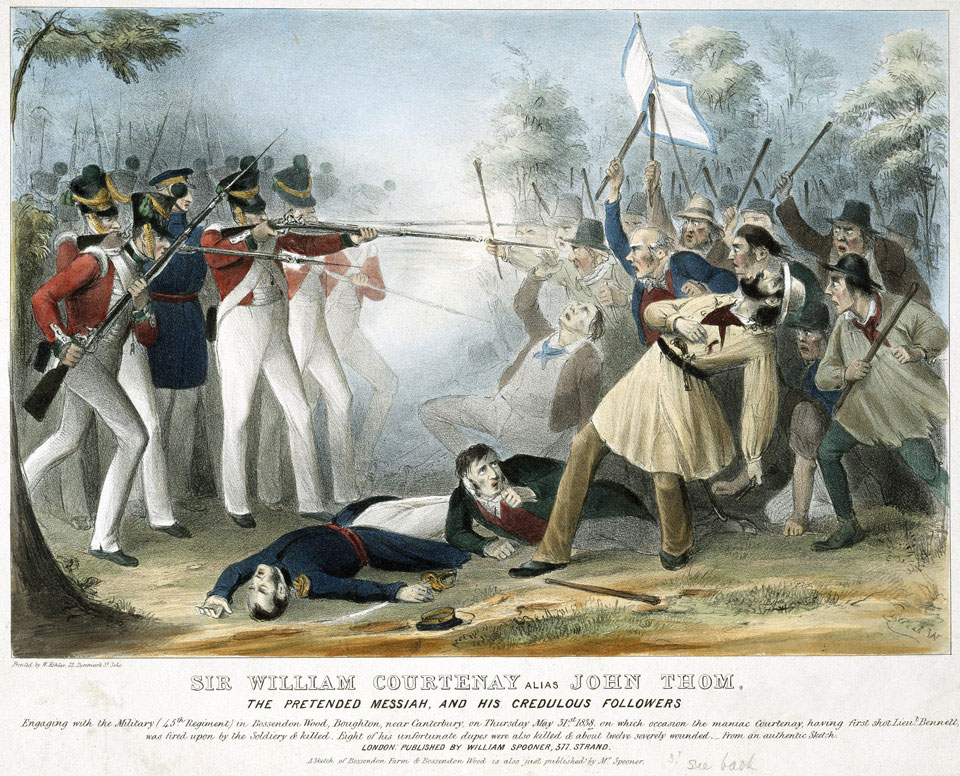
In May 1838 the regiment took part in the Battle of Bossenden Wood, a skirmish between a small group of labourers from the Hernhill, Dunkirk, and Boughton area and a detachment of soldiers of the 45th regiment sent from Canterbury to arrest the marchers' leader, the self-styled Sir William Courtenay, who was actually John Nichols Tom, a Truro maltster who had spent four years in Kent County Lunatic Asylum.
In November 1839 the regiment was involved in suppressing the Newport Rising which had been organised by Chartist protestors.
The regiment was deployed to South Africa in 1843 and saw action in the Seventh Xhosa War in 1846 and the Eighth Xhosa War in 1851 before returning home in 1859. In 1866, the regiment became the 45th (Nottinghamshire) (Sherwood Foresters) Regiment of Foot.
As part of the Cardwell Reforms of the 1870s, where single-battalion regiments were linked together to share a single depot and recruiting district in the United Kingdom, the 45th was linked with the 17th (Leicestershire) Regiment of Foot), and assigned to district no. 27 at Glen Parva Barracks in Leicestershire. On 1 July 1881 the Childers Reforms came into effect and the regiment amalgamated with the 95th (Derbyshire) Regiment to form the Sherwood Foresters.
Battle honours
The regiment's battle honours were as follows:
- Louisburg,
- Rolica, Vimiero, Talavera, Busaco, Fuentes D'Onoro, Ciudad Rodrigo, Badajoz, Salamanca, Vittoria, Pyrenees, Nivelle, Orthes, Toulouse, Peninsula,
- Ava,
- South Africa 1846–47,
Colonels of the Regiment
Colonels of the regiment were:
- 1741–1745: Brig-Gen. Daniel Houghton
45th Regiment of Foot – (1751)
- 1745–1761: Gen. Hugh Warburton
- 1761: Maj-Gen. Andrew Robinson
- 1761–1767: Maj-Gen. Hon. John Boscawen
- 1767–1784: Gen. William Haviland
45th (Nottinghamshire) Regiment of Foot
- 1784–1787: Maj-Gen. Sir John Wrottesley, 8th Baronet
- 1787–1788: Lt-Gen. James Cuninghame
- 1788–1802: Gen. James Whorwood Adeane
- 1802–1823: Gen. Frederick Cavendish Lister
- 1823–1837: Gen. Richard Lambart, 7th Earl of Cavan, KC
- 1837–1840: Lt-Gen. Sir William Henry Pringle, GCB
- 1840–1847: Gen. Sir Fitzroy Jeffries Grafton Maclean, Bt.
- 1847–1856: Gen. Sir Colin Halkett, GCB, GCH
- 1856–1858: Gen. Thomas Brabazon Aylmer
- 1858–1866: F.M. Sir Hugh Rose, 1st Baron Strathnairn, GCB, GCSI
45th (Nottinghamshire) (Sherwood Foresters) Regiment of Foot
- 1866–1868: Gen. Thomas Armstrong Drought
- 1868–1876: Gen. Frederick Horn, GCB
- 1876–1878: Lt-Gen. Henry Cooper
- 1878–1881: Gen. Sir Daniel Lysons, GCB
References
Sources
References
- "45th (Nottinghamshire) (Sherwood Foresters) Regiment of Foot". regiments.org.
- (25 June 1745). "The London Gazette Issue 8444 Page 2". [[London Gazette]].
- [https://books.google.com/books?id=Mt8IAwAAQBAJ&dq=%22warburton%27s+regiment%22&pg=PA6 History of the 45th 1st Nottinghamshire regiment Sherwood foresters By Philip Hugh Dalbiac, p.7]
- raid on Dartmouth]] in May 1751 during [[Father Le Loutre's War]] when French monarchist (natives and Acadians) from [[Isthmus of Chignecto. Chignecto]], under the command of Acadian [[Joseph Broussard]], raided [[Dartmouth, Nova Scotia]], destroying the town, killing twenty British villagers and torturing and mutilating a sergeant from the 45th Foot.Wilson, p. 16
- Dalbiac, p. 8
- Dalbiac, p. 9
- Dalbiac, p. 11
- Dalbiac, p. 12
- Dalbiac, p. 13
- Dalbiac, p. 18
- Dalbiac, p. 19
- (1 January 2013). "Winckworth Tonge". Hants County History.
- [https://archive.org/stream/selectionsfrompu00nova#page/n345/mode/2up ''Selections from the public documents of the province of Nova Scotia''] p.627
- "Patrick Sutherland". Canadian Dictionary of Biography.
- Dunlap, William. (1840). "History of the New Netherlands, Province of New York, and State of New York, to the Adoption of the Federal Constitution".
- Dalbiac, p. 22
- Hughes, p. 212
- Dalbiac, p. 45
- Dalbiac, p. 48
- Dalbiac, p. 52
- Dalbiac, p. 53
- Dalbiac, p. 62
- Dalbiac, p. 61
- Dalbiac, p. 76
- Dalbiac, p. 79
- Dalbiac, p. 87
- Dalbiac, p. 93
- Dalbiac, p. 103
- Dalbiac, p. 111
- Dalbiac, p. 117
- Dalbiac, p. 119
- Dalbiac, p. 125
- Dalbiac, p. 127
- Dalbiac, p. 129
- Dalbiac, p. 132
- Dalbiac, p. 133
- Dalbiac, p. 135
- Dalbiac, p. 140
- Dalbiac, p. 143
- "45th (Nottinghamshire) (Sherwood Foresters) Regiment of Foot". National Army Museum.
- Dalbiac, p. 152
- Dalbiac, p. 189
- Dalbiac, p. 208
- "Training Depots". Regiments.org.
This article was imported from Wikipedia and is available under the Creative Commons Attribution-ShareAlike 4.0 License. Content has been adapted to SurfDoc format. Original contributors can be found on the article history page.
Ask Mako anything about 45th (Nottinghamshire) (Sherwood Foresters) Regiment of Foot — get instant answers, deeper analysis, and related topics.
Research with MakoFree with your Surf account
Create a free account to save articles, ask Mako questions, and organize your research.
Sign up freeThis content may have been generated or modified by AI. CloudSurf Software LLC is not responsible for the accuracy, completeness, or reliability of AI-generated content. Always verify important information from primary sources.
Report