From Surf Wiki (app.surf) — the open knowledge base
449th Flying Training Squadron
| Field | Value | |
|---|---|---|
| unit_name | 449th Flying Training Squadron | |
| (Currently 449th Expeditionary Flying Training Squadron) | ||
| image | T-37 020925-F-9999s-0014.jpg | |
| image_size | 300px | |
| caption | Cessna T-37 at Mather Air Force Base | |
| dates | 1942–1945; 1947–1949; 1973–1988 | |
| country | ||
| branch | ||
| role | Pilot Training | |
| command_structure | Air Combat Command | |
| battles | European Theater of Operations | |
| decorations | Distinguished Unit Citation | |
| Air Force Outstanding Unit Award | ||
| identification_symbol | [[Image:449th Expeditionary Flying Training Squadron.jpg | 150px]] |
| identification_symbol_label | 449th Expeditionary Flying Training Squadron emblem | |
| identification_symbol_2 | [[File:449 Bombardment Squadron emblem.png | 150px]] |
| identification_symbol_2_label | 449th Bombardment Squadron emblem | |
| identification_symbol_3 | **PN** | |
| identification_symbol_3_label | World War II Fuselage Code |
(Currently 449th Expeditionary Flying Training Squadron)
Air Force Outstanding Unit Award
The 449th Expeditionary Flying Training Squadron is a provisional United States Air Force unit. It was first activated as the 449th Bombardment Squadron in July 1942. After training in the United States, it deployed to the European Theater of Operations (ETO) in December 1942. It engaged in combat operations from 1943 to 1945, earning a Distinguished Unit Citation for demonstrating the effectiveness of medium bombers in the ETO. Following V-E Day, it participated in the disarmament of the Luftwaffe, until September 1945, when it returned to the United States for inactivation.
The squadron served in the reserves from October 1947 to June 1949, when it was inactivated as the military budget was reduced, although it does not appear to have been fully manned or equipped with operational aircraft at this time.
In 1973, Air Training Command was converting its flying training units from MAJCON status. As part of this reorganization, the squadron was redesignated the 449th Flying Training Squadron and replaced the 3536th Navigator Training Squadron at Mather Air Force Base, California. It conducted flight training for members of the United States military and foreign allies until inactivating in May 1993 as Mather prepared for closure.
On 28 October 2008, it was converted to provisional status as the 449th Expeditionary Flying Training Squadron and assigned to Air Combat Command to activate or inactivate as needed, but does not appear to have been active.
History
World War II
Initial organization and training
The squadron was first activated at MacDill Field, Florida on 17 July 1942 as the 449th Bombardment Squadron, one of the four original squadrons of the 322nd Bombardment Group. However, it did not receive its initial cadre until 7 August. until it began to ferry its Marauders from Morrison Field to Europe via the South Atlantic ferry route as new aircraft became available. The 449th was the last squadron of the group to leave the United States, not departing until April 1943, with its last B-26 arriving on 29 May 1943.
Combat in the European Theater
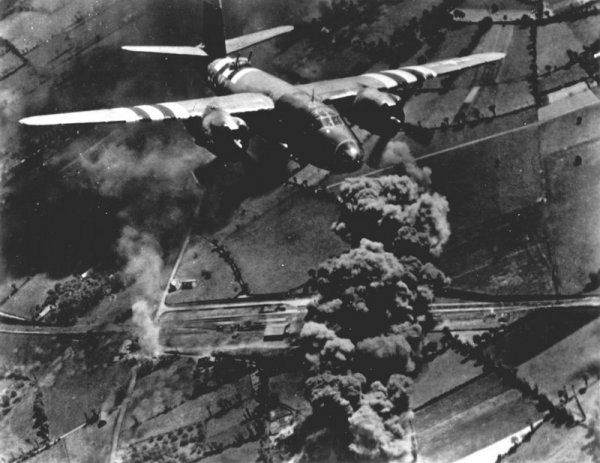
The ground echelon was established at RAF Bury St Edmunds, its first combat station on 1 December 1942. The 322d Group flew its first mission, and the first B-26 Marauder mission in the European Theater of Operations, on 14 May against an electrical power plant near IJmuiden in the Netherlands using low level attack tactics. Three days later, it dispatched eleven planes for a repeat low level attack on the IJmuiden power plant and another at Haarlem in the Netherlands. One plane returned early due to a mechanical malfunction. The remaining ten aircraft and their crews were lost to enemy action. For these actions and for demonstrating the effectiveness of medium bombers, the 322nd Group, including the squadron, was awarded the Distinguished Unit Citation.
In June 1943, the squadron, along with all other B-26 units in England moved to Essex, an area where it was planned to build up a tactical air force for the forthcoming invasion of Europe, with the 449th arriving at RAF Great Saling on 12 June. Once the squadron entered combat, enemy airfields were its principal targets through February 1944, but it also attacked power stations, shipyards, construction works, marshalling yards and other targets. In March 1944, its emphasis shifted to railway and highway bridges, and oil storage facilities in preparation for Operation Overlord, the invasion of Normandy. It also participated in Operation Crossbow, the attacks on V-1 flying bomb and V-2 rocket launch sites.
On D-Day, the squadron attacked coastal defenses and artillery batteries. It supported the Allies in the Battle for Caen and in Operation Cobra, the breakout at Saint Lo in July. Through August and September, it provided air support for the drive of United States Third Army across Northern France.
In late September, the squadron moved from England to Beauvais/Tille Airfield, France. It bombed bridges, road junctions, defended villages, and ordnance depots in the assault on the Siegfried Line from October through December of 1944. During the Battle of the Bulge, it flew attacks on railroad bridges to cut German lines of communications. From then until it flew its last mission on 24 April 1945, it concentrated on communications, bridges, marshalling yards and fuel dumps.
Following V-E Day, the 449th moved to Hanau-Langendiebach Airfield as part of the military occupation force. It engaged in inventorying and disassembling Luftwaffe equipment until September 1945. In December it returned to the United States and was inactivated at the Port of Embarkation on 11 December 1945.
Air Force reserve
The squadron was reactivated on 4 October 1947 at Northeast Philadelphia Airport, Pennsylvania. It does not appear to have been fully manned and was equipped only with trainer aircraft. President Truman’s reduced 1949 defense budget required reductions in the number of units in the Air Force, and the 449th was inactivated and not replaced as reserve flying operations at what was now North Philadelphia Airport ceased.
Navigator training
Background
.jpg)
However, the 3536th was a MAJCON unit, created by ATC. MAJCON units could not carry a permanent history or lineage. ATC received authority from Headquarters USAF to discontinue its MAJCON flying training wings and to activate Air Force controlled (AFCON) units, most of which were inactive at the time, which could carry a lineage and history.
Training Operations

On 1 April 1973, the squadron, now designated the 449th Flying Training Squadron, absorbed the mission, personnel and equipment of the 3536th Navigator Training Squadron. In May 1975, the Chief of Staff, United States Air Force and the Chief of Naval Operations agreed to consolidate navigator training, and the squadron began training United States Navy and United States Marine Corps and United States Coast Guard navigators. In 1978, the first females began navigator training. It conducted undergraduate navigator training for USAF, United States Navy, United States Marine Corps, and United States allies from 1973 until 1992. In 1989, the base closure commission recommended that Mather be closed. The Air Force moved its navigator training to Randolph Air Force Base, Texas and the squadron was inactivated on 31 May 1993 as Mather drew down in preparing for closing on 1 October.
Expeditionary unit
On 28 October 2008, the squadron was converted to provisional status as the 449th Expeditionary Flying Training Squadron and assigned to Air Combat Command to activate or inactivate as needed.
Lineage
- Constituted as the 449th Bombardment Squadron (Medium) on 19 June 1942 : Activated on 17 July 1942 : Redesignated 449th Bombardment Squadron, Medium on 20 August 1943 : Inactivated on 11 December 1945
- Redesignated 449th Bombardment Squadron, Light on 13 August 1947 : Activated in the reserve on 4 October 1947 : Inactivated on 27 June 1949
- Redesignated 449th Flying Training Squadron on 28 July 1972 : Activated on 1 April 1973 : Inactivated on 31 May 1993
- Redesignated 449th Expeditionary Flying Training Squadron and converted to provisional status on 28 October 2008
Assignments
- 322d Bombardment Group, 17 July 1942 – 11 December 1945
- 322d Bombardment Group, 4 October 1947 – 27 June 1949
- 323d Flying Training Wing, 1 April 1973
- 323d Operations Group, 15 December 1991 – 31 May 1993
- Air Combat Command, to activate or inactivate at any time after 28 October 2008
Stations
- MacDill Field, Florida, 17 July 1942
- Drane Field, Florida, 22 September 1942 – 13 November 1942
- Camp Kilmer, New Jersey, 15–23 November 1942
- RAF Bury St Edmunds (Rougham Airdrome) (AAF-468), England, 1 December 1942
- RAF Great Saling (later Andrews Field) (AAF-485), England, 12 June 1943
- Beauvais/Tille Airfield (A-61) (also B-42), France, 29 September 1944
- Le Culot Airfield (A-89) (also B-68), Belgium, 31 March 1945
- Hanau-Langendiebach Airfield (Y-91), Germany, July 1945
- Fritzlar Airfield (Y-86), Germany, September 1945
- Clastres Airfield (A-71), France, c. 1 October – 3 December 1945
- Camp Kilmer, New Jersey, 9–11 December 1945
- Northeast Philadelphia Airport (later North Philadelphia Airport), Pennsylvania, 4 October 1947 – 27 June 1949
- Mather Air Force Base, California, 1 April 1973 – 31 May 1993
Aircraft
- Martin B-26 Marauder (1942–1945)
- North American AT-6 Texan (1947–1949)
- Beechcraft AT-11 Kansan (1947–1949)
- Convair T-29 Flying Classroom (1973–1974)
- Cessna T-37 Tweet (1974–1992)
- Boeing T-43 Bobcat (1973–1992)
Awards and campaigns
| Campaign Streamer | Campaign | Dates | Notes | |
|---|---|---|---|---|
| [[Image:Streamer EAMEC.PNG | 200px]] | Air Offensive, Europe | 17 July 1943–5 June 1944 | 449th Bombardment Squadron |
| [[Image:Streamer EAMEC.PNG | 200px]] | Air Combat, EAME Theater | 17 July 1943–11 May 1945 | 449th Bombardment Squadron |
| [[Image:Streamer EAMEC.PNG | 200px]] | Normandy | 6 June 1944–24 July 1944 | 449th Bombardment Squadron |
| [[Image:Streamer EAMEC.PNG | 200px]] | Northern France | 25 July 1944–14 September 1944 | 449th Bombardment Squadron |
| [[Image:Streamer EAMEC.PNG | 200px]] | Rhineland | 15 September 1944–21 March 1945 | 449th Bombardment Squadron |
| [[Image:Streamer EAMEC.PNG | 200px]] | Ardennes-Alsace | 16 December 1944–25 January 1945 | 449th Bombardment Squadron |
| [[Image:Streamer EAMEC.PNG | 200px]] | Central Europe | 22 March 1944–21 May 1945 | 449th Bombardment Squadron |
| [[File:Streamer AFGCS.PNG | 200px]] | Consolidation III | unknown | 449th Expeditionary Flying Training Squadron |
References
Notes
; Explanatory notes
; Citations
Bibliography
References
- (12 February 2009). "Factsheet 449 Expeditionary Flying Training Squadron (ACC)". Air Force Historical Research Agency.
- Maurer, ''Combat Squadrons'', pp. 554–555
- Rust, p. 211
- Maurer, ''Combat Units'', pp. 202-03
- Maurer, ''Combat Squadrons'', pp. 554-58
- Freeman, pp. 248-49
- Freeman, p. 56
- Knaack, p. 25
- Manning, ''et al.'', p. 106
- Mueller, p. 380
- No byline. (27 May 2023). "3536 Navigator Training Squadron".
- Manning, ''et al.'', p. 96
- Manning, ''et al.'', p. 302
- Manning, ''et al.'', p. 213
- Manning, ''et al.'', pp. 260, 277, 286
- (20 May 2011). "Factsheet 322 Air Expeditionary Group (USAFE)". Air Force Historical Research Agency.
- Lineage in Robertson, Factsheet 449 Expeditionary Flying Training Squadron, except as noted.
- Station number in Anderson, p. 31.
- Station number in Anderson, p. 33.
- Station number in Johnson, p. 19.
- Station number in Johnson, p. 60.
- Station number in Johnson, p. 34.
- Station number in Johnson, p. 33.
- Station number in Johnson, p. 49.
- Station information in Robertson, Factsjeet, except as noted.
This article was imported from Wikipedia and is available under the Creative Commons Attribution-ShareAlike 4.0 License. Content has been adapted to SurfDoc format. Original contributors can be found on the article history page.
Ask Mako anything about 449th Flying Training Squadron — get instant answers, deeper analysis, and related topics.
Research with MakoFree with your Surf account
Create a free account to save articles, ask Mako questions, and organize your research.
Sign up freeThis content may have been generated or modified by AI. CloudSurf Software LLC is not responsible for the accuracy, completeness, or reliability of AI-generated content. Always verify important information from primary sources.
Report