From Surf Wiki (app.surf) — the open knowledge base
43rd New Zealand Parliament
Term of the Parliament of New Zealand
Term of the Parliament of New Zealand
| Field | Value |
|---|---|
| name | 43rd Parliament of New Zealand |
| image | File:Parliament House, Wellington, New Zealand (50).JPG |
| caption | Parliament House, Wellington |
| body | New Zealand Parliament |
| election | [1990 New Zealand general election](1990-new-zealand-general-election) |
| government | Fourth National Government |
| term_start | 28 November 1990 |
| term_end | 23 September 1993 |
| before | [42nd Parliament](42nd-new-zealand-parliament) |
| after | [44th Parliament](44th-new-zealand-parliament) |
| website | |
| chamber1 | House of Representatives |
| chamber1_image | File:43rd New Zealand Parliament Seating.png |
| membership1 | 97 |
| chamber1_leader1_type | Speaker of the House |
| chamber1_leader1 | Robin Gray |
| chamber1_leader2_type | Leader of the House |
| chamber1_leader2 | Don McKinnon |
| — Paul East until 27 March 1993 | |
| chamber1_leader3_type | Prime Minister |
| chamber1_leader3 | Jim Bolger |
| chamber1_leader4_type | Leader of the Opposition |
| chamber1_leader4 | Mike Moore |
| chamber2 | Sovereign |
| chamber2_leader1_type | Monarch |
| chamber2_leader1 | Elizabeth II |
| chamber2_leader2_type | Governor-General |
| chamber2_leader2 | Catherine Tizard |
| — Paul Reeves until 29 November 1990 | |
| session1_start | 28 November 1990 |
| session1_end | 19 December 1990 |
| session2_start | 22 January 1991 |
| session2_end | 23 September 1993 |
— Paul East until 27 March 1993 — Paul Reeves until 29 November 1990 The 43rd New Zealand Parliament was a term of the Parliament of New Zealand. Its composition was determined by the 1990 elections, and it sat until the 1993 elections.
The 43rd Parliament saw the beginning of the fourth National Party government, with the Labour Party failing to win a third term in office. The 43rd Parliament was heavily dominated by National, which controlled nearly seventy percent of the seats. Only one minor party, Jim Anderton's NewLabour, was present at the beginning of the 43rd Parliament. Later, NewLabour would join with several unrepresented parties to form the Alliance, which would gain two additional seats when two National MPs defected. Another National MP, Winston Peters, would also break away from his party, becoming an independent.
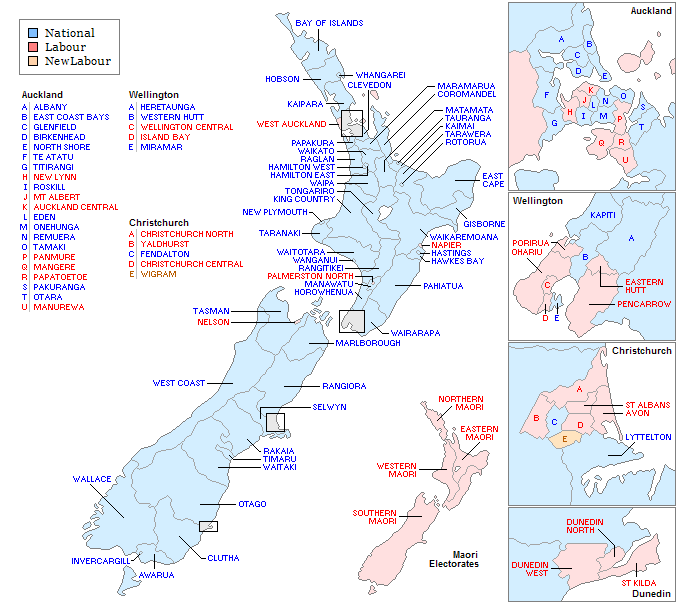
The 43rd Parliament consisted of ninety-seven representatives, the same as the previous Parliament. All of these representatives were chosen by single-member geographical electorates, including four Māori electorates.
Electoral boundaries for the 43rd Parliament
Overview of seats
The table below shows the number of MPs in each party following the 1990 election and at dissolution:
| Affiliation | Members | At [1990 election](1990-new-zealand-general-election) | At dissolution |
|---|---|---|---|
| 67 | **63** | ||
| ***Government total*** | *67* | ***63*** | |
| 29 | **29** | ||
| 1 | *Merger* | ||
| *Not yet founded* | **2** | ||
| *Not yet founded* | **2** | ||
| – | **1** | ||
| ***Opposition total*** | *30* | ***34*** | |
| **Total** | |||
| 97 | **97** | ||
| **Working Government majority** | 37 | **29** |
Notes
- Jim Anderton, Leader of the NewLabour Party merged the party into the newly founded Alliance party.
- The Working Government majority is calculated as all Government MPs less all other parties.
Initial composition of the 43rd Parliament
Changes during 43rd Parliament
There were a number of changes during the term of the 43rd Parliament.
By-elections
| Electorate and by-election | Date | Incumbent | Cause | Winner |
|---|
- Robert Muldoon, the National Party MP for Tamaki and a former Prime Minister of New Zealand, quit Parliament on 17 December 1991. His departure prompted a by-election in Tamaki early the following year — it was won by Clem Simich, also of the National Party.
- Fran Wilde, the Labour Party MP for Wellington Central, quit Parliament in 1992 to become Mayor of Wellington. Her departure prompted a by-election in Wellington Central in December — it was won by Chris Laidlaw, also of the Labour Party.
- Winston Peters, the National Party MP for Tauranga, resigned from both his party and his seat on 18 March 1993. His departure prompted a by-election in Tauranga in April — Peters contested and won it as an independent candidate. Later, he would found the New Zealand First party.
Party affiliation changes
| Name | Year | Seat | From | To |
|---|---|---|---|---|
| Jim Anderton | 1991 | Sydenham | NewLabour | |
| Gilbert Myles | 1991 | Roskill | National | |
| 1991 | Independent | Liberal | ||
| 1992 | Liberal | Alliance | ||
| 1993 | Alliance | New Zealand First | ||
| Hamish MacIntyre | 1991 | Manawatu | National | |
| 1992 | Liberal | Alliance | ||
| Cam Campion | 1991 | Wanganui | National | |
| Winston Peters | 1993 | Tauranga | Independent |
- Jim Anderton, the sole MP for the NewLabour Party, merged his party with several others to form the Alliance in 1991. Anderton was thereafter recorded as an Alliance MP rather than a NewLabour MP.
- Gilbert Myles and Hamish MacIntyre, the National Party MPs for Roskill and Manawatu, respectively, quit their party in 1992. They established a small group Liberal Party, which they eventually merged into the Alliance.
- Cam Campion, the National Party MP for Wanganui, announced his resignation from the party on 3 March 1993. He accused the party of attempting to rig the reselection process against him. Campion remained an independent for the remainder of the term.
- Winston Peters formed the New Zealand First party in 1993. He was joined in the party by Myles.
Notes
References
This article was imported from Wikipedia and is available under the Creative Commons Attribution-ShareAlike 4.0 License. Content has been adapted to SurfDoc format. Original contributors can be found on the article history page.
Ask Mako anything about 43rd New Zealand Parliament — get instant answers, deeper analysis, and related topics.
Research with MakoFree with your Surf account
Create a free account to save articles, ask Mako questions, and organize your research.
Sign up freeThis content may have been generated or modified by AI. CloudSurf Software LLC is not responsible for the accuracy, completeness, or reliability of AI-generated content. Always verify important information from primary sources.
Report