From Surf Wiki (app.surf) — the open knowledge base
42nd Street–Port Authority Bus Terminal station
New York City Subway station in Manhattan
New York City Subway station in Manhattan
| Field | Value |
|---|---|
| name | 42nd Street– |
| Port Authority Bus Terminal | |
| image | 42nd Street-PABT Entrance.JPG |
| image_caption | Southeastern stair |
| address | West 42nd Street & Eighth Avenue |
| New York, New York | |
| accessible | yes |
| acc_note | passageway to Times Square–42nd Street not accessible |
| transfer | At : |
| other | NYCT Bus: |
| MTA Bus: Port Authority Bus Terminal New Jersey Transit Bus: | |
| division | IND |
| line | IND Eighth Avenue Line |
| service | Eighth south |
| platforms | 2 island platforms |
| cross-platform interchange (upper level) | |
| 1 abandoned side platform (lower level) | |
| tracks | 4 (upper level) |
| 1 (lower level) | |
| levels | 2 (lower level abandoned) |
| structure | Underground |
| opened | (upper level) |
| (lower level) | |
| closed | 1981 (lower level) |
| system | New York City Subway |
| line1 | Eighth express south |
| left1 | 59th Street–Columbus Circle |
| right1 | 34th Street–Penn Station |
| note-left1 | |
| note-right1 | |
| to-right1 | southbound |
| line2 | Eighth local south |
| left2 | 50th Street |
| right2 | 34th Street–Penn Station |
| note-left2 | |
| note-right2 | |
| to-left2 | services split |
| to-right2 | southbound |
| route_map | {{Routemap |
| inline | y |
| footnotes | track |
| map-title | Upper level |
| map2-title | Former lower level |
Port Authority Bus Terminal New York, New York
MTA Bus: Port Authority Bus Terminal New Jersey Transit Bus: cross-platform interchange (upper level) 1 abandoned side platform (lower level) 1 (lower level) (lower level) | note-left1 = | note-right1 = | to-right1 = southbound | note-left2 = | note-right2 = | to-left2 = services split | to-right2 = southbound | map-title = Upper level uvSTR!~MFADEg ~~ ~~ ~~ to numN330\udSTR!~dMFADEg\uvSTR\udSTR!~dMFADEg\ ~~ ~~ ~~ to lower level udSTR!~dMFADEg\ubvvvSTR\udSTR!~dMFADEg ~~ ~~ ~~ to upper level uvSTRf\uvSTRfg\uvSTRg udSHI2g+l\udSHI2glr\udSHI2g+r\udSHI2g+l\udSHI2lr\udSHI2g+r d\udSTR\udENDExe\uvSTR\d\uvSHI2l- d\uxvSTR\uvSTR\PLT\udSTR d\uxvSTR\uvSTR\PLT\udSTR d\uxvSTR\uvSTR\PLT\udSTR uv-STR\uexdSTR!~dMFADEf\uvSTR\PLT\udSTR ~~ ~~ ~~ to former lower level uv-STR\dPLT\uvSHI2l.R+d\dPLT\udSTR uv-STR\PLT\uvSTR\uv-SHI2r udSTR\PLT\udSTR\uvSTR udSTR\PLT\udSTR\uvSTR udSTR\PLT\udSTR\uvSTR udSTR\uexdSTR!~dMFADEg\uvSHI2+l\uvSHI2r ~~ ~~ ~~ from former lower level udSHI2l\uxdSHI2gxl+r\uedSHI2g+r\uvSTR\d uvSTRf\uvSTRg uvSTR!~MFADEf\uvSTR!~MFADEf ~~ ~~ ~~ to | map2-title = Former lower level uexSTR!~MFADEg ~~ ~~ ~~ from middle southbound track uexSTRf uexPSTR(R) uexPSTR(R) uexPENDE@F(R) ~~ ~~ ~~ platform cut off by wall vSTRq fuchsia!~MFADEgq\vSTRfgq_fuchsia\vSTRq fuchsia\vSTRq fuchsia\vSTRfgq_fuchsia\vSTRq fuchsia!~MFADEfq ~~ ~~ ~~ tracks uexENDE@G!~MFADEf The 42nd Street–Port Authority Bus Terminal station is an express station on the IND Eighth Avenue Line of the New York City Subway. Located at the intersection of 42nd Street and Eighth Avenue in Manhattan, it is served by the A and E trains at all times, and by the C train at all times except late nights. Passageways connect this station to the nearby station at Times Square–42nd Street, providing a free transfer, and to the Port Authority Bus Terminal.
The 42nd Street station was built as an express station for the Independent Subway System (IND)'s Eighth Avenue Line. The station opened on September 9, 1932, as part of the initial section of the Eighth Avenue Line. The connection to the Port Authority Bus Terminal opened in 1950, and a platform on a lower level operated intermittently between 1952 and 1981. A free transfer to the Times Square station opened in 1988.
The station has two offset island platforms and four tracks, as well as a mezzanine leading from 40th to 42nd Streets. There was originally a lower level with one track and one side platform that served southbound trains from the Queens Boulevard Line. The station is compliant with the Americans with Disabilities Act of 1990, but the passageway to the Times Square–42nd Street complex is not accessible. The Times Square/Port Authority stations comprise the busiest station complex in the system, serving 65,020,294 passengers in 2019.
TOC
History
Planning and construction
As early as March 1918, soon after the Brooklyn–Manhattan Transit Corporation (BMT)'s Broadway Line opened to Times Square–42nd Street, plans were being considered for an extension of that line beyond the stubs at 57th Street–Seventh Avenue to the Upper West Side and Washington Heights via Central Park West (Eighth Avenue). On August 3, 1923, the New York City Board of Estimate approved the Washington Heights Line, an extension of the Broadway Line to Washington Heights. The line was to have four tracks from Central Park West at 64th Street under Central Park West, Eighth Avenue, Saint Nicholas Avenue, and private property to 173rd Street, and two tracks under Fort Washington Avenue to 193rd Street. South of 64th Street, one two-track line would connect to the Broadway Line stubs at 57th Street, and another would continue under Eighth Avenue to 30th Street at Penn Station, with provisions to continue downtown.
Mayor John Hylan instead wanted to build an independent subway system, operated by the city. The New York City Board of Transportation (NYCBOT) gave preliminary approval to several lines in Manhattan, including one on Eighth Avenue, on December 9, 1924. The main portion of the already-approved Washington Heights Line—the mostly-four track line north of 64th Street—was included, but was to continue north from 193rd Street to 207th Street. South of 64th Street, the plan called for four tracks in Eighth Avenue, Greenwich Avenue, the planned extension of Sixth Avenue, and Church Street. Two tracks would turn east under Fulton Street or Wall Street and under the East River to Downtown Brooklyn. The BOT announced a list of stations on the new line in February 1928, with an express station at 40th Street.
A groundbreaking ceremony was held at St. Nicholas Avenue and 123rd Street on March 14, 1925. Most of the Eighth Avenue Line was dug using a cheap cut-and-cover method, where the street above was excavated. Still, the construction of the line was difficult, as it had to go under or over several subway lines. 42nd Street, the longest station along the line at 1115 ft, was expected to be a major express station with large platforms, so the platforms were staggered away from each other in order to avoid going under property lines. The station's construction required over 4000 ST of structural steel and nearly 15000 ft3 of concrete. Neighboring buildings, such as the Times Square Hotel and the Franklin Savings Bank at 42nd Street, had to be underpinned because the station extended all the way to the property line on either side. Several workers died in cave-ins during construction. The stations on the line were built with 600 feet long platforms, but they had provisions to lengthen them to 660 feet to accommodate eleven-car trains.
The IND's 42nd Street station was substantially completed by December 1930 except for some interior finishes. The entire line was completed by September 1931, except for the installation of turnstiles. The Eighth Avenue Line station opened on September 10, 1932, as part of the city-operated Independent Subway System (IND)'s initial segment, between Chambers Street and 207th Street. At the time of the IND Eighth Avenue Line's completion, the New York Herald Tribune referred to the line's 42nd Street station as the "largest platform in the world". The line's opening was expected to spur development around the intersection of 42nd Street and Eighth Avenue. The construction of the Eighth Avenue Line caused real-estate values along Eighth Avenue to increase by as much as 400 percent.
A pedestrian passageway under 41st Street, connecting the IND station at 42nd Street with the IRT and BMT stations at Times Square, opened on December 24, 1932; the passageway included an entrance on 41st Street between Seventh and Eighth Avenues. Passengers had to pay an additional fare to transfer to and from the IND.
Mid-20th century
With the construction of the Port Authority Bus Terminal, in September 1950, the Board of Transportation approved the construction of a 30 ft ramp between the Eighth Avenue Line station and the bus terminal for $100,000. The IND's lower level was built together with the upper-level platforms but existed as an unfinished shell. The city approved a $300,000 renovation of the lower level in June 1952, and the lower level opened on August 25, 1952, to serve rush hour E trains. For most of its existence, the lower-level platform was only used for occasional service specials, including summer "Rockaway Special" trains to Beach 98th Street at the Rockaways' Playland beginning in 1958, the Aqueduct Racetrack special fare trains from 1959 to 1981, and rush hour E trains in the 1970s, beginning on March 23, 1970.
By the 1970s, city officials planned to raise funds for a renovation of the Times Square station complex, using sales-tax revenue from materials used in the construction of the New York Marriott Marquis hotel. As part of a pilot program to reduce high crime in the New York City Subway system, in May 1981, the MTA spent $500,000 to install CCTV screens at the Columbus Circle subway station. The MTA expanded the experiment to the Times Square–42nd Street station in 1983. The cameras were deactivated in 1985 after further tests showed that their presence did not help reduce crime. The MTA considered transferring 220 CCTV cameras from these stations to token booths at the stations with the most crime. On August 1, 1988, the passageway between the IND Eighth Avenue Line station and the IRT/BMT complex was finally placed within fare control. The two previously separate stations had the highest crime rates in the system at the time.
Late 20th and early 21st centuries
The Empire State Development Corporation (ESDC), an agency of the New York state government, had proposed redeveloping the area around a portion of West 42nd Street in 1981. As part of the redevelopment, in 1988, the state and NYCTA announced that they would spend $125 million on renovating the Times Square subway complex. The project would have included an underground rotunda with stores, connecting several office buildings; new subway entrances inside these buildings; and elevators. The project excluded renovation of the platforms or the passageway under 41st Street. Park Tower Realty, which had committed to developing four buildings in the redevelopment, would have paid for 60 percent of the project's cost, while the New York City Transit Authority would have provided $45 million and the city would have provided $10 million. The project was canceled in August 1992 after Prudential Insurance and Park Tower Realty was given permission to postpone the construction of these buildings.
The station underwent total reconstruction in three stages starting in 1994. The Eighth Avenue Line platforms were renovated as part of the second phase of the project, finished in 2006.
In the late 2000s, the MTA began construction on an extension of the IRT Flushing Line to 34th Street, which would require demolishing the IND Eighth Avenue lower level platform. By January 2010, the lower level platform was being demolished as part of the Flushing Line extension, which slopes down through where the old lower level platform was. On September 13, 2015, the Flushing Line was extended one stop west from Times Square to 34th Street–Hudson Yards. The Metropolitan Transportation Authority announced in 2024 that it would replace the station's existing waist-high turnstiles with taller, wide-aisle turnstiles. In April 2025, the MTA announced plans to install taller fare gates with glass panels at 20 stations, including the 42nd Street–Port Authority Bus Terminal station. The fare gates would be manufactured by Cubic Transportation Systems, Conduent, Scheidt & Bachmann, and STraffic as part of a pilot program to reduce fare evasion.
Station layout


| **Northbound** | do not stop here → |
|---|
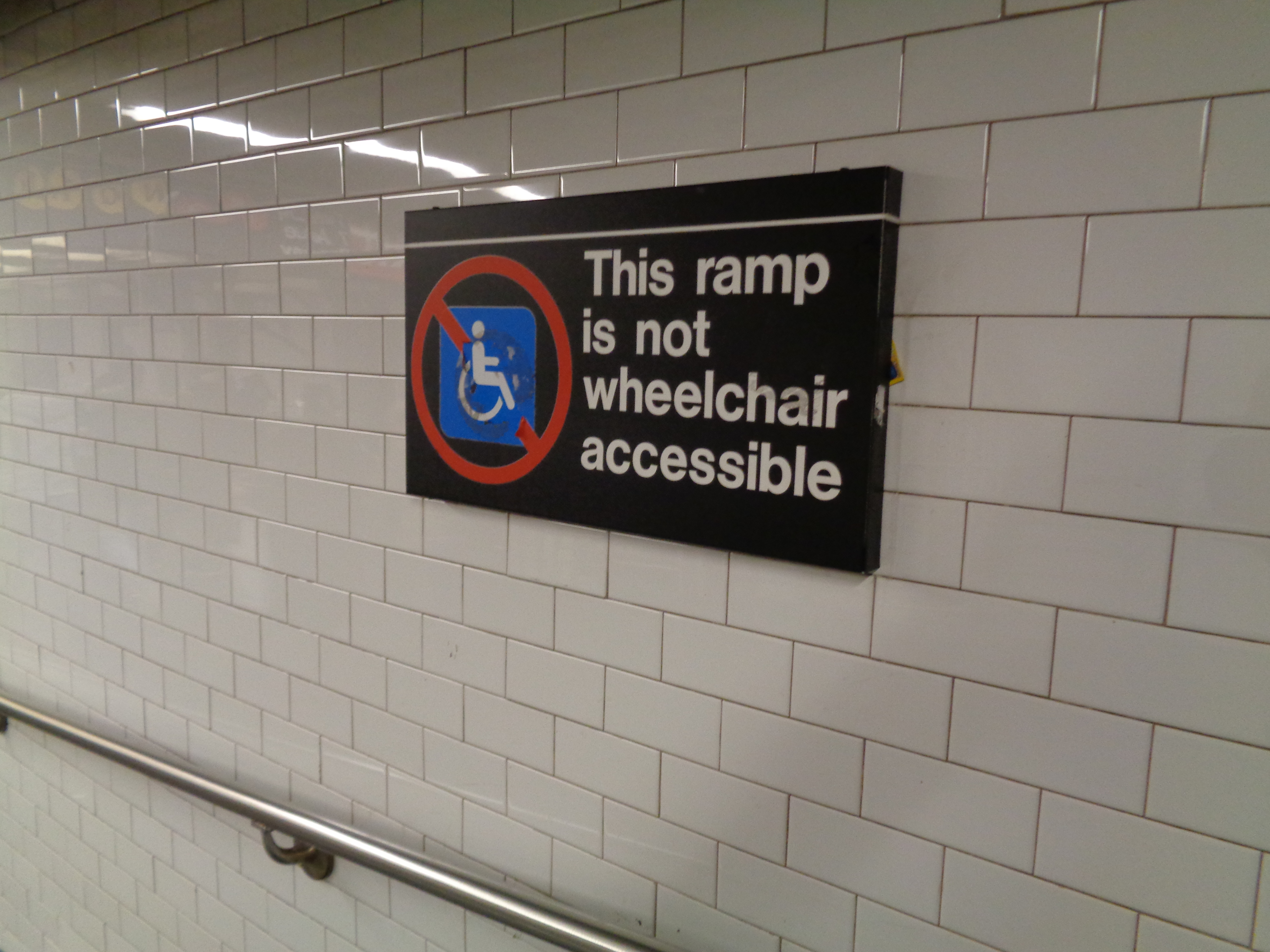
The 42nd Street–Port Authority Bus Terminal station is an express stop that abuts the Port Authority Bus Terminal. The A and E trains stop here at all times, while the C train stops here except at night. The A runs on the express tracks during the day and on the local tracks during the night, while the C and E always run on the local tracks. The next stop to the north is 50th Street for local trains and 59th Street–Columbus Circle for express trains, while the next stop to the south is 34th Street–Penn Station for all service. It has one operational platform level, two offset island platforms, and a long mezzanine. Formerly, it also had a lower level with a single side platform, which could be served by southbound trains from the IND Queens Boulevard Line. The 42nd Street–Port Authority Bus Terminal station is fully wheelchair-accessible. A ramp connects to the Times Square–42nd Street station but is not accessible.

The station ranges up to 50 ft below the street, running under Eighth Avenue in approximately a north–south direction, one block west of the Times Square–42nd Street station. Both island platforms were originally 600 ft long, although the station served 660 ft, 11-car trains on the E route from 1953 to 1958. The northbound platform extends from 42nd to 44th Streets and is 30 ft wide. The southbound island platform extends from 40th to 42nd Streets and is 36 ft wide. Formerly, escalators led from the mezzanine to the southbound side platform on the lower level, dividing the southbound island platforms. At 41st Street, the station crosses over the IRT Flushing Line tunnels; this overpass required 217000 lb of steel.
The walls beside each local track contain blue-tile bands with black borders; since 42nd Street is an express station, it has a wider tile band than local stations. The tile colors are intended to help riders identify their station more easily, part of a color-coded tile system for the entire Independent Subway System. The tile colors were designed to facilitate navigation for travelers going away from Lower Manhattan; on the Eighth Avenue Line, the tiles change color at the next express station to the north. As such, the 42nd Street station originally had purple tiles, which were also used at 50th Street, the local station to the north; the next express station, 59th Street, used a different tile color.
Former lower level
The 42nd Street–Port Authority Bus Terminal station formerly had a lower platform level, with one track underneath the southbound local track and one side platform underneath the southbound island platform. The lower level featured two high-speed escalators to the mezzanine, and three staircases to the southbound island platform. The walls featured 1950s-era cream tiles, a purple and black tile band, and white mosaic name plates with black "42ND ST" text.
Theories differ on why the lower-level platform was built. The platform could only be reached by trains originating from Queens via the IND Queens Boulevard Line, and 53rd Street (the current E service), and a 1930 New York Times article said the platform had always been intended for Queens Boulevard Line service. Reportedly, this would have allowed E trains to load and unload passengers without having to wait for one of the two upper level tracks to clear. When the station was being built, the 42nd Street Property Owners' and Merchants' Association expressed concerns that the double-level station would prevent the Flushing Line from being extended westward. The New York Herald Tribune wrote in 1928: "The construction is such as will enable the engineers to extend the Queensboro subway under and beyond Eighth Avenue in the direction of the 42nd Street ferry if desired".
Film producers have used the lower-level platform for several films, most notably Ghost (1990), starring Patrick Swayze and Demi Moore. By the 2010s, the lower-level platform had been bisected by the extension of the Flushing Line.
Mezzanines
The IND mezzanine stretches above the platforms, under Eighth Avenue, from 40th to 44th Street. It covers 130000 ft2. It was one of four large mezzanines at express stations on the Eighth Avenue Line where passengers could walk the entire length of the mezzanines without having to pay a fare. It was proposed to develop the mezzanines of these four stations with shops, so that they would become retail corridors. The station's mezzanine extends four blocks from 40th to 44th Streets. There were originally six stairs from the mezzanine to either of the IND's island platforms. The center of the mezzanine originally featured an 18 ft public passageway outside fare control. Between 44th and 42nd Streets, the passageway was flanked by stores on the west and stairs to the northbound platform on the east. Between 42nd and 40th Streets, the stairs to the southbound island platform were on the west, while there were stores to the east.
A 600 ft passageway runs under 41st Street and connects the IND station with the Times Square complex. The passageway is located above the mezzanines at either end. It is stair-free but contains steep ramps at both ends, which are not ADA-compliant. At the eastern end of the passageway, the passageway connects to a mezzanine at the Times Square station, just above the IRT Flushing Line's platform.
Artwork


The Port Authority and Times Square stations contain several artworks commissioned as part of the MTA Arts & Design program. In 1991, Norman B. Colp created The Commuter's Lament or A Close Shave, a series of signs attached to the roof of the 41st Street passageway between Seventh and Eighth Avenues, inspired by classic Burma-Shave ads. In order, the signs read Overslept/So tired/If late/Get fired/Why bother?/Why the pain?/Just go home/Do it again. The last panel is a picture of a bed. The panels were part of an art project that was supposed to last only one year, but were never removed. The mezzanine also contains a mosaic artwork by Jane Dickson, Revelers. The mosaics depict about 70 life-size people who are moving around in groups.
The 42nd Street–Port Authority Bus Terminal station contains the mosaic artwork Losing My Marbles, which was created by Lisa Dinhofer and installed in 2003. The primary section of the artwork is on a 32 ft portion of wall, which depicts marbles overlaid on a black-and-white "floor" with a gold-colored frame; the marbles seem to be rolling in the viewer's direction. The artwork extends onto two additional walls.
Exits
There is one street stair to each of the northwest, northeast, and southeast corners of Eighth Avenue and 40th Street. There are two underground passageways to Port Authority Bus Terminal: one between 40th and 41st Streets, and a wheelchair accessible passageway between 41st and 42nd Streets. At the intersection of Eighth Avenue and 42nd Street, there is one street stair to the northwest corner, one stair inside a building on the northeast corner, and one escalator bank inside a building on the southeast corner. One street stair leads to the southwest corner of Eighth Avenue and 43rd Street. Finally, there is one street stair to each of the northwest, southwest, and southeast corners of Eighth Avenue and 44th Street. The southwest-corner entrance also has a wheelchair lift that leads to an elevator. All of these exits are signed as serving the A, C, E, and 7 trains.
References
Notes
Citations
References
- (September 10, 1932). "List of the 28 Stations on the New 8th Av. Line". [[The New York Times]].
- {{NYCS const. riderref
- (March 3, 1918). "Plan a New Subway on Upper West Side". The New York Times.
- (August 4, 1923). "Two Subway Routes Adopted by City". The New York Times.
- (March 12, 1924). "Plans Now Ready to Start Subways". The New York Times.
- (December 10, 1924). "Hylan Subway Plan Links Four Boroughs at $450,000,000 Cost". The New York Times.
- {{Cite Routes Not Taken
- (5 Feb 1928). "Express and Local Stations For New Eighth Avenue Line". New York Herald Tribune.
- (March 14, 1925). "Will Break Ground Today for New Uptown Subway". The New York Times.
- Warner, Arthur. (November 22, 1931). "The City's New Underground Province; The Eighth Avenue Subway Will Be Not Only a Transit Line but a Centre for the Shopper A New Underground Province of New York The Eighth Avenue Subway Will Be a Rapid Transit Line With Innovations and Will Provide Centres for the Shoppers". The New York Times.
- (1928-07-16). "Big Station Built for New Subway; Times Square Stop of City's Eighth Avenue Line Sets Record for Size". The New York Times.
- (1932). "Transit Journal". McGraw-Hill Publishing Company, Incorporated.
- (1930-12-19). "Finish Structure of 8th Av. Subway; Contractors Now Doing Work on Tracks, Signals, Lighting and Stations". The New York Times.
- O'Brien, John C.. (9 Sep 1931). "8th Ave. Line Being Rushed For Use Jan. 1: Turnstile Installation on Subway Begins Monday; Other Equipment Ready for Start of Train Service City Has Yet to Find Operating Company Transit Official on Trip, 207th to Canal Street, Inspects Finished Tube". New York Herald Tribune.
- (September 10, 1932). "Gay Midnight Crowd Rides First Trains In The New Subway: Throngs at Station an Hour Before Time, Rush Turnstiles When Chains are Dropped". The New York Times.
- (11 Sep 1932). "Largest Platform in World at Forty-second Street and Eighth Avenue". New York Herald Tribune.
- (11 Sep 1932). "Tube Expected To Open More Trade Centers: 34th, 42d and 57th Street Areas Seen Benefiting From 8th Avenue Line". New York Herald Tribune.
- (29 Jul 1928). "Eighth Avenue Site Enhanced 400 Per Cent: Parcel Offered for $2,000 a Front Foot Seven Years Ago Now Worth $10,000 Great Changes Predicted Subway Under Construction Han Opened New Future". New York Herald Tribune.
- (1928-08-26). "Eighth Av. Gradually Emerging From Its Chaotic Condition; New Pavement Likely to Be Finished by End of Year--Building Has Continued Active in Midtown Section Despite Upheaval Due to New Subway Construction. New Building Work. Sidewalk Paving. Big Advance in Values. Subway Work Progress.". The New York Times.
- (December 24, 1932). "600-Foot Pedestrian Tunnel, Linking Subways, Opens Today". The New York Times.
- (September 9, 1932). "City to Open Subway in 8th Av. Tonight; Crowds Visit Tube; First Line in Huge Municipal Network to Take First Nickel One Minute After Midnight". The New York Times.
- (1950-09-11). "Ramp Will Link Subway With New Bus Terminal". The New York Times.
- Transportation, New York (N Y. ) Board of. (1953). "Proceedings".
- (June 20, 1952). "New IND Platform at 8th and 42d To Expedite Service From Queens". [[The New York Times]].
- (August 23, 1952). "New IND Platform Will Open Monday". [[The New York Times]].
- Mindlin, Alex. (April 20, 2008). "No Whoosh, No 'All Aboard'". [[The New York Times]].
- Brennan, Joseph. (2002). "Abandoned Stations: 42 St Lower Level".
- (July 3, 1958). "Non-Stop Trips, Reserved Seats On Special Here: Deluxe Subway Express Ride Also Features Music; $1.55 Round-Trip Fare From 42nd Street To Playland Station Provides Admission And Rides". [[Wave of Long Island]].
- Oelsner, Lesley. (1978-11-14). "'New' Times Square Waiting in the Wings". The New York Times.
- Goldman, Ari L.. (February 5, 1983). "Crime in Subway Station Rises in Spite of TV Monitors". The New York Times.
- Carmody, Deirdre. (October 4, 1985). "Subway Anticrime TV Test Abandoned". The New York Times.
- Gordy, Margaret. (October 14, 1985). "TA Aim: Make Subways Unsafe For Muggers: Will Spend $22M To Upgrade Safety". Newsday.
- Hirsch, James. (1988-07-30). "Authority to Begin Free-Transfer Policy In Times Sq. Station". The New York Times.
- Lueck, Thomas J.. (February 14, 1988). "The Region: Redevelopment; Times Square Plan Takes A Shaky Step Forward". The New York Times.
- Gordy, Molly. (9 Nov 1988). "Mission Impossible? There are big doings under foot at Times Square. And all of them are to be accomplished without a disruption of train or street traffic". Newsday.
- Johnson, Kirk. (1988-06-18). "Crossroads for Times Square Subway: Is Tidier Better?". The New York Times.
- Silverman, Edward R.. (1992-08-24). "TA Sent Back To (Times) Square 1". Newsday.
- Levy, Clifford J.. (1992-08-23). "Times Sq. Subway Station Plan Is Canceled". The New York Times.
- Dunlap, David W.. (March 28, 2004). "1904-2004; Crossroads of the Whirl". The New York Times.
- Kabak, Benjamin. (April 21, 2008). "With the 7 on the way, a swan song for a Times Square platform".
- Donohue, Pete. (June 20, 2009). "Abandoned No More: 2nd Life Drilled into Old 7 Subway Platform". [[Daily News (New York).
- "New 34 St-Hudson Yards 7 Station Opens". [[Metropolitan Transportation Authority.
- (September 2015). "7 subway service is now running to/from the new 34 St-Hudson Yards station. Times Sq-42 St is no longer the Manhattan terminal. At Times Sq-42 St, Queens-bound express and local service leave from Track 2 only.". Metropolitan Transportation Authority.
- Brachfeld, Ben. (May 22, 2024). "MTA will test middle-out turnstiles at 15 subway stops this year".
- (April 28, 2025). "NYC fare evasion: MTA to test four different modern gates for subway system in New York City".
- Simko-Bednarski, Evan. (April 28, 2025). "NYC to get new subway turnstiles at 20 stations by year’s end: MTA".
- {{NYCS const. timetable. a
- {{NYCS const. timetable. e
- {{NYCS const. timetable. c
- (1930-08-01). "Times Sq. Station of New Tube Ready; Builders Putting Last Touches on New Stop Under 8th Av. From 40th to 44th St.". The New York Times.
- (2022-05-20). "MTA Accessible Stations".
- Ingalls, Leonard. (August 28, 1953). "2 Subway Lines to Add Cars, Another to Speed Up Service". The New York Times.
- Perlow, Austin. (August 10, 1962). "16-Point Plan Can Give Boro Relief Now". Long Island Star–Journal.
- (August 22, 1932). "Tile Colors a Guide in the New Subway; Decoration Scheme Changes at Each Express Stop to Tell Riders Where They Are". The New York Times.
- Carlson, Jen. (February 18, 2016). "Map: These Color Tiles In The Subway System Used To Mean Something".
- Gleason, Will. (February 18, 2016). "The hidden meaning behind the New York subway's colored tiles".
- (1927-02-12). "Sees Subway Line to Jersey Blocked; Forty-Second Street Group Holds Eighth Av. Platforms Will Prevent Extension.". The New York Times.
- Daly, William Jerome. (February 5, 1928). "New Subway Work Far Advanced, From the Circle to 207th Street: Small Section Near St. Nicholas Avenue and 148th Street Being Constructed". New York Herald Tribune.
- (2015). "MTA Neighborhood Maps: Pennsylvania Station/Times Square". [[Metropolitan Transportation Authority]].
- Wilson, Michael. (2017-12-12). "'The Tunnel.' Depressing, Claustrophobic and Now a Terror Target.". The New York Times.
- {{Cite archive
- Stewart, Barbara. (1997-10-12). "Neighborhood Report: Midtown; Lament Of Commuter In 8 Parts". The New York Times.
- Carlson, Jen. (August 10, 2018). "Thanks MTA For The Depressing AF Poem That's Been In This Subway Tunnel Since The '90s".
- "Artwork: "The Commuter's Lament/A Close Shave", Norman B. Colp (1991)".
- "Revelers".
- Blakinger, Keri. (April 25, 2016). "A look at the colorful marbles bouncing around Times Square subway stop".
- "Losing My Marbles".
- (2018). "MTA Neighborhood Maps: Times Sq-42 St (1)(2)(3)". [[Metropolitan Transportation Authority]].
This article was imported from Wikipedia and is available under the Creative Commons Attribution-ShareAlike 4.0 License. Content has been adapted to SurfDoc format. Original contributors can be found on the article history page.
Ask Mako anything about 42nd Street–Port Authority Bus Terminal station — get instant answers, deeper analysis, and related topics.
Research with MakoFree with your Surf account
Create a free account to save articles, ask Mako questions, and organize your research.
Sign up freeThis content may have been generated or modified by AI. CloudSurf Software LLC is not responsible for the accuracy, completeness, or reliability of AI-generated content. Always verify important information from primary sources.
Report