From Surf Wiki (app.surf) — the open knowledge base
4179 Toutatis
Near-Earth asteroid of the Apollo and Alinda group

Near-Earth asteroid of the Apollo and Alinda group
| Field | Value |
|---|---|
| minorplanet | yes |
| name | 4179 Toutatis |
| background | NavajoWhite |
| image | Asteroid 4179 Toutatis close-up.jpg |
| caption | Toutatis imaged by Chang'e 2 during its flyby |
| discovery_ref | |
| discoverer | Christian Pollas |
| discovery_site | Caussols |
| discovered | 4 January 1989 |
| mpc_name | (4179) Toutatis |
| alt_names | {{Hlist |
| pronounced | |
| adjective | Toutatian |
| named_after | Toutatis (Celtic mythology) |
| mp_category | {{Hlist |
| PHA<ref name | "MPC-object" / |
| orbit_ref | |
| epoch | 27 November 2008 (JD 2454797.5) |
| uncertainty | 0 |
| observation_arc | 83.29 yr (30,422 days) |
| earliest_precovery_date | 10 February 1934 |
| aphelion | 4.1242 AU |
| perihelion | 0.9399 AU |
| semimajor | 2.5321 AU |
| eccentricity | 0.6288 |
| period | 4.03 yr (1,472 days) |
| mean_anomaly | 5.1220° |
| mean_motion | / day |
| inclination | 0.4460° |
| asc_node | 124.30° |
| arg_peri | 278.75° |
| moid | 0.0064 AU |
| dimensions | {{Ubl |
| km<ref name | "nature1" / |
| km<ref name | "Hudson-2003" / |
| mean_diameter | |
| mass | |
| density | |
| rotation | 176 h |
| albedo | 0.13 |
| spectral_type | Sk (SMASSII) |
| magnitude | 8.8–22.4 |
| abs_magnitude | 15.30 |
| 1989 AC | 1934 CT | NEO | Apollo | PHA | Alinda | Mars-crosser | km | km
4179 Toutatis (provisional designation ****) is an elongated, stony asteroid and slow rotator, classified as a near-Earth object and potentially hazardous asteroid of the Apollo asteroid group, approximately 2.5 kilometers in diameter. Discovered by French astronomer Christian Pollas at Caussols in 1989, the asteroid was named after Toutatis from Celtic mythology.
Toutatis is also a Mars-crosser asteroid with a chaotic orbit produced by a 3:1 resonance with the planet Jupiter, a 1:4 resonance with the planet Earth, and frequent close approaches to the terrestrial planets, including Earth. In December 2012, Toutatis passed within about 18 lunar distances of Earth. The Chinese lunar probe Chang'e 2 flew by the asteroid at a distance of 3.2 kilometers and a relative velocity of 10.73 km/s. Toutatis approached Earth again in 2016, but will not make another notably close approach until 2069.
Properties
Toutatis was first sighted on 10 February 1934, as object 1934 CT, but lost soon afterwards. It remained a lost asteroid for several decades until it was rediscovered on 4 January 1989 by French astronomer Christian Pollas, and was named after the Celtic god of tribal protection Toutatis (Teutates). The name of this god is very familiar in France due to the catchphrase Par Toutatis! of the Gauls in the comics series Asterix.
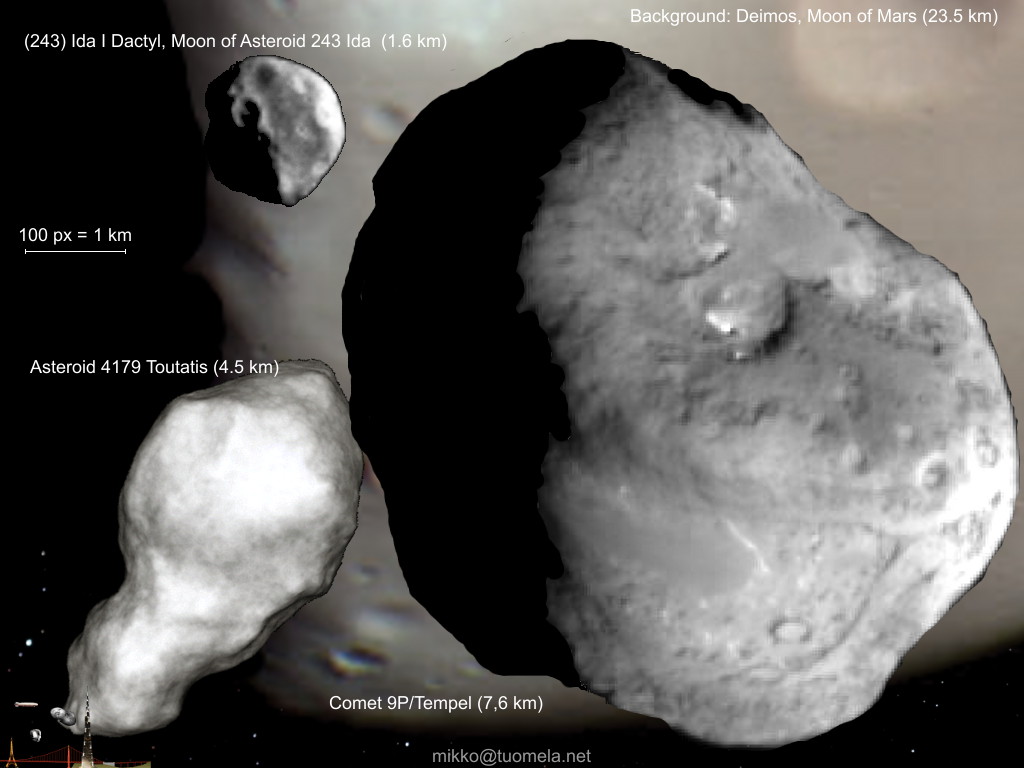
The spectral properties suggest that this is an S-type, or stony asteroid, consisting primarily of silicates. It has a moderate Bond albedo of 0.13. Radar imagery shows that Toutatis is a highly irregular body consisting of two distinct lobes, with maximum widths of about 4.6 km and 2.4 km, respectively. It is hypothesized that Toutatis formed from two originally separate bodies which coalesced at some point (a contact binary), with the resultant asteroid being compared to a rubble pile.
Its rotation combines two separate periodic motions into a non-periodic result; to someone on the surface of Toutatis, the Sun would seem to rise and set in apparently random locations and at random times at the asteroid's horizon. It has a rotation period around its long axis (Pψ) of 5.38 days. This long axis is precessing with a period (Pφ) of 7.38 days. The asteroid may have lost most of its original angular momentum and entered into this tumbling motion as a result of the YORP effect.
Orbit
With a semimajor axis of 2.5294 AU, or roughly 2.5 times the distance between Earth and the Sun, Toutatis has a 3:1 orbital resonance with Jupiter and a near-1:4 resonance with Earth making it a member of the Alinda asteroid group. It thus completes one orbit around the Sun for every 4.02 annual orbits of Earth. The gravitational perturbations caused by frequent close approaches to the terrestrial planets lead to chaotic behavior in the orbit of Toutatis,
The low inclination (0.47°) of the orbit allows frequent transits, where the inner planets Mercury, Venus, Earth, and Mars can appear to cross the Sun as seen from the perspective of Toutatis. Earth did this in January 2009, July 2012, July 2016 and 2020.
Close approaches and collision risk
| Close approaches | Year | AU | LD |
|---|---|---|---|
| 1985 | 0.28 | 109 | |
| 1988 | 0.12 | 45 | |
| 1992 | 0.02 | 9 | |
| 1996 | 0.03 | 14 | |
| 2000 | 0.07 | 29 | |
| 2004 | 0.01 | 4 | |
| 2008 | 0.05 | 20 | |
| 2012 | 0.05 | 18 | |
| 2016 | 0.25 | 98 | |
| 2065 | 0.36 | 142 | |
| 2069 | 0.02 | 8 |
Toutatis makes frequent close approaches to Earth, with a currently minimum possible distance (Earth MOID) of just 0.006 AU (2.3 times as far as the Moon). The approach on 29 September 2004 was particularly close, at 0.0104 AU (within 4 lunar distances) from Earth, presenting a good opportunity for observation, with Toutatis having an apparent magnitude of 8.8 at its brightest. A close approach of 0.0502 AU happened on 9 November 2008. The most recent close approach was on 12 December 2012, at a distance of 0.046 AU, with a magnitude of 10.7. At magnitude 10.7, Toutatis was not visible to the naked eye, but just visible to experienced observers using high-end binoculars. During the 2012 encounter Toutatis was recovered on 21 May 2012, by the Siding Spring Survey at apparent magnitude 18.9. A close approach will be 5 November 2069, at 0.01985 AU.
Given that Toutatis makes many close approaches to Earth, such as in 1992, 1996, 2000, 2004, 2008, 2012, and 2016, it is listed as a potentially hazardous object. As a planet-crossing asteroid, Toutatis is likely to be ejected from the inner Solar System within a few million years. In 2004 a chain e-mail falsely claimed that Toutatis had a 63% chance of impacting Earth then. In fact, Toutatis passed by at 1.5 million kilometres, or about four Earth–Moon distances, as predicted.
In 2006 Toutatis came closer than 2 AU to Jupiter; its orbit lies inside of Jupiter's. In the 2100s, it will approach Jupiter many times at a similar distance.
Physical characteristics
Large amounts of data of Toutatis were obtained during Chang'e 2's flyby. Toutatis is not a monolith, but most likely a coalescence of shattered fragments. This bifurcated asteroid is shown to be mainly consisting of a head (small lobe) and a body (large lobe). The two major parts are not round in shape, and their surfaces have a number of large facets. In comparison with radar models, the proximate observations from Chang'e 2's flyby have revealed several remarkable discoveries concerning Toutatis, among which the presence of the giant basin at the big end appears to be one of the most compelling geological features, and the sharply perpendicular silhouette in the neck region that connects the head and body is also quite novel. A large number of boulders and several short linear structures are also apparent on the surface.
Giant basin
The giant basin at the big end of Toutatis has a diameter of ~805 m, suggesting that one or more impactors may have collided with it there. The most significant feature is the ridge around the largest basin. The wall of this basin has a relatively high density of lineaments, some of which seem to be concentric to the basin. These ridges are indicative of an internal structure of small bodies and most of the ridges near the largest basin at the big end are most likely related to the huge stress energy during impact.
Observation
Toutatis has been observed with radar imaging from the Arecibo Observatory and the Goldstone Solar System Radar during the asteroid's prior Earth flybys in 1992, 1996, 2000, 2004, and 2008. It was also observed with radar during the December 2012 flyby and observed more distant flyby with radar in December 2016. After 2016, Toutatis will not pass close to Earth again until 2069.
Resolution of the radar images is as fine as 3.75 m per pixel, providing data to model Toutatis's shape and spin state.
Exploration
The Chinese lunar probe Chang'e 2 departed from the Sun–Earth L2 point in April 2012 and made a flyby of Toutatis on 13 December 2012, with closest approach being 3.2 kilometers and a relative velocity of 10.73 km/s, when Toutatis was near its closest approach to Earth. It took several pictures of the asteroid, revealing it to be a dusty red/orange color.
References
- More Chang'E 2 Toutatis flyby images (Emily Lakdawalla : 2013/01/20)
- Chang'E 2 images of Toutatis - 13 December 2012 (Planetary Society)
- CCTV13 Special (all in Mandarin)
- China joined the interplanetary club by successfully imaging the asteroid Toutatis (Franck Marchis, 14 December 2012)
- Chinese space probe flies by asteroid Toutatis (Xinhua 2012-12-15)
- Surface Features of Asteroid Toutatis Revealed by Radar (YouTube: JPLnews)
- Goldstone radar images from the 2012 flyby
- Toutatis radar information
- Space.com: Video of Toutatis's close approach to Earth, 29 Sept, 2004
- Interesting views of asteroid
- Astrobiology Magazine article (09/27/04)
- Simulating the orbit of Toutatis exposes its resonance with Jupiter (Gravity Simulator)
- Asteroid 4179 Toutatis' upcoming encounters with Earth and Chang'E 2 (Emily Lakdawalla 2012-12-06)
- Six-Centimeter Radar Observations of 4179 Toutatis
- Size comparison (Source)
- Chang'e 2 fly-by of Toutatis Presentation from Small Bodies Assessment Group (SBAG) 8 meeting
- Boulders on asteroid Toutatis as observed by Chang'e-2 (arXiv:1511.00766 : 3 Nov 2015)
References
- Hudson, [http://users.tricity.wsu.edu/~hudson/Research/Asteroids/4179/water2.htm "Gravitational Isopotentials on Toutatis"]
- "Asteroid 4179 Toutasis".
- (2020-01-23). "By Toutatis! France unveils statue to Asterix creator".
- (1994). "The Minor Planet Bulletin". Association of Lunar and Planetary Onservers.
- (1993). "Close call for earth ahead?{{Snd}} possible collision with asteroid Toutatis". USA Today (Society for the Advancement of Education).
- "2012 Goldstone Radar Observations of (4179) Toutatis".
- "Big Asteroid Tumbles Harmlessly Past Earth".
- ""Pseudo-MPEC" for 2010-050A = SM999CF = Chang'e 2 probe".
- "[视频]"嫦娥二号"飞越探测小行星_新闻台_中国网络电视台". News.cntv.cn.
- (2013). "The Ginger-shaped Asteroid 4179 Toutatis: New Observations from a Successful Flyby of Chang'e-2 : Scientific Reports : Nature Publishing Group". Scientific Reports.
- "NEODys (4179) Toutatis Close Approaches". Department of Mathematics, University of Pisa, Italy.
- "JPL Close-Approach Data: 4179 Toutatis (1989 AC)".
- "AstDys (4179) Toutatis Ephemerides for 2004". Department of Mathematics, University of Pisa, Italy.
- "(4179) Toutatis = 1934 CT = 1989 AC". IAU Minor Planet Center.
- "(4179) Toutatis = 1934 CT = 1989 AC". IAU Minor Planet Center.
- "NEODys (4179) Toutatis Ephemerides for December 2012". Department of Mathematics, University of Pisa, Italy.
- "AstDys (4179) Toutatis Ephemerides 2059". Department of Mathematics, University of Pisa, Italy.
- (2000-10-31). "Trick or Treat: It's Toutatis!". Science@Nasa.
- "Toutatis is in a 3:1 mean-motion resonance with Jupiter (rotating frame)". Gravity Simulator.
- Whipple, L.. (1993). "Long-Term Dynamical Evolution of the Minor Planet (4179) Toutatis". Icarus.
- Ostro, S. J.. (1998). "Asteroid 4179 Toutatis: 1996 Radar Observations". Icarus.
- David Morrison. (27 September 2004). "Close Flyby This Week from Asteroid Toutatis". Asteroid and Comet Impact Hazards (NASA).
- "Solex by Aldo Vitagliano".
- (October 2007). "Implications of the YORP Effect for Our Understanding of Asteroid Evolution". Bulletin of the American Astronomical Society.
- (August 2002). "The Diagnosis of Complex Rotation in the Lightcurve of 4179 Toutatis and Potential Applications to Other Asteroids and Bare Cometary Nuclei". Icarus.
- Lakdawalla, Emily. (2012-06-14). "Chang'E 2 has departed Earth's neighborhood for.....asteroid Toutatis!?". [[The Planetary Society]].
- Lakdawalla, Emily. (2012-12-14). "Chang'E 2 imaging of Toutatis succeeded beyond my expectations!". [[The Planetary Society]].
This article was imported from Wikipedia and is available under the Creative Commons Attribution-ShareAlike 4.0 License. Content has been adapted to SurfDoc format. Original contributors can be found on the article history page.
Ask Mako anything about 4179 Toutatis — get instant answers, deeper analysis, and related topics.
Research with MakoFree with your Surf account
Create a free account to save articles, ask Mako questions, and organize your research.
Sign up freeThis content may have been generated or modified by AI. CloudSurf Software LLC is not responsible for the accuracy, completeness, or reliability of AI-generated content. Always verify important information from primary sources.
Report