From Surf Wiki (app.surf) — the open knowledge base
40 Eridani
Triple star system in the constellation Eridanus
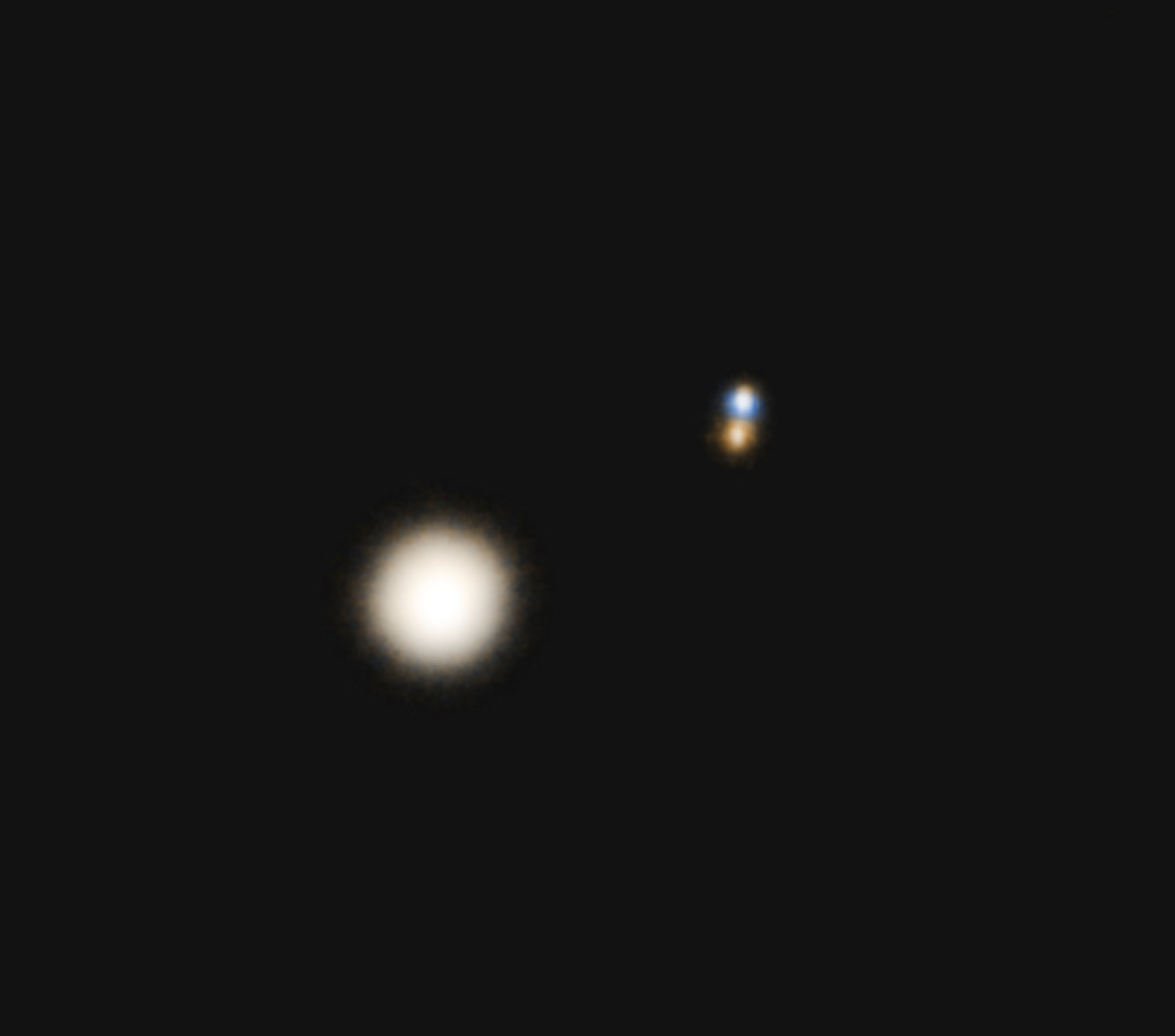
Triple star system in the constellation Eridanus
| r-i = | v-r = | b-v = +0.82 | u-b = +0.45 | r-i = | v-r = | b-v = +0.03 | u-b = +0.45 | r-i2 = | v-r2 = | b-v2 = +1.67 | u-b2 = +0.83 | display-authors=1 | last1=Rains | first1=Adam D.
40 Eridani is a triple star system in the constellation of Eridanus, abbreviated 40 Eri. It has the Bayer designation Omicron2 Eridani, which is Latinized from ο2 Eridani and abbreviated Omicron2 Eri or ο2 Eri. Based on parallax measurements taken by the Gaia mission, it is about 16.3 light-years from the Sun.
The primary star of the system, designated 40 Eridani A and named Keid, is easily visible to the naked eye. It is orbited by a binary pair whose two components are designated 40 Eridani B and C, and which were discovered on January 31, 1783, by William Herschel. It was again observed by Friedrich Struve in 1825 and by Otto Struve in 1851.
In 1910, it was discovered that although component B was a faint star, it was white in color. This meant that it had to be a small star; in fact it was a white dwarf, the first discovered. Although it is neither the closest white dwarf, nor the brightest in the night sky, it is by far the easiest to observe; it is nearly three magnitudes brighter than Van Maanen's Star, the nearest solitary white dwarf, and unlike the companions of Procyon and Sirius it is not outshone by the glare of a much brighter primary.
Nomenclature
40 Eridani is the system's Flamsteed designation and ο2 Eridani (Latinised to Omicron2 Eridani) its Bayer designation. The designations of the sub-components – B and C – derive from the convention used by the Washington Multiplicity Catalog (WMC) for multiple star systems, and adopted by the International Astronomical Union (IAU). also bears the variable star designation DY Eridani.
The system bore the traditional name Keid derived from the Arabic word قيض (ar) meaning "the eggshells", alluding to its neighbour Beid (Arabic "egg"). In 2016, the IAU organized a Working Group on Star Names (WGSN){{cite web | access-date=22 May 2016 | archive-date=10 June 2016 | archive-url=https://web.archive.org/web/20160610172014/https://www.iau.org/science/scientific_bodies/working_groups/280/ | url-status=dead |access-date=2018-07-14 |archive-date=2022-10-09 |archive-url=https://ghostarchive.org/archive/20221009/https://www.iau.org/static/science/scientific_bodies/working_groups/280/wg-starnames-triennial-report-2015-2018.pdf |url-status=dead
Properties
40 Eridani A is a main-sequence dwarf of spectral type K1, 40 Eridani B is a 9th magnitude white dwarf of spectral type DA4, and 40 Eridani C is an 11th magnitude red dwarf flare star of spectral type M4.5e. When component B was a main-sequence star, it is thought to have been the most massive member of the system at , but ejected much of its mass before it became a white dwarf. B and C orbit each other approximately 400 AU from the primary star, A. Their orbit has a semimajor axis of 35 AU and is rather elliptical with an orbital eccentricity of 0.410.
As seen from the 40 Eridani system, the Sun is a 3.4-magnitude star in Hercules, near the border with Serpens Caput.From 40 Eridani the Sun would appear on the diametrically opposite side of the sky at the coordinates RA=, Dec=, which is located near the border of Hercules (constellation) and Serpens Caput, the closest bright star being Alpha Serpentis. The absolute magnitude of the Sun is 4.85, so, at a distance of 5.04 parsecs, the Sun would have an apparent magnitude \begin{smallmatrix}m\ =\ M_v\ +\ 5\cdot((\log_{10}\ 5.04)\ -\ 1)\ =\ 3.36\end{smallmatrix}.
Potential for life
The habitable zone of where a planet could exist with liquid water, is near 0.68 from A. At this distance a planet would complete a revolution in 223 Earth days (according to the third of Kepler's laws) and would appear nearly 20%From \ h = \frac{\ a\ }{d} ,, where h is the apparent height, d is the distance of the object, and a is the actual size of the object. wider than the Sun does on Earth. An observer on a planet in the system would see the B-C pair as unusually bright white and reddish-orange stars in the night sky – magnitudes −8 and −6, slightly brighter than the appearance of Venus seen from Earth as the evening star.
It is unlikely that habitable planets exist around because they would have been sterilized by its evolution into a white dwarf. As for , it is prone to flares, which cause large momentary increases in the emission of X-rays as well as visible light. This would be lethal to Earth-type life on planets near the flare star.
Search for planets
40 Eridani A shows periodic radial velocity variations, which were suggested to be caused by a planetary companion. The 42-day period is close to the stellar rotation period, which made the possible planetary nature of the signal difficult to confirm. A 2018 study found that most evidence supports a planetary origin for the signal, but this was controversial, with a 2021 study characterizing the signal as a false positive, and a 2022 study getting inconclusive results. Further studies in 2023 and 2024 concluded that the radial velocity signal very likely does originate from stellar activity, and not from a planet.
The candidate planet would have had a minimum mass of , and lie considerably interior to the habitable zone, receiving nine times more stellar flux than Earth, which is an even greater amount than Mercury, the innermost planet in the Solar System, on average receives from the Sun.
In fiction
In the Star Trek franchise, the planet Vulcan orbits 40 Eridani A. Vulcan has been referenced in relation to the real-life search for exoplanets in this system. The hypothetical planet 40 Eridani A b is also mentioned in the book Project Hail Mary as the home of the eponymous Eridian species. In the Bobiverse series by Dennis E. Taylor, a double planet is found orbiting 40 Eridani A, and named Vulcan and Romulus by an uploaded intelligence in a von Neumann probe.
Notes
References
References
- [[Gliese Catalogue of Nearby Stars]], preliminary 3rd ed., 1991. [[Centre de Données astronomiques de Strasbourg. CDS]] ID [https://vizier.u-strasbg.fr/viz-bin/Cat?V/70A V/70A].
- (2006). "Contributions to the Nearby Stars (NStars) Project: Spectroscopy of Stars Earlier than M0 within 40 pc-The Southern Sample". The Astronomical Journal.
- [[General Catalogue of Trigonometric Parallaxes]], 4th ed., 1995. [[Centre de Données astronomiques de Strasbourg. CDS]] ID [https://vizier.u-strasbg.fr/viz-bin/Cat?I/238A I/238A].
- (2009). "VizieR Online Data Catalog: General Catalogue of Variable Stars (Samus+ 2007-2013)". VizieR On-line Data Catalog: B/GCVS. Originally Published in: 2009yCat....102025S.
- (1967). "The Revision of the General Catalogue of Radial Velocities". Determination of Radial Velocities and Their Applications.
- "Naming Stars". IAU.org.
- (1785). "Catalogue of Double Stars. By William Herschel, Esq. F. R. S". Philosophical Transactions of the Royal Society of London.
- (1974). "Astrometric study of four visual binaries". Astronomical Journal.
- (1926). "The orbit and the masses of 40 Eridani BC". Bulletin of the Astronomical Institutes of the Netherlands.
- ''White Dwarfs'', E. Schatzman, Amsterdam: North-Holland, 1958. , p. 1
- [http://www.astro.uiuc.edu/~kaler/sow/keid.html Keid] {{webarchive. link. (2007-05-14 , Jim Kaler, STARS web page, accessed 15/5/2007, 10/12/2011.)
- (2010). "On the naming convention used for multiple star systems and extrasolar planets".
- "Beid". University of Illinois.
- "{{nobr".
- "Vulcan's Sun".
- (2018-09-18). "Spock's home world has been discovered (sort of)". [[Science (journal).
- Weir, Andy. (2021). "Project Hail Mary". Ballantine Books.
- Taylor, Dennis E.. (2016). "We are Legion (We are Bob)". Worldbuilders Press.
- {{Cite Gaia DR3. 3195919528989223040
- {{Cite Gaia DR3. 3195919254111315712
- {{Cite Gaia DR3. 3195919254111314816
- (2007). "Validation of the new Hipparcos reduction". Astronomy and Astrophysics.
- (2018). "The test case of HD26965: Difficulties disentangling weak Doppler signals from stellar activity". The Astronomical Journal.
- (2020-10-01). "CARMENES input catalogue of M dwarfs. V. Luminosities, colours, and spectral energy distributions". Astronomy and Astrophysics.
- (2018). "The first super-Earth Detection from the High Cadence and High Radial Velocity Precision Dharma Planet Survey". Monthly Notices of the Royal Astronomical Society.
- (2025-04-11). "The CARMENES search for exoplanets around M dwarfs. Cluster analysis of signals from spectral activity indicators to search for shared periods". Astronomy and Astrophysics.
- (2021). "The California Legacy Survey. I. A Catalog of 178 Planets from Precision Radial Velocity Monitoring of 719 Nearby Stars over Three Decades". The Astrophysical Journal Supplement Series.
- (2022). "The EXPRES Stellar Signals Project II. State of the Field in Disentangling Photospheric Velocities". The Astronomical Journal.
- (February 2023). "Doppler Constraints on Planetary Companions to Nearby Sun-like Stars: An Archival Radial Velocity Survey of Southern Targets for Proposed NASA Direct Imaging Missions". [[The Astronomical Journal]].
- (April 2024). "The Death of Vulcan: NEID Reveals That the Planet Candidate Orbiting HD 26965 Is Stellar Activity". [[The Astronomical Journal]].
- (May 2012). "XHIP: An extended hipparcos compilation". Astronomy Letters.
This article was imported from Wikipedia and is available under the Creative Commons Attribution-ShareAlike 4.0 License. Content has been adapted to SurfDoc format. Original contributors can be found on the article history page.
Ask Mako anything about 40 Eridani — get instant answers, deeper analysis, and related topics.
Research with MakoFree with your Surf account
Create a free account to save articles, ask Mako questions, and organize your research.
Sign up freeThis content may have been generated or modified by AI. CloudSurf Software LLC is not responsible for the accuracy, completeness, or reliability of AI-generated content. Always verify important information from primary sources.
Report