From Surf Wiki (app.surf) — the open knowledge base
380th Electromagnetic Warfare Squadron

| Field | Value | |
|---|---|---|
| unit_name | 380th Electromagnetic Warfare Squadron | |
| image | Boeing B-47B rocket-assisted take off on April 15, 1954 061024-F-1234S-011.jpg | |
| image_size | 300 | |
| caption | B-47 Stratojet rocket-assisted takeoff | |
| dates | 1942–1945; 1947–1949; 1952–1965; 2008–present | |
| country | ||
| branch | ||
| role | Electronic warfare | |
| size | 119 (32 AGR, 87 TR) | |
| command_structure | Air Force Reserve Command | |
| garrison | Buckley SFB, Colorado | |
| nickname | "Blue Squadron", "The Blue Team", "The Blues" | |
| motto | ||
| colors | Corsican Blue and Gold | |
| battles | Mediterranean Theater of Operations | |
| Global war on terrorism | ||
| decorations | Distinguished Unit Citation | |
| Air Force Outstanding Unit Award | ||
| identification_symbol | [[File:380th Space Control Squadron.png | 150px]] |
| identification_symbol_label | 380th Electromagnetic Warfare Squadron emblem | |
| identification_symbol_2 | [[File:380th Bomb Squadron 1955.png | 150px]] |
| identification_symbol_2_label | 380th Bombardment Squadron emblem | |
| identification_symbol_3 | [[File:380th Bomb Squadron 1945.png | 150px]] |
| identification_symbol_3_label | 380th Bombardment Squadron emblem (World War II) | |
| identification_symbol_4 | [[File:380th Bomb Squadron 1945 unofficial.png | 150px]] |
| identification_symbol_4_label | Unofficial 380th Bombardment Squadron emblem (World War II) |
Global war on terrorism Air Force Outstanding Unit Award
The squadron was organized in March 1942 as the 380th Bombardment Squadron and trained in the Southeastern United States with North American B-25 Mitchells. In September, the air echelon of the unit moved to the United Kingdom in preparation for Operation Torch, the allied invasion of North Africa. In November, the squadron was reunited in French Morocco. It continued in combat in the Mediterranean Theater of Operations until V-E Day, earning two Distinguished Unit Citations. It was inactivated in September 1945 in Italy.
From 1947 to 1949, the squadron was active in the reserve, but does not appear to have been fully manned or equipped during this time. It was activated again in March 1952, and operated Boeing B-47 Stratojets until inactivating at the end of 1965 as the B-47 was withdrawn from service.
In 2008, the squadron was reactivated in the reserve at Peterson Air Force Base, Colorado as the 380th Space Control Squadron. It moved to Buckley Space Force Base in 2017 and was redesignated to its current name in December 2022. It is an associate squadron of the 16th Electromagnetic Warfare Squadron.
Mission
The 380th Electromagnetic Warfare Squadron is the reserve Associate Unit to the 16th Space Control Squadron. They jointly conduct space electronic warfare support operations to enable U.S. offensive and defensive space control capabilities. The squadrons utilize the Rapid Attack Identification Detection Reporting System Block 10 systems to rapidly achieve flexible and versatile space superiority in support of theater Unified Combatant Commands, such as European or Central Commands, and United States Strategic Command's space superiority mission.
Equipment Operated
The squadron will operate the RB-10 Central Operating Location, five RAIDRS Deployable Ground Segments. The units monitor, intercept and geolocate satellite communications jammers, sources of electromagnetic interference and other signals of interest. When fully operational, RB-10 will detect and geolocate signals in the C-, X-, Ku- and UHF frequency bands.
- Rapid Attack Identification Detection Reporting System (2008–present)
- SATCOM Interference Response System
History
World War II
Initial organization and training
The squadron was activated at Davis-Monthan Field in March 1942 as the 380th Bombardment Squadron, one of the four original squadrons of the 310th Bombardment Group. It moved the same day to Jackson Army Air Base, Mississippi, where it began training with North American B-25 Mitchells.
Combat in the Mediterranean heater
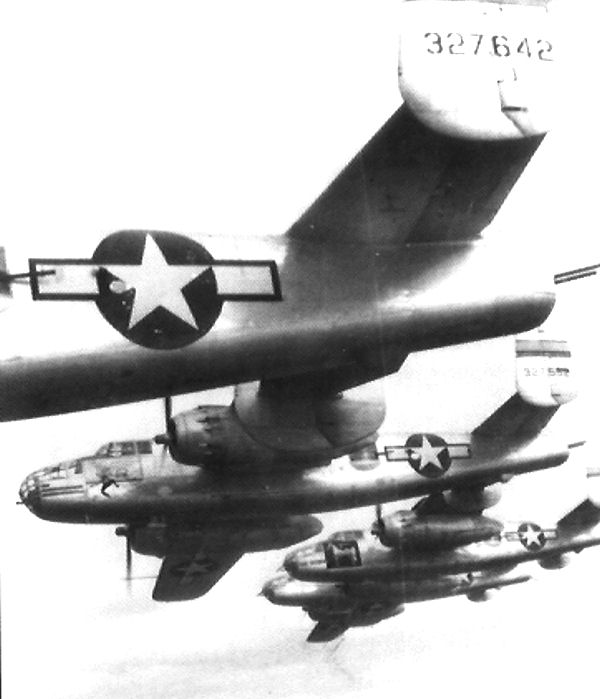
In November 1942, the squadron flew its planes to Mediouna Airfield, French Morocco, to support Operation Torch, the invasion of North Africa, although some remained behind in England until as late as March 1943. The squadron engaged primarily in air support and interdiction in Tunisia, Sicily, Sardinia, Corsica, Italy and Southern France. Through May 1943, it also attacked shipping and harbor facilities to cut the logistics lines of the Afrika Corps. It bombed marshalling yards, rail lines, highways, bridges, viaducts, troop concentrations, gun emplacements, shipping, harbors and other objectives in North Africa. It moved forward to Tunisia with the allied forces, locating at Dar el Koudia Airfield in June. It bombed airfields, landing grounds and gun emplacements, supporting Operation Corkscrew, the reduction of Pantelleria and Lampedusa islands during June 1943. The following month it supported Operation Husky, the invasion of Sicily.
On 27 August 1943, the squadron conducted a mission against marshalling yards in Benevento, Italy. Despite heavy antiaircraft artillery, it effectively bombed the target and destroyed several enemy interceptor aircraft making persistent attacks. For this action, it was awarded the Distinguished Unit Citation (DUC). From August 1943 to the end of hostilities in the spring of 1945, it struck German lines of communication, bridges, rail lines, marshalling yards, viaducts, tunnels and road junctions in Italy. From January through June 1944, it gave air support to ground forces in the drive toward Rome. The squadron also engaged in psychological warfare missions, dropping propaganda leaflets behind enemy lines.
In August 1944, it supported Operation Dragoon, the invasion of southern France from its base in Ghisonaccia Airfield, Corsica. On 10 March 1945, the squadron maintained close formation in the face of severe antiaircraft fire in successfully attacking the railroad bridge at Ora, a vital link in the German supply line to Italy. For this action, it was awarded its second DUC. In April 1945, it moved to Italy and was inactivated in theater in September 1945.
Air Force reserve
The squadron was activated at Bedford Army Air Field, Massachusetts on 9 August 1947 as part of the reserve, moving to T. F. Green Airport, Rhode Island in March 1948. It is unclear whether or not the squadron was fully manned or equipped with operational aircraft before it was inactivated in 1949.
Strategic bomber operations
The squadron was activated in 1952 as a Strategic Air Command squadron, receiving Boeing B-29 Superfortress bombardment training from 90th Bombardment Wing from April to August 1952. It acted as a training squadron until 1954 when it replaced its propeller-driven B-29s with new Boeing B-47E Stratojet swept-wing medium bombers, capable of flying at high subsonic speeds and primarily designed for penetrating the airspace of the Soviet Union. In the early 1960s, the B-47 was considered to be reaching obsolescence, and was being phased out of SAC's strategic arsenal. B-47s began being sent to AMARC at Davis-Monthan in early 1965; and the squadron was inactivated in March.
Space Operations
Reactivated as the 380th Space Control Squadron in 2008, assuming the personnel and equipment of Detachment 1, 310th Space Group. Redesignated 380th Electromagnetic Warfare Squadron in December 2022.
Lineage
- Constituted as the 380th Bombardment Squadron (Medium) on 28 January 1942 : Activated on 15 March 1942 : Redesignated 380th Bombardment Squadron, Medium on 20 August 1943 : Inactivated on 12 September 1945
- Redesignated 380th Bombardment Squadron, Light on 11 March 1947 : Activated in the reserve on 9 August 1947 : Inactivated on 27 June 1949
- Redesignated 380th Bombardment Squadron, Medium on 15 March 1952 : Activated on 28 March 1952 : Inactivated on 25 March 1965
- Redesignated 380th Space Control Squadron on 1 February 2008 : Activated on 7 March 2008 : Redesignated 380th Electromagnetic Warfare Squadron on 22 December 2022
Assignments
- 310th Bombardment Group, 15 March 1942 – 12 September 1945
- 310th Bombardment Group, 9 August 1947 – 27 June 1949
- 310th Bombardment Wing (later 310th Strategic Aerospace Wing), 28 March 1952 – 25 March 1965
- 310th Operations Group, 7 March 2008
- 710th Operations Group, 1 October 2017 – present
Stations
- Davis-Monthan Field, Arizona, 15 March 1942
- Jackson Army Air Base, Mississippi, 15 March 1942
- Key Field, Mississippi, 25 April 1942
- Columbia Army Air Base, South Carolina, 16 May 1942
- Walterboro Army Air Field, South Carolina, 14 August 1942
- Greenville Army Air Base, South Carolina, 18 September – 17 October 1942 : RAF Hardwick (Station 104), England, September–November 1942 (air echelon)
- Mediouna Airfield, French Morocco, 17 November 1942
- Telergma Airfield, Algeria, c. 13 December 1942
- Berteaux Airfield, Algeria, 1 January 1943
- Dar el Koudia Airfield, Tunisia, 6 January 1943
- Menzel Temime Airfield, Tunisia, 5 August 1943 (detachment operated from Oudna Airfield, tunisia from 10 October)
- Philippeville Airfield, Algeria, 10 November 1943 (detachment continued to operate from Oudna Airfield until 19 November)
- Ghisonaccia Airfield, Corsica, France, 4 January 1944
- Fano Airfield, Italy, 7 April 1945
- Pomigliano Airfield, Italy, c. 15 August 15 – 12 September 1945
- Bedford Army Air Field, Massachusetts, 9 August 1947
- Theodore F. Green Airport, Rhode Island, 4 March 1948 – 27 June 1949
- Forbes Air Force Base, Kansas, 28 March 1952
- Smoky Hill Air Force Base (later Schilling Air Force Base), Kansas, 3 September 1952 – 25 March 1965
- Peterson Air Force Base, Colorado, 7 March 2008
- Buckley Air Force Base (later Buckley Space Force Base), 1 October 2017 – present
Aircraft
- North American B-25 Mitchell, 1942–1945
- Boeing B-29 Superfortress, 1952–1954
- Boeing B-47 Stratojet, 1954–1965
References
Notes
; Explanatory noted
; Citations
Bibliography
References
- (17 January 2023). "Factsheet 380 Electromagnetic Warfare Squadron (AFRC)". Air Force Historical Research Agency.
- Maurer, ''Combat Squadrons'', pp. 469-470
- Watkins, p.80
- [https://www.petersonschriever.spaceforce.mil/?id=123084017 21st Space Wing Public Affairs: "Total Force 'RAIDRS' keep high frontier secure"]
- Maurer, ''Combat Units'', pp. 184-186
- Maurer, ''Combat Squadrons'', pp. 468-471, 525-526
- A portion of the ground echelon sailed for the United Kingdom aboard the {{RMS. Queen Mary on 5 September 1942,{{efn. Freeman refers to this as the air echelon on page 265, but contradicts this on page 15, which has more detail on the 310th Group's time in England. while the remainder sailed directly for North Africa from the United States. The air echelon ferried the squadron's Mitchells via the [[North Atlantic air ferry route in World War II
- Station number in Anderson, p. 19.
- Aircraft through March 1963 in Maurer, ''Combat Squadrons'', pp. 469-470
This article was imported from Wikipedia and is available under the Creative Commons Attribution-ShareAlike 4.0 License. Content has been adapted to SurfDoc format. Original contributors can be found on the article history page.
Ask Mako anything about 380th Electromagnetic Warfare Squadron — get instant answers, deeper analysis, and related topics.
Research with MakoFree with your Surf account
Create a free account to save articles, ask Mako questions, and organize your research.
Sign up freeThis content may have been generated or modified by AI. CloudSurf Software LLC is not responsible for the accuracy, completeness, or reliability of AI-generated content. Always verify important information from primary sources.
Report