From Surf Wiki (app.surf) — the open knowledge base
371st Bombardment Squadron
| Field | Value | |
|---|---|---|
| unit_name | 371st Bombardment Squadron | |
| image | Lockheed-Marietta B-47E Stratojet 53-1830 parked at Langley Air Force Base.jpg | |
| image_size | 300 | |
| caption | B-47 Stratojet as flown by the squadron | |
| dates | 1942–1946; 1946–1965 | |
| country | ||
| branch | ||
| role | Medium bomber | |
| battles | Southwest Pacific Theater | |
| decorations | Distinguished Unit Citation | |
| Philippine Presidential Unit Citation | ||
| Republic of Korea Presidential Unit Citation | ||
| identification_symbol | [[File:371st Bombardment Squadron - SAC - Emblem.png | 165px]] |
| identification_symbol_label | Patch with 371st Bombardment Squadron emblem | |
| identification_symbol_2 | [[File:371 Bombardment Sq emblem.png | 165px]] |
| identification_symbol_2_label | 371st Bombardment Squadron emblem (World War II) |
Philippine Presidential Unit Citation Republic of Korea Presidential Unit Citation
The 371st Bombardment Squadron is an inactive United States Air Force unit. Its last assignment was with the 307th Bombardment Wing at Lincoln Air Force Base, Nebraska, where it was inactivated on 25 March 1965.
The squadron was first activated in April 1942 as one of the original four squadrons of the 307th Bombardment Group. After training in the United States, it deployed to the Pacific, serving mainly in the Southwest Pacific Theater. The squadron earned two Distinguished Unit Citations for its actions in combat. Following V-J Day, it returned to the United States for inactivation.
The squadron was reactivated as a Strategic Air Command (SAC) bomber squadron in 1946. During the Korean War, it deployed to Okinawa and engaged in combat missions under the control of Far East Air Forces. Following the end of hostilities in Korea, it returned to the United States, converting to Boeing B-47 Stratojets. It flew the Stratojet until it was inactivated in 1965 as that plane was withdrawn from the SAC inventory.
History
World War II
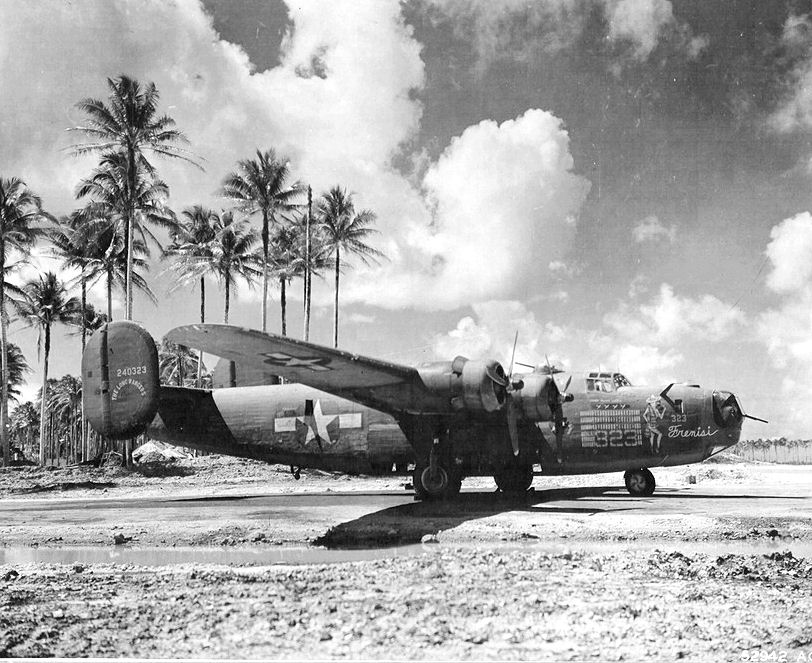
The squadron was activated at Geiger Field, Washington on 15 April 1942 as the 371st Bombardment Squadron, one of the original four squadrons of the 307th Bombardment Group. It was first equipped with Boeing B-17 Flying Fortresses, but while still in training converted to Consolidated B-24 Liberators. In addition to training with these heavy bombers, it also flew some antisubmarine patrols off the Pacific northwest coast. In October 1942, it began its movement to Hawaii.
The squadron arrived at Wheeler Field, Hawaii in November 1942, continuing its training in the Liberator and flying search and antisubmarine patrols in defense of Hawaii as part of Seventh Air Force. In December 1942, it staged through Naval Air Station Midway to attack Wake Island.
In February 1943, the squadron was relieved from assignment to Seventh Air Force and began to operate under the control of Thirteenth Air Force, although it did not move forward to Luganville Airfield, Espiritu Santo, New Hebrides, until June. From Guadalcanal, it struck enemy airfields and military installations along with shipping in the Solomon Islands and Bismarck Archipelago. It helped neutralized enemy bases in Yap, Truk and Palau. On 29 March 1944, the squadron made an unescorted daylight attack on heavily defended airfields in the Truk Islands for which it was awarded a Distinguished Unit Citation (DUC).
As American forces moved forward, it supported operations in the Philippines by strikes against enemy shipping in the southern Philippines and striking airfields on Leyte, Luzon, Negros, Ceram and Halmahera and supported Allied operations in the Netherlands East Indies. It flew an unescorted mission attacking the oil refineries at Balikpapan on Borneo on 3 October 1944, for which it was awarded a second DUC.
In the closing months of the war in the Pacific, it supported Australian forces on Borneo and attacked targets in Indochina. After V-J Day, it ferried liberated prisoners from Okinawa to the Philippines and flew patrols along the coast of China. It moved to Clark Field in the Philippines in September 1945 and returned to the United States for inactivation at the Port of Embarkation in January 1946.
Strategic Air Command
It was reactivated as Boeing B-29 Superfortress squadron at MacDill Field, Florida in August 1946 as part of Strategic Air Command. It was a training unit for antisubmarine warfare. It deployed to Okinawa during the Korean War, carrying out combat operations over Korea throughout the conflict. It remained in Okinawa until November 1954 when it moved without personnel to Lincoln Air Force Base, Nebraska, as a Boeing B-47 Stratojet medium jet bomber squadron, performed Operation Reflex deployments to North Africa. And was inactivated with the of the B-47 in 1965 and inactivated.
Lineage
- Constituted as the 371st Bombardment Squadron (Heavy) on 28 January 1942 : Activated on 15 April 1942 : Redesignated 371st Bombardment Squadron, Heavy c. March 1944 : Inactivated on 18 January 1946
- Redesignated 371st Bombardment Squadron, Very Heavy on 15 July 1946
- Activated on 4 August 1946 : Redesignated 371st Bombardment Squadron, Medium on 28 May 1948 : Inactivated on 25 March 1965
Assignments
- 307th Bombardment Group, 15 April 1942 – 18 January 1946
- 307th Bombardment Group, 4 August 1946 (attached to 307th Bombardment Wing after 14 February 1951)
- 307th Bombardment Wing, 16 June 1952 – 25 March 1965
Stations
- Geiger Field, Washington, 15 April 1942
- Ephrata Army Air Base, Washington, 28 May 1942
- Sioux City Army Air Base, Iowa, 30 September-20 October 1942
- Wheeler Field, Hawaii, 2 November 1942 (operated from Henderson Field, Midway Atoll, 21–24 December 1942 and 20–25 January 1943; Canton Island Airfield, Phoenix Islands, 6–12 February 1943: Funafuti Airfield, Nanumea, Gilbert Islands, 18–23 April 1943 and 27 July-1 August 1943)
- Luganville Airfield, Espiritu Santo, New Hebrides, 13 June 1943 (operated from Henderson Field, Guadalcanal, 25 August-14 October 1943; 24 November-31 December 19430
- Munda Airfield, New Georgia, Solomon Islands, 9 January 1944
- Momote Airfield, Los Negros, Admiralty Islands, 13 May 1944
- Wakde Airfield, Netherlands East Indies, 22 August 1944 (operated from Kornasoren (Yebrurro) Airfield, Noemfoor, Schouten Islands, c. 18 September-c. 20 November 1944)
- Wama Airfield, Morotai, Netherlands East Indies, 10 November 1944
- Clark Field, Luzon, Philippines, 1 September-27 December 1945
- Camp Stoneman, California, 16–18 January 1946
- MacDill Field (later MacDill Air Force Base), Florida, 4 August 1946 (operated from Kadena Air Base, Okinawa after c. 5 August 1950
- Kadena Air Base, Okinawa, 15 August 1953
- Lincoln Air Force Base, Nebraska, 19 November 1954 – 25 March 1965
Aircraft
- Boeing B-17 Flying Fortress, 1942
- Consolidated B-24 Liberator, 1942–1945
- Boeing B-29 Superfortress, 1946–1954
- Boeing B-47 Stratojet, 1955–1965
References
Notes
; Explanatory notes
; Citations
Bibliography
References
- Maurer, ''Combat Squadrons'', pp. 459-460
- Maurer, ''Combat Squadrons''. pp. 457-461, 520-521
- Maurer, ''Combat Units'', pp. 181-182
- Lineage information, including aircraft, assignments and stations, through March 1963 in Maurer, ''Combat Squadrons'', pp. 459-460
This article was imported from Wikipedia and is available under the Creative Commons Attribution-ShareAlike 4.0 License. Content has been adapted to SurfDoc format. Original contributors can be found on the article history page.
Ask Mako anything about 371st Bombardment Squadron — get instant answers, deeper analysis, and related topics.
Research with MakoFree with your Surf account
Create a free account to save articles, ask Mako questions, and organize your research.
Sign up freeThis content may have been generated or modified by AI. CloudSurf Software LLC is not responsible for the accuracy, completeness, or reliability of AI-generated content. Always verify important information from primary sources.
Report