From Surf Wiki (app.surf) — the open knowledge base
33rd Armoured Brigade (United Kingdom)
| Field | Value | |
|---|---|---|
| unit_name | 33rd Armoured Brigade | |
| image | British 33rd Armoured Brigade - Tactical Formation Sign.svg | |
| image_size | 100 | |
| caption | Formation Insignia of the 33rd Armoured Brigade | |
| dates | 17 March 1944 - 22 August 1945 | |
| 1 January 1980 - 1 December 1992 | ||
| country | United Kingdom | |
| branch | [[Image:Flag of the British Army.svg | 23px]] British Army |
| type | Armoured | |
| size | Brigade | |
| command_structure | Independent Brigade | |
| [79th Armoured Division](79th-armoured-division-united-kingdom) | ||
| [3rd Armoured Division](3rd-division-united-kingdom) | ||
| [4th Armoured Division](4th-infantry-division-united-kingdom) | ||
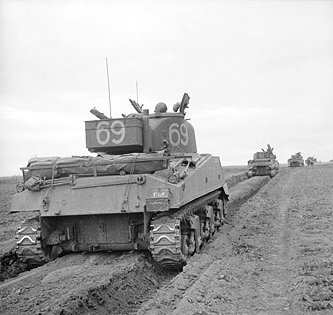
| equipment | M4 Sherman | |
| LVT 4 | ||
| garrison | Alanbrooke Barracks, Paderborn Garrison | |
| battles | Second World War | |
| Invasion of Normandy | ||
| Le Mesnil-Patry | ||
| Operation Charnwood | ||
| Operation Pomegranate | ||
| Operation Totalize | ||
| Rhine Crossing |
1 January 1980 - 1 December 1992 79th Armoured Division 3rd Armoured Division 4th Armoured Division LVT 4 Invasion of Normandy Le Mesnil-Patry Operation Charnwood Operation Pomegranate Operation Totalize Rhine Crossing 144th Regiment, RAC 148th Regiment, RAC 11th Royal Tank Regiment 1st Battalion, Royal Highland Fusiliers 1st Battalion, Black Watch 1st Battalion, Queen's Own Highlanders 1st Battalion, Queen's Lancashire Regiment 3rd Battalion, The Light Infantry The 33rd Armoured Brigade (33rd Armd Bde) was an armoured brigade of the British Army that was active in northwestern Europe in the Second World War from June 1944 until May 1945 and from 1980 to 1992.
History
Normandy
The brigade was formed in the United Kingdom on 17 March 1944 by the re-naming of the 33rd Tank Brigade. The brigade took part in the Normandy campaign and landed on Gold Beach on 6 June 1944. The brigade, consisting of three armoured regiments, was assigned to infantry divisions that needed armoured support and rarely fought as a unit.
The brigade took part in the Battle for Caen. On 11 June, the brigade took part in fighting at Le Mesnil-Patry. From 8 to 9 July, the brigade participated in Operation Charnwood; the capture of Caen north of the Orne. On 16 July, attached to the 59th (Staffordshire) Infantry Division, the brigade took part in Operation Pomegranate, part of the Second Battle of the Odon, to divert German attention from Operation Goodwood. Following the Battle for Caen, the brigade took part with the First Canadian Army attacks towards Falaise; on 8 August, the brigade took part in Operation Totalize.
Rhine Crossing
The brigade was reformed and re-equipped with LVT 4 (Buffalo amphibious armoured fighting vehicles) for Operation Plunder, the Rhine crossing, and was placed under the command of the 79th Armoured Division.
Post War
During the 1970s, the brigade was one of two "square" brigades assigned to 3rd Armoured Division. After being briefly converted to "Task Force Echo" in the late 1970s, the brigade was reinstated in 1981, assigned to 4th Armoured Division and based at Alanbrooke Barracks in Paderborn. In 1986, it was assigned to 3 (UK) Armd Div. Following the fall of the Berlin Wall, in December 1992, the brigade was merged with the 20th Armoured Brigade and disbanded as part of the Options for Change programme.
Organisation
The Organisation of the brigade at certain times included:
Second World War
- Brigade Headquarters & Signal Squadron, Royal Corps of Signals
- 1st Northamptonshire Yeomanry (Dragoons), 17/3/44–18/8/45
- 1st East Riding of Yorkshire Yeomanry (Lancers), 16/8/44–23/4/45
- The Queen's Own Staffordshire Yeomanry Regiment (Hussars), 26/4/45–26/6/45
- 4th Royal Tank Regiment, 1/3/45–30/3/45
- 11th Royal Tank Regiment, 28/1/45–30/3/45 and 26/4/35–19/8/45
- 144th (8th Battalion East Lancashire) Regiment, Royal Armoured Corps, 17/3/44–28/3/45
- 148th (9th Battalion Royal North Lancashire Regiment) Regiment, Royal Armoured Corps, 17/3/44–16/8/44
Cold War
- Brigade Headquarters & 202 Signal Squadron, Royal Corps of Signals
- Royal Scots Dragoon Guards, 1/1/1980–11/1986
- Blues and Royals, 11/1986–1/1990
- Life Guards, 1/1990–19/8/92
- 1st Battalion, The Royal Highland Fusiliers(Princess Margaret's Own Glasgow and Ayrshire Regiment), 1/1/1980–11/1984
- 1st Battalion, The Queen's Lancashire Regiment, 11/1984–2/1990
- 3rd Battalion, The Light Infantry, 2/1990–1/12/1992
- 1st Battalion, The Black Watch (Royal Highland Regiment), 1/1/1980–3/1985
- 1st Battalion, The Royal Scots (The Royal Regiment), 3/1985–12/1988
- 1st Battalion, The Queen's Own Highlanders (Seaforth and Camerons), 12/1988–3/1990
References
Sources
References
- Cole p. 126
- "Badge, formation, 33rd Army Tank Brigade & 33rd Armoured Brigade". Imperial War Museum.
- "Operation Pomegranate". 59th Division.
- Poulsen, p. 91
- Watson, Graham. (2005). "The British Army in Germany: An Organisational History 1947-2004". Tiger Lily.
- Black, Harvey. "The Cold War Years. A Hot War in reality. Part 6.".
- "Alanbrooke Barracks". BAOR locations.
This article was imported from Wikipedia and is available under the Creative Commons Attribution-ShareAlike 4.0 License. Content has been adapted to SurfDoc format. Original contributors can be found on the article history page.
Ask Mako anything about 33rd Armoured Brigade (United Kingdom) — get instant answers, deeper analysis, and related topics.
Research with MakoFree with your Surf account
Create a free account to save articles, ask Mako questions, and organize your research.
Sign up freeThis content may have been generated or modified by AI. CloudSurf Software LLC is not responsible for the accuracy, completeness, or reliability of AI-generated content. Always verify important information from primary sources.
Report