From Surf Wiki (app.surf) — the open knowledge base
3200 Phaethon
Asteroid responsible for the Geminids meteor shower
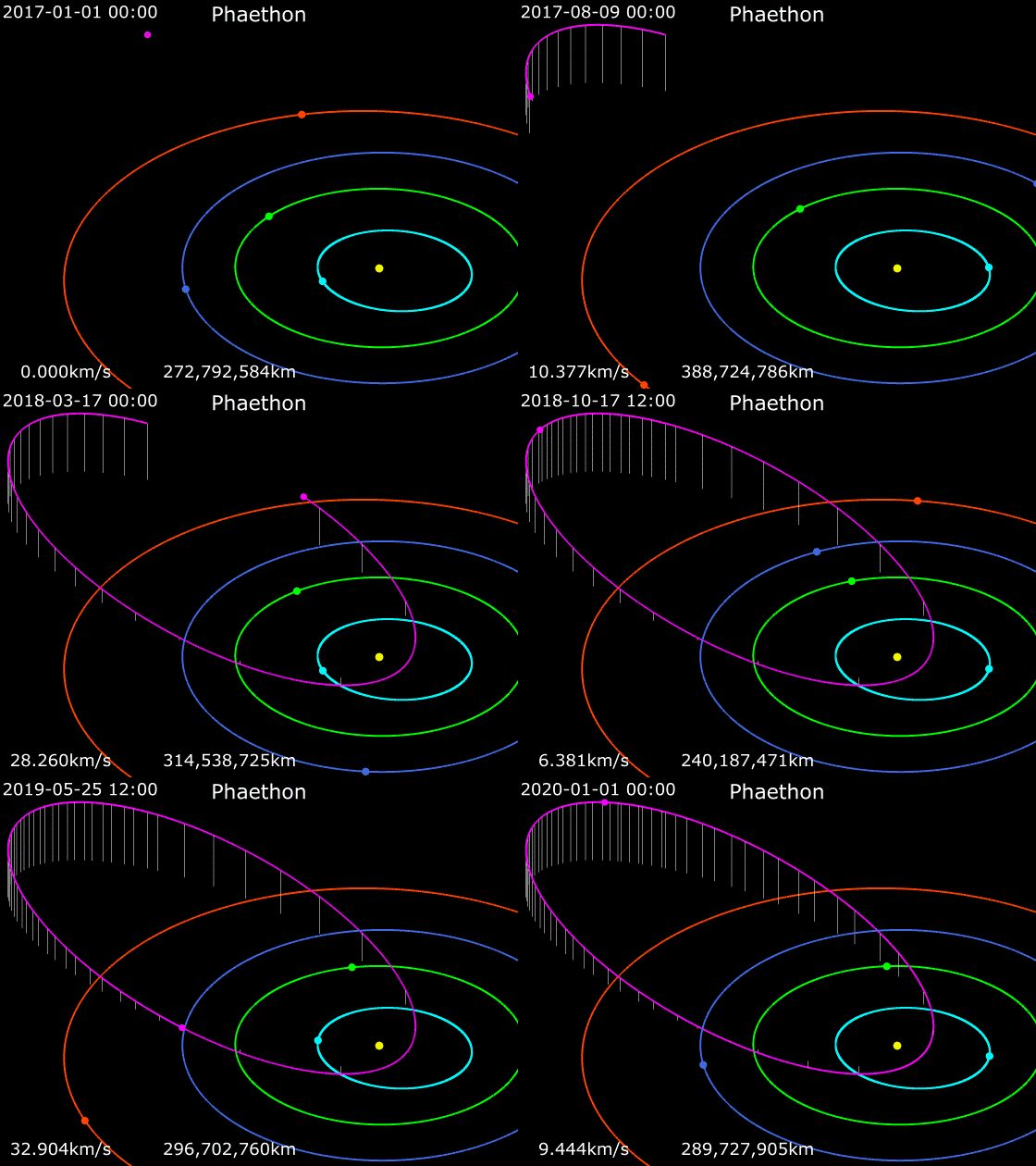
Asteroid responsible for the Geminids meteor shower
| Field | Value |
|---|---|
| minorplanet | yes |
| background | #FFC2E0 |
| name | 3200 Phaethon |
| image | PIA22185.gif |
| caption | Radar image of 3200 Phaethon taken by Arecibo, December 17, 2017 |
| discoverer | {{Ubl |
| discovered | October 11, 1983 |
| named_after | Phaëthon |
| mp_category | {{unbulleted list |
| Apollo asteroid<ref name | jpldata / |
| mpc_name | (3200) Phaethon |
| pronounced | |
| adjective | Phaethonian |
| alt_names | 1983 TB |
| orbit_ref | |
| epoch | April 27, 2019 (JD 2458000.5) |
| uncertainty | 0 |
| observation_arc | 12941 days |
| aphelion | 2.4028 AU |
| perihelion | 0.13998 AU |
| time_periastron | May 15, 2022 |
| semimajor | 1.2714 AU |
| eccentricity | 0.88990 |
| period | 523.6 days |
| avg_speed | 19.9 km/s |
| inclination | 22.260° |
| asc_node | 265.22° |
| mean_anomaly | 313.94° |
| mean_motion | day |
| arg_peri | 322.19° |
| moid | 0.01955 AU |
| venus_moid | |
| jupiter_moid | 2.7375 AU |
| tisserand | 4.510 |
| dimensions | × |
| mean_diameter | 3.6 mi |
| rotation | 3.604 hours |
| albedo | |
| spectral_type | F-type asteroid |
| abs_magnitude | 14.6 |
| magnitude | 10.7 (December 14, 2017) |
| Simon Green | John K. Davies / IRAS | Apollo asteroid | Potentially hazardous asteroid | Mercury-crosser asteroid | Venus-crosser asteroid | Earth-crosser asteroid | Mars-crosser asteroid
3200 Phaethon (; previously sometimes spelled Phæton), provisionally designated 1983 TB, is an active Apollo asteroid with an orbit that brings it closer to the Sun than any other named asteroid (though there are numerous unnamed asteroids with smaller perihelia, such as ). For this reason, it was named after the Greek Hero, Phaëthon, son of the sun god Helios. It is 3.6 mi in diameter and is the parent body of the Geminids meteor shower of mid-December. With an observation arc of 35+ years, it has a very well determined orbit. The 2017 Earth approach distance of about 10 million km was known with an accuracy of ±700 m.
Discovery
Phaethon was the first asteroid to be discovered using images from a spacecraft. Simon F. Green and John K. Davies discovered it in images from October 11, 1983, while searching Infrared Astronomical Satellite (IRAS) data for moving objects. It was formally announced on October 14 in IAUC 3878 along with optical confirmation by Charles T. Kowal, who reported it to be asteroidal in appearance. Its provisional designation was 1983 TB, and it later received the numerical designation and name 3200 Phaethon in 1985.
Orbital characteristics
Phaethon is categorized as an Apollo asteroid, as its orbital semi-major axis is greater than that of the Earth's at 1.27 AU. It is also suspected to be a member of the Pallas family of asteroids.
Its most remarkable distinction is that it approaches the Sun closer than any other named asteroid: its perihelion is only 0.14 AU — less than half of Mercury's perihelial distance. It is a Mercury-, Venus-, Earth-, and Mars-crosser as a result of its high orbital eccentricity. The surface temperature at perihelion could reach around 1025 K.
Phaethon is a possible candidate for detecting general relativistic and/or solar oblateness effects in its orbital motion due to the frequent close approaches to the Sun. The Apollo asteroids (155140) 2005 UD and (225416) 1999 YC share similar orbits with Phaethon, suggesting a possible common breakup origin.
Potentially hazardous asteroid
Phaethon is categorized as a potentially hazardous asteroid (PHA), but that does not mean there is a near-term threat of an impact. It is a potentially hazardous asteroid merely as a result of its size (absolute magnitude H ≤ 22) and Earth minimum orbit intersection distance (Earth MOID ≤ 0.05 AU). The Earth minimum orbit intersection distance (E-MOID) is 0.01945 AU, which is defined by the shortest distance between the orbit of Phaethon and the orbit of Earth. With a 30+ year observation arc, the orbit of Phaethon is very well understood with very small uncertainties. Close approaches of Phaethon are well constrained for the next 400 years.
Physical characteristics

Phaethon is an asteroid with fairly unusual characteristics in that its orbit more closely resembles that of a comet than an asteroid; it has been referred to as a "rock comet". In studies performed by NASA's STEREO spacecraft in 2009 and 2012, rapid brightening and a visible tail have been observed.{{cite journal|title=Recurrent Perihelion Activity in (3200) Phaethon It is possible that the Sun's heat is causing fractures similar to mudcracks in a dry lake bed. This occurs because Phaethon's orbit takes it closer to the Sun than any other named asteroid (0.14 AU at perihelion) causing extreme heating and enough solar radiation pressure to push any separated pieces off the asteroid's surface. Since its discovery, several other objects were found exhibiting mixed cometary and asteroidal features, such as 133P/Elst–Pizarro, leading to a new class of objects dubbed "active asteroids".
In 2018, observations revealed that Phaethon was blue in color. This is extremely rare, as most asteroids tend to be grey or red. In 2020, polarimetric study revealed Phaethon has a surface with steep slopes covered by a mix of regolith with larger pebbles. Phaethon's composition fits the notion of its cometary origin; it is classified as a F-type asteroid because it is composed of dark material how Phaethon's blue color and its rock-comet-like emission activity can be explained by the effects of the intense solar heating at perihelion causing sublimation of any darkish-red refractory organic, nano-phase iron (nFe0), and pyroxene materials on its surface.
Analysis of a mid-infrared spectral emissivity spectrum from the Spitzer Space Telescope showed Phaethon to be linked to the rare Yamato-type (CY) carbonaceous chondrites. This link rules out other carbonaceous meteorite types, although the understanding of the origins of CYs are evolving. Further analysis of this spectrum confirmed the presence of Mg-rich olivine, carbonates, and Fe-sulfides. Until further studies were done in 2023, it was believed that thermal decomposition and outgassing of these minerals during perihelion led to dust ejection, possibly explaining a faint observed tail and the formation of the Geminid meteor stream. However in a 2023 NASA study imaging from the SOHO spacecraft revealed that the material emitted from the asteroid was sodium gas, with filtered images revealing no sign of dust at all. This cast doubt on the origin of the Geminids being dust and material cast off from Phaethon during periodic solar perihelions, and instead invited speculation of an ancient breakup event.
Meteor shower
Shortly after its discovery, Fred Whipple noted that Phaethon's orbital elements were extremely similar to those of the Geminid meteor shower, indicating that Phaethon was the meteor shower's long-sought parent body.
Planned flyby

DESTINY+ (Demonstration and Experiment of Space Technology for INterplanetary voYage Phaethon fLyby dUSt science) is a planned mission to fly by 3200 Phaethon, as well as various minor bodies originating from it. The spacecraft is being developed by the Japanese space agency JAXA and will demonstrate advanced technologies for future deep space exploration. DESTINY+ is planned to be launched no earlier than 2028.
Close approaches
Phaethon approached to 0.120895 AU of Earth on December 10, 2007, and was detected by radar at Arecibo. When Phaethon came to perihelion in July 2009, it was found to be brighter than expected. During its approach, the STEREO-A spacecraft detected an unexpected brightening, roughly by a factor of two.
2010 approach
2017 approach
On December 16, 2017, at 23:00 UT, Phaethon passed 0.06893169 AU from Earth (27 lunar distances). The Earth approach distance was known with a 3-sigma precision of ±700 m. This was the best opportunity to date for radar observations by Goldstone and Arecibo, with a resolution of 75 m.
The asteroid was bright enough to see in small telescopes, peaking at magnitude 10.8 between December 13–15 while dimming slightly to magnitude 11 on December 16 at closest approach. Arecibo made observations of Phaethon from December 15–19. It will not make an Earth approach closer than the 2017 passage until December 14, 2093, when it will pass 0.01981 AU from Earth.
Notes
References
|access-date=June 5, 2019 |archive-url=https://web.archive.org/web/20190605055124/https://ssd.jpl.nasa.gov/sbdb.cgi?sstr=3200;cad=1 |archive-date=June 5, 2019 |url-status=live}}
References
- {{OED. phaeton
- [http://ssd.jpl.nasa.gov/horizons.cgi?find_body=1&body_group=sb&sstr=3200 JPL Horizons] Observer Location: @sun (Perihelion occurs when deldot changes from negative to positive.)
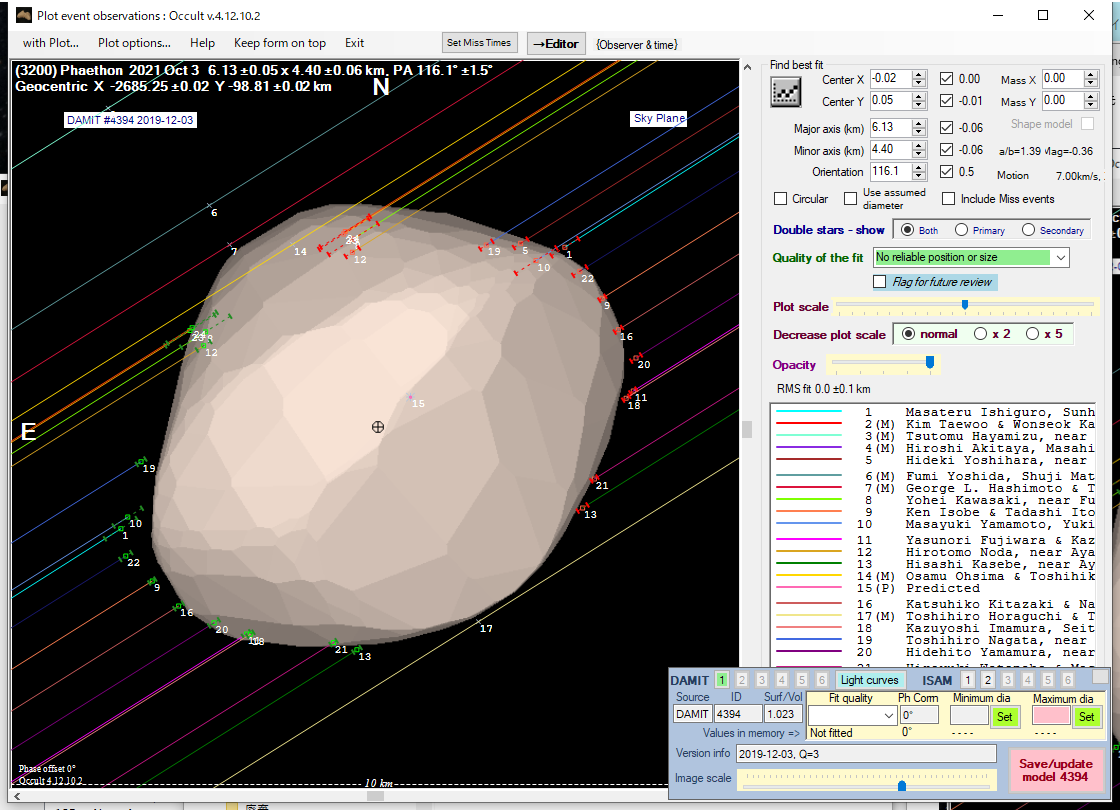
- (3 October 2021). "(3200) Phaethon 2021 Oct 3". Hayamizu Astro Laboratory.
- (June 5, 2019). "Photometric observations of the asteroid 3200 Phaethon using small and middle telescopes". Contributions of the Astronomical Observatory Skalnate Pleso.
- (June 1, 2023). "Formation, Structure, and Detectability of the Geminids Meteoroid Stream". The Planetary Science Journal.
- (2010). "Activity in Geminid Parent (3200) Phaethon". Astronomical Journal.
- (2015). "Asteroids IV". [[University of Arizona]].
- Eleanor Imster. (November 1, 2018). "Rare blue asteroid sometimes behaves like a comet". EarthSky.
- Eric Mack. (October 23, 2018). "A look at 3200 Phaethon: A big, bizarre, blue asteroid we plan to visit". CNET.
- (2020). "Polarimetric properties of asteroid 3200 Phaethon".
- (2 November 2023). "Thermal decomposition as the activity driver of near-Earth asteroid (3200) Phaethon". Nature Astronomy.
- (Feb 2025). "Reassessing the proposed "CY chondrites": Evidence for multiple meteorite types and parent bodies from Cr-Ti-H-C-N isotopes and bulk elemental compositions". Geochim. Cosmochim. Acta.
- (25 April 2023). "Sodium Brightening of (3200) Phaethon near Perihelion". The Planetary Science Journal.
- (9 October 2024). "宇宙科学・探査ミッションの進捗状況について". [[Cabinet Office (Japan).
- (December 22, 2017). "Arecibo Radar Returns with Asteroid Phaethon Images". NASA.
- "(3200) Phaethon Orbit". [[Minor Planet Center]].
- "JPL Small-Body Database Search Engine — Constraints: asteroids and q < 0.141 (au)". [[Jet Propulsion Laboratory]].
- Jaggard, Victoria. (October 12, 2010). "Exploding Clays Drive Geminids Sky Show?". National Geographic.
- Benner, Lance A. M.. (2017). "Goldstone Radar Observations Planning: Asteroid 3200 Phaethon". NASA/JPL Asteroid Radar Research.
- Phillips, Tony. (December 3, 2007). "Asteroid Shower". [[NASA]].
- "NEO Groups". NASA.
- (2010). "Activity in Geminid Parent (3200) Phaethon". [[The Astronomical Journal]].
- (2010). "Spectroscopy of B-type asteroids: Subgroups and meteorite analogs". [[Journal of Geophysical Research]].
- (2013). "The Dust Tail of Asteroid (3200) Phaethon". [[The Astrophysical Journal Letters]].
- Sutherland, Paul. (September 10, 2013). "Why an asteroid is crumbling into meteor dust". Skymania.com.
- Whipple, F. L.. (October 25, 1983). "1983 TB and the Geminid Meteors". [[IAU Circular]].
- Shanklin, Jonathan. (2009). "Comet Section: 2009 News". British Astronomical Association.
- (June 2009). "(3200) Phaethon". [[IAU Circular]].
- "(3200) Phaethon: Ephemerides for December 2017". University of Pisa Department of Mathematics.
- "(3200) Phaethon: Close Approaches". University of Pisa Department of Mathematics.
- (June 2020). "New Evidence for a Physical Link between Asteroids (155140) 2005 UD and (3200) Phaethon". The Planetary Science Journal.
- (2022). "Thermal alteration and differential sublimation can create Phaethon's "rock comet" activity and blue color". [[Icarus (journal).
This article was imported from Wikipedia and is available under the Creative Commons Attribution-ShareAlike 4.0 License. Content has been adapted to SurfDoc format. Original contributors can be found on the article history page.
Ask Mako anything about 3200 Phaethon — get instant answers, deeper analysis, and related topics.
Research with MakoFree with your Surf account
Create a free account to save articles, ask Mako questions, and organize your research.
Sign up freeThis content may have been generated or modified by AI. CloudSurf Software LLC is not responsible for the accuracy, completeness, or reliability of AI-generated content. Always verify important information from primary sources.
Report