From Surf Wiki (app.surf) — the open knowledge base
3131 Mason-Dixon
Minor planet
Minor planet
| Field | Value |
|---|---|
| minorplanet | yes |
| name | 3131 Mason–Dixon |
| background | #D6D6D6 |
| image | 003131-asteroid shape model (3131) Mason-Dixon.png |
| caption | *Mason–Dixon* modeled from its lightcurve |
| discovery_ref | |
| discoverer | E. Bowell |
| discovery_site | Anderson Mesa Stn. |
| discovered | 24 January 1982 |
| mpc_name | (3131) Mason–Dixon |
| alt_names | 1962 CK |
| A922 DC | |
| named_after | Charles Mason |
| Jeremiah Dixon | |
| (English astronomers) | |
| mp_category | main-belt(outer) |
| Koronis | |
| orbit_ref | |
| epoch | 27 April 2019 (JD 2458600.5) |
| uncertainty | 0 |
| observation_arc | 63.82 yr (23,311 d) |
| aphelion | 3.0505 AU |
| perihelion | 2.7940 AU |
| semimajor | 2.9222 AU |
| eccentricity | 0.0439 |
| period | 5.00 yr (1,825 d) |
| mean_anomaly | 118.17° |
| mean_motion | / day |
| inclination | 2.4041° |
| asc_node | 44.734° |
| arg_peri | 147.18° |
| mean_diameter | (est. at 0.15) |
| rotation | |
| albedo | (family albedo) |
| spectral_type | S (family based) |
| abs_magnitude | 12.0 |
A922 DC Jeremiah Dixon (English astronomers) Koronis
3131 Mason–Dixon (prov. designation: ) is a Koronian asteroid from the outer regions of the asteroid belt. It was discovered on 24 January 1982, by American astronomer Edward Bowell at Lowell's Anderson Mesa Station in Arizona, United States. The likely S-type asteroid has a rotation period of 19.7 hours and measures approximately 14 km in diameter. It was named for English astronomers Charles Mason and Jeremiah Dixon.
Orbit and classification
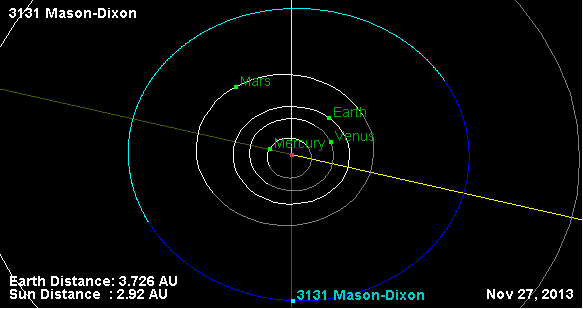
Mason–Dixon is a core member of the Koronis family (605), a very large asteroid family of almost 6,000 known asteroids with nearly co-planar ecliptical orbits. It orbits the Sun in the outer main-belt at a distance of 2.8–3.1 AU once every 5 years (1,825 days; semi-major axis of 2.92 AU). Its orbit has an eccentricity of 0.04 and an inclination of 2° with respect to the ecliptic.
The body was first observed at Heidelberg Observatory in February 1922. Its observation arc begins with a precovery taken at Palomar Observatory in July 1954. On 1 February 1907, Mason–Dixon made a close approach to one of the larger asteroids, 52 Europa. At its closest, it passed Europa within 1.1 million kilometers.
Naming
This minor planet was named by the discoverer in memory of English astronomers Charles Mason (1728–1786) and Jeremiah Dixon (1733–1779), who observed the 1761 transit of Venus from the Cape of Good Hope. Between 1763 and 1767 they surveyed the so-called Mason–Dixon line, the boundary between the US States of Pennsylvania and Maryland. The official was published by the Minor Planet Center on 22 June 1986 (M.P.C. 10847).
Physical characteristics
The asteroid's spectral type has not been determined. Due its membership to the stony Koronis family, Mason–Dixon is likely a common S-type asteroid.
Rotation period
In January 2012, a rotational lightcurve of Mason–Dixon was obtained from photometric observations by astronomers at the Palomar Transient Factory in California. Lightcurve analysis gave a rotation period of hours with a high brightness variation of 0.70 magnitude (), indicative of an elongated, non-spherical shape. Another fragmentary lightcurve by Maurice Clark at Preston Gott Observatory in September 2014 gave a less accurate period of 10.20 hours with an amplitude of 0.75 magnitude.
Diameter and albedo
Assuming a typical albedo of 0.15 for members of the Koronis family, Mason–Dixon measures 14 kilometers based on an absolute magnitude of 12.00. The Collaborative Asteroid Lightcurve Link assumes an albedo of a carbonaceous asteroid of 0.057 and consequently calculates a larger diameter of 18.6 kilometers.
References
This article was imported from Wikipedia and is available under the Creative Commons Attribution-ShareAlike 4.0 License. Content has been adapted to SurfDoc format. Original contributors can be found on the article history page.
Ask Mako anything about 3131 Mason-Dixon — get instant answers, deeper analysis, and related topics.
Research with MakoFree with your Surf account
Create a free account to save articles, ask Mako questions, and organize your research.
Sign up freeThis content may have been generated or modified by AI. CloudSurf Software LLC is not responsible for the accuracy, completeness, or reliability of AI-generated content. Always verify important information from primary sources.
Report