From Surf Wiki (app.surf) — the open knowledge base
3122 Florence
Near-Earth asteroid with 2 moons
Near-Earth asteroid with 2 moons
| Field | Value |
|---|---|
| minorplanet | yes |
| name | 3122 Florence |
| background | #FFC2E0 |
| image | File:Triple asteroid 3122 Florence.gif |
| caption | |
| discovery_ref | |
| discovered | |
| discoverer | Schelte J. "Bobby" Bus |
| discovery_site | Siding Spring Obs. |
| mpc_name | (3122) Florence |
| alt_names | |
| pronounced | |
| named_after | Florence Nightingale |
| (English nurse) | |
| mp_category | AmorNEOPHA |
| orbit_ref | |
| epoch | 4 September 2017 (JD 2458000.5) |
| uncertainty | 0 |
| observation_arc | 38.52 yr (14,069 days) |
| aphelion | 2.5180 AU |
| perihelion | 1.0203 AU |
| semimajor | 1.7691 AU |
| eccentricity | 0.4233 |
| period | 2.35 yr (859 days) |
| mean_anomaly | 351.44° |
| mean_motion | / day |
| inclination | 22.151° |
| asc_node | 336.10° |
| arg_peri | 27.847° |
| satellites | 2 |
| moid | 0.0443 AU17.3 LD |
| mean_diameter | km |
| km | |
| 4.35 km (taken) | |
| km | |
| 4.9 km | |
| rotation | h |
| h | |
| h | |
| h | |
| h | |
| h | |
| h | |
| density | 1.4 g/cm3 |
| albedo | |
| spectral_type | SMASS SSq |
| abs_magnitude | (R)14.0 (R)14.1 |
(English nurse) km 4.35 km (taken) km 4.9 km h h h h h h
3122 Florence is a stony triple asteroid of the Amor group. It is classified as a near-Earth object and potentially hazardous asteroid. It measures approximately 5 kilometers in diameter. It orbits the Sun at a distance of 1.0–2.5 AU once every 2 years and 4 months (859 days); the orbit has an eccentricity of 0.42 and an inclination of 22° with respect to the ecliptic. Florence has two moons.
Florence was discovered on 2 March 1981 by American astronomer Schelte J. "Bobby" Bus at Siding Spring Observatory. Its provisional designation was . It was named in honor of Florence Nightingale, the founder of modern nursing; the naming citation was published on 6 April 1993 (M.P.C. 21955).
Florence is classified as a potentially hazardous object because its minimum orbit intersection distance (MOID ≤ 0.05 AU) indicates that it has the potential to make close approaches to the Earth, and because measurements of its absolute magnitude (H ≤ 22) suggest that it is large enough to create serious damage were it to impact.
Moons
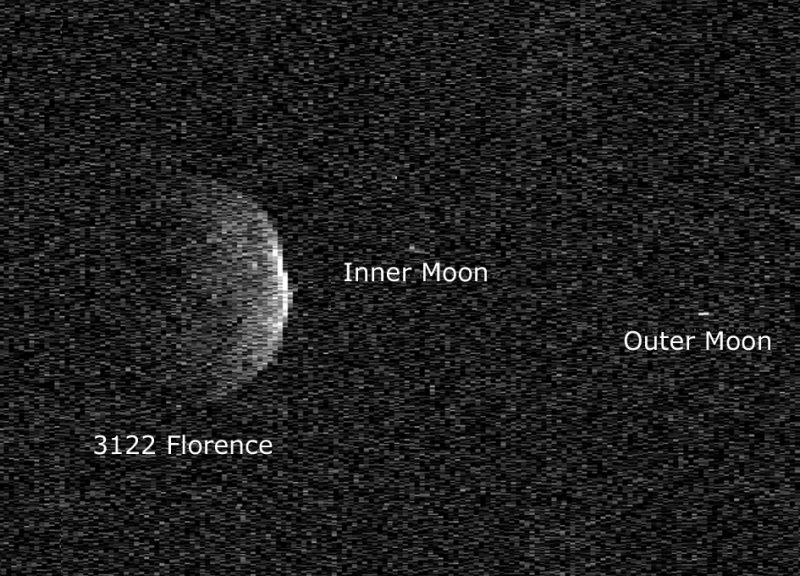
Radar observations during the 2017 flyby have shown that Florence has two moons. The inner of the two moons is estimated to have a diameter of 180 to 240 meters, the outer moon is between 300 and 360 meters across. Each moon is somewhat elongated, and both are tidally locked to the main body. They probably formed as loose material spun away from the main body as its rotation accelerated due to the YORP effect.
The inner moon's period orbiting Florence appears to be approximately 7 hours, while the outer moon completes a revolution in about 21 to 23 hours. The inner moon of Florence has the shortest orbital period of any of the moons of the 60 near-Earth asteroids known to have moons.
Florence is only the third known triple asteroid in the near-Earth asteroid population, after and .
2017 close approach
0.047237 AU from Earth, approximately eighteen times the average distance of the Moon. As seen from Earth, it brightened to apparent magnitude 8.5, and was visible in small telescopes for several nights as it moved south to north through the constellations Piscis Austrinus, Capricornus, Aquarius, and Delphinus. This was the asteroid's closest approach since 1890 and the closest until after 2500. Its previous flyby was on 29 August 1930, at a distance of 0.05239 AU and the next one will be on 2 September 2057, at 0.049952 AU. File:3122Florence (1981 ET3).gif|Animation: 2017-08-30 21:48:46 to 22:53:00 UTC File:Florence3122spon.jpg|3122 Florence passing the Earth in 2017 File:3122 Florence 2017 flyby3.png|Orbit of Florence File:3122 Florence 2017 flyby.png|Daily motion of 3122 Florence as seen from earth near 1 September 2017 flyby.
Radar imagery
During the flyby, scientists studied Florence using the Arecibo Observatory and the Goldstone Deep Space Communications Complex, and discovered that it has two moons.
; Goldstone Radar Florence.aug29.collage.5runs.p5usec.7.7Hz.jpg|Aug 29 Florence Goldstone September 1.gif|Sep 1
; Arecibo Radar Florence Arecibo September 2.gif|Sep 2
Florence Arecibo September 2 (high-res).gif|Sep 2 Florence Arecibo September 3.gif|Sep 3
Florence Arecibo September 4.gif|Sep 4
Florence Arecibo September 5.gif|Sep 5
Notes
References
|access-date= 7 January 2017}}
|access-date= 7 January 2017}}
|access-date = 7 January 2017}}
|access-date= 7 January 2017}}
|access-date= 14 September 2017}}
|access-date= 14 September 2017}}
|access-date = 30 August 2017 |archive-url = https://web.archive.org/web/20120812205611/http://earn.dlr.de/nea/003122.htm |archive-date = 2012-08-12 |url-status=dead}}
|access-date = 30 August 2017}}
|display-authors = 6
|access-date = 7 January 2017}}
|access-date= 7 January 2017}}
|display-authors = 6 |access-date= 7 January 2017|arxiv = 1210.0502 |s2cid = 41459166 }}
|display-authors = 6
|access-date= 7 January 2017}}
|access-date= 7 January 2017}}
|access-date= 7 January 2017}}
|access-date= 7 January 2017}}
|display-authors = 6 |doi-access= free
|access-date= 7 January 2017}}
References
- "Florence". [[Oxford University Press]].
- "NEO Groups". NASA.
- (1 September 2017). "Asteroid Besar dan Langka Lintasi Langit Indonesia Malam Ini".
- PTI. (2017-08-18). "Nasa says big asteroid to pass safely by Earth on 1 September".
- (30 August 2017). "Asteroid Florence Pays Earth a Visit – Sky & Telescope".
- (30 August 2017). "See Florence, One Of The Largest Near-Earth Asteroids, Zip By Earth".
- (29 August 2017). "Goldstone Radar Observations Planning: Asteroid 3122 Florence and 2001 QL142". NASA.
- (2 September 2017). "Arecibo announces two moons (September 2nd)". Twitter.
- (2 September 2017). "Arecibo imagery from September 2nd (5x higher resolution)". Twitter.
- (3 September 2017). "Arecibo reveals surface features of 3122 Florence". Twitter.
- (4 September 2017). "One full rotation of 3122 Florence, as seen from Arecibo". Twitter.
- (5 September 2017). "Last images of 3122 Florence from Arecibo". Twitter.
This article was imported from Wikipedia and is available under the Creative Commons Attribution-ShareAlike 4.0 License. Content has been adapted to SurfDoc format. Original contributors can be found on the article history page.
Ask Mako anything about 3122 Florence — get instant answers, deeper analysis, and related topics.
Research with MakoFree with your Surf account
Create a free account to save articles, ask Mako questions, and organize your research.
Sign up freeThis content may have been generated or modified by AI. CloudSurf Software LLC is not responsible for the accuracy, completeness, or reliability of AI-generated content. Always verify important information from primary sources.
Report