From Surf Wiki (app.surf) — the open knowledge base
.310 Cadet
Rifle cartridge
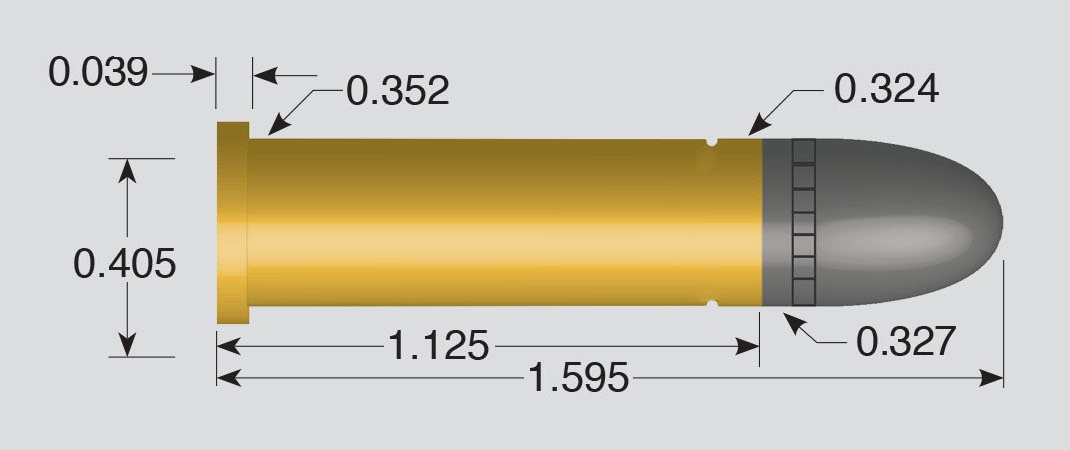
Rifle cartridge
| Field | Value |
|---|---|
| name | .310 Cadet |
| image | 310Cadet 22WMR 22LR.jpg |
| image_size | 270px |
| origin | United Kingdom |
| type | Rifle |
| designer | W.W. Greener |
| design_date | 1900 |
| manufacturer | Westley Richards and others |
| case_type | Rimmed, Straight |
| bullet | .323 |
| neck | .327 |
| base | .355 |
| rim_dia | .410 |
| rim_thick | .043 |
| case_length | 1.12 |
| length | 1.6 |
| rifling | 20" |
| primer | Small rifle |
| bw1 | 110 |
| btype1 | SP |
| vel1 | 1500 |
| en1 | 550 |
| bw2 | 120 |
| btype2 | SP |
| vel2 | 1530 |
| en2 | 624 |
| balsrc | "Cartridges of the World" |
The .310 Cadet, also known as the .310 Greener, or the .310 Martini, is a centerfire rifle cartridge, introduced in 1900 by W.W. Greener as a target round for the Martini Cadet rifle. Firing a 120 grain heeled lead projectile at 1350 ft/s the round is similar in performance to the .32-20 Winchester and some rifles may chamber both rounds with some accuracy. The full metal jacketed round was used in cadet rifles in Australia and New Zealand after early 20th-century Defence Acts. In New Zealand, after the start of the Boer War, a cadet corps had been started; by 1901 it was recommended that membership be compulsory. 500 Westley-Richards miniature Martini–Henry rifles were available by October 1902 (Auckland Star), and 5000 by April 1903 (Star). Such rifles gained popularity in Australia, New Zealand and the United States when thousands of Martini Cadet rifles were sold by the Australian government after World War II. A shorter version used as a humane killer was used in pistols. Known as the .310 cattle killer, invented by WW Greener, it was shorter in that a .310 cadet could not be accidentally chambered into the humane killer pistol.
Current Use
After being sold by the Australian government many were converted to sporting or target rifles, often re-barreled to calibers like .22 Hornet, .218 Bee, .25-20 Winchester, .222 Rimmed, .357 Magnum and others to .22 rimfire by gun makers like Sportco.
Those still using the .310 Cadet have to either buy cases to reload, by Bertram Bullet Co. in Victoria, Australia, or several small independent ammunition makers in Australia and the United Kingdom. However these new .310 Cadet cases are 3-4 times as expensive as new .32-20 Winchester cases, hence shooters modify .32-20 cases, as a cheaper alternative. Modifications involve length resizing, and in most cases reducing the rim thickness. Due to the .310 using a heeled projectile, the neck thickness of the .32-20 does not have to be reamed down, after first being case length resized to 1.075" (27.3 mm). Most .310 cadet chambered rifles need to have the rim of the .32-20 case reduced from 0.065" to 0.045" (1.7 mm to 1.14 mm), to allow proper head spacing and operation of rifle. However, in the unusual instance of a lever action .32-20 fitted with a .310 barrel, the rifle will cycle better without the case rim thickness being reduced. As home reloading is the main option for the .310, many shooters play with different case length reduction of the .32-20, anywhere from 0.875* to 1.185* (22.23 mm to 30.10 mm).
Dimensions
Gallery
|File:310 Cadet Australia Footscray.jpg|An Australian .310 Cadet FMJ. |File:310 Cadet Great Britain Kynoch.jpg|A British .310 Cadet lead bullet.
References
References
- Barnes, Frank C.. (1997). "Cartridges of the World". DBI Books.
- Barnes, Frank C., Cartridges of the World, 7th Edition, p305
- Donnelly, John J., Handloaders Manual of Cartridge Conversions, p360
- "MINIATURE CALIBRE RIFLES RESEARCH SITE".
This article was imported from Wikipedia and is available under the Creative Commons Attribution-ShareAlike 4.0 License. Content has been adapted to SurfDoc format. Original contributors can be found on the article history page.
Ask Mako anything about .310 Cadet — get instant answers, deeper analysis, and related topics.
Research with MakoFree with your Surf account
Create a free account to save articles, ask Mako questions, and organize your research.
Sign up freeThis content may have been generated or modified by AI. CloudSurf Software LLC is not responsible for the accuracy, completeness, or reliability of AI-generated content. Always verify important information from primary sources.
Report